

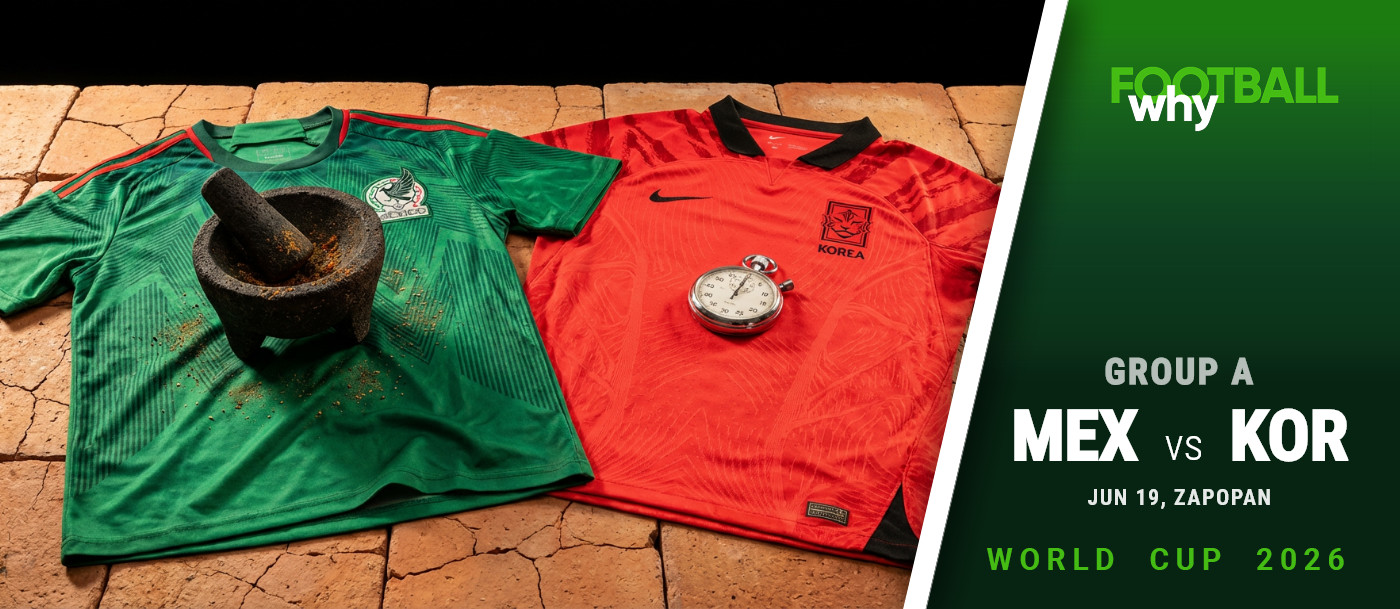
The World Cup Qualification Decider


Estadio Akron, Zapopan
SCORE BY AI PREDICTION: 2:1 SEE SIMULATION

Mexico vs South Korea FIFA World Cup 2026 Group Stage Match Stripped gears on a steep, suffocating territorial incline Forecast generated:

The heated blood of a communal brotherhood collides with the martial obedience of a strict hierarchy. It is a spectacle where raw, stadium-fuelled pride attempts to shatter an unyielding engine of stoic duty. One side demands glory; the other insists on protocol.

Mexico: One side's prayer...

Mexico enter this second Group A fixture carrying the suffocating weight of domestic expectation. The perennial anxiety surrounding their knockout-stage ceiling turns the home stadium into a pressure cooker, demanding not just victories but dominant performances. The persistent public debate over the goalkeeper hierarchy adds an unwelcome layer of scrutiny on Luis Ángel Malagón. Consequently, the squad is wired to smother the game early, desperate to dictate the tempo before the crowd's nervous energy bleeds onto the pitch and unravels their pragmatic blueprint.

South Korea: ...head-on with the other.

South Korea arrive against a backdrop of deep institutional unrest. Protests against the federation’s opaque governance and perceived lack of meritocracy continue to swirl back in Seoul, forcing the squad to circle the wagons around their captain. On the pitch, the medical staff are anxiously managing the workloads of recently returning stars, specifically capping Hwang Hee-chan’s minutes. Their mindset is strictly survivalist: they must execute their defensive protocols flawlessly to extract a result and keep their progression hopes alive ahead of the final group decider.
Mexico vs South Korea Structural Collision

Mexico: How we will host...

Dream
The mandate is to secure three points and qualify early on home soil. Yet, beneath the fearless exterior, there is a pragmatic desire to accept a controlled draw if the rhythm stalls. They must project national pride and competence without inviting chaotic, end-to-end exchanges.

Strength
Their bedrock is a hard-working, combative collective built on tight, wide combinations. They rely heavily on mutual aid and tournament craft. When put under pressure, this group compresses their lines and doubles down on sheer, unified effort, using the stadium's passion as a physical engine.

Plans
The tactical blueprint targets the seams left by advancing wing-backs. Expect quick, diagonal switches of play followed by sharp, low cutbacks into the penalty area. Defensively, a sturdy mid-block will shadow the opposition captain, forcing the visitors to deliver harmless crosses from deep territory.

Fears
The perennial knockout-stage anxiety looms large over the squad. If the home crowd grows impatient, that communal pride quickly curdles into haste. Players may revert to safe passes and emotional fouls, stretching the distances between their defensive lines and exposing their vulnerability in physical duels.

South Korea: With what we arrive...

Dream
The objective is to extract points quietly and efficiently, with a draw considered an entirely acceptable return. Amidst the swirling noise of federation protests and public scrutiny back home, the squad seeks to project meritocratic modernity. They must validate their rigid process on away soil without being drawn into chaotic, exhausting exchanges.

Strength
This side operates like a meticulously maintained engine room, built on a foundation of intense collective industry and deep-seated hierarchy. They are exceptionally well-drilled in their pressing cues, relying on a sturdy rest-defence and rapid, patterned counter-attacks. Their resilience is formidable, often upgrading their technical output from within a protective shell of sheer work ethic.

Plans
The strategy hinges on drawing Mexico onto them before launching sudden transition surges. They will funnel wide to deny cutbacks, with the centre-backs stepping up to intercept central threats. On regaining possession, the aim is to execute rapid, two-touch exits into the half-spaces, funnelling decisive touches towards their star forward while leaning heavily on set-piece reliability.

Fears
The primary vulnerability lies in their rigid adherence to protocol. When under severe stress or facing superior technicians, they tend to sink too deep and rush clearances. A heavy reliance on a few Europe-based stars for leadership means that if the initial plan stalls, their deference to hierarchy slows down on-pitch improvisation, inviting conservative, safety-first choices.
42%
30%
28%
Not a recommendation for betting
Tap [+] to cast your expert forecast. Can you outperform both the AI and the crowd?

How it will be...

The fixture would likely unfold as a slow-boiling pressure cooker, with the hosts’ communal fervour pressing against a rigid, hierarchical Korean shell. Mexico should probe the flanks relentlessly. They will aim to isolate the wide defenders through sharp, diagonal switches. Álvarez will anchor the midfield, stepping up strictly to smother transition avenues.

Korea would endure the territorial squeeze with stoic compliance. Their shape will contract, denying the cutback lanes while funnelling the ball toward the touchlines. If the Mexican full-backs vacate their posts, Son Heung-min is primed to exploit that exact seam. He will lurk on the blind side of the centre-backs, waiting for a single, hurried clearance to spark a counter.

The contest should fracture late in the second half. As altitude saps the visitors’ lung capacity, their zonal marking at the far post will fray. If Mexico shifts to a twin-striker barrage, the sheer volume of deliveries should eventually buckle the Korean resistance. Giménez’s aerial dominance will likely provide the decisive, cathartic puncture.

Mexico: How did they clinch it?

Mexico triumphed because they successfully exploited the far-post channel during the final quarter. Their late shift to a dual-striker system overwhelmed a tiring Korean defence. This tactical flexibility, underpinned by a sturdy rest-defence and their traditional wide-combination schooling, allowed them to convert territorial dominance into a tangible result.

South Korea: Why not go for the win?

The visitors fell short when their far-post zonal marking collapsed under a late barrage of crosses. As fatigue set in, the mandated minutes-cap on their forwards nullified their pressing intensity. Ultimately, an over-reliance on a few key European exports left them devoid of solutions when the primary system buckled.

Secret mastermind intent

Aguirre’s Traffic Control for the Azteca Cauldron

General Strategy
Aguirre is setting up a pragmatic mid-block, dropping the defensive line to about 40 metres. The primary focus is to control the territory rather than dominating the ball, stifling the game’s rhythm to avoid messy transitions.

He wants the ball moved quickly to the flanks the moment possession is won. By keeping the central areas congested, Mexico will rely on their wingers to build attacks through quick, compact combinations. It is a blue-collar shift designed to grind out a solid result.
Antidote for the Opponent
The tactical crosshairs are fixed firmly on the space behind Korea's advancing wing-backs. Aguirre wants early, diagonal switches of play targeting the far-side channel, specifically isolating the wide centre-backs before they can set their feet.

Without the ball, the mandate is to smother Son Heung-min. The defensive midfielder will step up aggressively whenever the Korean captain receives between the lines. The overarching aim is to force the visitors into hitting hopeful, looping crosses from deep, harmless areas.
Internal Task Solving
The background noise regarding the goalkeeper hierarchy is a genuine concern. To prevent the crowd’s anxiety from bleeding onto the pitch, Aguirre has installed a deliberate tempo governor.

The team will actively slow the game down with structured set-pieces every few minutes to manage the stadium's pulse. Furthermore, the goalkeeper is under strict orders to avoid risky short passes under pressure, opting instead for safe, long clearances to the touchline to keep the local supporters entirely onside.
Crisis Response Plans
If Korea’s mid-press successfully cages the midfield and forces Mexico to pass backwards, the safety valve involves bypassing the centre entirely. The goalkeeper will be instructed to launch long diagonals directly towards the left winger.

Meanwhile, the central striker will pin the centre-backs to challenge for the aerial ball. The rest of the midfield must then push up aggressively to sweep up the second balls. It is a pragmatic, no-nonsense fuse replacement for when the main circuit inevitably blows.
Specific Match Orders
Edson Álvarez: Track the inside receptions on the turn closely. Keep foul selection strictly outside the 30-metre mark to avoid conceding dangerous set-pieces. Drop into the back line to pick up the main aerial threat during defensive corners. Jorge Sánchez: Hold position on the right flank whenever the winger pushes high. Deny the underlapping channel at all costs. Only deliver crosses when the attacking shape is fully settled in the final third. Alexis Vega: Attack the space left behind the wing-back on quick diagonal switches. Look immediately for the low cutback into the danger area. Avoid floating hopeful crosses into the box from wide areas.
/ What if the home crowd turns restless?

If the stadium noise shifts from support to frustration, the team will immediately simplify their shape into a deeper 4-4-2. The focus shifts to reducing central risk and pumping up the volume of early crosses. It is a blunt mechanism to re-engage the fans through sheer territorial pressure.

/ What if they concede an early goal?

Should they fall behind, the recovery protocol is strictly manual. The holding midfielder drops to form a temporary back three during restarts. The first line of the press is bypassed entirely with long balls aimed at the striker's chest, while throw-ins are slowed down to reset the defensive distances.

Secret mastermind intent

Hong’s Rigid Audit of the Mexican Flanks

General Strategy
Hong Myung-bo is deploying a disciplined 5-4-1 mid-to-deep block, setting the line of confrontation around 45 metres from their own goal. The primary intent is to absorb pressure without trading chaotic punches. They will rely on an intense, coordinated counter-press lasting three to five seconds immediately after losing possession.

If that initial wave is bypassed, the mandate is a rapid, full retreat to protect the penalty area. They are entirely comfortable ceding possession, waiting patiently for the opposition to overcommit before initiating pre-rehearsed, patterned transition strikes.
Antidote for the Opponent
The defensive focus is squarely on nullifying Mexico’s low cutbacks. The wide players are instructed to double up on the flanks whenever the opposing full-back advances. Simultaneously, an attacking midfielder will closely screen the Mexican holding player to disrupt their first forward pass.

Offensively, the plan targets the space left by the retreating right-back. The captain will be rotated into the right half-space to create a two-versus-one overload on switches of play. On set-pieces, they will deliberately crowd the goalkeeper to clear a path for a late, curved run to the back post.
Internal Task Solving
Load management is a pressing concern for the medical staff. Key personnel returning from recent injuries are operating on strict minutes caps. Consequently, the pressing intensity from the front line is expected to drop off significantly around the 65-minute mark.

To mitigate the effects of the high altitude late in the game, the bench has prepared earlier hydration cues. The squad is drilled to revert instantly to basic shape and spacing triggers whenever external public pressure threatens to cloud their decision-making on the pitch.
Crisis Response Plans
Should Mexico successfully overload the wide areas and repeatedly pin the wing-backs deep, the tactical shape will swiftly contract into a narrower 5-3-2. One of the advanced midfielders will drop alongside the pivot to congest the centre.

This adjustment aims to thoroughly block the cutback lanes. To maintain a threat, the star forward will be pushed higher up the pitch, serving as a pure, isolated outlet for direct counter-attacks when the ball is eventually cleared.
Specific Match Orders
Son Heung-min: Rotate fluidly across both half-spaces to find pockets of room. Attack the seam between the right-back and the right-sided centre-back immediately following a switch of play. Remain high up the pitch during defensive corners to act as the primary transition outlet. Kim Min-jae: Step forward aggressively through the opposition striker to break the first line of the press. Take absolute command of the penalty box against back-post overloads. Execute a delayed, curved run towards the back post on all attacking corners. Jo Hyeon-woo: If put under pressure by the forwards, distribute directly to the runner hugging the touchline. Strictly avoid attempting risky, splitting passes through the central defensive midfielder.
/ What if the stadium momentum surges?

If the home crowd begins to heavily influence the game's rhythm, the team will deliberately lengthen their spells of possession. By circulating the ball slowly among the back three, they aim to deflate the stadium's energy before attempting any forward progression.

/ What if they concede early in the match?

Should the defence be breached early, the squad will compress into an even deeper 5-4-1 shape for eight to ten minutes. They will deliberately slow down all restarts to weather the storm, only reintroducing the mid-press once fresh legs are brought onto the wings.

MAIN SIMULATION 0'-25'

Both sides start with a risk-managed blueprint. Mexico holds a mid-block, probing the far-side seam behind Seol Young-woo with early diagonal switches. Korea sits in a compact 5-4-1, doubling wide to deny cutbacks while screening Edson Álvarez to stifle central progression. Mexico's goalkeeper bypasses the flat press by going long to the touchlines. It is a cautious probing phase. The tension stems from Mexico's wide-seam attacks meeting Korea's rigid defensive funnel.

MAIN SIMULATION 25'-45'

Mexico intensifies their wide-seam pattern, using decoy overlaps to pin Korea's right side deeper. Around the 39th minute, a rapid switch of play isolates the wing-back; Vega sprints in behind and drills a low cutback for Santiago Giménez to convert at the near post. It is a textbook training-ground routine. Korea responds by dropping their block further, lengthening possessions to bleed the crowd's momentum before the interval.

MAIN SIMULATION 45'-65'

Korea re-enters with an energised mid-press, forcing Mexico into back-to-goal circulation. Around the 60th minute, Korea's set-piece focus pays off: a near-post crowd disrupts Mexico's markers, allowing Kim Min-jae to execute a curved run and head home at the back post. Mexico enters a brief shock-recovery phase. Álvarez drops into a temporary back three, and they slow the game with throw-ins and tactical fouls to reset their defensive distances.

MAIN SIMULATION 65'-90'

Sensing Korea's pressing taper and the creeping altitude fatigue, Mexico switches to a double-9 crossing surge. Fresh wingers stretch the pitch. By the 78th minute, a recycled cross from a far-post overload finds Sánchez, whose whipped delivery meets Giménez for the decisive header. Korea desperately chases the game by shifting to a 3-1-4-2. Mexico then kills the clock, deploying a situational 5-4-1 and executing tactical fouls high up the pitch.

And it will come to...

The forecast suggests this match would be decided in the final quarter, where Mexico's controlled risk outlasts Korea's disciplined containment. If the simulation holds true, the hosts would exploit Korea's altitude fatigue through relentless wide overloads and a late double-9 surge. Korea would likely find joy from a well-drilled set-piece, but their reliance on a few key figures leaves them vulnerable late on. Ultimately, Mexico's sturdy rest-defence would secure the result just as the visitors' legs begin to fail.
end of Game