

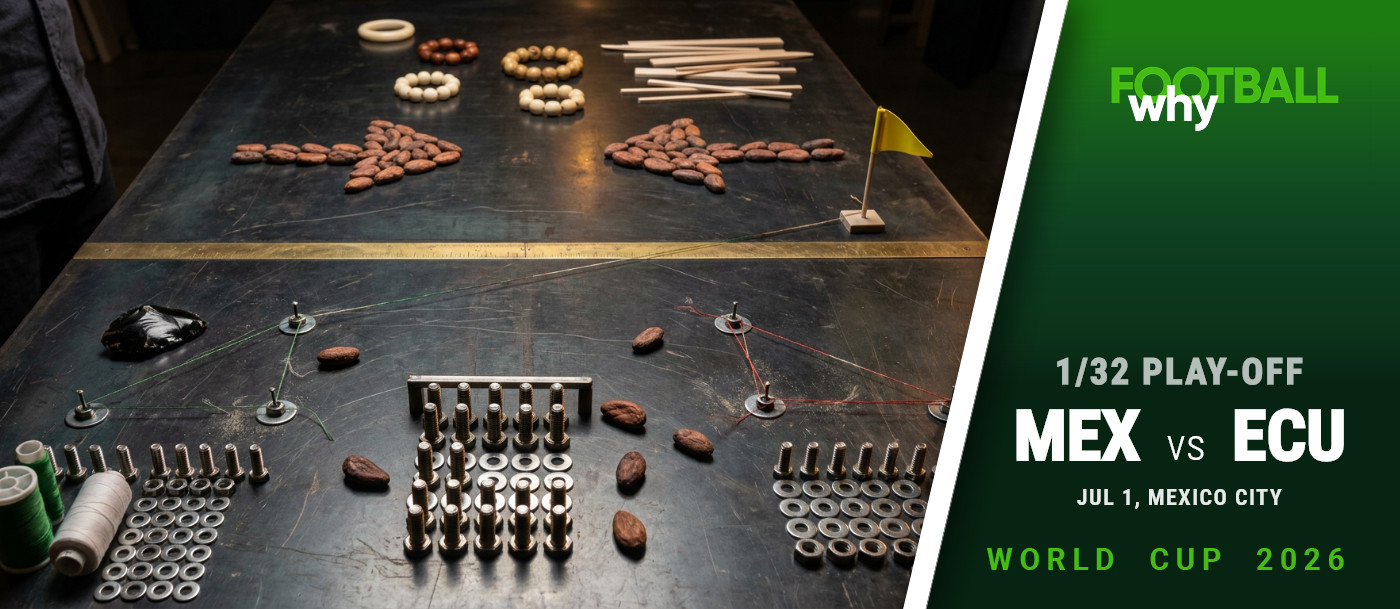
Round of 32 (B), Match #79
UTC

Estadio Azteca, Mexico City

Prediction by whyFootball readers

MEX
DRAW
ECU
55%
0%
45%
Not a recommendation for betting
Tap [+] to cast your expert forecast.
SCORE BY AI PREDICTION: 1:0 SEE SIMULATION

Mexico vs Ecuador FIFA World Cup 2026 Group Stage Match A planning committee dispute settled by a sudden cutback Forecast generated:

The suffocating expectations of a proud host nation collide with the stoic, communal resilience of an Andean brotherhood. It is a clash between intricate, fiery possession and unyielding, hardened defiance. One side seeks a coronation; the other demands a quiet upset.

Mexico: One side's prayer...

Mexico arrive at this knockout tie buoyed by a flawless group stage and the imposing altitude of the Estadio Azteca. Raúl Rangel has firmly claimed the gloves following Luis Malagón’s Achilles injury, tasked with projecting absolute calm from the back. The squad must navigate the suffocating pressure of the 'quinto partido' complex, a perennial mental hurdle that demands they advance without their customary emotional collapse. They need to turn the stadium's feverish heat into a steady, controlled boil rather than letting it scorch their own tactical blueprint.

Ecuador: ...head-on with the other.

Ecuador step onto the pitch fortified by a hardened siege mentality. Their dramatic, late victory over Germany in the group stage validated Beccacece’s pragmatic approach and eased the simmering public frustration over their lack of open-play goals. With Moisés Caicedo fully fit to anchor the midfield, the squad operates with a deep, communal work ethic. They approach this knockout clash like a stubborn tenant refusing eviction, perfectly content to absorb the host's pressure and wait for a single, fleeting set-piece window to force the lock.
Mexico vs Ecuador Structural Collision

Mexico: How we will host...

Dream
The minimum requirement is to advance without gifting the opposition cheap, farcical counter-attacks. Aguirre wants to harness the Azteca’s fervent heat, turning it into a steady, controlled boil rather than a catastrophic spill.

Strength
This side is built on communal graft and sharp, technical combinations. They are combative and deeply loyal to the collective effort. The team is highly capable of moving the ball through tight spaces with a quiet, industrious pride.

Plans
The blueprint revolves around wide overloads and smart cutbacks. They will deliberately target the spaces behind the full-backs, using the likes of Quiñones to drive to the byline. Defensively, they will lock the door on near-post set-pieces.

Fears
The perennial anxiety of the fifth game looms large over the squad. When the crowd grows restless, national pride often morphs into hasty decision-making. The great fear is that they abandon their patient combinations, resorting to aimless, panicked crosses that play right into the opposition's hands.

Ecuador: With what we arrive...

Dream
The primary objective is to survive the emotional cauldron of the Azteca and maintain a clean sheet for as long as humanly possible. They are not here to entertain; they are here to execute timed, surgical strikes and advance through sheer resilience.

Strength
This squad is anchored by a hardened, European-pedigree backline and an elite midfield destroyer. They operate with a deeply ingrained communal work ethic. Their defensive structure is rigid, and they possess the athletic capability to spring devastating counter-attacks from deep positions.

Plans
The strategy leans heavily on absorbing pressure within a compact shell and launching rapid, two-pass transitions down the wide channels. They will also rely heavily on rehearsed set-piece routines, specifically targeting the near post to bypass the need for intricate open-play combinations.

Fears
The glaring vulnerability is a historical struggle to create high-quality chances against organised defences. When frustrated by a lack of openings, the team has a tendency to resort to hopeful long balls and cheap fouls, which only serves to stretch their lines and invite further pressure.

How it will be...

The fixture will likely unfold as a tense, bureaucratic standoff, resembling a local council planning meeting where neither side wishes to concede an inch of topsoil. Mexico are expected to hoard possession across the middle third. They will use their defensive anchor to sweep up any loose debris. Ecuador will retreat into a rigid, communal shell. Their flat banks of four will deny the central avenues.

The intrigue lies in the sudden ruptures of this established order. Viewers should watch for the visitors' rapid transitions. A sudden, diagonal sprint from their wide forwards could easily bypass the host's high line. Ecuador will actively seek dead-ball situations near the penalty area to deploy their rehearsed routines.

The altitude of the Azteca acts as an invisible dampener on the tempo. If the home supporters grow restless with the lack of penetration, the hosts might abandon their calculated approach. The tension will peak when the visitors attempt their near-post flick-ons. The match balances on whether Mexican discipline can withstand the sheer stubbornness of the Andean collective.

Mexico: How did they clinch it?

Mexico triumphed because they successfully barricaded the near-post zone, neutralising Ecuador's primary set-piece threat. From there, a choreographed surge from their full-backs fractured the opposition's defensive shell. The hosts maintained their structural composure, ensuring their superior technical combinations prevailed over a transition-reliant opponent.

Ecuador: Why not go for the win?

Ecuador suffered defeat because their most reliable attacking lever — the near-post corner — was heavily policed and shut down. Deprived of this avenue, their lack of intricate central combinations left them completely isolated against a compact block. The rigid defensive structure eventually succumbed to coordinated wide overloads.

Secret mastermind intent

Aguirre’s traffic management for the Azteca rush hour

General Strategy
Aguirre’s primary directive is to establish a compact mid-block and manage the game's temperature. He wants a steady 4-3-3 shape with Edson Álvarez sitting as a lone defensive anchor. There will be no frantic high pressing in the opening exchanges.

Instead, the focus is on positional control and keeping the ball away from chaotic transition zones. The team will circulate possession patiently, ensuring their defensive structure remains entirely uncompromised before committing bodies forward.
Antidote for the Opponent
The most crucial defensive adjustment involves barricading the near post during corners. Ecuador relies heavily on a specific flick-on routine, so Romo and Montes are tasked with forming a physical wall right on the six-yard line. They will block the runners rather than just watching the flight of the ball.

In attack, the plan targets the space behind the opposition's right wing-back. The left winger is instructed to drive straight to the byline and cut the ball back, actively avoiding floated crosses that feed the towering centre-backs.
Internal Task Solving
A unique internal directive surrounds the goalkeeper situation. Rangel has been firmly established as the starter to prevent any media circus or locker-room debate. He is instructed to avoid playing short passes into the central midfield where the opposition sets their pressing traps.

There is also a strict protocol for moments of severe match shock. If the team concedes, they are ordered to hold possession for ninety seconds. They will take slow throw-ins and short corners to manually reset the stadium's frantic energy.
Crisis Response Plans
If the team falls behind, the immediate response is not to panic and throw strikers onto the pitch. Instead, Aguirre has a pre-planned, twenty-minute window where both full-backs will push up simultaneously to overload the flanks. This is a calculated gamble to stretch the opponent's defensive block.

Should that fail, further adjustments involve introducing technical midfielders to dictate the tempo or adding a second striker late on. The manager is prepared to shift to a 4-2-4, but only as a final, desperate roll of the dice.
Specific Match Orders
Raúl Rangel: Keep the first few long distributions aimed squarely at the left flank channel. Absolutely no central ground passes into the main pressing zone until the game settles. Julián Quiñones: Target the blind spot on the right wing-back's shoulder during early transitions. Drive straight to the byline and look for the cutback; early, speculative shots from wide angles are strictly off the menu. Edson Álvarez: Hold the position as the single anchor in front of the defence for the first half. Do not step ahead of the ball when defending counter-attacks; only use cynical, tactical fouls if the backline is completely exposed.
/ What if the team suffers a sudden shock?

If a goal is conceded or the opponent strings together three rapid transitions, a strict ninety-second cooling protocol begins. The team will hold possession through the central midfielders, full-backs will stay deep, and restarts will be taken at a glacial pace to kill the rhythm and quieten the crowd.

/ What if the first-line press is overwhelming?

Should the opposition commit five or more men to press the initial build-up, the short passing game will be abandoned. The goalkeeper will bypass the midfield entirely with directed diagonals toward the left flank. The striker will pin the centre-backs while the midfield anchor holds his ground.

Secret mastermind intent

Beccacece’s stoic barricade and the timed ambush

General Strategy
Beccacece is preparing for an attritional battle, setting his side up in a resilient 4-4-2 or 4-4-1-1 formation. The line of engagement will be drawn fairly deep, roughly forty-five metres from their own goal.

The overarching philosophy is to mute the stadium's fervour by denying any space through the middle. They will defend first, maintain a tight shape, and trust that opportunities will arise through carefully selected, rapid counter-attacks rather than sustained possession.
Antidote for the Opponent
To stifle the home side's creativity, the weak-side winger is instructed to collapse inwards all the way to the penalty spot. This specific movement is designed to congest the area and block the opponent's preferred cutback routines.

Offensively, the plan is to exploit the space left by the opposition's advancing right-back. Once possession is won, the team will look to hit the left channel immediately, providing the defensive midfielder is firmly set to cover any potential turnover.
Internal Task Solving
A significant portion of the attacking threat relies on a highly choreographed near-post corner routine. The squad has been drilled to exploit the flick-on zone just five metres from goal, using this as a primary weapon to compensate for a lack of open-play fluidity.

Furthermore, the veteran players in the squad have been tasked with maintaining a siege mentality. The captain and the goalkeeper must act as the emotional anchors, ensuring the team's communal discipline does not fracture under the intense scrutiny of the knockout stage.
Crisis Response Plans
If trailing, the manager will not immediately throw caution to the wind. Instead, he will implement time-boxed, five-to-seven-minute surges of high pressing. If these intense bursts fail to yield a shot, the team will dutifully retreat to their defensive block to conserve energy.

Only in the dying embers of the match will the structure radically alter. The formation will shift to a 3-1-4-2, introducing a second striker and pushing both wing-backs extremely high to deliver a barrage of low crosses.
Specific Match Orders
Moisés Caicedo: Remain anchored as the single defensive screen during the first half. Do not jump to press simultaneously with the other central midfielder. Only commit tactical fouls in the immediate vicinity of our own penalty area. Gonzalo Plata: When the play is switched to the weak side, target the space behind the opposing left-back. If double-teamed, recycle the ball backwards to the full-back and immediately reposition yourself in the half-space. Ángelo Preciado: Do not overlap at the same time as the left-back. The first forward run is only permitted after a clean ball recovery and only if the defensive midfielder is in position to cover the space left behind.
/ What if the defence is breached early?

The team will immediately retreat into a highly compressed 4-4-2 shell for two minutes. The defensive midfielder will drop even deeper, and all overlapping runs from the full-backs will be temporarily suspended. The goal is to force a stoppage in play and completely reset the defensive lines.

/ What if the opposition dominates the wide areas?

If the opponent successfully breaches the right channel multiple times early on, the left winger will drop to form a flat midfield four. The right-back's forward runs will be paused, and the central midfielder will shift across to permanently close the half-space.

MAIN SIMULATION 0'-25'

A cautious, measured opening is expected. Mexico will probe the flanks, particularly down the right with Sánchez and Alvarado. Ecuador will sit in a disciplined mid-block, waiting for set-piece opportunities. It is a slow-burn tactical arm-wrestle. Mexico will pass the ball horizontally across the midfield. Ecuador will maintain their two banks of four without pressing high. The altitude acts as a natural speed bump, suppressing any frantic end-to-end exchanges early on.

MAIN SIMULATION 25'-45'

Following the hydration break, the match settles into a tense rhythm. Mexico will increase their combination play down the right side, searching for an opening. Ecuador will use Caicedo to quickly release Plata into space. The game will resemble a deadlocked local planning committee. Both teams will strictly adhere to their defensive assignments. Neither side will commit extra men forward. As half-time approaches, restarts will slow down significantly to avoid cheap turnovers.

MAIN SIMULATION 45'-65'

The tactical script gets flipped immediately after the interval. Mexico will execute a pre-planned surge, pushing both full-backs high simultaneously. This aggressive gamble is highly likely to yield a breakthrough via a cutback from the byline. Once ahead, Mexico will attempt to put the game in the fridge. They will drop their wingers ten yards deeper. The central midfielders will focus entirely on retaining possession. Ecuador will respond by pressing in aggressive, short waves.

MAIN SIMULATION 65'-90'

The final stages will see Ecuador escalate their risk profile. They will push their full-backs higher and lean heavily on rehearsed set-pieces. Mexico will rely on their holding midfielder to marshal the space in front of the centre-backs. It will be an exercise in municipal pedantry. Mexico will take their time with every throw-in. The goalkeeper will hold the ball for as long as legally permitted. The match will likely end with the home side cleverly managing the clock near the corner flags.

And it will come to...

If the simulation holds true, methodical planning would ultimately defeat opportunistic moments. Mexico's disciplined blueprint — relying on wide overloads and cutbacks — would outlast Ecuador's transition-heavy approach. By specifically neutralising the near-post corner threat, Mexico would remove the visitors' most reliable attacking lever. Ecuador's lack of intricate central combinations would leave them struggling to break down a compact block. Ultimately, a calculated tactical surge from the home side would prove enough to secure a pragmatic victory.
end of Game