

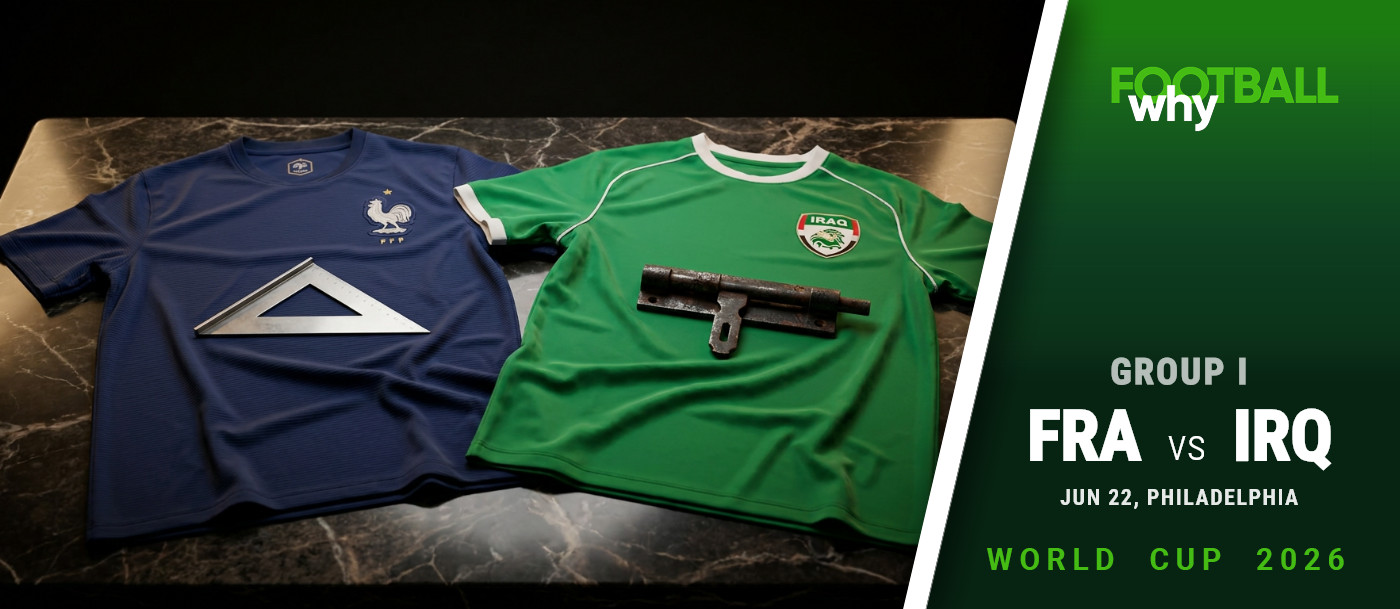
The World Cup Qualification Decider
Monday, 22 June

Lincoln Financial Field, Philadelphia

France vs Iraq FIFA World Cup 2026 Group Stage Match Precision engineering ignores a two-hour lightning delay Forecast generated:

A two-hour lightning delay couldn't disrupt Didier Deschamps' ruthless bureaucracy. France methodically dismantled a toothless Iraq 3-0 in a masterclass of clinical administration. Step inside to see how elite talent happily submits to the system.
France vs Iraq Structural Collision

What was it?

The rain lashed the stadium, emptying the stands for over two hours and leaving the pitch slick with surface water. It altered absolutely nothing about Didier Deschamps' blueprint. His squad operates like a heavy industrial press, stamping out results with terrifying efficiency. Kylian Mbappé struck after fourteen minutes following a sharp angle created by Michael Olise.

The Asian side lost Aymen Hussein, their sole physical reference point, to injury just 26 minutes in. Without him, they registered zero shots on target. Mike Maignan stood completely untested.

The extended weather interruption at half-time might have derailed a more fragile setup. Instead, the French resumed play by immediately squeezing high up the pitch. They forced a panicked exchange between goalkeeper Ahmed Basil and his defence on the wet turf, allowing Mbappé to tap in a second. Ousmane Dembélé soon slid a third under the keeper.

They could have scored eight if they truly wanted to entertain. Instead, they exerted only the minimum required force. It was a staggering display of elite individuals willingly submitting to a relentless, unyielding framework.

How did they clinch it?

France

France succeeded with minimal fuss because their entire tactical architecture is designed to eradicate variance. Deploying a central playmaker behind the striker, while heavily rotating the full-backs, allowed them to methodically test the opponent's seams without ever over-committing numbers forward.

They applied high pressure immediately following a massive weather delay, fully aware that a slick surface turns cautious defensive passing into a severe liability. This isn't spontaneous brilliance; it is the calculated execution of a pre-approved crisis protocol.

This squad operates under a rigid, almost technocratic hierarchy. The staggering depth of talent available to the manager means that any individual who drifts from the script can be instantly replaced by an equally athletic, fully compliant alternative.

Behind this lies a sprawling, highly standardised academy system. Players are processed from a young age to value efficient decision-making under pressure over unchecked individual expression. The domestic sporting culture values the aesthetic of control; victory is expected, but it must be achieved with a cool, unbothered authority.

They do not play football; they conduct a rigorous, successful audit of the opposition.

Why not go for the win?

Iraq

Iraq collapsed because their entire survival strategy relied on a single, fragile load-bearing pillar. When their primary target forward left the pitch injured early on, they lost the only reliable mechanism they had for bypassing pressure and establishing territory higher up the field.

Forced to navigate a slick pitch against an aggressive press, the defence was asked to execute intricate passing routines that simply aren't in their muscle memory. A catastrophic error near their own goal was the inevitable result of asking men built for clearance to perform delicate distribution.

This structural fragility points to a deeper reliance on emotional resilience over tactical flexibility. The team is built on a foundation of fierce, attritional pride. However, when the game state shifts against them, there is a distinct lack of automated, pre-planned responses to fall back on.

This is exacerbated by systemic domestic volatility. Frequent logistical disruptions and a lack of consistent exposure to elite, high-tempo opposition mean that the required speed of thought is often alien to them. They rely on sheer grit to bridge the gap.

Courage will hold a defensive line, but it cannot negotiate a way out of a burning building.

Match hero...

Michael Olise
Michael Olise acted as the lead inspector for the French civil service. Operating centrally, he audited the Iraqi midfield, finding the structural flaws and stamping the necessary paperwork for Mbappé to exploit. Two assists merely formalised the process. He possesses a rare, cooling intellect that aligns perfectly with Deschamps' demand for strict procedural compliance. Olise doesn't rely on frantic improvisation; he simply reads the established codes of space and files his passes with bureaucratic inevitability.

...and one more

Zidane Iqbal
Zidane Iqbal was the lone elder trying to negotiate passage through an unyielding checkpoint. While his teammates panicked under the European press, he attempted to haggle for time, dragging the ball away from immediate danger with a quiet dignity. His technique, honed away from domestic volatility, allowed him to see the wider picture. Yet, without a strong frontman to receive his offerings, his efforts amounted to a brave but futile attempt to reason with a steamroller.