

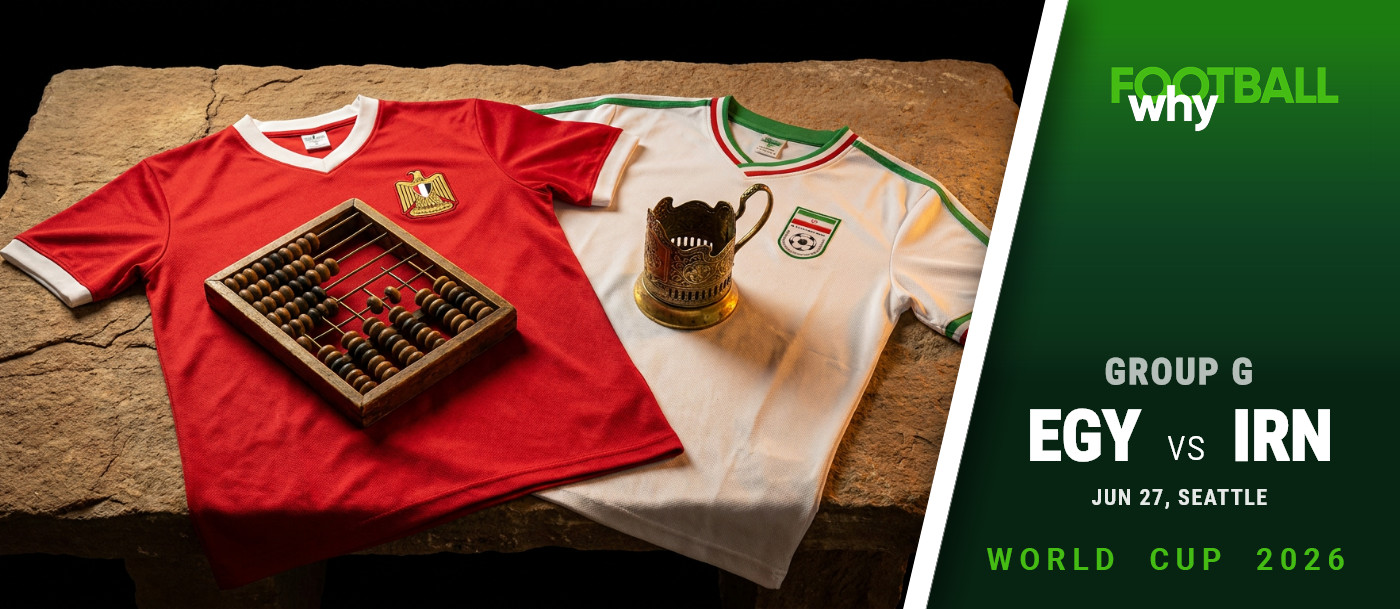
Group G, Matchday 3, Match #63
UTC

Lumen Field, Seattle

Prediction by whyFootball readers

EGY
DRAW
IRN
36%
33%
31%
Not a recommendation for betting
Tap [+] to cast your expert forecast.
SCORE BY AI PREDICTION: 1:1 SEE SIMULATION

Egypt vs IR Iran FIFA World Cup 2026 Group Stage Match A Patient Bazaar Negotiation Over Midfield Scraps Forecast generated:

The enduring pride of the Nile collides with the stubborn walls of a Persian fortress. This is not a fixture for the faint-hearted; it is a test of collective endurance, where the burden of national expectation meets an unwavering refusal to yield.

Egypt: One side's prayer...

Egypt arrive at this third group fixture carrying the suffocating expectations of the Cairo pressure cooker. A point keeps their tournament alive, though national pride demands more. Internally, the squad is rallying around Mohamed Salah, who has recently recovered from a muscle injury sustained in the Champions League. The mood is stoic and risk-averse. They are setting up their defensive block like a delayed commuter train refusing to leave the station, determined to manage the narrow margins and avoid any naive expansiveness that could invite disaster.

IR Iran: ...head-on with the other.

Iran approach this decisive match entrenched in their familiar siege mentality. A draw likely secures qualification, and they will guard that point fiercely. The camp has had to insulate itself from the external noise surrounding Sardar Azmoun’s reported exclusion over disciplinary disputes, leaning instead on their veteran core and a strict conscription-style discipline. The public expects a united, resilient front. They will sit deep and absorb pressure, waiting to strike via set-pieces with the stubborn patience of a bidder waiting out a frantic auction room.
Egypt vs IR Iran Structural Collision

Egypt: How we will host...

Dream
The absolute minimum requirement is a draw to keep qualification hopes alive, though a victory remains the ultimate target. Nobody is going to gamble early or chase shadows; the aim is to protect the game state and strike safely.

Strength
They are built on a bedrock of defensive honour and stoic patience. Like a family protecting its home, they sit in a compact block, absorb pressure without panic, and rely heavily on their talisman to deliver a decisive blow in transition.

Plans
The manager is looking to bypass the midfield entirely. The blueprint relies on firing quick, diagonal passes into the space behind the opponent's right-back, waiting for Mohamed Salah to arrive on the second wave to finish the move.

Fears
The heavy reliance on one star creates a dangerous attacking gravity. If the talisman is isolated or successfully double-marked, their forward threat dries up, and natural caution can quickly devolve into a sterile, deep retreat.

IR Iran: With what we arrive...

Dream
The primary goal is to avoid defeat, keeping their grip on second place. A win would be a welcome bonus, but the focus is entirely on limiting the opponent's transition game and slowly building pressure through territorial gains and restarts.

Strength
They are a team forged in the fires of siege mentalities. Their foundation is a battle-hardened veteran spine that trusts in collective resilience, refusing to buckle under pressure. They excel at turning scrappy, broken play into high-value set-piece opportunities.

Plans
The tactical blueprint is heavily reliant on starving the opposition's star man. They intend to double-team him on reception and show him down the line. Offensively, they will bypass complex build-up play, opting to hit the channels early and flood the box for crosses.

Fears
Their major vulnerability is an overreliance on an ageing core, which can lead to a drop in tempo when pressed. If they fall behind early, their default reaction is often a deeper retreat rather than a structured push forward, inviting further pressure.

How it will be...

The fixture ought to unfold as a deeply cautious affair, dictated by two sides who view unscripted possession as a liability rather than a luxury. We are likely to witness a congested midfield where Iran’s preference for territorial gains and set-piece volume crashes into Egypt’s disciplined, counter-punching block.

Yet, within this rigidity, moments of genuine quality should surface. Keep an eye on the right channel; Egypt’s captain will consistently lurk on the blindside of the opposing full-back, waiting for that single, incisive diagonal pass to bypass the midfield entirely. His ability to manipulate the half-space remains their most potent, albeit predictable, route to goal.

Iran’s threat will materialise in a far more abrasive manner. Their veteran centre-forward is a master of inducing contact near the penalty area. By drawing fouls, he feeds his nation’s primary weapon: a rehearsed, aerial bombardment from dead-ball situations.

Do not expect either side to crumble mentally if they concede. Both are steeped in a culture of resilience — whether it be the Pharaonic pride of the Africans or the siege mentality of the Asians. If the deadlock breaks, the trailing team will likely adjust their shape with measured urgency rather than descending into chaotic desperation. A draw feels less like a compromise and more like a mutually acceptable treaty.

Egypt: Just short of victory

Egypt failed to secure a win because their ingrained conservatism stifled their own attacking potential. A momentary lapse in near-post zonal marking allowed Iran to capitalise on a set-piece. Whilst they eventually altered their shape to force an equaliser through individual brilliance, their overarching reluctance to commit bodies forward meant they could not sustain the pressure required for a victory.

IR Iran: Just short of victory

Iran fell short of victory due to an inability to maintain their defensive intensity after taking the lead. A tactical yellow card for their right-back softened their flank, allowing Egypt to deliver unchecked crosses. Once pegged back, their reliance on a veteran core meant they lacked the mobility to shift gears and threaten again in open play.

Secret mastermind intent

Hossam Hassan’s Patient Haggling at the Tactical Bazaar

General Strategy
The primary objective is to secure at least a draw to keep qualification hopes intact. There will be no early gambles or expansive possession games.

The tactical setup is as rigid as a tenon joint. They will sit in a compact mid-block, engaging the opposition near the halfway line. The focus is purely on protecting the central lanes and launching fast, vertical transitions.
Antidote for the Opponent
To nullify the opposition's crossing threat, the wide forwards are tasked with aggressive tracking to double up on the delivery men.

In attack, they plan to exploit the space behind the advanced right-back like an express train bypassing a broken signal. The ball will be released early on the diagonal, allowing the wingers to carry it forward before the talisman arrives inside on the second wave.
Internal Task Solving
Given the intense external noise surrounding the team's star, the manager has enforced a strict protocol for dealing with the officials.

This acts as a psychological safety valve against mounting pressure. Only the captain and one senior player are allowed to interface with the referee. This prevents unnecessary bookings and stops the match from descending into whistle-heavy turbulence.
Crisis Response Plans
If the opposition manages to bombard the box with early crosses, the team will immediately drop the wing-backs deeper.

They will pack the defensive line like a busy sorting office during the morning rush. The shape shifts to a flat 5-4-1, with wingers dropping to form a secondary wall. The game will then be deliberately slowed down with longer restarts to kill the momentum.
Specific Match Orders
Mohamed Salah: Start in the right half-space off the centre-back's shoulder, rather than hugging the touchline. Attack the channel behind the full-back on the first regain. Avoid dribbling entries that invite fouls within 22 metres of the goal. Omar Marmoush: Track the right-back for the first twenty minutes to block early crosses. Upon winning the ball back, drive diagonally for 20 to 30 metres into the vacated space before their defensive midfielder can reset. Hamdy Fathi: Screen the central zone without making physical contact on the striker. Do not clip heels at the edge of the box. When attacking set-pieces, set a near-post screen on the goalkeeper to force him into parrying the ball centrally.
/ What if Iran floods the box with a second striker?

Introduce a third centre-back or a tall defensive midfielder to anchor a strict zonal system at the near post. Clear the ball wide, never centrally. Hold one runner high up the pitch as an outlet to kill their crossing momentum.

/ What if Salah is repeatedly double-teamed and shut down?

Flip the left winger inside to act as a second striker, shifting the shape to a 2-3-2-3 in possession. Instruct the right-back to underlap. Use rapid switches of play to the left wing-back to attack the opposite channel with cut-backs.

Secret mastermind intent

Amir Ghalenoei’s Pragmatic Fortress in the Desert

General Strategy
The tactical ethos here is entirely risk-averse. The side will set up in a compact 4-4-2 mid-block, dropping back roughly 46 metres from the opponent’s goal.

The press is only triggered when the opposition plays a negative pass back to their centre-backs or goalkeeper. It is a system built on patience, like a commuter waiting for a delayed train. They will rely on drawing fouls and capitalising on set-piece deliveries rather than expansive possession.
Antidote for the Opponent
To neutralise the opposition’s primary threat, the left-back and defensive midfielder are instructed to form a double-team whenever he receives the ball.

They must force him down the touchline and avoid conceding cheap free-kicks centrally. Going forward, the plan is to exploit the space behind the opposing left wing-back with early diagonal passes. High-volume crossing will only commence once the rest-defence is securely in place.
Internal Task Solving
To counter the narrative of late-game collapses and ill-discipline, the manager has imposed strict rules regarding on-pitch behaviour.

There is a cap on dissent and theatrical reactions from the bench. Pre-agreed restart cadences are in place to ensure the team doesn't rush actions after a controversial VAR call or a soft goal. The aim is to project a united, resilient front regardless of the match state.
Crisis Response Plans
If the opposition starts finding joy behind the right-back, the defensive line will immediately drop eight to ten metres.

The winger on that side will be tasked with providing all the width, acting as a secondary full-back. Full-back overlaps will be strictly forbidden until the team has completely consolidated its deep shape. It is a pragmatic shift to weather the storm before attempting to break out again.
Specific Match Orders
Milad Mohammadi: Stagger your position one to two metres off the winger's inside shoulder to show him the outside. Do not dive into tackles. Avoid committing any fouls within 22 metres of the goal centrally. Saeid Ezatolahi: Shade to the right to screen the half-space against the opposition's talisman. Only step forward to press when the centre-back has set his cover behind you. Upon winning the ball, your first pass must be vertical to the striker or wide to the winger. Alireza Beiranvand: Use long throws exclusively when the opponent’s rest-defence is unbalanced. Otherwise, distribute diagonally to the right side. Avoid parrying shots centrally; always tip the ball wide.
/ What if the opposition’s star isolates the left-back repeatedly?

The team will immediately shift to a 4-1-4-1 formation without making a substitution. The defensive midfielder will drop in as a single pivot to double the marking, and the near-side winger will track back to the edge of the penalty box.

/ What if the team goes a goal down and needs to chase the game?

They will maintain a 4-4-2 but introduce a runner to operate underneath or alongside the main striker. Deliveries from both flanks will arrive earlier, and players will be instructed to crash the far post, keeping the defensive midfielder deep to screen against counters.

MAIN SIMULATION 0'-25'

Both teams would open in compact mid-blocks, feeling each other out like commuters avoiding eye contact. Iran’s right-corridor supply would be swiftly checked by Egypt’s diligent winger tracking and doubling up on the crosser. Egypt’s primary tactic — firing diagonals into the space behind Iran’s right-back with Salah arriving late — would force Iran to drop their defensive line slightly. The rest-defence on both sides holds firm, keeping the game tightly locked.

MAIN SIMULATION 25'-45'

Iran would lean heavily on their core strengths: territory, crossing volume, and set-pieces. After a spell of recycled crosses, a near-post flick from a corner would destabilise Egypt’s zonal marking, allowing Taremi to score. Egypt would respond by executing their shock protocol, reverting to a 5-4-1 shape to absorb pressure. Their strict rule against fouling near the penalty area prevents dangerous free-kicks but concedes successive corners, playing right into Iran’s hands.

MAIN SIMULATION 45'-65'

Chasing the game, Egypt would shift to a more aggressive 3-2-5 shape, pushing their right wing-back high and introducing an extra runner. This structural change stretches Iran’s block. On a broken counter-press, a cut-back to Salah would finally breach the defence. Iran would suffer a brief dip in execution quality but manage to cool the game down with a simple six-pass reset, preventing a complete collapse.

MAIN SIMULATION 65'-90'

The structure would loosen slightly under shared ambition, but tournament pragmatism ultimately reigns. Iran would toggle to a 4-1-4-1 to crowd Salah. A tactical yellow card for Iran's right-back would soften their right edge, allowing Egypt to deliver more crosses without clean penalty-box separation. Iran's far-post overloads remain dangerous, but Egypt's re-anchoring of their near-post zone and restrained defending would prevent a decisive final touch.

And it will come to...

If the match unfolded this way, it would be a clash of two distinct identities holding firm. Iran’s solid floor would deliver the opener via a rehearsed set-piece, while Egypt’s star gravity would produce parity without them having to abandon their defensive honour. A draw would preserve each side’s existential comfort, postponing bolder tactical evolutions for another day.
end of Game