

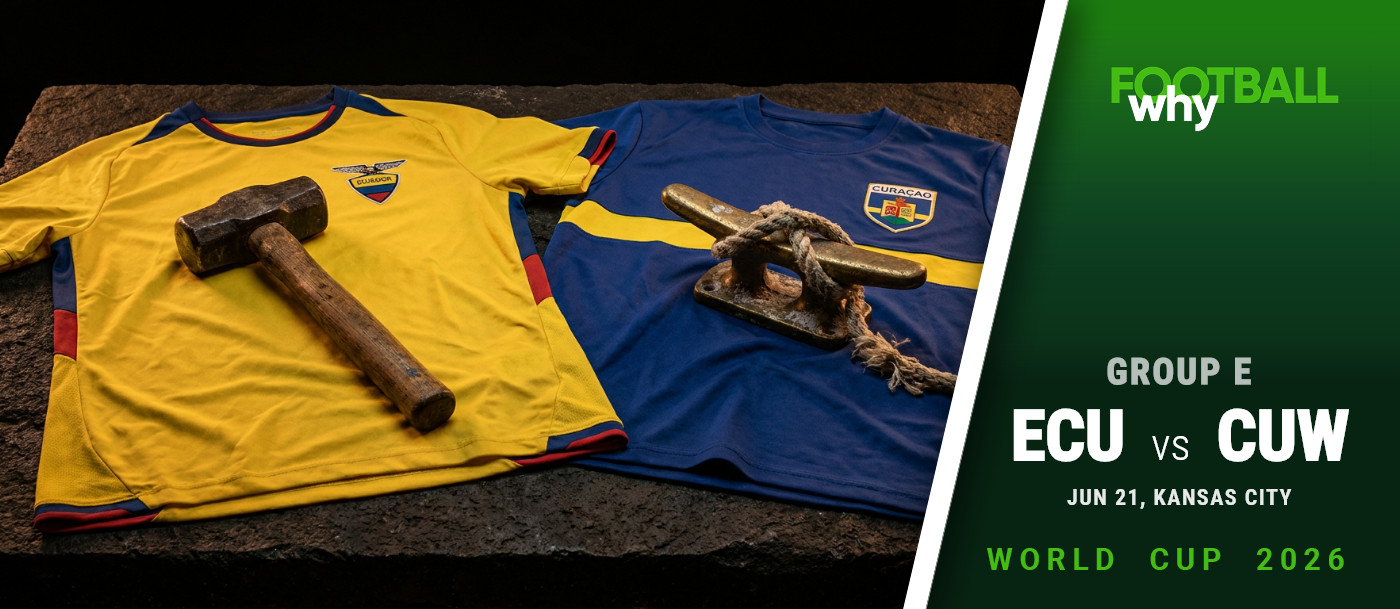
Group E, Matchday 2, Match #34
UTC

Arrowhead Stadium, Kansas City

Prediction by whyFootball readers

ECU
DRAW
CUW
55%
28%
17%
Not a recommendation for betting
Tap [+] to cast your expert forecast.
SCORE BY AI PREDICTION: 2:0 SEE SIMULATION

Ecuador vs Curaçao FIFA World Cup 2026 Group Stage Match A stubborn territorial dispute settled by near-post grit Forecast generated:

The communal toil of the Andes meets the stoic, maritime resistance of the Caribbean. A fixture where South American collective sweat attempts to erode an island fortress forged in Dutch pragmatism. Eighty-odd minutes where a single blink buries survival.

Ecuador: One side's prayer...

Ecuador arrive at this second group fixture carrying the heavy baggage of an opening-day defeat. The public mood is restless, demanding immediate results rather than sterile, U-shaped possession. Fortunately, they welcome back Moisés Caicedo, whose return from suspension provides the midfield ballast they desperately lacked. The squad has circled the wagons, treating this encounter not as a football match, but as a mandatory communal shift to repair the leaking roof of their qualification campaign.

Curaçao: ...head-on with the other.

Curaçao step onto the pitch fuelled by the quiet pride of the overlooked. Stung by external condescension labelling them a mere 'passport team', the diaspora-built squad has forged a tight, familial bond. They sit in a precarious but hopeful group position where a draw represents pure gold. With no fresh injury concerns, Dick Advocaat’s men are fully prepared to drop anchor and weather the impending storm, relying on their Dutch-schooled positional discipline to frustrate their desperate opponents.
Ecuador vs Curaçao Structural Collision

Ecuador: How we will host...

Dream
Securing three points is the absolute baseline, but the real mandate is risk management. Ecuador must protect their defensive floor and avoid needless bookings before the heavy hitters arrive. It is a stoic, communal duty over individual vanity.

Strength
Their foundation is a European-hardened back line shielded by an elite ball-winner in Moisés Caicedo. They possess the collective grit of a mountain forge, relying on a shared work ethic where every player hauls their own weight to keep the structure intact.

Plans
Sebastián Beccacece wants to bypass the crowded middle. The strategy relies on early, flat deliveries from the flanks to Enner Valencia, alongside targeted near-post set-pieces to expose Curaçao’s aerial frailties.

Fears
The lingering anxiety is a return to sterile, U-shaped possession. If the attack looks blunt, the restless public noise will seep onto the pitch, potentially causing rushed decisions and a dip in late-game composure.

Curaçao: With what we arrive...

Dream
Survival is the only currency that matters here. A draw keeps the tournament pulse beating ahead of the final group fixture. The ambition is to navigate the opening hour unscathed, hoarding energy for a handful of calculated surges rather than engaging in a draining slugfest.

Strength
Their resilience is anchored in a rigorous Dutch positional pedagogy. This diaspora-built squad operates with a blue-collar, maritime discipline, pulling together as a tight-knit family unit to weather heavy storms and frustrate technically superior opponents.

Plans
Dick Advocaat will look to exploit the flanks, specifically funnelling the ball to Tahith Chong in the spaces vacated by advancing full-backs. They intend to disrupt the penalty box with heavy traffic on set-pieces, turning every dead ball into a crowded, uncomfortable scramble.

Fears
The glaring structural leak is a chronic deficit in aerial duels and raw physical power. If the match devolves into a chaotic, bruising aerial bombardment, their carefully tailored defensive seams could rip apart under the sheer weight of the onslaught.

How it will be...

We should anticipate an exercise in abrasive patience. The fixture will likely present itself as a knotty, almost bureaucratic standoff, featuring two collectives wholly unwilling to unpick their own stitching. Ecuador will erect a perimeter fence underpinned by the physical endurance of their midfield, whilst the Caribbean islanders will deploy a maritime blockade inherited directly from Dutch academies.

The genuine friction should germinate down the flanks. Estupiñán’s forward excursions will invariably leave a furrow that Tahith Chong will attempt to exploit with his loping, elastic gait. Should the Andean full-back misjudge his timing, the winger possesses an unobstructed alleyway to trouble the goalkeeper.

Ultimately, the imbalance relies on highly specific, veteran craftsmanship. Enner Valencia will lurk, primed to dart across the front shoulder at the near post — a piece of old-school street cunning that routinely dismantles sealed units. Curaçao will counter by clustering their ranks, leaning heavily on Leandro Bacuna’s policing of the penalty area’s edge.

Do not expect any psychological unravelling. The Caribbean fraternity will absorb the physical toll without fracturing, honouring their familial code. The South Americans, bound by their mandate of communal toil, will keep their overalls fastened until the final whistle. It promises to be a battle of attrition, where the slightest miscalculation beneath a dropping ball dictates the verdict.

Ecuador: How did they clinch it?

Victory was cemented inside the six-yard box. A providential near-post dart from Valencia broke the initial deadlock. Subsequently, they capitalised on the opposition's late desperation to deliver a clinical counter-punch. Fundamentally, their European-schooled centre-backs provided an impenetrable foundation.

Curaçao: Why not go for the win?

They succumbed to a fatal lapse beneath a dropping ball. Losing the primary duel on a short corner dismantled their defensive web. Forced to abandon their low block, the midfield emptied out, facilitating the final, lethal counter-attack. A chronic vulnerability to raw physical power defined their ceiling.

Secret mastermind intent

Beccacece’s defensive forge and the communal tarmac shift

General Strategy
Sebastián Beccacece is treating this fixture as an exercise in risk management. The primary focus is establishing a secure defensive floor, accepting a narrow margin of victory rather than chasing aesthetic thrills. It is a pragmatic shift of heavy lifting.

The team will deploy a compact mid-block, prioritising territorial control over high-volume pressing. They want to absorb pressure safely and rely on measured, opportunistic transitions when the spaces naturally open up.
Antidote for the Opponent
The defensive preparation is entirely built around isolating Tahith Chong. The plan is to show him the outside foot and immediately double up on contact, using the central midfielder to shade his inside lane.

In attack, Ecuador will relentlessly target Curaçao’s fragility at the first contact on set-pieces. They have stacked their corner routines to feature near-post flicks from the centre-backs, aiming to bypass the goalkeeper entirely before the defensive line can reset.
Internal Task Solving
The most unusual setup is the pre-planned 'Minga call' from the captain. This is a designated collective sprint reset triggered during a dead-ball situation, designed to re-synchronise distances and energy levels across the pitch.

They have also implemented a strict three-pass vertical rule if their possession becomes too sterile. This manual override forces the team to hit a runner, deliberately breaking the monotony of U-shaped passing to restart their attacking threat.
Crisis Response Plans
If the opposition starts dominating the aerial duels, Beccacece has a clear contingency. Moisés Caicedo will drop deeper to front-screen their target man on long balls, while the centre-backs hold a rigid line to sweep up the second contacts. It is a simple patching of a leaking roof.

The manager is also prepared to tweak the full-back starting positions if the flanks become overloaded. He remains ready to swap central midfielders to reinforce the structure.
Specific Match Orders
Pervis Estupiñán: Start five metres deeper than usual. Only commit to the overlap when the possession platform is absolutely secure. When crossing, prioritise the low cutback over the lofted ball unless the back post is a clear one-on-one. Moisés Caicedo: Shade towards the inside lane to cut off the winger. Tackle from the outside-in and strictly avoid giving away cheap fouls in the central defensive zone. Do not offer them target practice from dead balls. Willian Pacho: Do not get dragged out wide chasing the striker. Hold the defensive line, cue the full-back to cover, and force the play towards the touchline before engaging the tackle.
/ What if Curaçao repeatedly isolates the left flank?

If the opposition winger consistently overloads the left side, the defensive structure will immediately tilt. The left-back will lower his starting height by five to eight metres, and the winger will track back fully to create a two-versus-one. The central midfielders will swap sides to put a more defensive profile in the vulnerable channel.

/ What if the team suffers a sudden shock concession?

Should the team concede against the run of play, a strict 180-second freeze protocol kicks in. The formation drops into a narrow 5-4-1, drastically slowing the rhythm. The focus shifts entirely to restoring field position through touchline restarts before any further attacking risks are taken.

Secret mastermind intent

Dick Advocaat’s maritime blockade and positional rationing

General Strategy
Dick Advocaat is setting up a maritime blockade. The fundamental objective is to protect parity at all costs, rationing energy and accepting a low volume of shots. It is an exercise in austere resource management.

The team will sit in a disciplined mid-to-low block, conceding width to protect the central lanes. They will patiently wait for the opposition to overcommit before releasing sudden, vertical transitions down the touchlines.
Antidote for the Opponent
The primary attacking trigger involves isolating the space behind the opposition's left-back. The instruction is to hit quick diagonal switches, carrying the ball deep before delivering low, driven cutbacks rather than floating crosses into the box.

Defensively, they will step onto the front foot early to block early crosses at the source. The centre-backs are tasked with defending the near-post zone aggressively to deny the striker's trademark darting runs across the front shoulder.
Internal Task Solving
Eloy Room is tasked with dictating the emotional temperature of the match. The goalkeeper will use longer holds after saves to deliberately blunt the opposition's pressing traps, prioritising field position over risky, short restarts.

The squad has also drilled a pre-agreed hybrid marking switch for set-pieces. If they lose the first aerial contact in the box, they will automatically shift from a zonal front to man-marking the biggest aerial threats.
Crisis Response Plans
If the opposition repeatedly pins the right-back and overloads the flank, Advocaat will deploy a structural patch. The shape will slide into a flat 5-4-1, with the wingers dropping deep to kill the cutback lanes.

Should the midfield anchor pick up an early booking, the manager will immediately drop a second midfielder in to form a double pivot. This reduces central exposure and prevents the engine room from being overrun.
Specific Match Orders
Leandro Bacuna: Anchor the midfield as a traditional number six rather than a hybrid box-to-box player. Screen the opposition striker and permanently block the edge of the penalty area. Only advance beyond the midfield line when possession is completely secure. Tahith Chong: Maintain a fixed starting position high on the right flank to exploit the space behind their advancing full-back. Deliver low, driven cutbacks instead of lofted crosses. Conserve physical output to guarantee three explosive, designated sprints per half. Kenji Gorré: If the tactical shape shifts to a back five, drop immediately to a wing-back depth to handle defensive overloads. The primary duty is to deny the cross at the source. Once secured, carry the ball out to relieve pressure.
/ What if the defensive wall suffers an early breach?

A strict three-minute compactness mandate is instantly activated. The team will huddle, reset their emotional baseline, and drop into a rigid block at thirty-five metres. All counter-attacking is strictly forbidden until the defensive shape is verified. Once stability returns, they will reintroduce wide isolations.

/ What if the physical duels become overwhelming?

If the opposition begins to bully the midfield, the entire defensive block will pull five metres deeper. The priority shifts entirely to denying crossing lanes and crowding the penalty area. The team will willingly accept sterile opposition possession as long as the danger zones remain heavily fortified.

MAIN SIMULATION 0'-25'

Ecuador sets up a steady 42-metre mid-block, trying to feed early balls to Enner Valencia. Curaçao counters this by sitting deep, refusing to be drawn out, and keeping Tahith Chong primed for a quick sprint down the right. The main tactical tug-of-war occurs down that flank. Pervis Estupiñán wants to push forward, but Moisés Caicedo has to shepherd Chong towards the touchline to prevent a clean break. It is a cagey opening, with both sides testing the structural mortar rather than swinging the sledgehammer.

MAIN SIMULATION 25'-45'

Ecuador’s persistence at set-pieces eventually breaks the deadlock. They draw Curaçao narrow, fire in a short corner variant, and Valencia nods home across the near post. It is a classic bit of set-piece tarmac-laying. Curaçao immediately triggers a shock-recovery protocol, dropping into a tight defensive shell for three minutes to stop the bleeding. Ecuador responds by managing the game state, specifically ensuring they do not concede cheap fouls near their own penalty area.

MAIN SIMULATION 45'-65'

Curaçao selectively raises their engagement line, finding their best moment when Chong slips behind an overlapping Estupiñán, only for the goalkeeper to smother the danger. It is a sudden draught in Ecuador's otherwise well-sealed house. The South Americans react by cooling the tempo and dropping into a rigid 5-4-1 shape without the ball. They freeze the play on the flanks, draw fouls, and walk up the pitch for restarts to kill the game's rhythm.

MAIN SIMULATION 65'-90'

Curaçao abandons the handbrake, switching to a 4-2-3-1 to chase the game. They flood the far post and test the goalkeeper from distance, stretching the pitch to its limits. Ecuador selectively accepts this extra space. Just as the pressure peaks, the South Americans execute a textbook counter-punch. A quick switch finds Estupiñán, who cuts it back for Gonzalo Plata to finish cleanly. With a two-goal cushion, Ecuador simply shuts the door and turns the lock.

And it will come to...

If Ecuador were to maintain their European-hardened defensive floor, their pragmatism would naturally suffocate the game. Curaçao would likely try to survive the early exchanges and strike via a timed counter, but their systemic vulnerability at set-pieces would ultimately be their undoing. Should the Caribbean side be forced to chase the game, they would leave gaping holes at the back. In the end, Ecuador's ability to seamlessly toggle their rest-defence and punish stretched structures would prove too much for a spirited but limited opponent.
end of Game