

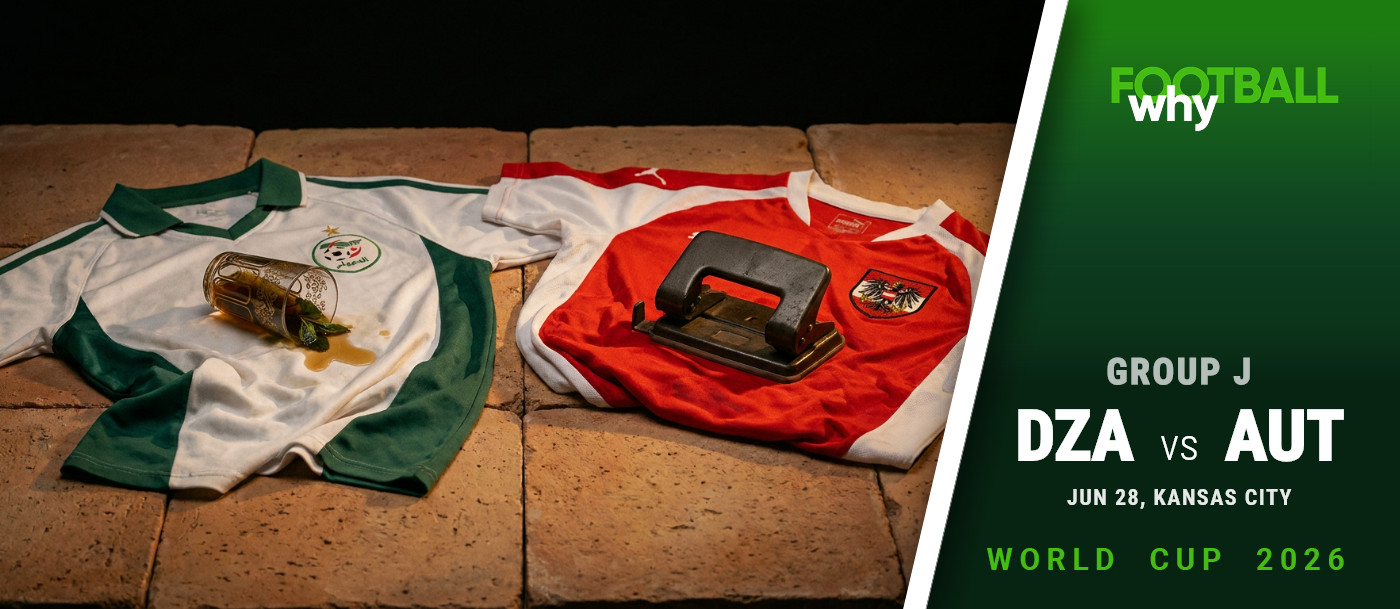
Group J, Matchday 3, Match #69
UTC

Arrowhead Stadium, Kansas City

Prediction by whyFootball readers

DZA
DRAW
AUT
33%
30%
37%
Not a recommendation for betting
Tap [+] to cast your expert forecast.
SCORE BY AI PREDICTION: 1:1 SEE SIMULATION

Algeria vs Austria FIFA World Cup 2026 Group Stage Match Smothering a desert rebellion with heavy procedural tweed Forecast generated:

The fierce, honour-bound pride of the desert collides with the unyielding, procedural logic of the Alps. Will communal fury dismantle a meticulously constructed trap, or will cold bureaucracy comfortably file away the rebellion?

Algeria: One side's prayer...

Algeria step onto the pitch facing a stark, unforgiving reality: win or go home. The public mood is a powder keg of zero-excuse expectation, heavily focused on Riyad Mahrez delivering in what feels like his final tournament crusade. Hovering over their preparations is the lingering shadow of recent disciplinary sanctions, forcing the squad to walk a tightrope between their honour-driven aggression and the need to keep eleven men on the pitch. They must channel their communal fire without letting it burn the house down.

Austria: ...head-on with the other.

Austria arrive with the quiet assurance of a team holding a favourable hand, knowing a draw secures their progression. The mood is distinctly pragmatic, driven by method rather than emotion. Their primary concern is physiological rather than psychological, carefully managing the workload of key figures like David Alaba and Konrad Laimer through the stifling humidity. While external noise regarding the manager's long-term contract occasionally rattles the windows, the dressing room remains entirely insulated, fully committed to executing their high-intensity blueprint without unnecessary drama.
Algeria vs Austria Structural Collision

Algeria: How we will host...

Dream
Win to qualify. The atmosphere is thick with zero-excuse demands and the lingering shadow of previous tournament failures. They need to channel this intense pressure into collective honour rather than individual panic.

Strength
They possess a potent blend of European tactical schooling and street-level improvisation. When functioning well, they are a fiercely loyal collective that thrives as the underdog. They use their wide overloads and technical flair to punish rigid structures.

Plans
The manager intends to survive the early Austrian storm with a disciplined, compact shape. Once the initial heat dissipates, they will look to exploit the spaces left by overlapping full-backs. They plan to use rapid diagonal switches and cutbacks to isolate the opposition's heavy-footed defenders.

Fears
Their deepest vulnerability is emotional combustion. A perceived injustice from a referee or a period of suffocating Austrian control can trigger a spiral of rash tackles. This unpicks their carefully stitched tactical seams and invites chaos.

Austria: With what we arrive...

Dream
Secure qualification without unnecessary drama. A draw suffices to see them through, yet their public expects an assertive, modern performance rather than a timid retreat. They aim to validate their credentials with a display of controlled authority.

Strength
They operate with the relentless efficiency of a civil service department. Their pressing traps are meticulously drilled, and their vertical transitions are sharp. This squad relies heavily on collective industry, trusting their structural integrity to suffocate more flamboyant opponents.

Plans
The manager intends to audit the midfield by picking his pressing triggers carefully to manage the stifling humidity. They will choke the central corridors and force the opposition's primary playmakers into rushed decisions. Offensively, they plan to target the back-post areas with late-arriving runners from deep.

Fears
A sudden collapse of their procedural discipline. If they concede early or grow frustrated with contentious refereeing, their rigid shape can occasionally fray. This leads to rushed tackles, pointless arguments, and the concession of dangerous set-pieces.

How it will be...

The fixture should largely unfold as a test of structural endurance against mounting emotional grievance. Austria will likely establish a high-pressing perimeter early on, functioning like strict inspectors determined to confiscate the ball in the central third. Algeria, burdened by the absolute necessity of victory, will attempt to bypass this bureaucratic web by clipping passes towards the flanks, seeking the touchline sanctuary.

Should the Algerian goalkeeper misjudge a clearance under this early interrogation, Austria are primed to capitalise instantly, converting a momentary hesitation into a scoreboard advantage. Such a setback would immediately activate Algeria's communal survival instincts, forcing them to retreat and repair their fraying shape while suppressing the urge to engage in theatrical disputes with the referee.

As the humidity thickens, the match will likely devolve into an exercise in metabolic conservation. Austria will rotate their personnel to preserve their pressing integrity, while Algeria will eventually discard their tactical caution. Expect a late, chaotic bombardment from the North Africans, a desperate 3-2-5 formation raining crosses into the penalty area. If Austria's central defenders maintain their stoic near-post vigilance, the match will likely settle into a stalemate, proving that a robust protocol can just about withstand a fiercely proud, communal uprising.

Algeria: Just short of victory

An early, unconvincing parry centrally from Zidane surrendered the initiative almost immediately. Their late, desperate transition to a 3-2-5 attacking shape lacked the crossing precision required to breach a set defence. Ultimately, their emotional urgency degraded their structural discipline just enough to prevent a victory.

Austria: Just short of victory

A momentary lapse in near-post concentration during a set-piece allowed Algeria a crucial foothold before the interval. Furthermore, their conscious decision to prioritise game-management and lateral recycling in the final quarter neutered their own attacking threat. They lacked the individual spontaneity to punish the spaces Algeria vacated late on.

Secret mastermind intent

Vladimir Petković anchors the family tent against the storm

General Strategy
Petković is prioritising phase-control discipline to navigate the high-stakes opening exchanges. The primary objective is to absorb pressure without conceding central turnovers.

The team will sit in a compact mid-block, engaging only when the opposition plays negative passes. If they reach the second half unscathed, the structural handbrake comes off, escalating risk to secure the necessary victory.
Antidote for the Opponent
To exploit Austria's aggressive full-back jumps, the plan relies on rapid diagonal switches toward the left flank. The aim is to isolate the weak-side centre-back before the defensive line can shift.

There is also a specific trap set for Austrian corners. The near-post area will be heavily loaded to drag their primary aerial threat out of position, allowing a flick-on across the face of goal.
Internal Task Solving
A unique linguistic shield is being deployed to counter the opposition's pressing triggers. All touchline communication regarding build-up play will be conducted strictly in French, obfuscating their intentions from the German-speaking press.

Furthermore, a strict protocol is in place for dealing with officials. Only the captain is permitted to speak to the referee. This is a vital measure to prevent the squad's honour-driven grievances from spiralling into needless bookings.
Crisis Response Plans
If Austria successfully man-marks the midfield pivot and traps early progression, the team will bypass the centre entirely. The goalkeeper is instructed to clip aerial balls directly toward the left-back's zone.

An attacking midfielder will then drop deep to form a temporary back three. The manager maintains a flexible playbook, ready to freeze full-back runs or throw on a second striker depending on the game state.
Specific Match Orders
Luca Zidane: Avoid square ground passes inside the first line of pressure. Your primary distribution route is a clipped diagonal to the left-back zone. Retreat to your line on long goal-kicks to command the box for second balls. Riyad Mahrez: Limit your retrievals below the midfield line. Make sure your first touch is forward, and use your second to release a runner. Accept early crosses from the touchline to vary your attacking cues rather than forcing extended dribbles against double-teams. Ismaël Bennacer: Do not force vertical passes if you are under body-closed pressure. If a shadow marker is tracking you, call an 'over' and drop between the centre-backs to reset the tempo before looking for the far-side midfielder.
/ What if the opposition repeatedly exploits the space behind the left-back?

The manager will immediately freeze the left-back's forward runs for a ten-minute cooling period. The right-back will tuck inside to create a makeshift back three in rest-defence. The left-winger will then hold maximum width to preserve an attacking threat down that channel without exposing the defensive line to further transitions.

/ What if the team is still chasing a mandatory victory in the final fifteen minutes?

The shape escalates into a highly aggressive 3-2-5 structure. A second striker and an additional right-sided playmaker are introduced to flood the penalty area. The team will enforce a strict five-second counter-press, dramatically increasing their direct crossing volume to overwhelm the opposition's penalty spot.

Secret mastermind intent

Ralf Rangnick winds the clockwork for a midfield audit

General Strategy
Rangnick is focused on dictating the match tempo through selective mid-to-high pressing waves. The primary objective is to manage the physical toll of the humidity while keeping the ball in the red zone.

The midfield double-pivot will hold their ground to lock down the central corridor. They want to avoid a chaotic track meet, forcing the game into the less dangerous wide channels instead.
Antidote for the Opponent
Special attention is devoted to neutralising the opposition's deep-lying playmaker. The nearest attacking midfielder is tasked with blocking his inside shoulder, ensuring he cannot turn and dictate play.

Defensively, they will aggressively double up on the opposing right-winger to deny his trademark inside curl. The full-back and the nearest pivot will force him down the touchline, accepting crosses from poor angles as a calculated risk.
Internal Task Solving
A pre-planned cooling protocol is baked directly into the substitution strategy. Wingers will be swapped around the hour mark to maintain the integrity of the counter-press without risking soft-tissue injuries.

Furthermore, a strict 'no swarm' rule has been issued regarding the match officials. The bench will enforce this ruthlessly. Only the captain will engage in dialogue, ensuring the defensive shape remains intact during contentious moments.
Crisis Response Plans
Should the initial pressing waves be routinely bypassed, the team will methodically drop their line of engagement by ten metres. This tactical retreat aims to compress the space around the penalty area.

The full-backs will narrow their positioning, while the wingers maintain width to act as decoy outlets. They will then rely on their central defenders to clear predictable deliveries and hunt for second balls.
Specific Match Orders
Kevin Danso: Hold your line and protect the near-post channel at all costs. Do not step out to follow the opposing forward when he drops deep, unless the midfield pivot has already locked onto his run. Konrad Laimer: Prioritise the inside lane when covering the right flank. Only underlap on a pre-agreed third-man cue. Managing your energy levels in this humidity is far more important than making repeated, fruitless sprints. Marcel Sabitzer: Maintain your height in the right half-space when the opposition drops into a low block. Avoid drifting into the pivot line to demand early touches. Arrive late into the penalty area for cutbacks instead.
/ What if the opposition winger continually wins one-on-one duels?

The manager will deploy a hard double-team using the left-back and the nearest pivot player to force an immediate cross. Tactical fouls will be initiated higher up the pitch, around 40 metres from goal. This delays the attack and allows the defensive block to fully reset.

/ What if the team needs to protect a narrow lead late on?

The formation will shift into a rigid 5-4-1 structure without the ball. An extra central defender is introduced to anchor the backline. Full-back overlapping is strictly forbidden. The sole focus becomes preserving the central corridor and clearing the ball cleanly into the channels.

MAIN SIMULATION 0'-25'

Austria will likely start with a high 50-metre defensive line, operating like strict customs officers to lock down Ismaël Bennacer. Algeria attempts to bypass this trap by clipping passes out to Rayan Aït-Nouri, but they consistently lose the subsequent second balls. This territorial dominance pays off around the 12th minute when Luca Zidane parries a cutback, allowing Michael Gregoritsch to sweep home. Algeria immediately initiates a shock-recovery protocol, dropping into a compact 4-5-1 to slow the tempo. Austria keeps their full-backs disciplined to prevent any immediate counter-attacks.

MAIN SIMULATION 25'-45'

Algeria patches the tactical leak by freezing Aït-Nouri's forward runs and dropping Farès Chaïbi as an auxiliary holding midfielder. The match settles into a tense parish council standoff. Algeria's wide-to-inside passing improves, reducing central turnovers and allowing Riyad Mahrez to force early line crosses. This set-piece hunting pays dividends in the 41st minute when Aïssa Mandi flicks a near-post corner for Amine Gouiri to equalise. Austria responds by dropping their pressing line back ten metres to comfortably ride out the half.

MAIN SIMULATION 45'-65'

The match enters a phase of metabolic management, with both sides treating the humidity like a heavy tweed jacket. Austria rotates their wingers around the hour mark to preserve their counter-pressing energy. Algeria probes through the half-spaces, but the Austrian pivots brilliantly shade the penalty box to deny cutbacks. A spilled shot from Sabitzer briefly raises pulses, but Mandi clears the danger efficiently. The execution of complex tactical instructions begins to flatten by about ten percent as fatigue slowly sets in.

MAIN SIMULATION 65'-90'

Austria shifts into a bureaucratic 4-2-3-1 shape to manage the draw, prioritising clean exits over final-third risks. Algeria, desperate for a win, rips up the script at the 75th minute to deploy a chaotic 3-2-5 formation. Crosses rain into the box as Baghdad Bounedjah joins the fray. Austria’s Marko Arnautović hits the post on a counter-attack, but the central defensive spine holds firm. Danso's front-post discipline ultimately blunts the aerial bombardment, securing the stalemate.

And it will come to...

If this match were to unfold as simulated, Austria's system-first identity would successfully weather the emotional storm. We would likely see Algeria's defiant surge express the raw, communal character of their football, tearing up the tactical blueprints in the final quarter. However, the draw would ultimately reflect a stubborn equilibrium between passionate improvisation and structural rigidity. Austria would lean on their central defensive spine to survive, while Algeria would find their only true joy through set-piece leverage.
end of Game