

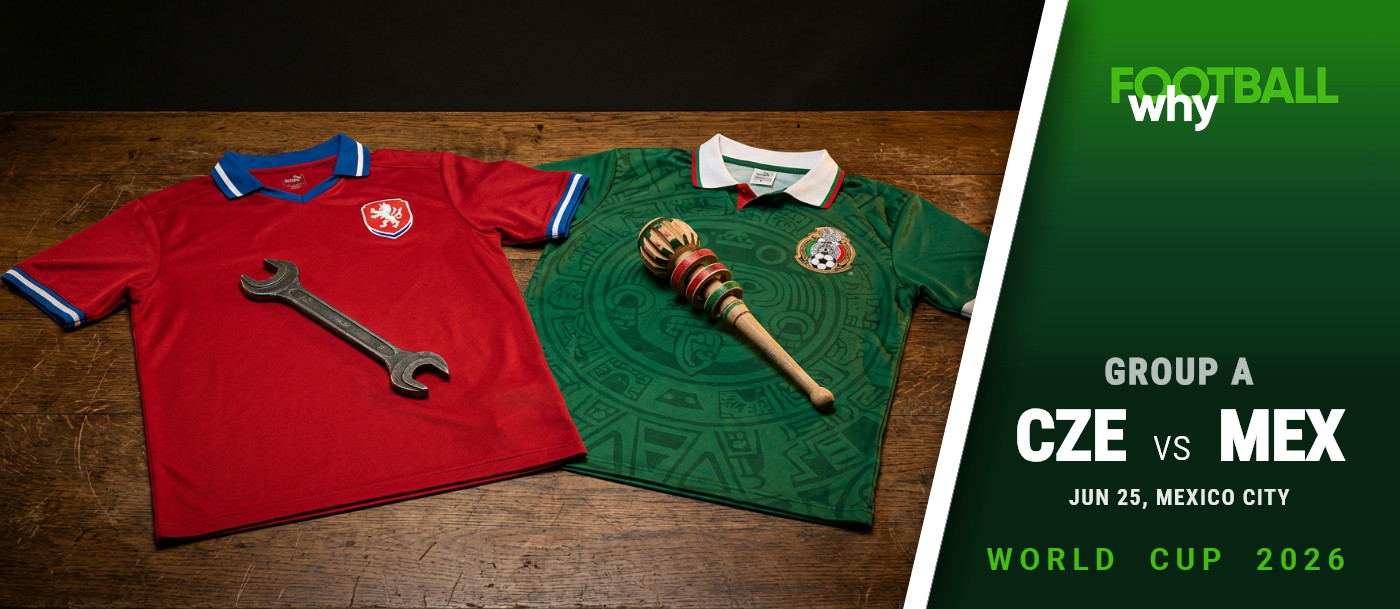
The World Cup Qualification Decider
Thursday, 25 June

Estadio Azteca, Mexico-city

Czech Republic vs Mexico FIFA World Cup 2026 Group Stage Match A Jammed Latch and Three Ruthless Thrusts Forecast generated:

The first half ground along with the rusted friction of a jammed clock tower, but Mexico eventually bypassed the tedium. Discover how tactical cutbacks ruthlessly punished a Czech side that mustered just 0.47 expected goals.
Czech Republic vs Mexico Structural Collision

What was it?

The turf at the Estadio Azteca hosted an exercise in pure bureaucratic friction. The Europeans shifted left and right with the stiff repetition of a jammed window latch. Forty-five minutes passed without a single pulse of adrenaline. Goalkeepers stood entirely untroubled under the floodlights.

Javier Aguirre read the lethargy and turned the dial. He ordered his fullbacks to surge simultaneously into the inside channels immediately after the interval. Mateo Chávez broke through the interior corridor at the 55th minute and finished low. Six minutes later, Julián Quiñones scrambled in a second following a deep overlapping run from Jorge Sánchez.

The visitors paid heavily for their initial caution. Their management kept Patrik Schick and Tomáš Souček seated in the dugout until past the hour mark. Stripped of their physical focal points, the Czechs offered nothing but harmless lateral passes. They finished the evening with a dismal 0.47 expected goals and exactly one shot on target.

The closing minutes provided a sudden, romantic jolt to an otherwise clinical transaction. Guillermo Ochoa arrived from the touchline to equal the record of six World Cup appearances. Deep into stoppage time, the veteran goalkeeper launched a massive, arcing clearance downfield. Álvaro Fidalgo brought it down and slotted home the third, cutting through the lingering tension with one sweeping, nostalgic stroke.

Why not go for the win?

Czech Republic

The Czech Republic approached the opening whistle with the cautious formalism of a municipal audit. By voluntarily benching their primary physical reference points, they deliberately neutered their own set-piece threat. They settled instead for a sterile, risk-averse shape that kept Mexico at arm's length but offered zero penetration.

This passive configuration exposed a glaring imbalance in the current squad. When a team lacks elite wingers capable of beating a man one-on-one, the entire attacking rhythm relies on winning second balls and bullying centre-halves in the box.

Stripped of that aerial gravity, their wide deliveries simply floated into empty space. The talent pool remains shallow beyond the established core, meaning early rotation inevitably drops the technical floor.

Such tactical rigidity stems directly from a domestic schooling system that values compliance over invention. Academies drill positional responsibility and honest two-way running, viewing flair with deep suspicion. The national footballing conscience prefers the safety of the known procedure.

A cultural aversion to hubris ensures managers rarely gamble early, trusting the slow grind. When forced to chase the game, the sudden removal of a central defender to push wingbacks high felt entirely unnatural. It fractured their rest-defence and exposed a fatal inability to manage chaos.

They filed their paperwork flawlessly while the building burned down around them.

How did they clinch it?

Mexico

Mexico resolved a suffocating first half not with frantic energy, but with a highly pragmatic adjustment. Recognising the Czechs' deep central congestion, the management instructed both fullbacks to surge simultaneously. Crucially, they bypassed floated crosses in favour of sharp cutbacks, exploiting the space behind the retreating defensive line.

This measured approach highlights a distinct shift in the current squad's emotional management. Historically, Mexican sides might have forced the issue, accelerating the tempo impulsively and leaving themselves vulnerable. Here, a single holding midfielder anchored the shape, allowing the team to accept compact, passive phases without panicking.

It is a deliberate recalibration designed to counter the psychological weight of the 'quinto partido' complex. The intense scrutiny of a massive diaspora fanbase often transforms home-soil advantages into crippling anxiety. Players are conditioned by a domestic league that prioritises commercial spectacle, sometimes leaving them underprepared for the cynical grind of tournament knockouts.

By stripping away the performative flair and focusing on structural discipline, the coaching staff has built a shield against that systemic volatility. They absorb pressure, rely on communal work rates, and wait for the exact moment to apply a localised overload.

They traded the romantic mariachi crescendo for the cold, silent efficiency of a lockpick.

Match hero...

Vladimír Coufal
Vladimír Coufal operated his flank with the grim obedience of a tram driver sticking strictly to the printed timetable. He offered a constant, industrious outlet down the right, logging the miles with heavy-legged diligence. The tragedy was that nobody was waiting at the stops. He pushed high because the tactical blueprint demanded width, but this honest labour simply left the back door wide open for Mexican counters. He executed his duties perfectly within a system that was entirely broken.

...and one more

Mateo Chávez
Mateo Chávez looked at the congested European block and simply took his vehicle onto the pavement. When the traditional overlapping routes clogged up, he underlapped through the inside channel, cutting a sudden detour through the rigid Czech lines. This wasn't a rehearsed boardroom strategy; it was an informal, street-smart fix to a stalled game. His instinct to abandon the touchline and dart centrally bypassed the heavy traffic entirely, proving that a little calculated cheek often resolves what patient possession cannot.