

Group A, Matchday 3, Match #53
UTC

Estadio Azteca, Mexico City

Prediction by whyFootball readers

CZE
DRAW
MEX
26%
32%
42%
Not a recommendation for betting
Tap [+] to cast your expert forecast.
SCORE BY AI PREDICTION: 1:1 SEE SIMULATION

Czech Republic vs Mexico FIFA World Cup 2026 Group Stage Match Tightening the bolts against a rising local fever Forecast generated:

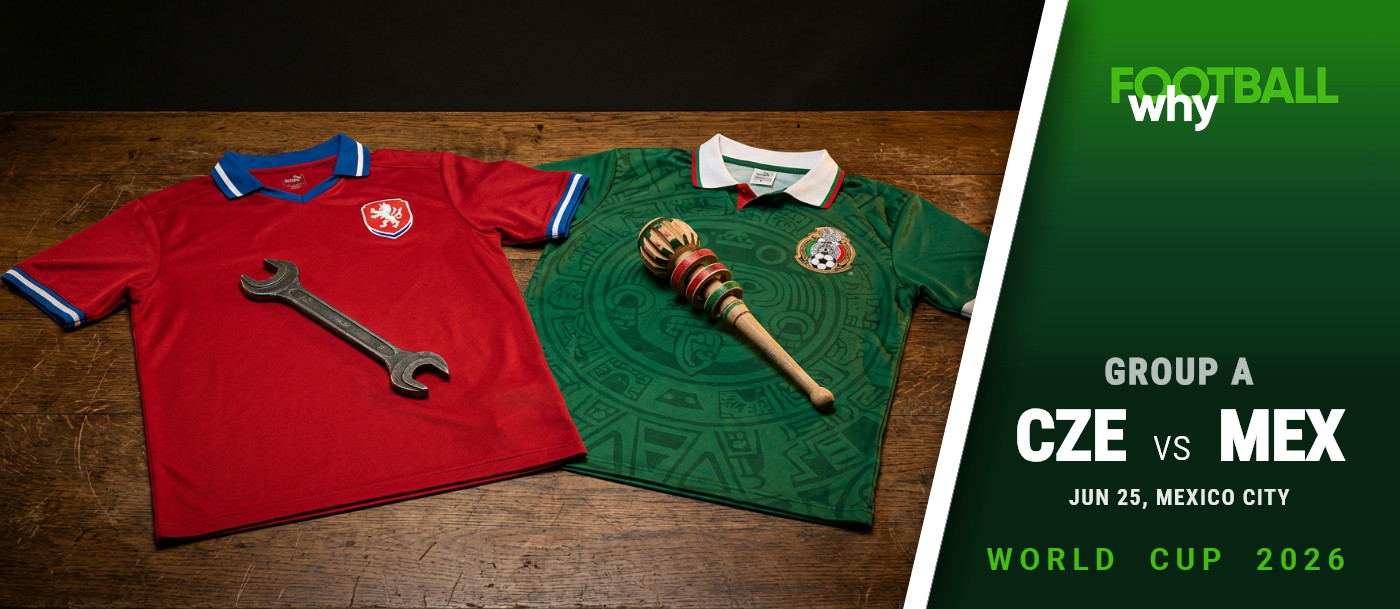
The sweltering devotion of a communal brotherhood collides with the cynical patience of a mechanic’s workshop. It is the vibrating noise of collective expectation crashing against a quiet, unyielding insistence on procedural routine. Passionate fervour meets the iron timetable.

Czech Republic: One side's prayer...

This is the final group game, and the Czechs arrive with a pragmatic, oxygen-accounting mindset. They are perfectly content to sit deep and protect their group standing, knowing a draw likely secures progression. Domestically, the public is exhausted by lingering federation governance scandals — specifically an ongoing distrust of executive competence — so expectations are grounded purely in survival rather than style. With Patrik Schick fit but heavily monitored and Ladislav Krejčí newly wearing the armband to stabilise the defensive line, they are ready to drop the shutters and secure a result.

Mexico: ...head-on with the other.

Mexico steps onto their home turf burdened by the suffocating weight of the 'quinto partido' complex and the absolute expectation to top the group. The Azteca crowd demands authority, but Javier Aguirre’s squad is acutely aware that blind aggression could lead to fatal transition leaks. Edson Álvarez is fit to anchor the midfield, while Luis Malagón retains the gloves despite external media noise demanding a veteran presence. The mood is tense but familial; they must carefully thread the needle between feeding the crowd’s emotional fire and maintaining strict tournament discipline.
Czech Republic vs Mexico Structural Collision

Czech Republic: How we will host...

Dream
Qualify cleanly without any structural drift or dramatic fuss. The domestic mood is tinged with scandal fatigue and a deep skepticism of grand promises. Nobody wants heroic failure; they want a quiet, competent result that secures progression without exposing a soft underbelly to the Azteca crowd.

Strength
A stoic, industrious collective built entirely on percentages and set-piece craftsmanship. They trust in the quiet competence of a workmanlike spine and the sheer physical gravity of their aerial game. It is a classic workshop mentality: fix the small things, stick to the routine, and let the reliable mechanics do the heavy lifting.

Plans
Frustrate the hosts by narrowing the pitch and denying the half-spaces, forcing sterile possession. When the ball is won, bypass the midfield entirely with early, flat deliveries into the box. The manager expects to exploit the space behind the Mexican full-backs, using targeted crosses before the defensive block can settle.

Fears
The creeping threat of altitude fatigue and the chaotic noise of a hostile stadium. If they concede an early goal, the disciplined shape can sometimes sink too deep, reducing their clearances to hopeful punts. The ultimate dread is losing their structural composure and getting dragged into an emotional, end-to-end shootout.

Mexico: With what we arrive...

Dream
Top the group cleanly without gifting any foolish transitions. The Azteca crowd demands a commanding performance, and the pervasive anxiety of the ‘quinto partido’ ceiling means the team is desperate for a result that projects unquestioned authority. They want to ride the stadium's fervour without being burnt by its impatient heat.

Strength
An intricate, ground-based combination game driven by a profound sense of collective solidarity. This is a side that redefines the squad as kin, relying on mutual aid and combative grit rather than isolated heroism. Their technical schooling shines brightest when they weave through tight spaces, trusting the familiar rhythms of their domestic league.

Plans
Refuse the aerial battle entirely. Javier Aguirre has instructed his players to bypass the towering Czech centre-backs by exclusively seeking low cutbacks from the byline. The strategy hinges on third-man runs down the right flank, dragging the opposition wide before snapping sharp, grounded deliveries into the penalty area.

Fears
The creeping paralysis of crowd anxiety and the resulting breakdown of tactical discipline. When the Azteca grows restless, the team’s pride often morphs into frantic haste — spamming hopeful crosses and abandoning their defensive structure. The manager’s greatest concern is a loss of patience leading to a fatal counter-attack.

How it will be...

The Azteca will likely resemble a stifling boiler room, testing the sealant of the Czech defensive glazing. Mexico should dictate the territorial footprint, weaving low-trajectory passes through the half-spaces to bypass the towering European centre-backs. It represents a collision of familial fever against procedural carpentry.

We might witness the visitors’ workshop mentality crystallise during dead-ball situations. Tomáš Souček will construct deliberate screens, allowing Patrik Schick to exploit fractional seams. If the Mexican goalkeeper’s sightline is obscured by this sheer physical masonry, a sudden set-piece breakthrough feels highly probable.

Yet, the hosts possess their own emotional accelerant. Should Orbelín Pineda pivot the attacking focus toward the left, dragging the Czech structure out of alignment, the resulting cutbacks could fracture the visitors' resolve. Matěj Kovář’s glove-work will be paramount here. If he spills a low delivery, the ensuing stadium noise could unravel the Czechs entirely.

Ultimately, altitude fatigue will likely drop a heavy plywood curtain over the final quarter. Both benches harbour an ingrained dread of transition leaks, meaning the contest should fizzle into a mutually agreeable, risk-averse stalemate.

Czech Republic: Why not go for the win?

An early booking neutered Ladislav Krejčí’s front-foot anticipation, granting the Mexican forwards a crucial fraction of space to recalibrate. After securing their set-piece breakthrough, the Czechs voluntarily suffocated their own transition threat to conserve oxygen. They fundamentally lack the individual disguise necessary to unpick a set block without dead-ball scaffolding.

Mexico: How did they clinch it?

A momentary lapse in visual tracking during a crowded corner gifted the visitors an opening. Despite successfully unpicking the lock via a left-sided overload, Mexico's inherent dread of a counter-attack capped their late ambition. The lingering psychological ceiling of tournament knockout football actively discouraged the deployment of a second overlapping full-back.

Secret mastermind intent

Miroslav Koubek's dusty workshop audit and structural sealant

General Strategy
Koubek is not interested in expansive aesthetics. He wants a compact, low-risk 4-4-2 mid-block positioned around 42 metres from goal.

The primary directive is to secure progression through an acceptable draw. They will willingly cede territory, focusing on absorbing pressure and striking through rehearsed set-pieces or rapid wide transitions. It is a tactical approach built like painted plywood: unspectacular, but structurally sound.
Antidote for the Opponent
To counter Mexico’s intricate flank play, the midfield is instructed to ruthlessly narrow the half-spaces. This denies Orbelín Pineda his preferred third-man running lanes.

In attack, the target is the space left behind Mexico’s advancing right-back. Patrik Schick will deliberately pin the nearest centre-back, creating a seam for early, flat crosses. They are trying to find the fracture points in the Mexican defensive glass.
Internal Task Solving
The most unique preparation revolves around managing the suffocating Azteca altitude. Koubek has mandated a strict oxygen-accounting protocol, limiting pressing bursts to short six-minute waves.

The goalkeeper and captain are tasked with aggressively slowing down all restarts and dead-ball situations. The recent captaincy handover to Ladislav Krejčí was specifically designed to stabilise this chain of command under physical duress.
Crisis Response Plans
Should the team concede early or suffer a barrage of penalty-box entries, Koubek will trigger an immediate structural lockdown. The shape will snap into a rigid 5-4-1 for an eight-to-ten minute cooling phase.

During this period, the tempo will be deliberately suffocated to hunt for set-piece territory. Other in-game shocks are met with a similar insistence on procedural routine, dropping the rhythm like a heavy theatre curtain to kill momentum.
Specific Match Orders
Vladimír Coufal: Limit overlapping runs to strictly controlled windows. If the opposition anchor drops between the centre-backs, hold the half-space and deliver early, flat crosses from deep rather than chasing the byline. Tomáš Souček: Track the opposition holding midfielder meticulously on all restarts. Time late surges into the penalty area only during the second phase of play. Abort all high-stepping pressure immediately following a turnover. Patrik Schick: Live constantly on the seam between the right-back and right-sided centre-back. Make aggressive near-post darts to meet flat, outswinging deliveries. Avoid drifting into wide areas seeking touches; stay strictly between the goalposts.
/ What if Mexico scores early or strings together multiple box entries?

Immediately drop into a 5-4-1 shape and deepen the winger positions by five to seven metres. Abandon short combinations and prioritise long diagonal passes towards the striker. Slow the game to an absolute crawl until the pass count stabilises.

/ What if a key defender picks up an early yellow card?

Reduce all front-foot stepping and aggressive anticipation. Flip the defensive scheme to conservative side-traps. Tilt the rest-defence structure deeper, holding the defensive midfielder further back to protect the booked player from isolation.

Secret mastermind intent

Javier Aguirre's pragmatic familial barricade and ground-level grit

General Strategy
Aguirre is demanding tournament pragmatism over romantic flair. He wants a compact 4-4-2 mid-block, squeezing the game into a tight 25-metre band.

The objective is to control territory without over-extending. They will gladly tolerate spells of sterile possession to ensure their rest-defence remains impregnable. It is an approach designed to strip the match of chaos, relying on disciplined, selective pressing to force errors rather than chasing shadows.
Antidote for the Opponent
To neutralise the Czech aerial threat, Aguirre has issued a blanket ban on floating crosses. Every final delivery must be a low cutback or a driven pull-back from the byline.

Defensively, the focus is entirely on smothering the early out-swinging crosses. The full-backs are instructed to engage the wide servers with an early, aggressive body shape, cutting off the supply line before the Czech forwards can set their feet.
Internal Task Solving
The Azteca crowd’s notorious impatience requires active management. Aguirre has instructed his players to re-engage the fans through hard, visible defensive actions — crunching tackles and emphatic clearances — whenever the attacking rhythm stalls.

Crucially, only one full-back is permitted to advance at any given time. This non-negotiable rule ensures a permanent three-man defensive guard, mitigating the risk of transition leaks when the crowd demands a reckless forward surge.
Crisis Response Plans
If they concede or suffer a dangerous set-piece scare, Aguirre will deploy a rigid shock-recovery protocol. The team will instantly compress to a 30-metre depth and force two cycles of utterly safe, sideways possession to kill the rising panic.

Once the pulse settles, they will relaunch via a heavy overload on the right flank. Aguirre has also pre-planned early substitutions for his wide players around the hour mark to ensure the defensive tracking never wanes.
Specific Match Orders
Edson Álvarez: Maintain a strict central anchor position at all times. Step forward to engage the opposition striker only if the defensive line is fully set and a central midfielder has dropped to cover the vacated space. Orbelín Pineda: Operate as the third-man creator — arrive in the half-space, do not linger there. Prioritise rapid ground combinations and low cutbacks. Absolutely no hanging crosses into the penalty area. Santiago Giménez: Attack the front post aggressively on all low deliveries. Pin the centre-backs to open passing lanes for the midfield. Initiate an immediate counter-press after losing possession; do not waste time protesting.
/ What if the Czechs drop into a deep 5-4-1 block early on?

Introduce deliberate asymmetry. The right-back stays anchored while the left-back advances aggressively. The central creator rotates wider to form a 3v2 overload on the left flank, insisting exclusively on low deliveries across the six-yard box.

/ What if the holding midfielder receives an early yellow card?

Immediately shift the midfield structure into a double pivot to share the defensive load. Drastically reduce all aggressive, front-foot stepping and prioritise the protection of transition lanes over winning the ball high up the pitch.

MAIN SIMULATION 0'-25'

Mexico will likely assume territorial control without overcommitting, funnelling attacks down the right via Jorge Sánchez and Orbelín Pineda. They will strictly honour their brief to avoid floaty crosses. The Czechs will sit in a compact 4-4-2, prioritising touchline exits and controlled delivery windows for Vladimír Coufal. Tactical friction peaks centrally: Mexico’s inside runs will crash into Tomáš Souček’s midfield screen, while Coufal’s crossing angles will be aggressively body-blocked by Sánchez. After an early booking for Ladislav Krejčí, the Czechs will drop their engagement line to manage oxygen.

MAIN SIMULATION 25'-45'

The Czechs will double down on their workshop pragmatism, leaning heavily on set-piece routines to bypass open-play struggles. A pre-rehearsed corner — featuring a Souček screen and a near-post flick — is their most probable route to an opening goal around the 34-minute mark. In response to conceding, Mexico will deploy a shock-control protocol: dropping the tempo, stringing together safe passes at a 30-metre depth, and overloading the right flank. The Czechs will spend the remainder of the half flattening transitions and taking their time over throw-ins to kill the momentum.

MAIN SIMULATION 45'-65'

Facing a blocked right channel, Mexico will flip their attacking asymmetry, pushing Jesús Gallardo high on the left while Álvarez holds the centre. This sustained pressure and penalty-box occupation will eventually crack the Czech resolve, likely yielding an equaliser via a near-post cutback around the hour mark. The Czech response to this setback will be purely mechanical: an immediate shift to a 5-4-1 shape for a ten-minute cooling period. They will slow the game to a crawl, relying entirely on Schick’s knockdowns to relieve pressure.

MAIN SIMULATION 65'-90'

With parity restored and the group mathematics acceptable to both benches, risk dials will be firmly turned down. Mexico will maintain crowd engagement through aggressive, visible defensive tackles but will refuse to spam chaotic crosses into the box. The Czechs will willingly accept long stretches of sterile possession against them, compressing their lines to 25 metres and protecting set-piece zones. Fatigue will visibly degrade the passing tempo, but both teams' strict tactical guardrails will prevent any late, open-play transition leaks. The draw will harden into a mutual non-aggression pact.

And it will come to...

If this match were to unfold as forecasted, two highly compatible, risk-averse blueprints would inevitably neutralise one another. Mexico would lean into their controlled, flank-led combinations to manage crowd anxiety, while the Czech Republic would rely heavily on their stoic, set-piece pragmatism. Should an early Czech goal disrupt the balance, Mexico would methodically grind out an equaliser before both managers lock down their defensive shapes. Ultimately, a draw would honour both sides’ existential goals: securing group progression without succumbing to the chaotic, transition-heavy football they both deeply fear.
end of Game