

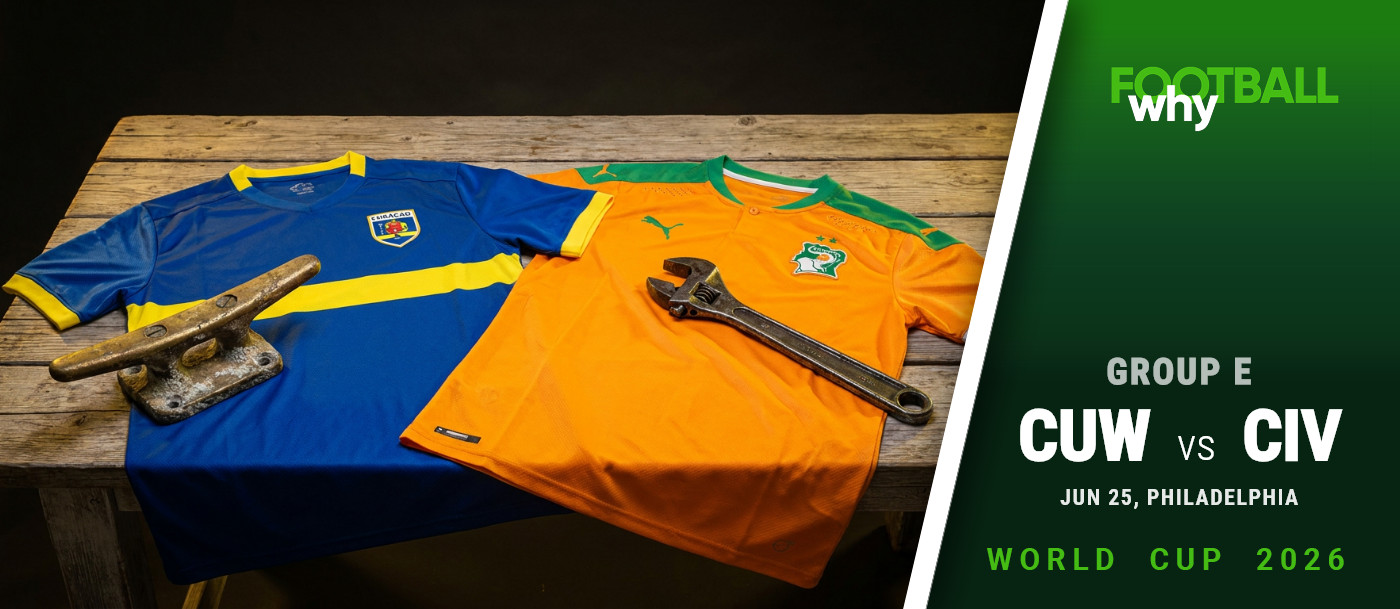
Group E, Matchday 3, Match #55
UTC

Lincoln Financial Field, Philadelphia

Prediction by whyFootball readers

CUW
DRAW
CIV
18%
25%
57%
Not a recommendation for betting
Tap [+] to cast your expert forecast.
SCORE BY AI PREDICTION: 1:2 SEE SIMULATION

Curaçao vs Côte d'Ivoire FIFA World Cup 2026 Group Stage Match Industrial rhythm against a patched coastal breakwater Forecast generated:

The thrifty resilience of a maritime outpost collides with the exuberant, unifying rhythm of the savanna. It is a contest between island survivalists hoarding their scarce energy and a proud continental force demanding total dominance through sheer, overwhelming momentum.

Curaçao: One side's prayer...

Curaçao arrive at this final group fixture nursing bruised egos following two consecutive defeats. The arithmetic for third place requires a victory, meaning the public will not stomach a passive surrender. The squad remains tightly knit under their 'La Familia' code, determined to channel their island pride into disciplined resistance. They are currently sealing the cracks in a battered hull, knowing their ageing core must endure one last punishing shift in stifling humidity without losing their structural integrity.

Côte d'Ivoire: ...head-on with the other.

Côte d'Ivoire need only a draw to secure qualification, though the public mandate demands a commanding victory to banish the lingering anxiety of past tournament collapses. The dressing room is leaning heavily into a unity-first narrative to suppress any individual egos. Sébastien Haller’s match sharpness remains a delicate balancing act, but he will start to provide a vital focal point. The team is operating like a heavy industrial piston, aiming to dictate territory and avoid the chaotic, emotional surges that typically expose their defence.
Curaçao vs Côte d'Ivoire Structural Collision

Curaçao: How we will host...

Dream
The mandate is blunt: win and salvage some dignity. The island will not tolerate a passive exit after two bruising defeats. The primary task is to keep the scoreline blank for as long as possible, waiting for the opponent to overcommit, and then striking to keep any faint third-place hopes alive.

Strength
Curaçao’s greatest asset is their Dutch-schooled defensive structure, acting as a sturdy frame against the storm. They excel at compressing space and rationing their energy, relying on a deeply ingrained, pragmatic discipline. This blue-collar resilience ensures they rarely beat themselves through careless positioning.

Plans
Dick Advocaat has prepared a trap built on patience. The plan is to invite the Ivorians to press down the right side, then suddenly switch play to target the space left behind their advancing full-back. On set-pieces, they will avoid wrestling with the towering African centre-backs, opting instead for clever, near-post flick-ons.

Fears
Their Achilles heel is their own volatile pride. If they feel disrespected or get dragged into a physical scrap, the structural discipline melts away. Players start chasing individual duels to settle scores, abandoning their shape and leaving the penalty area dangerously exposed to crosses.

Côte d'Ivoire: With what we arrive...

Dream
The objective is stark: secure qualification without any unnecessary drama. The public mandate demands authority and a complete refusal to toy with inferior opposition. They need to manage the stifling humidity, avoid silly bookings, and ensure the final twenty minutes are a procession rather than a panic.

Strength
The Ivorian engine room operates like a finely tuned industrial turbine, blending raw athleticism with elite European tactical schooling. They boast a midfield capable of dominating possession while retaining a vicious bite in transition. When synchronized, their collective pressing suffocates opponents high up the pitch.

Plans
Emerse Faé has instructed his men to ruthlessly overload the left flank, isolating the opposition right-back. Before delivering the ball into the penalty area, they must adhere to a strict 'two more passes' rule to guarantee high-quality chances. Defensively, they will assign a dedicated screener to disrupt the Caribbean set-piece specialist.

Fears
Their greatest vulnerability is a tendency to let the heart rule the head. When frustration mounts, the tactical framework often gives way to heroic individualism. Full-backs bomb forward simultaneously without cover, stretching the distances between the lines and offering vast tracts of empty grass for counter-attacks.

How it will be...

The contest should unfold as an exercise in structural rationing colliding with industrial rhythm. Côte d'Ivoire will likely monopolise the geography, treating the pitch as an expansive market to dictate terms. Observers should watch Simon Adingra’s elastic, stop-start surges on the left flank; his capacity to fracture the Caribbean defensive lattice will dictate the opening exchanges.

Curaçao’s response relies entirely on their refinery-shiftwork discipline. They conserve energy, absorbing pressure like a saturated coastal breakwater. When they do breach the Ivorian half, expect them to bypass aerial dogfights. Instead, they will seek to exploit set-piece leverage through Leandro Bacuna’s outswinging deliveries, aiming for Locadia’s near-post darts.

The fixture’s hinge point rests on mental endurance. Should Eloy Room spill a driven cross centrally — a known vulnerability under sustained duress — Franck Kessié’s predatory timing will likely punish the error. Such a concession would trigger a metabolic dip in the hosts' ranks. Watch for the Ivorians to then deploy their 'verrou' back-five, shutting the shopfront entirely. They will drop Singo inside as a third centre-half. This structural shift neutralises any late Caribbean overloads.

Curaçao: Why not go for the win?

Curaçao succumbed to the unforgiving margins of their own low-risk baseline. A single handling error from Room gifted Kessié the decisive rebound, undoing their disciplined block. Relying heavily on set-piece leverage restricted their open-play volume, while a shallow talent pool ultimately left them lacking the late transitional pace required to chase the deficit.

Côte d'Ivoire: How did they clinch it?

The visitors prevailed by ruthlessly capitalising on a singular moment of goalkeeping fragility. Kessié’s anticipation of a central parry proved decisive. Crucially, they managed their historical tendency for emotional surges, successfully deploying a late back-five shape to protect the lead. Their European-schooled positional discipline perfectly channelled their inherent physical supremacy.

Secret mastermind intent

Advocaat’s steady hand on the tiller

General Strategy
Dick Advocaat’s blueprint relies on a risk-averse, mid-low block designed to frustrate the opposition. The team will drop deep, roughly thirty yards from their own goal, prioritising the denial of central spaces over aggressive pressing.

Once possession is won, the focus shifts to immediate, wide transitions. The instruction is to bypass elaborate midfield play and release the wingers early, exploiting the flanks before the opponent can retreat and reset.
Antidote for the Opponent
A major defensive priority is starving Sébastien Haller of service. The midfield screen is tasked with stepping in front of the Ivorian striker to prevent him from acting as a wall-pass target for onrushing midfielders.

In attack, Curaçao will actively avoid launching high crosses to the back post, where the Ivorian centre-backs hold a massive physical advantage. Instead, corners will be whipped towards the near post, relying on sharp movement and flick-ons to bypass the heavy traffic.
Internal Task Solving
The squad has a pre-agreed code word for managing momentum: 'trim the sails'. When called, the entire team drops five yards and tightly closes the half-spaces for three minutes to weather any sudden surge in pressure.

Additionally, the captain will use Papiamentu during brief on-pitch huddles to reinforce the 'keep the shape' mantra, grounding the team in their shared identity when the heat rises. Pre-planned hydration pauses are also scheduled to manage the physical toll.
Crisis Response Plans
If the defensive lattice fractures early, or if Kessié repeatedly finds space on the edge of the box, Advocaat will not hesitate to alter the shape. The primary contingency is a swift shift to a 4-2-3-1, dropping an extra midfielder deep to lock down the central zone.

The bench is primed for flexibility. Should the Ivorian wingers consistently win their individual battles, Curaçao will accept an even deeper defensive line, instructing the full-backs to stay rooted and abandoning counter-attacks unless the ball is won cleanly.
Specific Match Orders
Leandro Bacuna is expected to shadow Kessié's runs when out of possession. On dead balls, he must consistently aim for Locadia at the near post, and he should avoid forcing straight, vertical passes during the opening half-hour. Eloy Room must look to bypass the press by finding the striker directly if put under severe pressure. He is instructed to slow the game down after making a save and must never parry the ball back into the central area just outside the box. Kenji Gorré needs to exploit the space behind the opposing full-back within three seconds of winning the ball. His main attacking duty is to arrive late at the far post for tap-ins rather than delivering early crosses himself.
/ What if the Ivorian wingers constantly beat their man one-on-one?

The full-back will stop overlapping entirely. The nearest central midfielder will shift across to create a two-against-one scenario out wide, while the winger on the opposite flank tucks inside to protect the central spaces. The team will simply accept a deeper block.

/ What if the team is desperately chasing a goal in the dying minutes?

The formation shifts to a 4-2-3-1, bringing on fresh, rapid wingers on both sides. A second striker is introduced to pin the defence back, and for the final eight minutes, a centre-back will be thrown forward to contest set-pieces and long balls.

Secret mastermind intent

Emerse Faé’s calculated market discipline and wide overloads

General Strategy
Emerse Faé intends to dictate the tempo through an assertive mid-high press, squeezing the play near the halfway line. It functions like a heavy industrial vice tightening on brittle glass. The team will prioritize structured possession over chaotic vertical rushes. They want to control the geography of the pitch without unnecessary risk.

He demands that his players win the ball back swiftly and launch rapid switches of play. The ultimate goal is to disorient the defensive block before it can settle.
Antidote for the Opponent
They intend to hammer a single fracture point until it shatters. Faé plans to overload the opposition's right-hand channel, creating constant three-on-two scenarios to force dangerous cutbacks. The goal is to drag the opposing full-back completely out of position.

To nullify the Caribbean dead-ball threat, a dedicated midfielder will front-screen their primary corner taker. This prevents the delivery rhythm from ever being established. By starving the set-piece specialist of clean contact, they remove the underdog's most reliable weapon.
Internal Task Solving
The squad operates with a unique cooling mechanism triggered by their captain. Following any on-pitch flare-up, the team gathers for a brief, call-and-response reset. It acts as a blown fuse resetting the electrical circuit.

When protecting a narrow lead, the bench will shout the code word 'verrou'. This instantly morphs the side into an impenetrable back five to kill the contest. It is a pre-planned manual override to prevent late-game chaos.
Crisis Response Plans
Should the game state deteriorate, the manager is prepared to introduce explosive pace on the hour mark to stretch tired legs. If they concede early, the strict instruction is to maintain a two-plus-one defensive base.

The bench will absolutely forbid simultaneous full-back overlaps during a crisis. They will not panic or throw men forward recklessly. The system is trusted to generate equalisers through sustained, methodical pressure rather than emotional surges.
Specific Match Orders
Ibrahim Sangaré is instructed to firmly shade the opposing playmaker's corridor during settled defensive phases. He must screen the central zone on all restarts and is strictly forbidden from chasing wide players down the touchline. Sébastien Haller must ensure his first action is a wall-pass to release the advancing central midfielders. When early crosses arrive from the left wing, he is expected to attack the front post aggressively to pin the centre-backs. Ghislain Konan is only permitted to overlap when he has visual confirmation of midfield cover behind him. Otherwise, he must hold his position and bait the opposition into attempting a diagonal pass before jumping the lane.
/ What if the opposition deploy a rigid back five from the first whistle?

The right winger will invert to act as a second central playmaker, while the box-to-box midfielder pushes higher between the lines. The left-back will only overlap when the ball is switched to his side, ensuring the defensive base remains securely locked beneath him at all times.

/ What if the opponents repeatedly launch counter-attacks behind the right-back?

The right-back will immediately drop his starting position five yards deeper to manage the space in behind. If the bleeding continues, the formation will pivot to a back three, tucking the defender inside as a right-sided centre-half while maintaining a high winger to threaten the counter.

MAIN SIMULATION 0'-25'

Côte d'Ivoire will likely set up shop on the left flank, using Adingra to pin Gaari and tilt Curaçao’s defensive block. It resembles a steady drip on corroded pipework. The Ivorians maintain their discipline to avoid rushed crosses. Konan eventually finds the exact angle to deliver a near-post ball for Haller to glance home. Curaçao’s deep shape absorbs the initial probes well enough. However, a quick switch of play exposes the late-arriving far winger and breaks their resistance early.

MAIN SIMULATION 25'-45'

Curaçao will likely drag the game into the mud, compressing space as Côte d'Ivoire delay their final passes. The hosts find joy with a sharp diagonal to Gorré, serving as a warning shot. Shortly after, they level the score through set-piece leverage. Leandro Bacuna whips an outswinger for Locadia to flick home at the near post. This equalizer forces Kessié to call a team huddle, resetting the visitors' tempo to avoid an emotional unravelling.

MAIN SIMULATION 45'-65'

The visitors adjust their shape, inverting Amad and pushing Kessié higher to suffocate the ball. It is a ruthless tightening of the bureaucratic screws. Room is forced into a low parry from an Adingra cutback. Kessié arrives perfectly to drive the rebound into the net. Curaçao immediately suffer a ten-minute drop in execution quality due to fatigue and shock. They attempt to rotate their wingers to reopen passing lanes, but Kossounou dominates the defensive duels.

MAIN SIMULATION 65'-90'

Curaçao abandon caution, switching to a 4-2-3-1 with double wide pace to chase the game. Côte d'Ivoire respond by dropping the shutters. They shift into a 5-3-2 shape at the 78th minute, deploying Singo as a third centre-back. The hosts manage one premium look when Chong’s delivery finds Locadia, but the shot is smothered. The final exchanges are frantic but fruitless. The Ivorian defensive block holds firm against a barrage of desperate, late crosses.

And it will come to...

Should this scenario unfold, Côte d'Ivoire’s potent blend of physical power and European-schooled structure would ultimately survive the group-stage nerves. Curaçao would likely mount a spirited, disciplined resistance, relying heavily on set-piece leverage to unsettle the favourites. However, their low-risk baseline would severely limit their open-play shot volume. The match would be decided by fine margins and momentary lapses. Kessié’s clinical timing to punish a single goalkeeping error would prove the decisive difference against a tiring island defence.
end of Game