

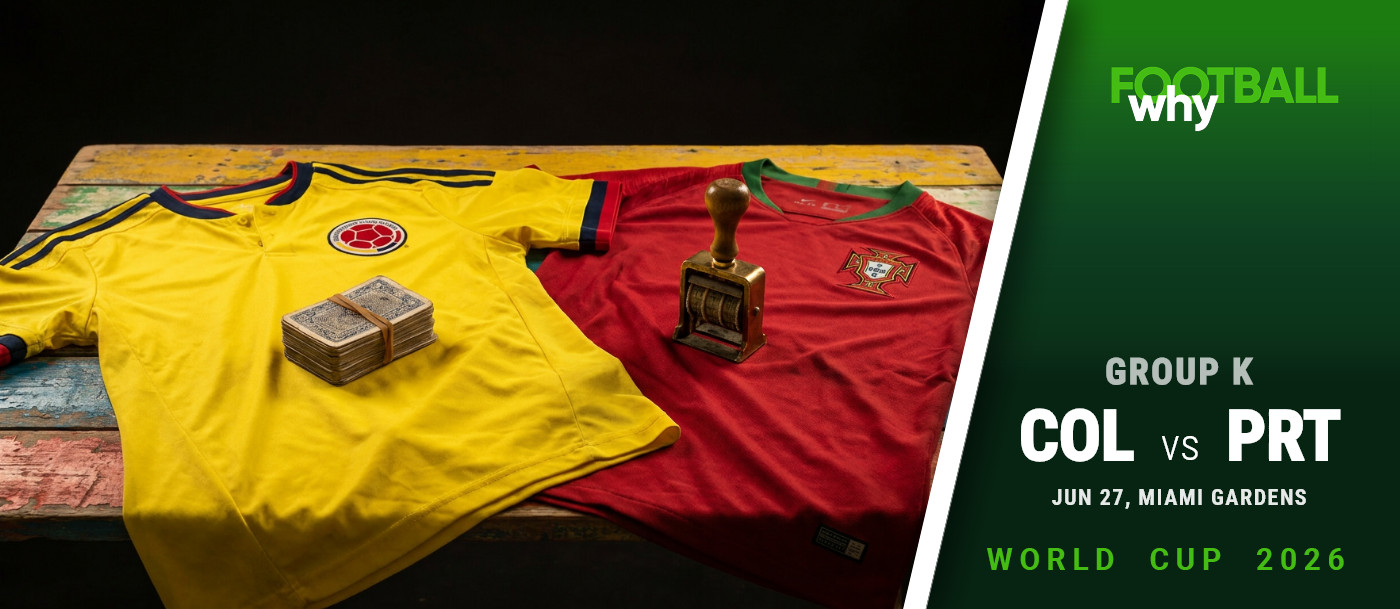
The World Cup Qualification Decider
Saturday, 27 June

Hard Rock Stadium, Miami-gardens

Colombia vs Portugal FIFA World Cup 2026 Group Stage Match Sweat, ledgers, and a cruel geometric silence Forecast generated:

Twenty-four Colombian shots crashed against a European side determined to treat the match like a mundane filing exercise. Discover how Diogo Costa's six saves and a microscopic VAR ruling cemented the most exhausting nil-nil draw imaginable.
Colombia vs Portugal Structural Collision

What was it?

Miami's humidity hung in the air like damp wool. Twenty-four yellow-shirted surges crashed forward, desperate to force an issue. Red-shirted defenders simply absorbed the impact, retreating step by step with the dull routine of filing paperwork.

Colombia registered twenty-four shots and an expected goals tally of 1.63. Portugal managed just thirteen efforts. Diogo Costa recorded six saves without spilling a single rebound.

Roberto Martínez intervened at half-time to kill the tempo. He swapped João Cancelo for Diogo Dalot to lock down the right flank. At seventy minutes, Samú Costa arrived to bolt the midfield shut.

The European side processed the clock as if auditing a ledger. They refused to overextend in the heat. James Rodríguez orchestrated the South American pressure until his lungs gave out at the seventy-sixth minute.

The climax arrived in stoppage time. Davinson Sánchez bundled a cross into the back post. The stadium erupted in pure, unadulterated relief.

It lasted seconds. A video review traced a digital line across the grass and ruled the striker fractionally offside. The crowd paid for a spectacle, but received a lesson in cruel, geometric compliance.

Why stopped just short of victory?

Colombia

Colombia failed to secure a victory because their immense physical exertion lacked a surgical focal point. The late structural shift to a 4-2-3-1 sustained territorial dominance, yet it ultimately thinned out their presence inside the Portuguese penalty area.

They relied heavily on isolating their wingers to stretch the opponent's shape. However, the rotation of their central strikers provided relentless running rather than cold, efficient finishing.

The intense heat and a fiercely partisan crowd amplified these traits, pushing the players into a frenetic tempo that occasionally blurred their tactical decision-making in the final third.

This highlights a recurring generational vulnerability. The squad remains utterly dependent on a single playmaking hub to translate wide possession into central danger.

When that creator reaches his physical limit, the attacking structure often devolves into hopeful, predictable patterns. The wingers push too far inside, and the fullbacks overextend without a reliable target to hit.

Beneath this lies a deep-rooted systemic trait. The national academies prioritize street-futsal ball mastery and individual flair, producing world-class dribblers who thrive on emotional surges and collective rhythm.

Yet, this developmental pathway frequently neglects the unglamorous, brutal mechanics of elite penalty-box poaching. The footballing culture demands aesthetic joy and expressive connection, sometimes at the expense of ruthless tournament pragmatism.

They constructed a magnificent, intricate scaffold, but arrived at the site without the final nail.

Why stopped just short of victory?

Portugal

Portugal accepted a scoreless draw because their coaching staff prioritized structural preservation over the chaotic pursuit of victory. The halftime decision to swap fullbacks immediately signaled an intent to manage risk rather than exploit transitional spaces.

By introducing a conservative double pivot late in the game, the side deliberately capped their own crossing volume. They kept their veteran striker anchored in the box, utilizing his sheer gravitational pull to occupy defenders rather than serving him dynamic chances.

This tactical restraint reflects a broader tension within the current squad. Despite possessing a roster brimming with elite, seasoned technicians, the team frequently defaults to a risk-averse shell when placed under environmental or emotional stress.

They prefer to navigate matches through quiet, procedural control. Rather than engaging in an open, end-to-end exchange, they slow the tempo and rely on positional intelligence to weather the storm.

This stems from a deeply ingrained systemic identity. Portuguese academies excel at producing highly tactical, multi-positional thinkers who value ball security and collective consensus above individual anarchy.

The fear of losing their technical elegance often leads to a sterile over-management of the attacking phases. They would rather draw a match through flawless administrative procedure than win it through undignified brawling.

They plotted a perfectly safe maritime route, but deliberately left the cargo behind.

Match hero...

James Rodríguez
James Rodríguez operated like a seasoned fixer navigating a crowded street market. He deliberately sacrificed raw sprinting to preserve his seventy-six-minute physical window, finding quiet pockets of space behind the Portuguese midfield. By reading the shifting defensive strata, his left foot bypassed formal tactical structures to deliver key passes. He didn't force the tempo; he waited for the right relational connection to open, proving that true authority in the final third comes from human timing rather than sheer athletic volume.

...and one more

Diogo Costa
Diogo Costa approached the barrage of shots with the quiet diligence of a harbourmaster securing moorings before a sudden gale. He swallowed rebounds instantly, eliminating the chaotic second phases that the South Americans thrive upon. His positioning relied on Atlantic prudence — anticipating the trajectory of danger and moving early to intercept it without theatrical dives. He conserved his energy and his team’s structural dignity, turning near-certain concessions into mundane administrative tasks.