

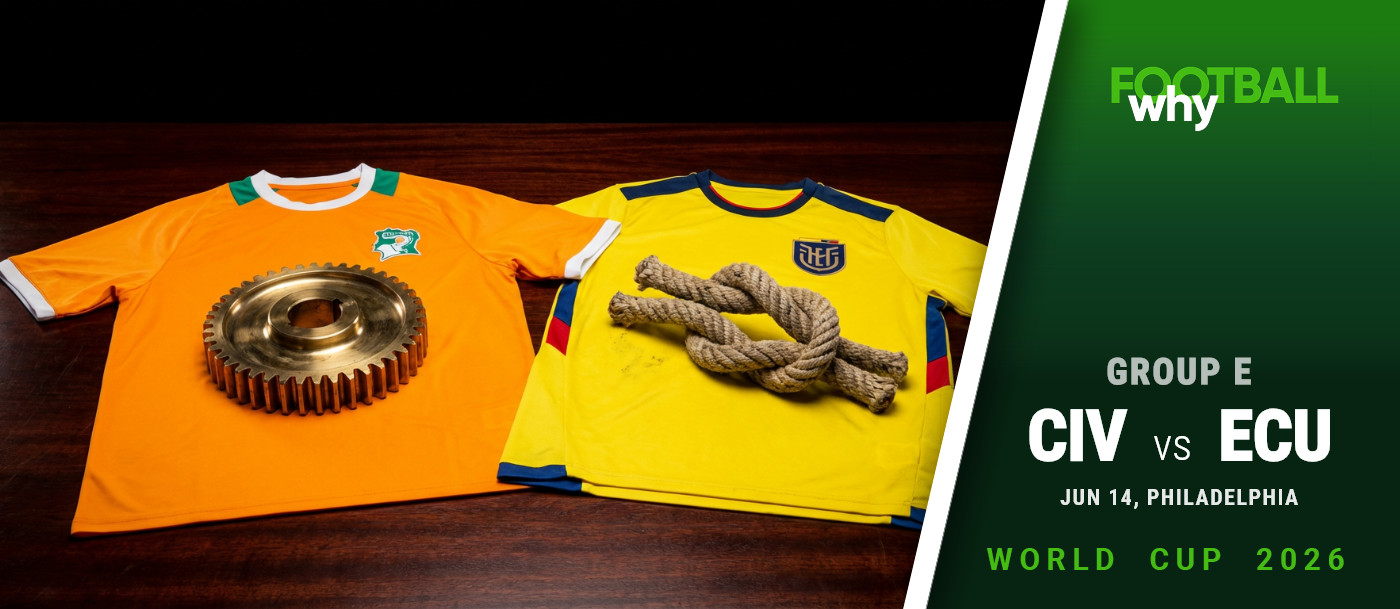
Group E, Matchday 1, Match #9
UTC

Lincoln Financial Field, Philadelphia

Prediction by whyFootball readers

CIV
DRAW
ECU
37%
31%
32%
Not a recommendation for betting
Tap [+] to cast your expert forecast.
SCORE BY AI PREDICTION: 1:1 SEE SIMULATION

Côte d'Ivoire vs Ecuador FIFA World Cup 2026 Group Stage Match A heavy tarmac roller stalling on the barricades Forecast generated:

The fervour of the savanna collides with resilience forged in the cordillera. A dispute between celebratory improvisation and unyielding communal duty. When tribal pride meets Andean stoicism, the turf will endure a clash of irrepressible lineages.

Côte d'Ivoire: One side's prayer...

Côte d'Ivoire arrive burdened by the expectation to project national unity through sheer physical dominance. In a group overshadowed by Germany, securing early points is a non-negotiable mandate. The engine room requires careful monitoring; Franck Kessié is operating on a strict minute-cap, and the absence of Evan Ndicka forces a hasty reshuffle at the back. The public demands a steamroller, but the manager must carefully bleed the radiator to prevent the system from boiling over under the Abidjan-fuelled pressure.

Ecuador: ...head-on with the other.

Ecuador approach this fixture with the stoic siege mentality of a village bracing for a harsh winter. Survival in a treacherous group depends on their collective minga — a shared, unglamorous defensive duty. Preparations have been meticulous but fraught; veteran talisman Enner Valencia is having his minutes strictly rationed, while Piero Hincapié is being carefully reintegrated into the backline after a late arrival. The diaspora crowd expects a blood-and-thunder shift, demanding the players lay down sandbags before dreaming of victory.
Côte d'Ivoire vs Ecuador Structural Collision

Côte d'Ivoire: How we will host...

Dream
Starting with points is the bare minimum. In a group overshadowed by Germany, a win lays the foundation, but a draw is acceptable if the team shows grit. The crowd demands front-foot intensity and visible unity, tolerating risks only if they stem from genuine courage.

Strength
Their core power lies in a robust midfield platform combined with relentless collective pressing. They rely on European-honed technique and raw athleticism, using Kessié and Fofana to dictate the tempo. This allows them to control possession without losing their bite in the transition.

Plans
The strategy focuses on wide, wing-led thrusts to bypass the central traffic. They plan to exploit the space behind Estupiñán, using Adingra's pace to stretch the play. Defensively, the priority is to cast a permanent shadow over Kendry Páez, starving Ecuador's main creative outlet of the ball.

Fears
Late-game anxiety remains their Achilles' heel. When the stadium roars for a hero, the tactical structure often frays. The urge to please the crowd can lead to rushed decisions, leaving the defence exposed to quick counter-attacks. Keeping their heads when the pressure spikes is the manager's primary concern.

Ecuador: With what we arrive...

Dream
A pragmatic point is the absolute baseline here. Snatching a gritty, one-nil smash-and-grab against the group's athletic heavyweights would be viewed as a masterstroke. The diaspora crowd expects a stoic, unified shift, valuing a clean sheet just as highly as a chaotic victory.

Strength
Their bedrock is a European-forged defensive wall, anchored by an elite ball-winning midfielder. They operate on a deeply ingrained communal work ethic — a collective 'minga' where every player mans the barricades. They do not need to monopolise possession to dictate the emotional temperature of the match.

Plans
The blueprint relies on surgical, direct strikes into the wide channels. They intend to bypass the midfield scrap entirely, launching early balls into the pockets vacated by advancing opposition full-backs. Defensively, the mandate is to shepherd the attackers wide and lock down the central zones with disciplined cover shadows.

Fears
A historical anxiety over goal-scoring lingers heavily over the camp. When the pressure mounts, their rigid structure can fray into rushed clearances and cheap fouls on the edge of their own box. The over-reliance on a single veteran striker to convert scarce chances remains a glaring vulnerability that the manager must carefully navigate.

How it will be...

The contest suggests a dense, unyielding standoff, a tailoring job where the needles prick but never quite draw blood. Côte d'Ivoire will likely impose a physical, rhythmic swell, looking to suffocate the flanks. Ecuador will counter with their communal 'minga', a sturdy defensive weave where no player shirks the heavy lifting.

The Ivorian script demands raw muscular exertion. Kessié and Fofana will patrol the edge of the box, waiting to capitalise on a loose rebound. Should the Ivorian captain’s lungs withstand the ticking clock, his late arrival into the six-yard box could shatter any padlock.

The South American vulnerability lies in sheer fatigue. If the barrage of low crosses exhausts the patience of the Ecuadorian block, the seams will tear. Galíndez, their custodian, must banish any indecision; a parry back into the central corridor is an invitation to the gallows.

The stadium will witness a collision of dogmas. The African audacity, buoyed by the murmur of their congregation, will strike against Andean stoicism. If the South Americans weather the initial squall and convert a dead-ball, the hosts' stage-fright will surface. Both contingents will sweat through the fabric until the final whistle, refusing to yield.

Côte d'Ivoire: Just short of victory

Urgency clouded their radar. They gifted a goal from a rehearsed corner and required a punishing volume of low crosses just to draw level. Missing a first-choice centre-back fractured their defensive assurance. That chronic lack of cynicism to kill off tight fixtures remains their historical burden.

Ecuador: Just short of victory

The oxygen tank ran dry near the shore. Preciado’s early booking severed their right-sided ambition. They absorbed the Ivorian siege until the seams split under the repetitive strain of wide overloads. Their heavy reliance on set-pieces ultimately mortgaged their attacking output.

Secret mastermind intent

Faé’s heavy tarmac for the midfield engine

General Strategy
The primary objective is to establish control without taking unnecessary risks early on. The team will sit in a mid-high block, triggering their press only when the opposition plays backward or square.

In possession, the focus is on moving the ball quickly to the flanks. The midfield must hold their ground, acting as a solid base to release the wingers. They want to manufacture low cutbacks into the box rather than floating hopeful crosses.
Antidote for the Opponent
To stifle Ecuador, the midfield has strict orders to block passing lanes into Kendry Páez. The nearest central midfielder will act as a permanent screen, forcing the opposition to play wide.

Going forward, the plan targets the left side of Ecuador's defence. The wingers are instructed to attack the space behind Estupiñán the moment he steps up. They want to isolate the full-backs and hit them with quick diagonal switches.
Internal Task Solving
The absence of Ndicka forces a reshuffle at the back. This means the full-backs must temper their attacking runs, ensuring the defence isn't left exposed during transitions.

Franck Kessié's fitness is another major consideration. His minutes and sprint load are capped. If he pushes too hard, he is instructed to sit deeper alongside Sangaré for a few minutes to recover his breath and restabilise the midfield spacing.
Crisis Response Plans
If Ecuador's high press starts choking the midfield, the team will flatten into a clear double pivot. Sangaré and Kessié will drop deeper to bypass the first line of pressure with long diagonals to the opposite winger.

For other breakdowns, the manager demands a flexible, pragmatic approach. If the game descends into chaos, the captain is expected to call a huddle, slow the tempo, and reset the shape before launching another attack.
Specific Match Orders
Wilfried Singo: Tuck inside to form a back three the moment the left-back pushes forward. Do not overlap at the same time. Keep the back door firmly shut. Ousmane Diomandé: Hold your ground. Do not step forward to meet Valencia when he runs the channel. Delay him, shepherd him wide, and make sure the central zone is clear for crosses. Simon Adingra: Attack the space behind the left-back on your first touch. When we lose the ball, track him all the way back to our defensive third without exception.
/ What if a sudden goal sparks panic?

Immediately freeze the full-backs and drop into a rigid defensive shape. Complete six to eight safe passes to calm the nerves before attempting to attack the wings again. The priority is to re-establish control, not chase the game blindly.

/ What if the crowd demands a solo hero?

If the players start ignoring the structure to chase glory, the tempo must be killed. The captain will drop deeper to dictate short passes, and a quick on-pitch huddle will be called to remind everyone of the game plan.

Secret mastermind intent

Sánchez Bas and the collective picket line

General Strategy
The overarching strategy is a stubborn, low-risk containment job. The side will drop into a compact mid-block, refusing to engage in full-pitch footraces.

Possession is strictly secondary. Upon winning the ball, the immediate instinct is a vertical release into the flanks to stretch the play. They will trust in athletic, timed surges rather than intricate central combinations.
Antidote for the Opponent
To neutralise the Ivorian engine room, the defensive anchor will position his body to physically obscure the passing lanes to their box-to-box runners.

Out wide, the plan involves doubling up on the wingers early and forcing them toward the touchline. The penalty area will be strictly cordoned off, with the near-post zone heavily fortified against low deliveries.
Internal Task Solving
The veteran centre-forward’s legs are being managed with extreme precision. His minutes are strictly capped to ensure he remains a potent trigger for the initial press before fatigue sets in.

Meanwhile, the left-sided centre-back has been warned to curb his natural instinct to carry the ball forward. He must prioritise the defensive seam over attacking ambition during the early, volatile exchanges.
Crisis Response Plans
Should the opposition's high press suffocate the short passing game, the goalkeeper is instructed to bypass the danger entirely with clipped balls into the right channel.

Alternatively, the manager has prepared a five-minute 'fake press' to deploy after hydration breaks. This aims to temporarily rattle the opposing defenders and disrupt their rhythm before the team retreats to safety.
Specific Match Orders
Enner Valencia: Stay pinned high between the centre-halves and resist the urge to drop deep for touches. Keep your powder dry for near-post runs and lead the very first wave of the press. Pervis Estupiñán: Only advance when the attacking midfielders are safely tucked in behind the ball. If the winger isolates you, delay the engagement and force him down the outside. Moisés Caicedo: Angle your first touch to shut down the opponent's inside running lane. Concede absolutely no cheap fouls in the central zone. Keep communicating with the number eight regarding defensive cover.
/ What if the defensive shape tears open?

Immediately drop into a flat 4-4-2 survival shell. Accept taking a tactical foul in the wide areas to stop the bleeding, but under no circumstances concede a free-kick in the central 'D'. Regroup and re-establish the defensive line.

/ What if the right winger gets suffocated?

Swap the wide men instantly. Bring the inverted winger over to the opposite flank to attack the full-back's weaker shoulder. Force the defender to deal with unpredictable, inside-cutting runs to break the stalemate.

MAIN SIMULATION 0'-25'

Côte d'Ivoire start by pushing their wingers high, trying to pin Ecuador’s full-backs and force cutbacks. Ecuador bypass the midfield traffic entirely. They clip passes out to the right flank to skip the press. Adingra tests the space behind Estupiñán early on, but Caicedo shuts the door. It becomes a tactical gridlock. Ecuador manage to win a pre-planned corner around the 18-minute mark, but it yields nothing.

MAIN SIMULATION 25'-45'

The Ivorians flatten their midfield pivot to bypass Caicedo's shadow. This allows them to switch the play much faster. A yellow card for Preciado on 27 minutes acts as a handbrake on Ecuador's right-sided attacks. Côte d'Ivoire exploit this caution immediately. Konan finds Seko Fofana for a shot on 31 minutes, but the resulting rebound is smothered. Ecuador respond with a measured counter, ensuring the half ends in a tight stalemate.

MAIN SIMULATION 45'-65'

Ecuador settle into a deeper, disciplined block, relying on set-pieces to break the deadlock. This pays off on 58 minutes. A rehearsed corner routine sees Torres flick the ball on, allowing Hincapié to bundle it home at the back post. A real sucker punch. Côte d'Ivoire immediately freeze their full-backs and reset their structure. They begin funnelling the ball wide again, but their initial response lacks precision.

MAIN SIMULATION 65'-90'

Côte d'Ivoire commit their numbers forward to overload the attacking line. Ecuador respond by sinking into a back five. The pressure finally tells. Galíndez parries a central strike back into the danger zone on 73 minutes. Shortly after, Kessié arrives late in the box to slot home the equaliser. The final exchanges become chaotic as both sides tire. Ecuador defend the draw grimly, absorbing the late pressure without breaking entirely.

And it will come to...

If the match unfolds as projected, we would witness a fascinating clash of endurance. Côte d'Ivoire would likely dictate the width, relying on their athletic superiority to force openings. Ecuador, however, would absorb this pressure, waiting to strike through a meticulously planned set-piece. The Africans would be forced to abandon their structural caution, throwing their captain forward to salvage a result. Ultimately, the raw physical attrition from repeated wide attacks would fracture the South American block just enough to force a gritty, hard-earned stalemate.
end of Game