

The World Cup Qualification Decider
Tuesday, 7 July

BC Place, Vancouver

Switzerland vs Colombia FIFA World Cup 2026 Group Stage Match Forty-three fouls and a stuttering, goalless grind Forecast generated:

What happens when frantic South American hustle collides with a Swiss health and safety audit? After 120 goalless minutes and a staggering 43 fouls, find out how cold procedural discipline finally broke the deadlock.
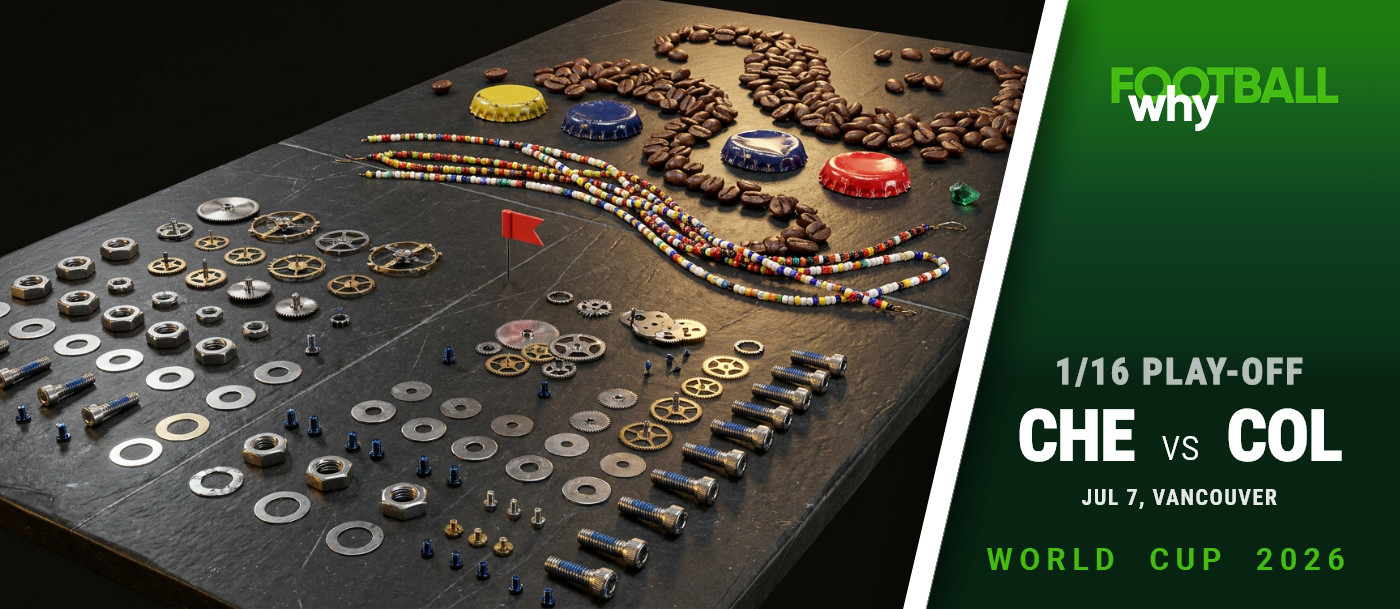
Switzerland vs Colombia Structural Collision

What was it?

Forty-three separate fouls fractured the evening in Vancouver into a relentless, stuttering rhythm. The South Americans buzzed across the turf as if fleeing a sudden blaze, accumulating fifteen shots and a 1.09 expected goals tally. Yet they never truly threatened to burn anything down.

Their European opponents simply absorbed the heat. Murat Yakin’s squad generated a microscopic 0.39 expected goals over two hours. They sacrificed width and ambition to sit deep, crowding the central lanes and daring the opposition to cross.

Anyone skipping the broadcast missed an absolute slog of attritional midfield wrestling. The absence of Jhon Córdoba left the Colombians whipping crosses toward a penalty area entirely locked down by Manuel Akanji.

Extra time briefly threatened to break the deadlock. Jhon Lucumí rattled the crossbar from a corner, and Jaminton Campaz dragged a clean one-on-one wide in the 116th minute.

It inevitably dragged into a penalty shootout. Gregor Kobel palmed away Cucho Hernández’s effort, Rubén Vargas converted the decider, and a triumph of cold procedural discipline finally put everyone out of their misery.

Why stopped just short of victory?

Switzerland

Switzerland advanced because they actively engineered a stalemate, treating possession as a defensive tool rather than an attacking weapon.

The decision to deploy Denis Zakaria at right-back preemptively locked down the flank against inverted wingers.

When the midfield required further stability, the halftime introduction of a second controller clamped the double pivot shut and deliberately starved the game of oxygen.

Granit Xhaka orchestrated this containment, managing the tempo to ensure the defensive lines never stretched beyond their designated limits.

This extreme risk aversion masks a glaring structural ceiling within the squad. Without a dominant centre-forward, their attacking patterns rely entirely on rehearsed sequences.

If the rehearsed width fails to penetrate early, the squad simply retreats into their shape rather than improvising.

It reflects a domestic academy system that prioritizes tactical literacy and collective consensus over individual flair.

Swiss youth development teaches players to view unsanctioned risks as a breach of protocol.

The production line consistently yields elite goalkeepers and disciplined midfielders, but routinely filters out the erratic mavericks needed to break open a tight contest.

They advanced because they treated the match as a hazardous worksite, meticulously taping over the exposed wires until the opponent short-circuited in the shootout.

Why stopped just short of victory?

Colombia

Colombia stumbled because their attacking volume lacked a functional focal point to anchor the final third.

Missing their primary target man, they were forced to rely on vertical runs and wide deliveries that repeatedly crashed into a perfectly set defence.

The necessity to withdraw their veteran playmaker early due to humidity severely fractured the creative hub.

Consequently, the wingers found themselves over-touching the ball, attempting to force lateral workarounds when the central channels clogged.

Under stress, the team's structural discipline rapidly degrades. Fullbacks push too high out of sheer enthusiasm, leaving central defenders exposed to transition footraces.

This spatial disconnect explains the sheer volume of tactical fouls the backline required to survive the ensuing counter-attacks.

This points to a chronic developmental gap in the national setup. The domestic schools prize futsal-style street skills and individual bravado.

While this produces exceptional wide dribblers, the system struggles to generate a reliable succession of disciplined centre-forwards or cohesive defensive units.

When frustration sets in, the collective shape dissolves into a series of isolated, emotional individual battles.

They ultimately exhausted themselves hammering against a reinforced shopfront, unable to realise the locks could not be picked by sheer willpower alone.

Match hero...

Gregor Kobel
Gregor Kobel operated as the ultimate liability buffer for Switzerland. Whenever the defensive grid buckled under South American pressure, he did not resort to theatrical dives; he simply executed the emergency protocol, claiming high balls with deadpan efficiency. This stems from a national goalkeeping curriculum that values positional redundancy over reflex heroics. He stood in the goalmouth like a well-audited safety valve, absorbing the chaos without a flicker of panic to eventually smother the shootout.

...and one more

Luis Díaz
Luis Díaz embodied the relentless hustle on the left flank. He continuously dragged two markers into the corner, probing for a side-channel when the main routes were blocked. His ability to absorb physical punishment and still force his way through tight spaces kept Colombia breathing. This is the streetwise cunning of a player raised on uneven pitches, where dropping a shoulder and inviting contact is the only way to negotiate space. He scrapped against a rigid system until the very end.