

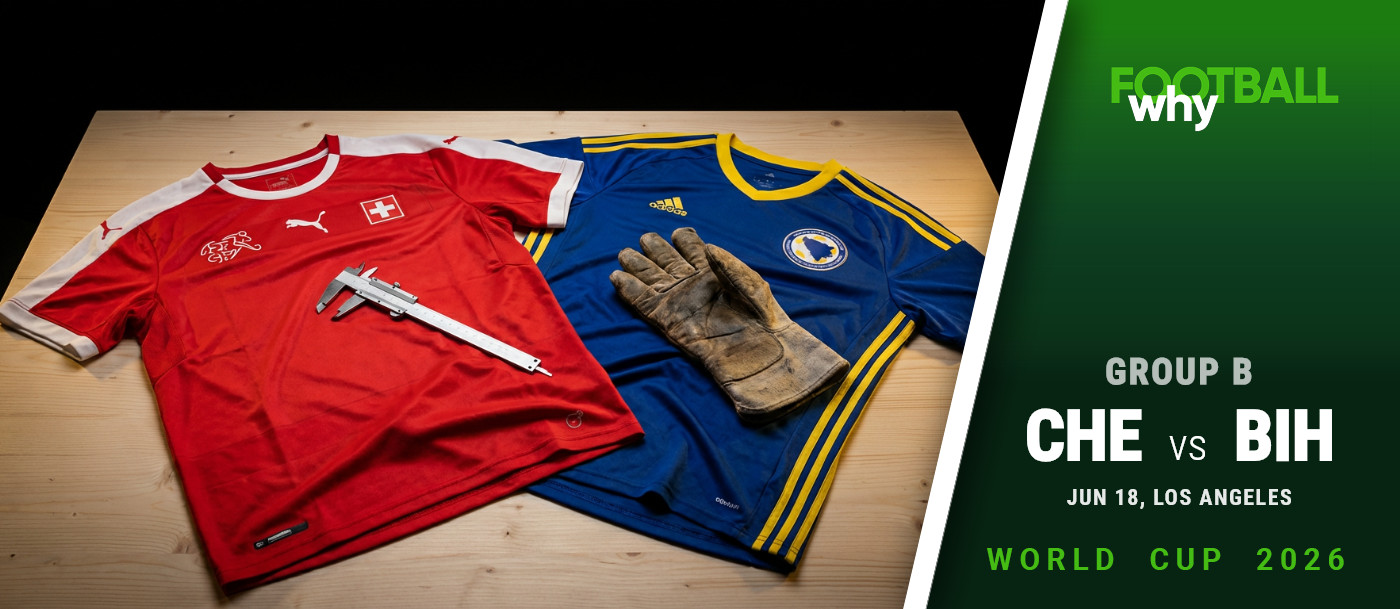
The World Cup Qualification Decider
Thursday, 18 June

SoFi Stadium, Los-angeles

Switzerland vs Bosnia and Herzegovina FIFA World Cup 2026 Group Stage Match Seventy minutes of bureaucracy, twenty of collapse Forecast generated:

Seventy minutes of sterile, bureaucratic passing instantly gave way to a frantic sorting-office scramble. Discover how a late red card and smart substitutions turned a tedious Swiss stalemate into a ruthless 4-1 demolition.
Switzerland vs Bosnia and Herzegovina Structural Collision

What was it?

The afternoon began as an exercise in claustrophobic friction. For over an hour, the pitch resembled a delayed commuter platform: heavy sighs, lateral shuffling, and a stubborn refusal to move forward. The Swiss hoarded 62 percent of possession with bureaucratic indifference. They probed a compact Bosnian block without ever threatening to puncture it.

Anyone tuning in late missed absolutely nothing of substance, saving themselves from a masterclass in risk aversion. The anomaly, however, lay in Murat Yakin’s back pocket. At 71 minutes, he introduced Johan Manzambi and Rubén Vargas, injecting immediate width into a previously narrow system. Three minutes later, Manzambi capitalised on a second-phase rebound.

The structural collapse was brutally swift. Deprived of Edin Džeko’s focal point up top, the Balkan rearguard fractured. Tarik Muharemović tripped Breel Embolo on the edge of the box at 80 minutes, earning a straight red.

Down to ten men, the remaining resistance dissolved into a chaotic sorting-office floor of lost markers. Vargas and Manzambi added two more in rapid succession. Even a scrappy 93rd-minute consolation from Ermin Mahmić couldn't mask the reality. Granit Xhaka’s 97th-minute penalty sealed a 4-1 scoreline, a hilariously inflated reflection of a deeply cynical, beautifully calibrated war of attrition.

How did they clinch it?

Switzerland

Switzerland won because their fundamental aversion to risk operates as a slow-acting poison on their opponents. They approach a football pitch not as a theatre for expression, but as an environment to be rigorously stress-tested and controlled.

The initial narrow formation was entirely deliberate. By refusing to force early vertical passes, they circulated possession laterally, forcing the Bosnian block to constantly shift and adjust. This wasn't attacking intent; it was an investment in the opponent's eventual physical bankruptcy.

The decisive substitutions leveraged this exact exhaustion. By introducing natural width only after the hour mark, they altered the geometry of the pitch against defenders who no longer had the lactic capacity to close down the newly opened spaces.

This method stems directly from a domestic academy system that prioritises positional fidelity over individual flair. Players are taught from a young age that the collective structure is a safety net. You do not improvise; you wait for the system to generate the numerical advantage.

Such a mature, collective mindset prevents panic when the score remains level late into the game. They trust the procedural timeline, knowing that the tactical blueprint is designed to yield results against fatigued minds and heavy legs.

It is the triumph of the well-funded insurance policy: eventually, the actuarial tables simply grind the opposition into dust.

Why not go for the win?

Bosnia and Herzegovina

Bosnia collapsed because their tactical resilience is tethered entirely to emotional endurance, a resource that depletes rapidly under sustained duress. They survived the opening hour by dragging the contest into a physical, combative space, relying on sheer defiance to maintain their shape.

However, the lack of a reliable mechanism to retain the ball exposed a fatal flaw in their defensive strategy. Without a focal point to secure direct clearances and buy time, the pressure became a relentless, cyclical wave. The defence was forced into repeated, desperate interventions without any respite.

This reliance on a few key veterans to manage the emotional temperature points to a broader generational vulnerability. When the primary leaders are removed or overwhelmed, the supporting cast struggles to navigate the resulting chaos, leading to rash, individualistic decisions under pressure.

Underneath this lies a fragmented developmental infrastructure. The disparity between raw, diaspora-honed talent and the lack of cohesive, domestic tactical schooling creates a team that plays in intense bursts but struggles to manage the quiet, attritional phases of a match.

The late red card was not merely an accident, but the inevitable snapping point of a system forced to operate constantly in the red zone without a cooling mechanism.

A defensive wall built on stubborn pride inevitably crumbles when you remove the mortar of possession.

Match hero...

Johan Manzambi
Johan Manzambi did not arrive to save the day; he arrived to execute a pre-approved cantonal directive. His late brace was the forensic extraction of value from a tiring opponent, capitalising on second-phase rebounds with the cold efficiency of an auditor finding a spreadsheet discrepancy. Yakin unleashed him precisely when the Bosnian lungs began to fail. Manzambi simply followed the structural blueprint, turning the messy, chaotic air around the penalty spot into a highly regulated, predictable outcome.

...and one more

Edin Džeko
Edin Džeko absorbed the physical toll of an entire nation until his legs gave out. His role was less about scoring and more about acting as a human shock-absorber, taking the brunt of the heavy midfield sludge to give his teammates a momentary breath. He leveraged decades of muscle memory to win cheap fouls and hold up aimless clearances. When he finally retreated to the bench, the entire defensive scaffolding, lacking its central load-bearing weight, immediately buckled under the pressure.