

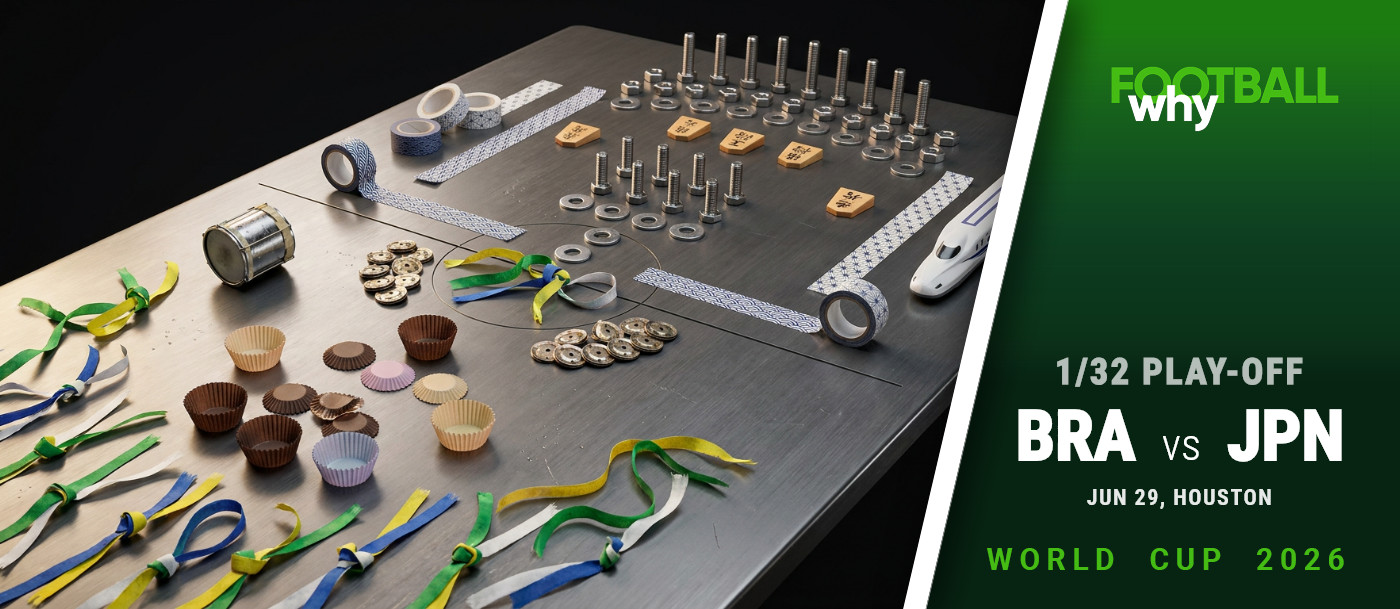
Round of 32 (B), Match #76
UTC

NRG Stadium, Houston

Prediction by whyFootball readers

BRA
DRAW
JPN
68%
0%
32%
Not a recommendation for betting
Tap [+] to cast your expert forecast.
SCORE BY AI PREDICTION: 2:0 SEE SIMULATION

Brazil vs Japan FIFA World Cup 2026 Group Stage Match A Heavy Velvet Rope Chokes the Assembly Line Forecast generated:

The cunning street-hustle, now fitted with a tailored European suit, meets the quiet, unwavering endurance of the craftsman's workshop. It is a collision of joyful, improvised problem-solving and the relentless, stoic pursuit of collective harmony. A true clash of fundamental philosophies.

Brazil: One side's prayer...

Brazil enter the knockout stages carrying the heavy expectation of effortless dominance. They are attempting to channel their natural, syncopated rhythm through a rigid European scaffold to avoid early elimination. Raphinha is missing due to a hamstring strain, forcing a reshuffle on the right flank. Neymar is available but his minutes are strictly managed following calf issues. The public demands a spectacle, yet recent tournament scars have instilled a deep craving for structural security.

Japan: ...head-on with the other.

Japan arrive in the knockout rounds carrying the quiet ambition of a squad determined to upset the traditional hierarchy. They view this fixture not as a glamorous exhibition, but as a structural stress-test. They suffered a major blow with the withdrawal of captain Wataru Endo due to an ankle injury. The national expectation remains grounded in stoic endurance rather than arrogant entitlement. The squad is emotionally steady, fully prepared to absorb sustained pressure and strike.
Brazil vs Japan Structural Collision

Brazil: How we will host...

Dream
To navigate this tie within ninety minutes, avoiding the draughty corridors of extra time. The public demands authority and control, not a chaotic end-to-end spectacle.

Strength
They possess an elite diaspora of talent, marrying street-schooled improvisation with European positional discipline. It is a stately home built on solid foundations. Individual flair is licensed, but only within a strict tactical framework.

Plans
The manager intends to launch a fierce high press early on to rattle the opposition's build-up. If that fails, they will settle into a measured rhythm. They will overload the left flank to isolate their star winger.

Fears
Their primary anxiety is the match devolving into a track meet. If the tempo spikes and the lines stretch, their right flank becomes vulnerable to rapid counter-attacks, exposing a lingering fragility.

Japan: With what we arrive...

Dream
To drag this fixture deep into the final minutes with the scoreline utterly unbothered. They want a low-volatility affair, protecting their penalty area like a parish council guarding its minutes.

Strength
They are defined by meticulous, process-driven collective effort. It is a triumph of shared responsibility over individual ego. Their defensive shape is a tightly wound spring, designed to absorb pressure and release rapidly through the flanks.

Plans
The blueprint relies on a disciplined mid-block that denies central progression. They will construct a two-man cage on the opposition's star winger. When possession is won, they will look to strike swiftly down the right channel.

Fears
Their Achilles heel remains defending the penalty box under a barrage of crosses. If they are pinned too deep and forced into a sustained aerial battle, their structural integrity tends to buckle under physical mismatches.

How it will be...

If the algorithms hold true, this fixture would unfold as a study in contrasting architectural tolerances. Brazil should launch an immediate, suffocating press. They will test the Asian side's deep build-up within the opening quarter-hour. This early squeeze is designed to yield a swift dividend. Should that pressure force a midfield turnover, their left-sided talisman is perfectly positioned to exploit the disarray.

Japan, predictably, would not dissolve into panic. Their response to an early setback involves a stoic retreat into a tightly packed formation, absorbing pressure like a well-constructed breakwater. The defensive line will drop to the penalty area edge. The midfield will tuck inside to block central passing lanes.

The spectacle would then settle into a tense holding pattern. Brazil's veteran pivot will dictate the tempo, orchestrating sterile possession to deny the underdog counter-attacking routes. We might see the South Americans' improvisational flair, but strictly confined to the final third. If the Asian side’s late crossing lacks precision, their industry will simply bounce off a resolute, aerially dominant defence.

Brazil: How did they clinch it?

Why did they win? The early high-press gamble paid off, forcing a critical turnover that validated their aggressive opening stance. From there, persistent left-channel overloads eventually dismantled the opposition's double-marking system. In the closing stages, their defensive pivot and aerially dominant centre-backs comfortably nullified a desperate barrage of late crosses.

Japan: Why not go for the win?

Why did they lose? Conceding early under intense pressure forced them to chase a game they intended to suffocate. Stripped of their primary midfield anchor, they struggled to establish central control during transitions. Ultimately, their late surge relied on wide deliveries that were easily repelled by physically superior opposing centre-backs.

Secret mastermind intent

Ancelotti’s Velvet Rope for the Carnival

General Strategy
The strategy begins with an aggressive audit of Japan's structural integrity. Brazil will launch a sustained high press for the opening fifteen minutes to force turnovers high up the pitch. It is a quick test of the opponent's nerve.

If this initial surge does not break the deadlock, they will drop into a compact mid-block. The priority then shifts to absolute positional control. They will not engage in open, transitional warfare under any circumstances.
Antidote for the Opponent
The primary attacking focus is a relentless assault down the left channel. Brazil intend to overload this side with their winger, full-back, and advanced midfielder to create a two-versus-one against Japan's right-back.

Defensively, the plan is to drop a heavy curtain over the edge of their own penalty area. The defensive midfielder is tasked with owning this zone entirely. This denies Japan their preferred cutback routines and forces them into low-percentage crosses.
Internal Task Solving
A crucial structural quirk is the heavy inversion of the right-back. By tucking inside next to the defensive midfielder, he forms a robust three-man defensive line to guard against transitions. It is a pragmatic safety net.

Another specific detail is the careful management of their returning star forward. He will be introduced on a strict minutes restriction and confined to two-touch football until he reaches the final third, ensuring he does not disrupt the team's established rhythm.
Crisis Response Plans
If the opposition successfully double-team the left winger and stifle progression, the manager is ready to alter the angles of attack. The advanced midfielder will drift wider to pull defenders away.

Should the right flank become a leaky turret against rapid counter-attacks, the left-back's attacking license will be revoked. The midfield will then shift to close the inside channels. This forces Japan to recycle possession backwards rather than sprinting into open space.
Specific Match Orders
Vinícius Júnior is instructed to hug the touchline right from the first whistle to stretch the opposing right-back. His first few attacking runs must be aggressive, driving from the outside towards the penalty box. If he finds himself constantly double-marked, he should abandon the flank and drift into the inside pockets to demand the ball. Danilo is told to step inside and operate alongside the defensive midfielder as soon as possession is secured. He must not overlap down the wing unless the midfield is completely set behind him to prevent counter-attacks. If the opposing winger beats him in a footrace, he is expected to commit a tactical foul immediately. Neymar is under strict orders to manage his physical output, with a hard cap of thirty-five minutes. He must limit himself to two touches per possession until he crosses into the final third. His defensive duties are reduced to pressing only when the ball comes directly into his zone, avoiding any long recovery sprints.
/ What if the left winger is fouled out of the game?

If the primary attacking outlet is repeatedly brought down and the rhythm stutters, the manager will introduce a direct, pacey substitute on the opposite flank. This stretches the opposition's defensive line vertically. Once the pitch is sufficiently expanded, the original winger can move inside to exploit the newly created central gaps.

/ What if the team concedes against the run of play?

A sudden concession triggers an immediate sixty-second freeze protocol. The team will engage in sterile, risk-free passing between the centre-backs to kill the stadium's momentum. A midfielder will drop deep to form a temporary shield, and the goalkeeper will slow down all restarts until the panic subsides.

Secret mastermind intent

Moriyasu’s Timetable for Frustration

General Strategy
The overarching strategy is to impose a stifling predictability on the match. Moriyasu aims to enforce a compact mid-block, challenging Brazil to find a way through a dense thicket of bodies. It is a deliberate dampening of the occasion.

Should they secure a lead or find themselves needing to protect a draw late on, the shape will compress further into a deep 5-4-1. This is a survival tactic, designed to drain the clock and limit the opponent's scoring opportunities to desperate long balls.
Antidote for the Opponent
Defensively, the entire operation pivots on neutralising Brazil's left flank. The plan dictates a strict two-versus-one engagement against the opposing winger. The right-back will delay the attacker, allowing the right-sided centre-back to step across and close the trap.

In possession, the focus shifts to exploiting the space vacated by Brazil's advancing left-back. The instruction is to quickly transition the ball into this right-sided channel. They aim to bypass the midfield entirely and deliver early, low crosses into the penalty area.
Internal Task Solving
A notable tactical wrinkle is the occasional deployment of an attacking player as a left wing-back for short bursts. This unexpected aggression is designed to pin the opposition's right-back deep in their own half, disrupting their defensive balance for a few crucial minutes.

Furthermore, the absence of their primary defensive anchor necessitates a shared responsibility in midfield. Three players will rotate through the holding role, ensuring that the zone just outside their penalty area is never left unguarded during transitions.
Crisis Response Plans
If the opposition's early high press successfully pins them back and chokes their passing rhythm, the manager is prepared to bypass the midfield entirely. The goalkeeper will be instructed to launch direct balls towards the channels. The midfield will then push up to contest the second balls.

Should the opposition's left-sided overloads begin to breach the defensive line too frequently, the team will drop into their 5-4-1 shape much earlier than planned. The right winger will be forced to track back, essentially becoming a second full-back to plug the leak.
Specific Match Orders
Takehiro Tomiyasu is the designated stopper against the opposition's primary threat. He must step out aggressively when the winger cuts inside, placing his body firmly across the attacker to force him into congested areas. He is strictly forbidden from engaging in wide footraces unless a midfielder is covering his vacated position. Ao Tanaka is tasked with shading towards the left to protect the central zone just outside the penalty area. If the opposing right-back tucks into midfield, Tanaka must hold his interior lane to block any slip passes. He must also be extremely cautious to avoid picking up an early yellow card in this busy area. Zion Suzuki is instructed to abandon short distribution if the opposition initiates a fierce high press in the opening fifteen minutes. He must instead aim long, direct kicks towards the channels for the forwards to chase. He is absolutely prohibited from rolling the ball out centrally when under pressure.
/ What if the defensive structure begins to tear?

If the space between the midfield and defence stretches dangerously, the manager will call for an immediate '5-4-1 lock'. The attacking midfielder drops deep into the midfield line, and the team completely disengages from any pressing actions for a solid three minutes to restore their compact shape.

/ What if the star winger starts winning cheap free-kicks?

If the opposition's primary attacker begins drawing repeated fouls, the manager will instruct his defenders to rotate the tactical fouling duties. This prevents any single player from accumulating a red card risk, ensuring the defensive cage remains fully staffed.

MAIN SIMULATION 0'-25'

The match begins with a conceptual collision. Brazil launch a pre-planned, high-intensity press for the first 15 minutes, directly challenging Japan’s deep build-up. The friction is heavy on Japan's first phase and Brazil’s left flank, where Vinícius Júnior probes a two-man cage. Japan attempts to bypass the squeeze with long, pre-wired diagonals. The pressure eventually tells around the 18-minute mark: a midfield turnover springs Vinícius to finish cleanly. Following the goal, Japan enact a 60-second structural freeze to avoid a cascade, while Brazil throttle down into measured possession.

MAIN SIMULATION 25'-45'

The game settles into a holding pattern after the hydration break. Friction shifts to Brazil probing down the left, constantly testing Japan’s double-team on Vinícius. Brazil maintain positional control, with Danilo tucking inside early to ensure a stable three-man defensive base. Japan remain resolute in their 5-4-1 shape, absorbing the pressure and looking for selective breaks down the right channel. Both sides adopt a cautious approach approaching half-time. Brazil circulate the ball safely through midfield, while Japan shut down the interior lanes, preserving the narrow scoreline.

MAIN SIMULATION 45'-65'

Brazil restart with intent, switching the play rapidly from left to right. Around the 50-minute mark, their persistent left-sided overloads finally crack the Japanese cage. An underlapping run and low cross find Matheus Cunha for a near-post finish. This forces a tactical pivot: Japan abandon their deep block, pushing their lines higher and introducing attacking substitutes to switch to a 3-2-5 in possession. Brazil counter this escalation with veteran game management, introducing Neymar with strict instructions to play two-touch football, thereby killing the tempo and securing the midfield.

MAIN SIMULATION 65'-90'

The final quarter is a high-friction affair in Brazil's half. Chasing a two-goal deficit, Japan throw caution to the wind, flooding the box with five players during wide attacks and significantly increasing their crossing volume. Brazil respond by dropping into passive rest-possession. They compress the edge of the penalty area, relying on their superior aerial ability and Alisson's assertive claims to defuse the crosses. Tactical fouls in midfield disrupt Japan's rhythm. Brazil use late substitutions to lock down the centre and provide fresh legs for counter-attacks, comfortably managing the clock to the final whistle.

And it will come to...

If this forecast holds true, we would see street-smart flair tightly bound within a pragmatic European scaffold. Brazil's individual brilliance, anchored by a disciplined structure, would likely override Japan's meticulous, process-driven approach. While Japan would remain stoic and compact, their vulnerability to early pressure and physical mismatches in the box would prove decisive. Brazil's ability to control the tempo and dominate crucial aerial duels should comfortably neutralise the underdog's late, desperate surges.
end of Game