

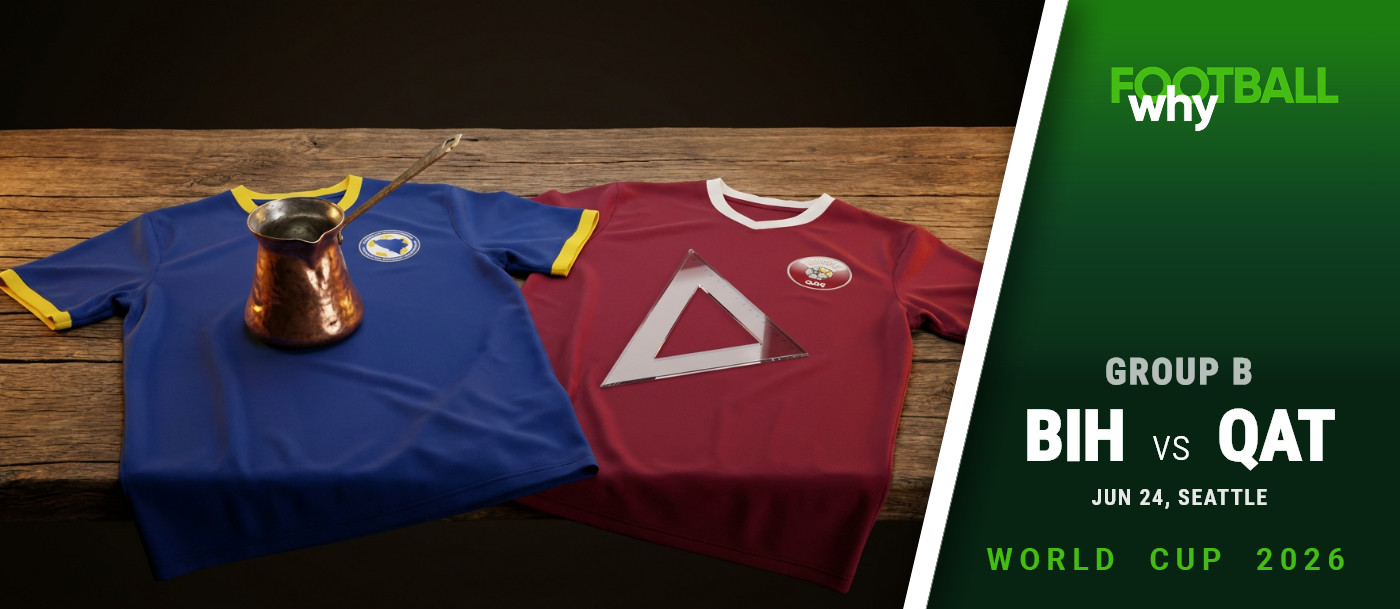
The World Cup Qualification Decider
Wednesday, 24 June

Lumen Field, Seattle

Bosnia and Herzegovina vs Qatar FIFA World Cup 2026 Group Stage Match Rusted trowels: Squeezing three goals from minimal threat Forecast generated:

It felt like digging up stubborn weeds with a rusted trowel. Discover how Bosnia wrung three goals from a microscopic 0.64 expected threat and dismantled Qatar's polite possession with unapologetic, bruising pragmatism.
Bosnia and Herzegovina vs Qatar Structural Collision

What was it?

The ninety minutes in Seattle felt like digging up stubborn weeds with a rusted trowel. It was abrasive, thoroughly unglamorous, and heavily reliant on blunt physical force. Bosnia extracted maximum yield from minimal soil, scoring three times from a microscopic 0.64 expected threat.

Anyone skipping the broadcast missed a brutal lesson in pragmatism. Qatar circulated possession like polite commuters avoiding eye contact, creating 0.77 expected goals but lacking a cutting edge. Kerim Alajbegović shattered that quiet etiquette early on, slaloming through a passive defence to drill home the opener.

The defining structural failure occurred when the trailing side chased the deficit. They pushed bodies forward and completely abandoned their midfield. This left a draughty, unpoliced corridor in the centre of the pitch.

Sergej Barbarez saw the gap, withdrew a visibly frustrated Edin Džeko, and bolted the door with fresh legs. Ermin Mahmić swept in a late corner rebound to finish the job. It was the crusty heel of a working-man's loaf, gnawed down to the last crumb with defiant, beautiful grit.

How did they clinch it?

Bosnia and Herzegovina

Bosnia and Herzegovina secured their progression because they recognised exactly when to abandon sentimentality for structural security. The defining adjustment against Qatar was the withdrawal of their talismanic striker just past the hour mark.

Sacrificing their primary focal point for a dedicated number ten instantly stabilised the central spaces. It allowed them to clamp down on the loose second balls that were previously spilling into dangerous zones.

This pragmatic shift reflects the broader reality of the current squad. Lacking the elite midfield orchestrators of previous generations, the team leans heavily on wide deliveries and raw penalty-box occupation to manufacture chances.

They accept prolonged periods of territorial submission, trusting their deep-seated defensive compactness to absorb the opponent's pressure. It is a highly functional approach, masking a transitional phase where aging veterans are being carefully balanced with diaspora-trained youth.

This dynamic mirrors the national footballing infrastructure itself. Without the luxury of heavily centralised, state-funded development, the federation relies on the technical schooling their emigrants receive in European academies, grafted onto a domestic culture of stubborn resilience.

They survive by dragging technically slick opponents into low-margin, physical attrition.

Their victory operated like a stubborn tenant fixing a leaking roof with rough, unyielding iron rather than waiting for the landlord.

Why not go for the win?

Qatar

Qatar ultimately failed to salvage their tournament because their structural discipline dissolved the moment they were forced to chase the game. Pushing into an expansive shape late on left their midfield fatally understaffed.

By committing extra forwards to the attack, they completely exposed their rest-defence. Opposing transitions easily bypassed their central pivots, repeatedly targeting the unprotected spaces down the flanks.

This late-game unravelling highlighted a critical flaw in their current roster. Starting without a traditional centre-forward meant their intricate build-up play frequently terminated in an empty penalty area.

They relied almost entirely on their left-sided creator to manufacture openings. When Bosnia sat deep and crowded that specific channel, the squad lacked the raw physical presence to force the issue through direct means.

This vulnerability points to the deeper contradictions of their systemic project. The national setup produces highly literate, technically sound players reared in pristine, state-backed high-performance academies.

However, these perfectly controlled environments rarely simulate the chaotic, attritional friction of high-stakes international football. They are taught to solve problems with geometry, but struggle when the situation demands blunt force.

When confronted with aggressive opponents who bypass the midfield and enforce physical duels, their rehearsed passing circuits falter.

They constructed a flawless, climate-controlled conservatory, only to watch the glass crack the moment a genuine storm blew in.

Match hero...

Kerim Alajbegović
Kerim Alajbegović shattered the polite holding patterns of the opening half hour. His solo run to score the opener operated like a sudden, stubborn refusal of the expected tempo — pure inat channelled through diaspora-polished technique. While the opposition waited for a predictable cross, he simply carried the ball into the penalty area, completing six of nine dribbles. He exploited the passive spacing ahead of him, proving that European academy refinement has not filed down the raw, defiant edges of a player willing to drag his team uphill.

...and one more

Hassan Al Haydos
Hassan Al Haydos acted as the senior statesman stepping in to restore order when the household faced public embarrassment. His close-range finish just before the interval was less about raw athleticism and more about hierarchical responsibility. He read the recycling of the cross perfectly, arriving in the six-yard box exactly as the academy manual dictates. Operating in a system that often defers to its marquee creators, the veteran captain absorbed the pressure, using his deep positional memory to validate his mandate and temporarily steady a fragile collective.