

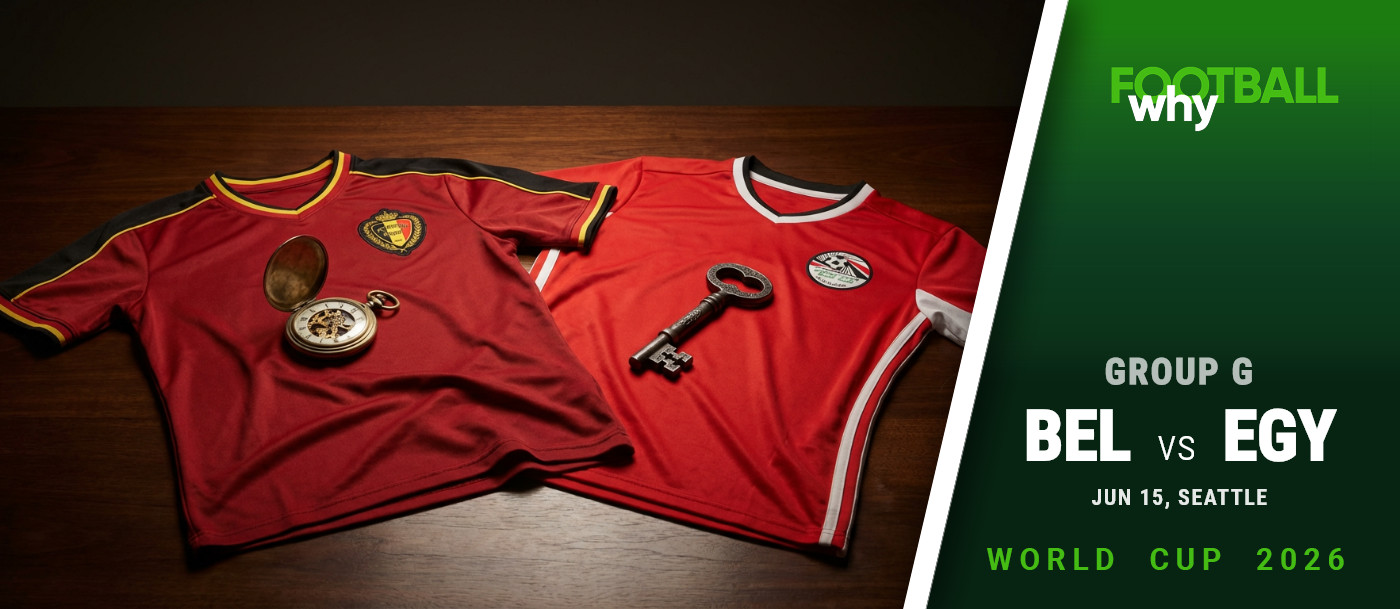
Group G, Matchday 1, Match #16
UTC

Lumen Field, Seattle

Prediction by whyFootball readers

BEL
DRAW
EGY
58%
24%
18%
Not a recommendation for betting
Tap [+] to cast your expert forecast.
SCORE BY AI PREDICTION: 2:0 SEE SIMULATION

Belgium vs Egypt FIFA World Cup 2026 Group Stage Match Filing Planning Permission Through a Barricaded Door Forecast generated:

Institutional procedure collides with fatalistic defiance. A collective of cosmopolitan craftsmen attempts to systematically dismantle a proud, familial citadel. It is a contest between the quiet hum of a technocratic engine and the sudden, pride-fuelled surges of a nation’s absolute faith.

Belgium: One side's prayer...

Belgium arrives for their Group G opener carrying the heavy, familiar baggage of their 'Golden Generation' quarter-final ceiling. The mood is measured but tense. Manager Domenico Tedesco must navigate early structural headaches, with centre-back Zeno Debast ruled out of the group stage due to a thigh injury. Furthermore, Romelu Lukaku’s lingering workload issues mean he is operating on a strict minutes cap. They are desperately seeking a quiet, procedural victory to oil the gears and ease the relentless domestic scrutiny.

Egypt: ...head-on with the other.

Egypt enters the tournament enveloped in the usual Cairo pressure cooker, desperate to translate their continental pedigree onto the global stage. The squad has adopted a fierce siege mentality, partly to deflect the intense domestic debate surrounding the manager's controversial decision to omit a traditional target man. Fitness concerns linger in the midfield, with Emam Ashour’s workload being heavily monitored following a recent knock, while backup goalkeeper Al Mahdi Soliman is unavailable. They are prepared to dig trenches and suffer for a dignified result.
Belgium vs Egypt Structural Collision

Belgium: How we will host...

Dream
The baseline is to secure an opening victory while suffocating the match's tempo, ideally keeping a clean sheet. They want to lay down a marker of quiet control, banishing the ghosts of previous tournament failures by proving they can manage the emotional temperature without descending into panic.

Strength
Their power lies in a deeply ingrained technical intelligence. They boast a midfield capable of methodical, possession-heavy orchestration, patiently picking at the seams of a defensive block before a world-class creator delivers clinical service to the penalty box.

Plans
To bypass a stubborn block, the strategy relies on dragging the opposition's left flank completely out of position. By isolating their fastest dribbler out wide and feeding sharp diagonals into the half-spaces, they intend to force defenders into uncomfortable areas, creating central cut-back opportunities.

Fears
The lingering anxiety is what happens when their procedural calmness is punctured. If forced into a chaotic, transition-heavy game, the distances between their midfield and defence tend to fray, risking severe structural vulnerability under intense scrutiny.

Egypt: With what we arrive...

Dream
The primary objective is survival via attrition; a draw is highly acceptable, provided it is achieved with dignity. They aim to protect their goal difference at all costs, frustrating the opposition and hoping to nick a late winner from a set-piece if the home side over-commits.

Strength
Their core asset is a stoic, collective resilience. They operate with a siege mentality, defending deep and narrow, willing to suffer without the ball for long stretches. This defensive honour is paired with a reliance on the decisive, talismanic moments of their star forward on the break.

Plans
The strategy involves erecting a mid-to-low block, explicitly designed to deny central passing lanes. They will funnel the opposition’s possession out wide and aggressively double-team the most dangerous opposing winger, relying on early, direct balls to their own forwards upon winning possession.

Fears
The existential dread is that their deep defending turns into sterile, passive containment. If they concede early, their ingrained risk-aversion makes chasing a game difficult, often resulting in isolated attackers, rushed clearances, and an over-reliance on drawing fouls rather than constructing meaningful chances.

How it will be...

Should the script hold, this fixture will resemble a protracted council planning dispute. Belgium will likely dictate the agenda, hoarding possession and circulating the ball with bureaucratic persistence, waiting for the Egyptian defence to leave a singular administrative loophole.

The visual rhythm will hinge on the right channel. Expect Kevin De Bruyne to linger in the half-space, probing for structural fatigue. If Egypt’s double-marking falters, Jérémy Doku’s lateral agility could single-handedly unravel their stoic containment. Observers should watch for sudden, isolating bursts out wide, bypassing the central congestion entirely to feed runners arriving in the penalty area.

Yet, fragility simmers beneath the Belgian composure. If Youri Tielemans neglects his central covering duties when the playmakers roam, a transition seam yawns open. Egypt’s capacity to override their own caution relies on these exact lapses. Mohamed Salah requires only a fractional lapse in concentration to alter the entire complexion of the afternoon.

However, if the North Africans are forced to chase a deficit, their compact discipline often splinters. A late shift towards a frantic, top-heavy shape might simply offer Belgium the vast, unprotected acreage they need to finalise the paperwork.

Belgium: How did they clinch it?

Belgium secured the result because they successfully converted rehearsed half-space patterns into tangible advantages, notably capitalising on a second-phase rebound. Their strict adherence to a three-man defensive anchor stifled most counter-attacks, ultimately allowing their inherent technical superiority to dismantle a fatigued block.

Egypt: Why not go for the win?

The defeat stemmed directly from a pivotal goalkeeper parry that fell into a congested central slot. Before that misfortune, their overly cautious posture starved their forwards of meaningful service. Ultimately, a chronic lack of midfield invention left them entirely dependent on predictable transitions.

Secret mastermind intent

The Manager's Municipal Blueprint for Half-Space Planning

General Strategy
The manager’s primary objective is to monopolise the match tempo, ensuring a clean sheet while methodically probing the final third. The team will sit in a high-mid block, looking to suffocate the game rather than turn it into a track meet.

In possession, the structure shifts into a rigid defensive base of five players staying behind the ball. This municipal pedantry ensures that while the creative players explore the attacking half, the back door remains firmly locked against sudden counter-attacks.
Antidote for the Opponent
Preparations are heavily focused on nullifying the opposition's primary threat down the right channel. The defence will essentially build a box around the star winger, forcing him to receive the ball facing the touchline rather than driving centrally.

Offensively, the plan targets the space left behind the advancing opposing left-back. The manager wants early, whipped deliveries into this vacated corridor, dragging the centre-backs out of their comfort zone and creating gaps for late runners.
Internal Task Solving
A highly specific fitness mandate dictates the attacking setup. The starting striker is on a strict minutes cap and will be withdrawn around the hour mark, regardless of the scoreline, to preserve his legs for the remainder of the tournament.

Furthermore, the team is prepped to utilise short corner routines. This is designed specifically to drag the opposition’s holding midfielder out of the penalty area, clearing the runway for edge-of-the-box strikes.
Crisis Response Plans
Should the opponent successfully bypass the initial counter-press and generate dangerous transitions, the baseline shape instantly becomes more conservative. The right-back will be instructed to abandon overlapping runs entirely, locking in as a permanent third central defender to stabilise the line.

The overall ethos is to avoid panic. If the initial attacking patterns look like brittle plastic snapping under pressure, the team will simply slow the game down, recycle possession, and wait for the structural integrity to return.
Specific Match Orders
Kevin De Bruyne: Hold the right half-space and look to deliver early, whipped crosses behind the opposition left-back. If heavily man-marked, drift wider to clean out the channel, then burst back inside on third-man runs. Do not waste energy chasing defensive transitions beyond the midfield line. Jérémy Doku: Attack the outside on the first touch to stretch the defensive block. If the penalty area is already congested, prioritise the cut-back over taking a low-percentage shot. Commit to a three-second counter-press immediately after losing the ball, then recover shape. Timothy Castagne: Start ten metres narrower in possession to anchor the rest-defence. Do not overlap at the same time as the winger. Take ownership of the inside lane against their main attacker first, then hand him off to the wide midfielder.
/ What if the opponent continually breaks the counter-press?

The full-backs are immediately ordered to pause their advanced positioning for ten minutes. The right-back locks inside to form a back three, and the holding midfielder drops to solidify the centre. The focus shifts entirely to retaining possession through the midfield, refusing to force vertical passes until control is restored.

/ What if the match descends into emotional chaos?

A manual override is triggered, handing authority to the veteran spine. The central defensive midfielder dictates a lower, more secure block height, while the primary playmaker purposefully slows the tempo of every restart. High-risk dribbles on the flanks are strictly prohibited until the structural dust settles.

Secret mastermind intent

Hossam Hassan’s Siege Mentality and Backstage Dust

General Strategy
The manager’s overarching philosophy for this fixture is risk minimisation. The team will deploy a compact 4-1-4-1 shape out of possession, dropping into a deep block that prioritises territorial pressure over expansive play.

The focus is entirely on frustrating the opponent. They will gladly concede possession in harmless areas, waiting to bait turnovers before springing fast, vertical transitions down the flanks.
Antidote for the Opponent
To neutralise the opposition's primary playmaker, the defensive midfield unit will create a dense trap in the right half-space. The aim is to crowd his passing lanes and deny him the time required to pick out runners.

In transition, the attacking trigger is to exploit the space behind the opposition's left-sided centre-back. The forwards are instructed to make diagonal sprints across the defender's blindside the moment the ball is won.
Internal Task Solving
Due to a condensed travel schedule, the physical load on the central midfielders is being heavily monitored. If the engine room begins to flag, the tactical setup will bypass them entirely, shifting to direct, long-ball distribution from the goalkeeper.

Additionally, there is a pre-planned late substitution to introduce a dedicated penalty-box target man, ensuring an aerial threat remains if they are forced to chase the game in the final quarter.
Crisis Response Plans
If the opposition playmaker begins to dominate the half-space, the manager will shift the shape to a 4-2-3-1. An extra holding midfielder will be introduced to form a double pivot, specifically tasked with blocking the central passing lanes.

The broader contingency involves a willingness to absorb pressure. If the defensive line is breached, they will not panic; instead, they will drop deeper into a 4-5-1, pulling the wingers inside to suffocate the penalty area and relying entirely on set-pieces for an attacking outlet.
Specific Match Orders
Mohamed Salah: Start in a wide right position, receive the ball to feet, and then attack the inside channels. If triple-marked, drift centrally alongside the striker. Keep deep defensive tracking to an absolute minimum to preserve energy for late counter-attacks. Omar Marmoush: Attack the left half-space immediately upon the first forward pass. Time your runs across the front shoulder of the opposition's left centre-back. Initiate the counter-press on the opponent's first touch following any of our long clearances. Emam Ashour: Without the ball, pinch into the right half-space to crowd the opposition playmaker. Double up on the opposing winger when the play shifts to your side. In possession, carry the ball forward before releasing it early to the right flank.
/ What if the team concedes a wave of sustained pressure or an early goal?

The team immediately activates a consolidation phase for ten minutes. They will drop into a rigid 4-4-2 mid-block, reduce the attacking height of the full-backs, and actively seek to draw fouls to break the opponent's rhythm and reset the defensive line.

/ What if the star forward is completely isolated and triple-marked?

The forward is instructed to abandon the flank and move centrally alongside the striker, temporarily creating a two-man frontline. The wide midfielder on that side then assumes responsibility for delivering crosses, shifting the focal point of the attack without overloading a dead lane.

MAIN SIMULATION 0'-25'

Belgium will likely set up a methodical 3-2 defensive base, pushing the ball towards Kevin De Bruyne in the right half-space. Egypt responds by building a municipal blockade: a 4-1-4-1 shape where Emam Ashour and Hamdi Fathy box De Bruyne in, while Zizo and Mohamed Hany double up on Jérémy Doku. This forces Belgium to rely on quick diagonal passes rather than overlapping runs. Egypt will sit tight, waiting for loose touches to launch Omar Marmoush into the space behind Arthur Theate.

MAIN SIMULATION 25'-45'

Youri Tielemans acts as a tempo valve, speeding up Belgium's passing. To escape his markers, De Bruyne drifts wider before darting back inside to whip a flat cross behind the Egyptian defence. Romelu Lukaku attacks the near post to finish. Egypt will likely respond to conceding by engaging a shock-recovery protocol. They will drop into a rigid 4-4-2 for ten minutes, drawing tactical fouls to cool the match down rather than chasing an immediate equaliser.

MAIN SIMULATION 45'-65'

Egypt will start pushing their engagement line higher in selective bursts. Around the hour mark, Belgium replaces Lukaku with Charles De Ketelaere to maintain mobility. This shift briefly destabilises the match. Egypt's best chance arrives when Ashour carries the ball forward, allowing Salah to cut inside and shoot. After Thibaut Courtois parries, Belgium's technocrats step in to kill the heat. They will immediately slow the tempo, re-establish their defensive shape, and play safe passes into the channels.

MAIN SIMULATION 65'-90'

Chasing the game, Egypt throws caution to the wind, shifting into a frantic 4-2-4 shape and committing to early crosses. This desperation leaves their box protection vulnerable. Belgium ruthlessly punishes this exposure. Doku finally isolates Hany, drives to the byline, and cuts the ball back. El Shenawy parries De Bruyne's shot, but De Ketelaere slots home the rebound. Belgium manages the remaining minutes by dropping into a disciplined 4-4-2, committing tactical fouls to break up any lingering Egyptian rhythm.

And it will come to...

If this scenario were to unfold, Belgium's cerebral orchestration would ultimately dismantle Egypt's proud, compact resistance. The match would likely hinge on Belgium's ability to maintain their procedural discipline while probing the half-spaces. Should Egypt fall behind, their shift from controlled suffering to desperate chasing would inevitably stretch their defensive fabric. In the end, it would be a triumph of methodical academy blueprints over defiant, talisman-dependent pragmatism, sealed by ruthless efficiency on second-phase rebounds.
end of Game