Where it hurts?
Paraguay: current status and team news
Extracting Survival
from Heavy Sludge
Gustavo Alfaro is currently attempting to extract a cohesive squad from heavy, unyielding sludge. The final roster remains stubbornly withheld until June. The public mood wavers sharply between the euphoria of a long-awaited qualification and deep scepticism over a heavily patched defensive line.
Blas Riveros abruptly exited the camp, leaving a collapsed seam on the left flank. This depth crisis forces an immediate deployment of conservative profiles to shield the space. Opponents will undoubtedly flood this newly exposed terrain before the back four can properly settle.
Gastón Olveira brings an untested distribution profile that challenges the traditional elder-guardian model in goal. Higher up the pitch, chance creation relies entirely on the Julio Enciso and Miguel Almirón conduit. Fans desperately monitor this single pipeline, fearing it will run completely dry.
The tournament opener will feature a rigid shape designed to drag opponents deep into a gruelling physical quarry. Gustavo Gómez and Diego Gómez will anchor a ruthless dead-ball siege. Viewers will watch a team endure long stretches of scarcity, waiting to strike once.
The Proposition?
Paraguay : Tactical guide - how to identify their movements and game variations on the pitch
The Rigid Mechanics
of the Guaraní Wall
Gustavo Alfaro is actively orchestrating a pragmatic restoration for La Albirroja. The immediate aim is to punch into knockout relevance through disciplined structural order and sheer set-piece mastery. This low-risk approach, however, constantly battles a severe lack of open-play creativity against entrenched defensive lines.
The baseline shape is a 4-2-3-1 that rigidly flattens into a 4-4-2 without the ball. Alfaro paces the touchline, constantly waving his hands to push the defensive line higher or lower, demanding absolute vertical compactness.
What to look at: If the back four stations roughly 40 metres from their own goal in the opening 15 minutes, with forwards Tonny Sanabria and Julio Enciso staggering their pressing, expect Paraguay to violently funnel the opponent towards the touchline to harvest throw-ins and fouls.
When protecting a narrow lead, this block deliberately sinks into a pure survival mode.
What to look at: If the defensive line drops deep into their own third and the wingers completely flatten alongside the midfielders, Paraguay is deliberately conceding possession to pack the penalty box with bodies, trusting their aerial dominance to safely burn the clock.
The entire structure revolves around Gustavo Gómez, acting as the undisputed nucleus of their rest-defence.
What to look at: Upon Gómez’s first controlled touch against a high press, watch defensive midfielder Andrés Cubas drop to form a temporary back-three. This invites pressure to one side, opening a late inside lane for Miguel Almirón or a 1v1 for Ramón Sosa on the far flank.
The attacking phases alternate between extremely cautious short passes and direct, towering launches toward Tonny Sanabria to fight for second balls.
What to look at: As Almirón drives diagonally across the halfway line and Sanabria pins the near-side centre-back, anticipate a low cutback to an arriving playmaker or a floated cross to the isolated weak-side winger.
Committing so many bodies to the strong side creates a glaring vulnerability.
What to look at: If an opponent compresses Paraguay’s strong side, wins the second ball, and immediately hits a diagonal switch, watch the weak-side winger ball-watch. This creates a lethal 2v1 against the far centre-back and full-back.
Despite a visible struggle to create open-play chances, their sheer physical resilience and lethal set-piece threat make them a gruelling, bruising puzzle that no elite side actually wants to solve.
The DNA
Paraguay: football's importance and what we will see in their game at the 2026 World Cup
The Humid Geometry
of the Siege
A blanket of suffocating humidity presses down on the training pitch in Asunción. Even before the session begins, sweat darkens the training tops. In this climate, unnecessary sprinting is not merely inefficient; it is an act of foolish self-sabotage.
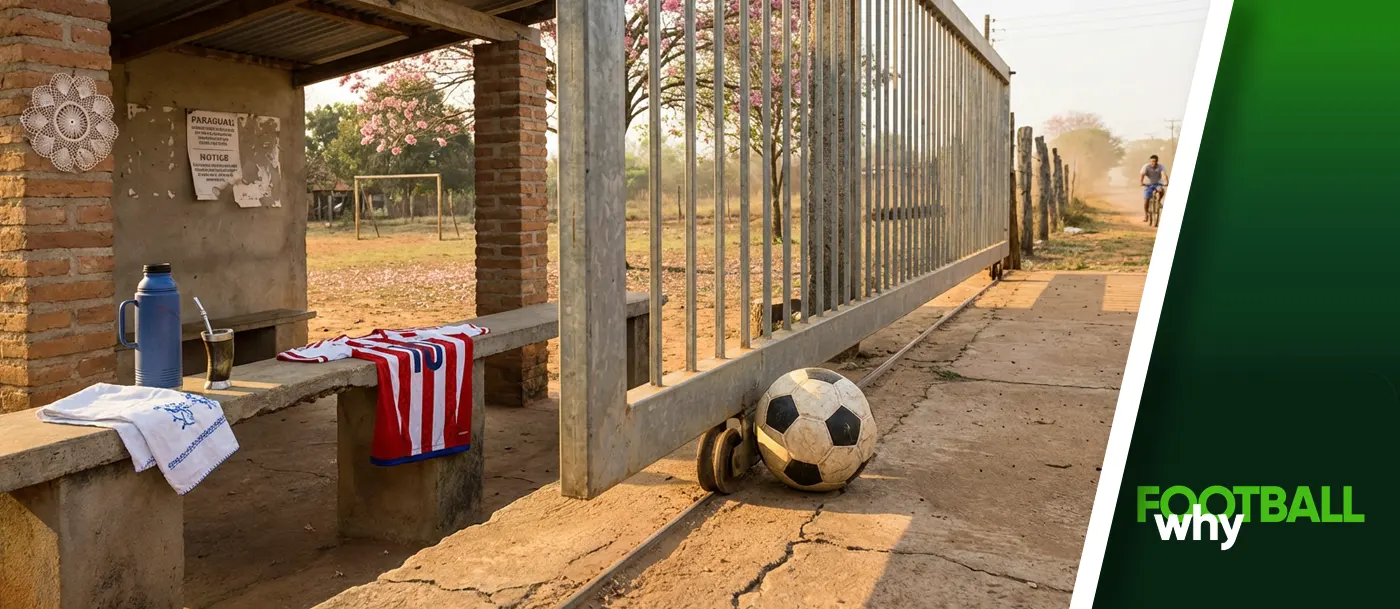
Observe a dispute over a property boundary in a rural Guaraní-speaking village. The men do not immediately shout or draw weapons. They sit in the shade, slowly passing a gourd of ice-cold tereré (yerba mate). The rhythm of preparing the drink, the deliberate sipping, and the patient silences serve to cool the blood. Decisions are reached through horizontal consensus, ensuring the group remains intact. A unilateral, aggressive move is a social sin.
This precise communal patience dictates their defensive architecture. When Paraguay faces a superior opponent, they do not attempt a frantic, high-risk counter-press. They construct a suffocating, low-variance mid-block.
Watch the wingers. They do not gamble on high interceptions; they track opposing full-backs deep into their own territory, creating narrow, impenetrable distances between the lines. It is a collective agreement to absorb pressure, conserving energy for the exact moment the opponent over-commits.
This stoicism is rooted in the garra guaraní — a culturally sanctioned persistence forged by the devastating War of the Triple Alliance, where a besieged nation learned that survival meant collective endurance, not individual heroics.
On the pitch, this translates to a profound comfort with low-event, trench warfare. They will cynically but carefully foul to break transitions, slowing the game to a crawl. The goalkeeper acts as the emotional metronome, dictating the tempo of restarts, much like the elder serving the tereré.
However, this deep-seated loss aversion is the exact mechanism that starves their attack.
The domestic export economy monetizes reliable, combative defenders, leaving the national side devoid of elite, spontaneous playmakers. Consequently, their attacking blueprint is painfully predictable: absorb pressure, launch a long diagonal to a target man, and pray for a set-piece.
What happens when this defensive purity is challenged?
A recent kit launch attempted to modernize the national image with a corporate, "tierra colorada" design. The public reaction was instantaneous, merciless mockery — dubbing it the "camiseta crayola." They fiercely protect their symbols.
Yet, a counterforce is brewing. The integration of dual-nationals and dynamic young forwards is beginning to inject much-needed final-third craft. The coaching staff is attempting to map modern pressing triggers onto this ancient bedrock.
It is a delicate balance. You can teach a man new geometry, but you cannot ask him to forget the heat, the siege, and the deep, quiet rhythm of the water.
Character