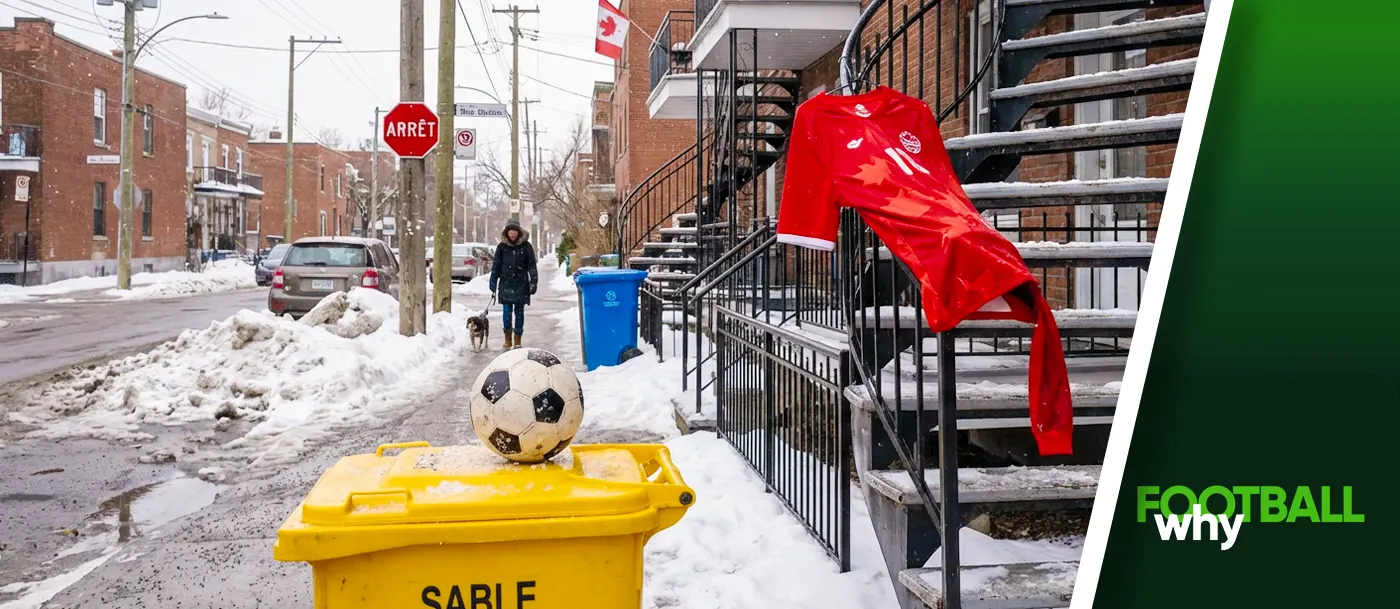
Frost bites the grass before the first whistle even blows. For decades, they carried the quiet baggage of polite defeats and a frozen, winless history. Now, a breathless intensity clashes against boardroom static and their own ingrained instinct to ask permission before striking. Watch them hunt in the cold, trading caution for sudden, blinding velocity down the touchline. The ice is finally cracking.
Team at a Glance
What do they want?
To definitively prove they can survive on grass, not just ice. And maybe, finally, win a World Cup match.
What are they strong at?
Apologetic politeness off the pitch, fused with a breathless, high-voltage pressing trap that suffocates opponents on it.
What will they show?
Sudden, explosive sprints down the flank, proving that survival in the cold requires both discipline and blinding speed.
Why are they as they are?
Surviving a blizzard requires conserving heat and waiting for the exact right moment to sprint for the door.
What is a chance of getting the title?
4%. Entirely possible, provided their left flank never fatigues and the boardroom stops arguing long enough to watch.
Where it hurts?
Canada: current status and team news
Filing Planning
Permission For The Flanks
Jesse Marsch has secured his mayoral mandate through to the next decade, yet the immediate agenda feels far less grand. The host nation’s countdown resembles a frantic zoning meeting over a condemned property. They are simply trying to pass a basic safety inspection before kickoff.
A sudden hamstring tear has ripped up the local transit map. Lightning literally delayed their humid Charlotte preparations, forcing staff to draft contingency routes while their captain remains marooned in the medical tent. The left-sided infrastructure is currently closed for emergency repairs ahead of the opener.
The domestic anxiety is neatly logged under the viral #PhonzyWatch hashtag. A scoreless spring window and that disjointed Toronto draw against Iceland act as a grim public inquiry into their attacking limits. Fans treat any blunted passing sequence as gross municipal negligence.
Emergency protocols demand heavy reliance on returning personnel to bear the redistributed load. Alistair Johnston arrives fresh from surgery clearance to sign off on the defensive paperwork. Ismaël Koné must manufacture central momentum, bypassing the cordoned-off flank to keep transitions running on time.
Spectators tuning in will witness a frantic exercise in high-speed, collective damage control. Expect a swarm of aggressive, front-foot pressure and desperate vertical sprints. A modest, hardworking collective is simply attempting to outrun its own structural collapse under the blinding tournament glare.
Canada: key player and his impact on the tactical system
The Kinetic Spark
In The Frost
A sudden blur of red cuts through the chilled air. Alphonso Davies operates as an unblinking force on the left flank, turning defensive recovery into an aggressive assault in a matter of strides. He is a modern hybrid full-back, overlapping to stretch the opposition or inverting to carry the ball through the midfield with galvanic speed.
When opponents transition, his 30-metre sprints — arms pumping, eyes fixed entirely on the attacker — to steal possession from impossible angles routinely ignite the stadium.
Born in a refugee camp and rising to become his nation's youngest continental scorer, he embodies an audacious ascent. The Canadian attacking structure leans heavily on his specific lane. Without his surges, progression out of the back becomes laboured, and crosses arrive from blunt, predictable angles. Relentless tournament schedules threaten his hamstring durability, yet his continuous refinement of blind-side timing and weak-foot delivery proves he is far more than a mere track athlete. Davies stands as the exhilarating catalyst of an entire footballing generation.
The Wild Card
Canada: dark horse and player to watch
Elegance Gliding
Through The Gridlock
A 6’2” frame moving with an upright, almost frictionless glide through heavy midfield congestion immediately catches the eye. Ismaël Koné brings a rare kinetic rhythm to the pitch: he accelerates smoothly through traffic while retaining the composure to play simple, one-touch passes.
Aligning perfectly with the modern ‘tall eight’ trend, he provides the essential central line-breaks when opposition blocks jam the wide channels. His progressive carries and perfectly weighted wall passes pin centre-backs and add vital verticality to the Canadian press.
Opposing midfields will try to exploit his occasional hesitation under tight man-marking. Defenders actively attempt to show him inside, springing a second-touch trap or applying staggered doubles to deny his turn angles. He absorbs physical contact with a calm gaze, shrugging off challenges before distributing the ball. As the tournament approaches, anticipation builds to see this elegant box-to-box presence slice through a top-tier defensive block, delivering that one decisive carry-to-assist on the global stage.
Canada : Tactical guide - how to identify their movements and game variations on the pitch
The Thrill and Peril of the High-
Tempo Trap
Jesse Marsch aims to turn the adrenaline of a host nation into a credible, knockout-stage reality. Canada operates as a vertical-pressing project built on sheer intensity and collective buy-in. This high-tempo identity faces a brutal test against big-moment finishing stress, alongside the latent fault lines of discipline and the fitness of key players like Stephen Eustáquio and Alphonso Davies.
The tactical foundation rests on an aggressive 4-4-2 mid-block. They keep narrow lines, funneling opponents into wide traps, and immediately look for vertical progression after regaining the ball. Their width is primarily generated by advancing full-backs, most notably the explosive Alphonso Davies, and direct wide midfielders.
What to look at: If, in the opening 15 minutes, Jonathan David and Cyle Larin curve their pressing runs to force the opposition centre-backs to play wide, while the Canadian back four sits at medium height with extreme horizontal compactness. Then, the team is imposing wing-channel games. They want to compress the touchline, win the second ball, and attack the very next pass before the opponent’s defensive shape can organize.
When transitioning into possession, the 4-4-2 morphs slightly. The wide midfielders step into the half-spaces, Alistair Johnston underlaps on the right, and Davies advances to winger height on the left.
What to look at: If Johnston steps inside during the initial build-up while Tajon Buchanan holds the width to pin the opposing full-back. Then, they are creating an extra interior player to bypass a two-striker press, allowing Ismaël Koné or Eustáquio a free body-shape to release a vertical pass.
The system tilts heavily to the left to maximize Davies as an outlet and final-third injector, while Johnston narrows to protect the backline.
What to look at: If Davies receives the ball wide on the move, and the near-side winger tucks inside to clear his lane, while David pins the near centre-back and Larin attacks the back post. Then, the hidden aim is to stretch the opposing backline horizontally, opening a central cutback seam or creating a weak-side isolation opportunity for Buchanan.
Progression relies on direct vertical entries into the strikers' feet and rapid wide-to-cutback patterns.
What to look at: If, upon crossing the halfway line, Koné drives into the inside lane, David drops to bounce the ball, and the near-side full-back releases on the outside. Then, expect a low cutback toward the penalty spot for David or Larin, or a third-man slip pass into Zone 14 for an early finish.
This aggressive style carries a heavy structural cost. The two-man midfield can easily be outnumbered, and the advanced full-backs leave vast spaces behind them. When intensity dips after half-time, these gaps magnify.
What to look at: If the opponent evades the wide trap via an early diagonal switch or frees a half-space receiver through midfield rotations. Then, Eustáquio is left isolated, a centre-back is dragged wide, and a cutback lane opens up, creating a high-probability scoring chance for the opposition.
If the pressure becomes too great, Marsch’s side will retract into a compact, low 4-4-2 to protect the penalty area.
What to look at: If the block height drops into their own third and the lines compress to 10-12 metres. Then, they are trading territory for box density and clock control, simplifying their exits to long, hopeful outlets for David or Buchanan.
The fragility of their two-man midfield and the constant risk of second-half fatigue are undeniable. Still, their fearless verticality and the sheer athletic audacity of their pressing traps guarantee that they will attack the tournament head-on, refusing to quietly accept their historical underdog status.
The DNA
Canada: football's importance and what we will see in their game at the 2026 World Cup
The Frozen Mechanics
Of A Polite Surge
Lake wind whipping across BMO Field carries a specific, biting message: survival here requires meticulous preparation. The cold breath flaring from players on autumn nights serves as a visual reminder of an ancestral blueprint. Rash, unilateral actions in the dead of winter once meant freezing to death. The rules are learned quickly. Walking to a grocery store during a February blizzard in Edmonton does not involve aimless sprinting. People conserve heat, measure their strides, and move with polite, collective purpose.
This climatic thrift translates directly into the team’s defensive architecture. They do not press with reckless, continuous abandon. Instead, they deploy a pragmatic mid-block, conserving energy before executing sudden, wide surges. During their historic Copa América 2024 semifinal run, they absorbed pressure with a disciplined, low-theatrics shape that was entirely task-focused.
Yet, when stressed, this loss-aversion becomes a trap. During the March 2026 friendlies against Tunisia and Iceland, the squad circulated the ball in a cautious, U-shaped passing sequence, terrified of an error. Without an explosive outlet, their possession looked exactly like an over-cautious snowplow — moving a lot of weight but going absolutely nowhere.
That hesitation is compounded by a persistent boardroom static. Picture a municipal planning meeting in Toronto: fixing a simple park bench requires three committee approvals, a community consultation, and a revised budget. The federation’s recent commercial realignment functions with the exact same exhausting friction. This institutional fragmentation dilutes resources and breeds public skepticism. When governance looks opaque, the stadium seats empty out, and the team feels the chill.
To break this polite gridlock, they rely on a stark contradiction: the multicultural speed injected by diaspora talent. The urban corridors of this country are a vibrant mosaic, but everyone eventually learns to queue in an orderly line. On the pitch, this means integrating foreign coaching tempos — like the high-press ethos imported recently — without losing the collective ethos.
Sometimes, it violently misfires. The Gold Cup 2025 collapse, triggered by a pivotal red card, showed what happens when a controlled edge tips into uncharacteristic, chaotic dissent.
They are a squad caught between the desire to be ruthless hosts and the ingrained habit of asking permission to attack. They want to break lines, but they check their mirrors first. It is a slow, methodical climb toward global relevance, built on the quiet assurance that as long as everyone diligently shovels their portion of the driveway, the path forward will eventually clear.