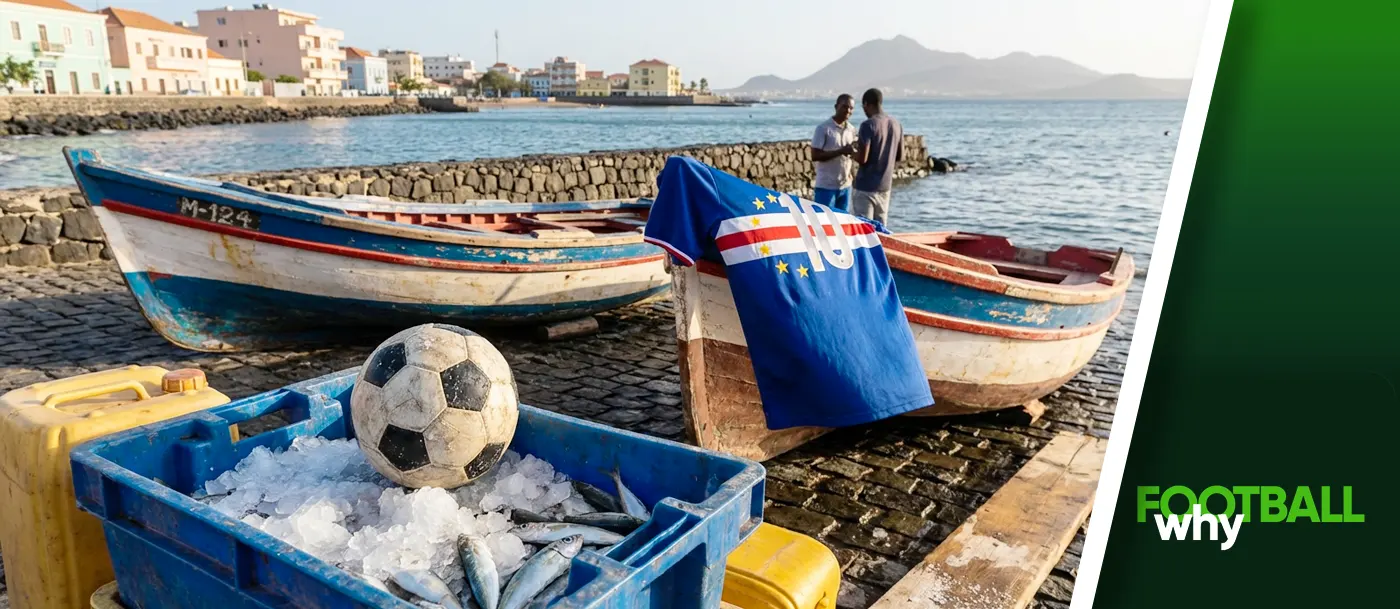
Born from isolated volcanic rock and scattered across oceans, they have always survived by holding the line together. Now, the intoxicating euphoria of a maiden global stage collides with the terrifying reality of elite predators. Watch a deeply coiled, thrifty collective absorb relentless storms before unleashing sudden, opportunistic strikes down the flanks. The archipelago is ready to cast its anchor in deep waters.
Team at a Glance
What do they want?
To prove that a scattered island diaspora can build a fortress capable of frustrating the world's biggest footballing empires.
What are they strong at?
Extreme maritime pragmatism. They boast a deeply disciplined collective that treats energy conservation as a sacred art form.
What will they show?
Seventy minutes of stoic, teeth-gritting containment, followed by a sudden, breathtaking sprint down the touchline to steal the win.
Why are they as they are?
Surviving Atlantic storms on isolated islands leaves absolutely zero margin for reckless individualism or wasted energy.
What is the chance of winning the title?
4%. Perfectly achievable, provided their opponents graciously agree to decide every single knockout match via a penalty shootout.
Where it hurts?
Cabo Verde: current status and team news
Patching A Hull For
The Grand Stage
Cabo Verde arrive in Tampa for their debut global appearance carrying the weary resilience of a crew patching a leaky hull mid-voyage. They operate under a strict scarcity calculus, knowing that survival in a group featuring Spain and Uruguay requires absolute adherence to their defensive blueprints.
A lingering police investigation involving an unnamed player hangs over the camp like a dark, unseasonal raincloud. Pedro Brito’s squad management is already stretched thin by severe logistical constraints. The defensive stability now heavily relies on Logan Costa, who is rushing back from a knee ligament injury.
That reliance on an undercooked centre-back feels increasingly perilous following a bruising four-goal defeat to Chile. The Islanders completely lost their spatial bearings after a red card. Opponents will study that tape, identifying a clear vulnerability when the team is dragged into physical, dead-ball scrums.
Rivals will inevitably aim quick diagonal switches toward the back post, testing the immediate recovery speed of the defensive line. They will pack the penalty area during corners, banking on momentary lapses in concentration. The starting eleven must marshal these crowded spaces with absolute, uncompromising discipline.
When they finally step out under the global glare, expect a side perfectly comfortable sitting deep and absorbing pressure. They will wait quietly for the right current, hoping to launch sudden, wide transitions and prove their tight-knit diaspora can outwit the heavyweights on the grandest stage.
The Headliner
Cabo Verde: key player and his impact on the tactical system
Distilled Precision
In Deep Waters
In low-possession football, time is a scarce currency. Ryan Mendes spends it with frugal, distilled precision.
He operates mostly in the right half-space, waiting out the chaotic midfield traffic with an unblinking focus. When the 70th minute approaches and the defensive block drops deep, he shifts centrally to hunt second balls and orchestrate late-box arrivals.
A minimalist penalty run-up — head entirely still — defines his technique under severe pressure.
If early touches misfire, a stubborn streak can see him recycle possession too often, momentarily stalling the attack. Regardless, every late-game shot selection and dead-ball responsibility inevitably flows through his boots. Equaling national scoring records and burying decisive knockout penalties, he has transformed raw athletic ability into a weathered, masterful closing act for the archipelago.
The Wild Card
Cabo Verde: dark horse and player to watch
Commanding The Aerial Chaos
There is a specific silence that falls when a cross hangs in the penalty area. Logan Costa owns that silence.
Operating with a square-hipped patrol and an absolute economy of movement, the 24-year-old centre-back relies on a two-step, high-knee takeoff to dominate crowded aerial duels. He provides the proactive, first-contact steel necessary to survive cross-heavy opponents.
If the midfield screen arrives late, his aggressive step-outs can occasionally leave blind spaces behind him, inviting fast wingers to launch relentless diagonals into the channels.
Despite this risk, his imposing calm and near-post set-piece threat make him the ultimate defensive amplifier for a squad navigating elite opposition. His commanding presence in the box establishes the exact foundation required for a resilient tournament run.
The Proposition?
Cabo Verde : Tactical guide - how to identify their movements and game variations on the pitch
Funneling Chaos Into
A Diaspora Storm
Cabo Verde step onto the World Cup stage for the first time carrying the immense pride of a vast diaspora. Their mission is straightforward: survive the initial shock of elite competition, consolidate their status through organised, wing-led counter-attacks, and navigate a path to the knockouts.
The main tension lies in balancing their ambition for wide, rapid transitions against the harsh reality of their finishing limitations. This is compounded by the terrifying five seconds immediately following a turnover, when their midfield is dangerously exposed.
Pedro "Bubista" Brito has engineered a deeply pragmatic 4-3-3 that quickly drops into a resolute 4-5-1 mid-block. The strategy controls the tempo and limits central risk against technically superior opponents, relying heavily on a single pivot, Kevin Pina, to secure the defensive structure behind the ball.
What to look at: In the opening 15 minutes, if the defensive block sits near the halfway line with the wingers tucked tightly alongside the full-backs, notice that they do not chase the ball deep into the opponent's half. They are setting a lateral trap. They wait to trigger an aggressive press only when the opponent plays a backward pass out wide, aiming to force throw-ins and establish a territorial foothold.
When they do win the ball, the progression is brutally direct.
What to look at: As they cross the halfway line, watch the winger tuck into the half-space while the right-back, often Steven Moreira, surges past him. Pina will open his hips to either launch a sweeping diagonal pass to the far winger or slip a quick ball to the underlapping runner, aiming for an early cutback to the penalty spot.
The entire system subtly bends to maximise the impact of their talisman, Ryan Mendes, isolating him in the right half-space.
What to look at: When Mendes receives the ball on the half-turn, the right-back will sprint on an overlapping decoy run to drag the defender away, while a midfielder darts beyond the near centre-back. This orchestrated movement collapses the opponent's defensive shape, opening a hidden diagonal lane for a far-post runner.
This reliance on advancing full-backs creates a glaring structural vulnerability the moment possession is lost.
What to look at: If Cabo Verde loses the ball out wide and the opponent immediately launches a diagonal switch into the space behind the advanced right-back, the defensive structure shatters. The pivot is dragged laterally, the central cover collapses, and the weak-side winger is left desperately recovering to prevent a free cutback across the six-yard box.
If the team finds themselves trailing late, caution is entirely abandoned.
What to look at: After the 75th minute, both full-backs push high, a second striker enters, and the shape morphs into a frantic 4-2-4. They accept massive defensive risks to stack the penalty area, hunting set-pieces and second balls through sheer crossing volume.
Regardless of their defensive frailties when stretched, Cabo Verde will be an enthralling watch. Powered by the roaring energy of their diaspora crowds in North America, their disciplined resilience and sudden, explosive wide transitions make them a deeply dangerous wildcard capable of shocking established giants.
The DNA
Cabo Verde: football's importance and what we will see in their game at the 2026 World Cup
Casting Anchors In
The Atlantic Wind
During a March 2026 friendly against Chile, a first-half red card triggered an immediate, fascinating collapse. The defensive shape stretched, panic set in, and the match ended in a harsh 4-2 defeat. For a squad that had just sealed its first-ever World Cup berth with a historic, tightly controlled victory over Eswatini months prior, that chaotic unravelling felt like a betrayal of their deepest nature.
The sting of that loss runs deep into the local psyche. Picture a cooperative fishing boat off the jagged coast of Santiago.
If a sudden storm rolls in, no one attempts a heroic, solo manoeuvre to save the nets. Instead, the crew immediately drops anchor, pulls together, and secures the rigging, their hands moving in quiet, synchronised, thrifty motions against the freezing spray.
Surviving the Atlantic on isolated islands leaves absolutely zero margin for reckless individualism.
This maritime pragmatism forms the absolute bedrock of the national team’s architecture. They do not press high with reckless abandon. Instead, they drop into a deep, disciplined defensive shell, prioritising tight distances and energy conservation over territorial dominance. It is a thrifty, patient containment strategy designed to weather the opponent's storm.
Casual onlookers might label them a lucky underdog clinging desperately to the ropes, hoping to steal a fluke goal. In reality, this is a highly calculated, sophisticated operation born from sheer necessity.
Walk past any brightly painted home in Mindelo and observe how the household operates. The roof might be repaired using funds wired from a cousin in Lisbon, while the plumbing is fixed with parts sent by an aunt in Rotterdam. The household functions perfectly by seamlessly integrating distant resources into a unified, reliable local structure.
On the pitch, this precisely mirrors a squad built almost entirely from a vast, multilingual diaspora.
Players moulded in French, Portuguese, and Dutch academies arrive in camp and instantly surrender their European club habits to serve the collective. They absorb pressure for seventy minutes, waiting until the opponent overcommits, before releasing a sudden, opportunistic surge down the wide channels.
Yet, the foundation remains perilously thin. A single injury to a veteran centre-back, or a momentary loss of emotional control under a high press, can fracture the entire system. Observers will notice a frantic push ahead of the tournament: an influx of global funding is currently being rushed to professionalise their scouting and analytics, desperately trying to patch these structural leaks before the elite forwards arrive.
It is a precarious balancing act between the joy of an unprecedented stage and the terrifying reality of elite competition, held together by sheer communal will. Sometimes, the strongest anchor is simply the shared memory of surviving the previous storm.