

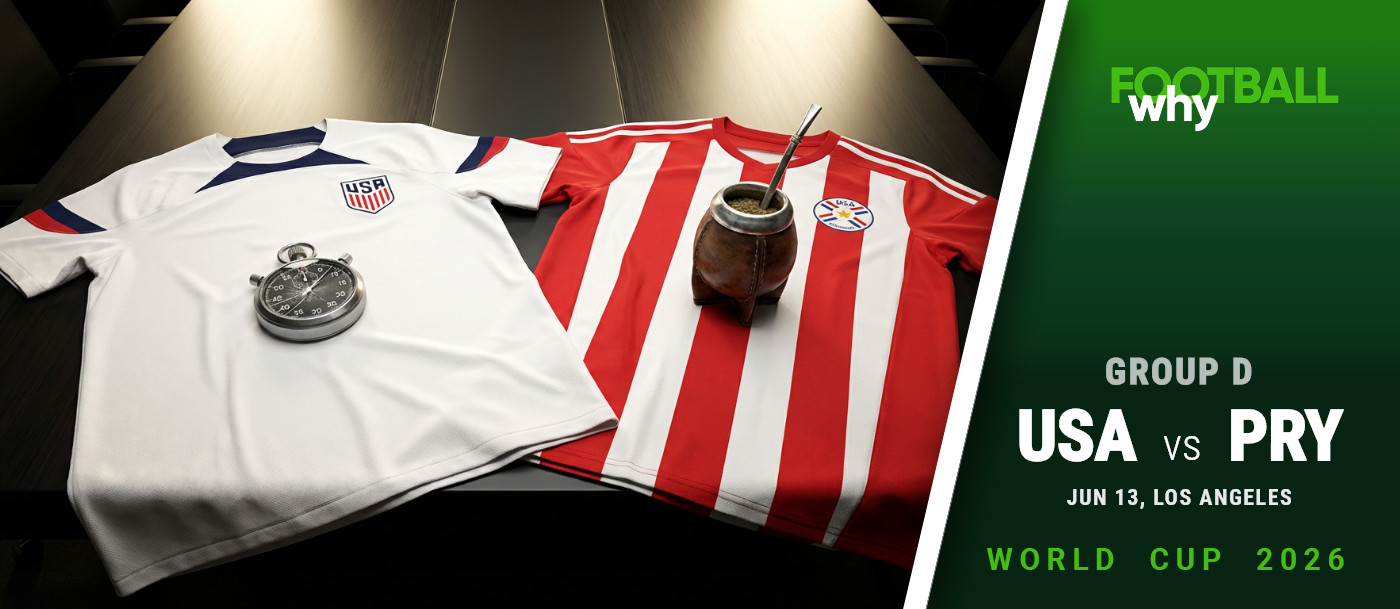
The World Cup Qualification Decider
Saturday, 13 June

SoFi Stadium, Los-angeles

USA vs Paraguay FIFA World Cup 2026 Group Stage Match Oxygen evaporates under the steamroller Forecast generated:

An industrial steamroller flattening a wooden shield. The USA suffocated Paraguay in a breathless 4-1 demolition that defied all expectations of a slow tactical slog. Step inside to see how pure athletic velocity broke the traditional survival ritual.
USA vs Paraguay Structural Collision

What was it?

The oxygen simply evaporated from the turf. A relentless, high-speed tarmac-laying operation flattened the South American defensive perimeter before anyone could even assess the blueprints. By the seventh minute, a fizzing Pulisic cross forced Bobadilla into a clumsy own goal. At the thirty-one-minute mark, Balogun converted an identical left-sided cutback.

Anyone tuning in late missed a genuine physical anomaly. The hosts operated at a frantic fast-forward speed, suffocating the opposition’s nervous system entirely. The visitors registered a solitary shot on target and exactly one corner all evening.

Relying on static, deep-lying resistance against supersonic wingers proved disastrous. Cáceres picked up an early yellow card, instantly stripping his flank of any aggressive friction. Balogun added a third deep in first-half stoppage time, effectively killing the contest.

Maurício eventually found a brief, solitary gap in the American lines. Reyna then restored the three-goal cushion in the ninety-eighth minute. Sometimes, quiet dignity simply gets steamrolled by superior, ruthless engineering.

How did they clinch it?

USA

The United States dismantled their opponents by weaponizing sheer athletic velocity against a static defensive philosophy. By initiating their pressing triggers at the very top of the pitch, they systematically denied Paraguay the milliseconds required to establish a stable shape.

This disruption was highly targeted. The hosts repeatedly isolated the opposition’s full-backs, forcing them into one-on-one defensive sprints that bypassed the central midfield entirely, ultimately yielding a staggering volume of touches deep inside the penalty area.

Such an approach reflects a maturing tactical identity within the current American generation. The squad is increasingly populated by players conditioned in elite European systems, where high-frequency transitions are the baseline requirement rather than an occasional tactic.

Consequently, the team has evolved from relying on raw, unstructured effort to deploying a highly engineered, collective press. They no longer merely outrun opponents; they suffocate them through coordinated spatial control and rapid decision-making under pressure.

This shift addresses a historical systemic flaw. For decades, American sides struggled to translate physical dominance into technical control, often stumbling when forced to break down entrenched blocks. Now, they use that physical dominance to completely bypass the need for intricate possession.

A high-torque mechanical press has finally been fitted with a razor-sharp cutting edge.

Why not go for the win?

Paraguay

Paraguay’s collapse stemmed from a fundamental miscalculation regarding the physical demands of containment. An early caution on their defensive perimeter forced an immediate behavioural shift, stripping their wide players of the combative friction usually required to slow down an advancing tide.

Without the ability to commit tactical fouls or disrupt the rhythm, the entire defensive block sank too deep. They attempted to absorb pressure passively, but the sheer velocity of the American transitions bypassed their traditional consensus-based defensive shifts.

This deep retreat isolated their forwards entirely. The attacking unit was left waiting for dead-ball opportunities that never materialized, forcing them to attempt low-probability, solitary carries from deep within their own half.

Such a disjointed performance exposes the current limitations of the squad’s tactical framework. The team remains heavily reliant on a historical blueprint of enduring pressure and exploiting set-pieces, lacking the modern positional fluency needed to escape a high-intensity press.

At a systemic level, this reflects a domestic footballing culture that still prioritizes rugged destruction and aerial dominance over technical invention in the middle third. When the traditional tools of survival — grit, fouls, and defensive headers — are neutralized by pure speed, the absence of a creative alternative becomes glaringly obvious.

A wooden shield built for a war of attrition simply shatters when fed into an industrial woodchipper.

Match hero...

Folarin Balogun
Folarin Balogun functioned as the ultimate apex metric in a high-bandwidth offensive pipeline. He bypassed the noise, identified the structural vulnerability on the right edge, and ruthlessly leveraged it. His ability to read the blind side of retreating defenders allowed him to convert raw transitional torque into clinical scoreboard reality. He transformed chaotic athletic surges into a quantifiable, high-yield return on investment.

...and one more

Julio Enciso
Julio Enciso refused to accept the collective drought. While his compatriots retreated behind a splintering wooden shield, he took on the solitary labour of ploughing a barren furrow. Relying on his low centre of gravity and short-striding resilience, he bypassed the high-speed press entirely on his own. His defiance was a stubborn survival instinct — a singular attempt to find a drop of water in an otherwise parched tactical landscape.