

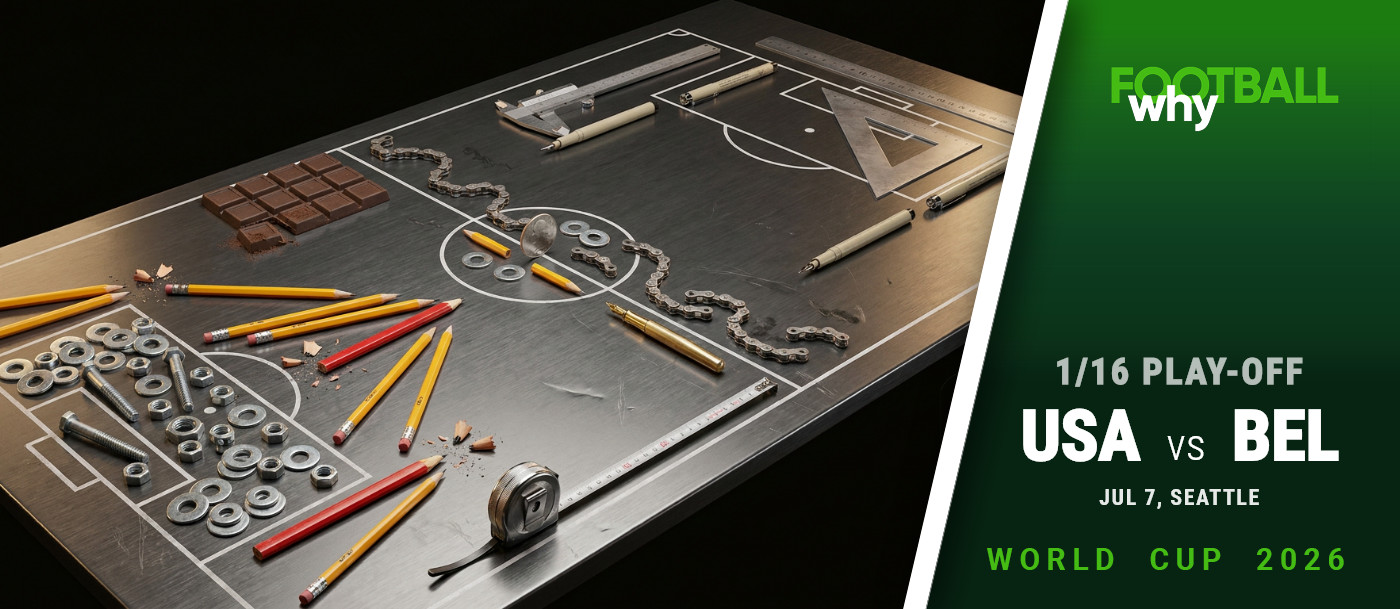
The World Cup Qualification Decider
Tuesday, 7 July

Lumen Field, Seattle

USA vs Belgium FIFA World Cup 2026 Group Stage Match Tactical intellect audits raw athletic exertion Forecast generated:

The USA's athletic playbook was quietly shredded by Belgium's tactical bureaucracy. Discover how a panicked 57th-minute goalkeeper error triggered a ruthless 4-1 audit of American footballing infrastructure.
USA vs Belgium Structural Collision

What was it?

The Seattle heat promised a chaotic physical scrap, yet the visitors imposed the chilling order of a municipal planning committee. Charles De Ketelaere opened the scoring after nine minutes from a simple cut-back. Malik Tillman levelled the scoreline momentarily with a deflected free-kick. Two minutes later, a swift far-post header restored the European advantage.

Despite leaving their most illustrious names on the bench, the visitors accumulated 2.15 expected goals to a paltry 0.67. Anyone skipping the broadcast missed a masterclass in suffocating geometry. The defining sequence arrived just before the hour mark. A coordinated high press clamped around Matthew Freese, forcing a panicked clearance that Hans Vanaken stroked into an empty net.

The hosts then compounded their misery by frantically tearing up their own blueprints. Chasing a deficit, they removed their defensive midfielder to introduce another forward. The central areas emptied out entirely.

Romelu Lukaku exploited this void in stoppage time, striding through the transition to finish into the far corner. Raw effort is a noble pursuit, but elite pedigree always arrives to collect the rent.

Why not go for the win?

USA

The United States lost because their operational protocols fractured the moment they attempted to manually override a deficit.

Removing a defensive midfielder to insert a second striker was a calculated risk that immediately bankrupted their central stability.

Without an anchor to audit the transition lanes, the midfield simply ceased to exist, allowing Belgium free passage through the centre.

This vulnerability compounded when their primary left-sided creator exited through injury, effectively shutting down their most reliable supply chain.

The resulting goalkeeper distribution error was merely the physical symptom of a team being forced to process information faster than their system allowed.

These in-game fractures stem from a broader developmental reliance on physical leverage and rehearsed restarts over spontaneous problem-solving.

The current generation boasts immense athletic capacity and a puritanical work ethic, yet they default to hurried, direct vertical surges when subjected to elite pressure.

At a systemic level, the domestic pipeline still prioritizes transition speed and structural compliance over the intricate ball mastery required to dismantle a set block.

Consequently, when the rehearsed playbook stalls, the collective response is to run harder rather than think clearer.

They remain a highly optimized engine that violently stalls the moment it is asked to navigate off the mapped highway.

How did they clinch it?

Belgium

Belgium secured the victory by treating the match as a logistical exercise in spatial management rather than a contest of physical endurance.

Their ability to absorb an early equalizer and immediately restore their advantage demonstrated a remarkable procedural calm.

The decisive moments did not stem from chaotic surges, but from a coordinated high-press trap that systematically dismantled the opposition's build-up.

Crucially, rotating key personnel did not dilute their tactical integrity. The incoming deputies slipped seamlessly into the established framework, maintaining control of the half-spaces.

This structural resilience highlights a squad deeply conditioned by continental European demands, where positional discipline supersedes individual improvisation.

The team functions like a well-calibrated peloton; if the lead rider changes, the collective rhythm adjusts without shedding momentum.

Such cohesion is the direct output of an academy ecosystem that exports talent early, ensuring players mature within highly structured, multilingual tactical environments.

They possess the collective intelligence to recognize when to circulate possession safely and when to ruthlessly exploit a fractured defensive line.

By deferring to a shared spatial understanding, they completely bypassed the physical attrition the hosts tried to impose.

It was a triumph of municipal efficiency, quietly filing away the opposition's athletic ambition into the correct administrative drawer.

Match hero...

Malik Tillman
Malik Tillman operated as the sole individual willing to ignore a failing playbook. While his colleagues rigidly audited their passing lanes, he treated the final third as a frontier requiring immediate, unscripted leverage. His deflected free-kick was a high-yield return on a dead-ball asset, bypassing the systemic gridlock by simply taking the initiative and exploiting the marginal spaces when the broader infrastructural plan ground to a halt.

...and one more

Charles De Ketelaere
Charles De Ketelaere managed the attacking junctions with the quiet efficiency of a senior technocrat. Producing two goals and an assist, his true value lay in calibrating the high press. He did not sprint recklessly; he calculated the exact moment the opposition's distribution would fracture under pressure. By hovering in the blind spots of the defensive structure, he ensured the team’s energy expenditure remained perfectly balanced.