

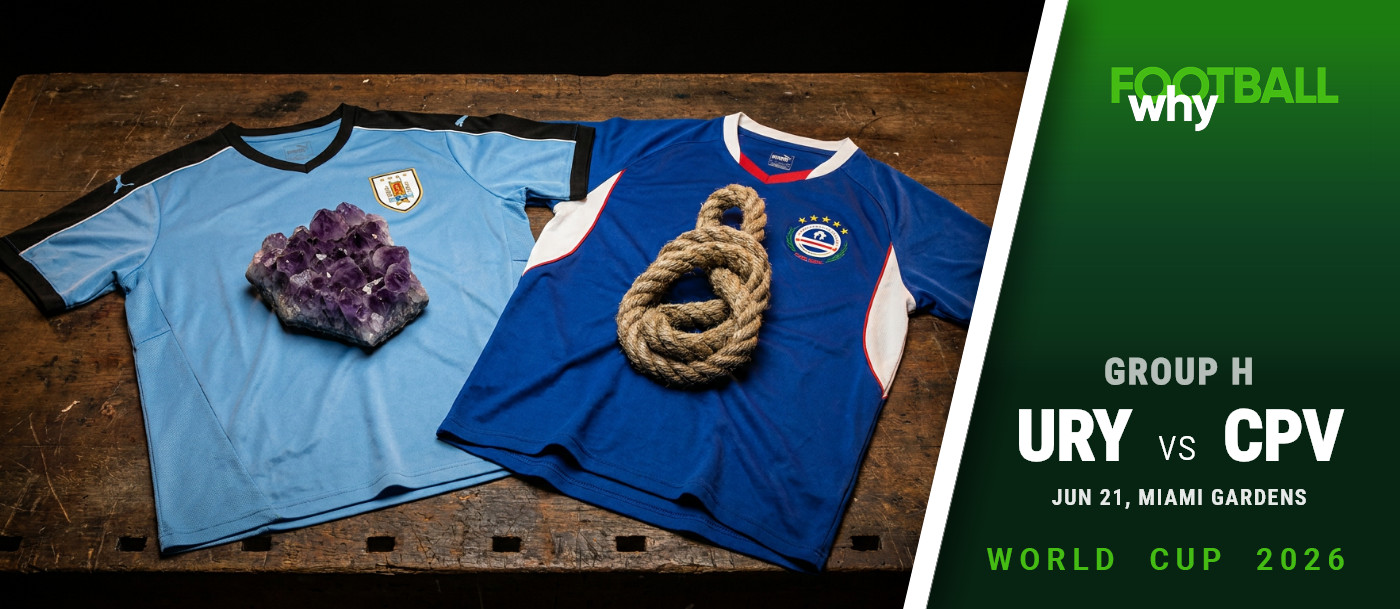
Group H, Matchday 2, Match #37
UTC

Hard Rock Stadium, Miami Gardens

Prediction by whyFootball readers

URY
DRAW
CPV
64%
23%
13%
Not a recommendation for betting
Tap [+] to cast your expert forecast.
SCORE BY AI PREDICTION: 2:0 SEE SIMULATION

Uruguay vs Cabo Verde FIFA World Cup 2026 Group Stage Match Dismantling the island barricade with a blunt chisel Forecast generated:

The simmering furnace of the South American workshop confronts the compass of the African archipelago. A clash of streetwise pragmatism, where combustible tempers must hold steady against islanders who have forged an identity from quiet, structural endurance.

Uruguay: One side's prayer...

Uruguay arrive carrying the heavy baggage of public anxiety and the lingering noise from their recent Tampa debacle. Marcelo Bielsa is under intense scrutiny to deliver a clean, professional victory without the disciplinary meltdowns that often plague this squad. With first-choice left-back Joaquín Piquerez ruled out, the defensive woodwork requires a makeshift patch. The dressing room mandate is absolute: secure the points, kill the external chatter, and refuse to let their trademark competitive fire boil over into self-destructive cards.

Cape Verde: ...head-on with the other.

Cape Verde step onto the pitch shielded by the immense goodwill of their historic World Cup qualification, but perfectly aware of their slim margins. A recent red-card wobble against Chile has sharpened the manager's internal messaging: absolute discipline is non-negotiable. They are here to survive the group stages and keep their hopes alive for the final matchday against Saudi Arabia. The mood is calm and fiercely united, anchoring themselves against the anticipated South American storm with a veteran core determined to avoid naive mistakes.
Uruguay vs Cape Verde Structural Collision

Uruguay: How we will host...

Dream
The baseline objective is to secure progression without igniting any unnecessary fires. The dressing room demands a professional, drama-free victory, steering well clear of the disciplinary meltdowns that have occasionally marred their recent campaigns.

Strength
They rely on a streetwise, duel-heavy pragmatism that treats suffering without the ball as a badge of honour. This is a side that weaponises set-pieces and trusts its elite defensive spine to weather any storm, reflecting a national mindset that values competence and collective grit over flamboyant aesthetics.

Plans
The tactical blueprint involves exploiting the space behind the opposition's right-back with diagonal runners, specifically targeting Darwin Núñez. Defensively, they will establish a strict no-foul zone thirty yards from goal, actively denying the opposition their preferred dead-ball opportunities.

Fears
The overriding concern is their own combustible temper. If the refereeing feels lenient or the match becomes a scrappy wrestling bout, the team risks unravelling into protest clusters, potentially costing them both their defensive shape and crucial personnel.

Cape Verde: With what we arrive...

Dream
The fundamental aim is to depart the pitch with their qualification hopes intact and their disciplinary record entirely unblemished. The camp is acutely aware that a dogged, unglamorous draw is infinitely more valuable than a chaotic defeat, prioritising tournament survival over expansive spectacle.

Strength
They are anchored by a veteran core that treats possession as a scarce resource to be hoarded and spent wisely. This tight-knit unit thrives on a stoic, maritime resilience, perfectly content to absorb pressure and wait patiently for structural cracks to appear in the opposition's framework.

Plans
The tactical design focuses heavily on isolating the space left by the opposition's advancing right-sided defenders. At the back, the centre-halves are instructed to operate like a relay team, passing the opposing striker across their zones rather than being dragged out of position into the midfield.

Fears
Their primary vulnerability lies in a sudden loss of emotional discipline when feeling provoked or outmatched. If they allow perceived injustices to fester, the structure tends to fray, resulting in rushed clearances and a fatal temptation to launch speculative, low-percentage shots from distance.

How it will be...

This fixture projects as a collision of survival intelligences, feeling less like an open shootout and rather more like an industrial stress-test conducted under severe humidity. Uruguay should administer their aggression with the thrift of a corner-shop accountant, banking heavily on their aerial supremacy and a desire to bolt the central trapdoors shut. Conversely, Cape Verde will likely deploy their structural instincts: a navigator’s patience honed by collective memory of drought, forming a defensive funnel that guards zones rather than chasing shadows.

The tension will spike whenever Darwin Núñez attempts to decipher the centre-back's blind spot, curving his run toward the near post. He is explicitly instructed to pause his sprint by a fraction of a second; if that timing splinters, he will find himself repeatedly flagged offside. On the opposing flank, Ryan Mendes will serve as the thermometer, hovering on the penalty area's fringes, waiting to capitalise on any South American sluggishness during defensive transitions.

The suffocating Miami climate will act as the fixture’s silent adjudicator. Should the heat warp Uruguayan communication, their defensive lattice will momentarily fracture, offering a fleeting window for an islander heist. Ultimately, however, if the contest demands raw, attritional grappling, the South Americans' pedigree for prevailing in the mud should dictate the terms.

Uruguay: How did they clinch it?

Uruguay profited from a rehearsed near-post corner flick and a clinical transition in the dying minutes. Their strict discipline in denying free-kicks near their own penalty area neutralised the opposition's primary weapon. Ultimately, the pedigree of an elite spine, accustomed to navigating tight, attritional fixtures, proved decisive.

Cabo Verde: Why not go for the win?

The misfortune of squandering a high-quality cutback near the hour mark sealed their fate. Having failed to convert that isolated opening, the side remained hostage to their own offensive scarcity. Lacking a central creative hub, they relied on wide deliveries that the opposition's defence dismantled with relative ease.

Secret mastermind intent

Marcelo Bielsa's controlled firecraft and defensive joinery

General Strategy
The primary objective is to secure the result while keeping the disciplinary slate impeccably clean. Bielsa’s side will set up in a mid-high block, engaging the opposition in calibrated, short bursts of pressing rather than relentless, lung-busting waves.

In possession, the emphasis rests on a swift, two-pass vertical release. The aim is to bypass the midfield scrap entirely and punch diagonal balls into the channels, ensuring the team's energy reserves are not squandered on needless circulation.
Antidote for the Opponent
The attacking blueprint heavily targets the space vacated by Cape Verde’s right-back when he steps inside to form a back three. Uruguay will deploy a left-sided decoy to drag markers away, allowing a diagonal pass to find Darwin Núñez running into the exposed channel.

Defensively, the mandate is to neutralise the threat of early crosses and long-range artillery. Manuel Ugarte is tasked with shadowing Jamiro Monteiro to prevent him turning, while the wider defenders must shepherd their wingers down the touchline, firmly denying them the inside track.
Internal Task Solving
The stifling humidity dictates a pre-planned substitution strategy on the flanks, acting as a crucial pressure valve. A wide runner will be replaced around the hour mark regardless of the scoreline, ensuring the vertical threat remains potent without exhausting the starting eleven.

Furthermore, a strict communication protocol has been established to manage the referee and avoid needless bookings. Federico Valverde is designated as the sole interlocutor, ensuring the team's combustible nature is channelled entirely into tackles and interceptions rather than futile clusters of dissent.
Crisis Response Plans
Should Cape Verde drop the shutters and bunker into a deep, stubborn low block for extended periods, Bielsa is prepared to aggressively alter the structural woodwork. The side will shift into an expansive 3-3-1-3 formation in possession.

This involves pushing a full-back inside, pinning the left winger to the chalk, and introducing a pure right winger to isolate the opposition full-back. Alternatively, if early yellow cards disrupt the defensive rhythm, the manager is ready to temporarily abandon man-marking in favour of a safer zonal system.
Specific Match Orders
Darwin Núñez (Centre-Forward): Delay the first near-post dart by a half-step. Start on the right-back's blindside and curve across the centre-back. After a missed chance, hold the timing of the next run instead of sprinting straight into an offside trap. Federico Valverde (Central Midfielder): Act as the sole voice to the referee. Avoid solitary, prove-it pressing runs. If the opposition block compacts, operate as a third-man runner arriving beyond the striker rather than settling for early, low-percentage shots. Ronald Araújo (Centre-Back): Switch immediately to a hold-and-delay stance upon making a first error or receiving a booking. Do not step aggressively through the opponent's wall-pass. Maintain a two-metre cushion against the winger to force them exclusively down the touchline.
/ What if the team concedes an early goal or faces a sudden wave of pressure?

The team will execute a deliberate shock-recovery routine to plunge the game into deep freeze. Restarts will be heavily delayed, the team will compress vertically into a tight 30-metre block, and they will look to force two rehearsed corner routines to regain territorial authority before resuming normal attacking patterns.

/ What if a key defender picks up a yellow card in the opening exchanges?

The defensive apparatus will temporarily loosen its grip to protect the booked player. Central man-marking assignments will be dropped for twenty minutes, shifting to a zonal cover system. The full-backs will hold their depth, and aggressive high traps will be strictly postponed.

Secret mastermind intent

Bubista’s stoic navigation and defensive U-bend

General Strategy
The overarching strategy resembles a carefully managed maritime holding pattern, dropping the side into a disciplined mid-low block roughly 35 metres from their own goal. Rather than chasing the ball in a frantic press, the focus is entirely on denying central passing lanes.

The team will maintain a rigid defensive triangle beneath the ball at all times. This ensures they are never caught structurally exposed on the turnover, forcing the opposition to navigate the scenic, less dangerous routes out wide.
Antidote for the Opponent
To nullify the South American creative hubs, the midfield anchor is tasked with applying a suffocating screen on their primary playmaker's turning circle. The centre-backs have strict orders to shepherd the opposing striker out wide, actively refusing to track him into deeper midfield zones.

In attack, they will launch early, flat deliveries toward the back post. This specifically targets the makeshift left side of the opposition's defence, aiming to catch their full-backs ball-watching on cross-field switches.
Internal Task Solving
A strict internal governor has been placed on shot selection, outright banning speculative long-range efforts before the final twenty minutes. This ensures the team does not squander hard-won possession on low-yield gambles when the game remains tight.

Additionally, the manager has instituted a mandatory rotation for one of the wide players on the hour mark. This guarantees fresh legs to exploit late transitions, acknowledging that the tropical heat will inevitably sap the starters' energy and defensive diligence.
Crisis Response Plans
Should the team find themselves pinned inside their own final third for extended spells, the manager will bypass the clogged midfield U-bend entirely. The centre-backs will be instructed to hit clipped, diagonal passes directly to the furthest winger.

To facilitate this emergency exit, the central attacking midfielder will drop five yards deeper. This creates a temporary dual-pivot, offering a reliable release valve to safely transport the ball out of immediate danger without resorting to blind clearances.
Specific Match Orders
Steven Moreira (Defender): Hold your line three to five metres deeper than standard to monitor the striker's diagonal runs. Only commit to an underlapping run once the central pivot is securely in possession and the far-side full-back is anchored. Ryan Mendes (Winger): Hug the touchline to stretch the pitch until the final quarter of the match. Delay your arrival into the penalty area to attack the blind side, rather than attempting to pin the defender early. Kevin Pina (Defensive Midfielder): Play out of the opponent's cover-shadow with sharp, one-touch distributions. Avoid receiving the ball with your back to goal under heavy pressure; bounce the pass and spin to the weaker side immediately.
/ What if the team falls behind to an early goal?

They will activate a deliberate cooling protocol to stop the bleeding. The team is instructed to recycle possession across the width of the pitch for a full three minutes, lowering the match's temperature and resetting distances before gradually resuming any wide attacking patterns.

/ What if a defender receives a swift yellow card?

The entire defensive line will retreat an additional five yards to mitigate the risk of desperate footraces. The winger on the affected side will prioritise hard recovery runs to form a robust five-man midfield screen, temporarily shelving any overlapping ambitions.

MAIN SIMULATION 0'-25'

Uruguay will likely start with a controlled, simmering urgency, initiating short bursts of pressing to funnel Cape Verde wide. They will hunt early cutbacks through Nicolás de la Cruz, while Darwin Núñez deliberately delays his near-post darts to stay onside. Cape Verde will drop into a thrifty 4-5-1 block, sitting deep to choke the penalty area's inside edges. The tactical wrestling centres on Núñez's blindside runs against Steven Moreira's deep defensive line. Uruguay will dominate the territory, but the islanders' trench work should hold firm.

MAIN SIMULATION 25'-45'

Finding the central avenues clogged, Uruguay will likely turn to their dead-ball playbook. Expect a rehearsed near-post screen around the half-hour mark: Ronald Araújo wins the physical mismatch to flick the ball on, allowing Núñez to finish at the back post. Following this, Cape Verde will initiate a stoic structural recovery, recycling possession out wide to kill the adrenaline spike. Uruguay will then resist the urge to chase a second, keeping their defensive framework intact to prevent immediate counter-attacks.

MAIN SIMULATION 45'-65'

The stifling Miami heat will begin to warp the match's tempo, turning the game into a physical grind. Uruguay will substitute De la Cruz and refresh their wide runners to preserve their vertical threat. Sensing this dip in energy, Cape Verde will step their line up slightly, targeting the seam on Uruguay's right. A momentary lapse in Uruguay’s defensive shape could gift Jamiro Monteiro a high-quality chance around the hour mark. Uruguay will respond by slowing restarts to stabilise the match.

MAIN SIMULATION 65'-90'

Cape Verde will introduce Bebé and push their full-backs higher, escalating the pressure without entirely abandoning their shape. Uruguay will seamlessly slip into lead-protection mode, dropping their line into a compact 4-4-2. They will enforce a strict 'no-foul' zone 30 yards from goal to deny Bebé his trademark artillery fire. As Cape Verde commit forward, Uruguay will exploit the space. A late, two-pass counter-attack, spearheaded by Valverde arriving as the third man, should seal the victory.

And it will come to...

If this forecast holds true, Uruguay’s pragmatic iteration of 'garra' would eventually outlast Cape Verde’s stoic, structure-first blueprint. The South Americans' elite set-piece mechanics and late-game outlet freshness would prove the decisive wedge. Cape Verde would mount a deeply respectable, process-faithful resistance, but their lack of central creative hubs would leave them chasing low-volume chances. Ultimately, Uruguay's disciplined lead-protection would suffocate the islanders' late surges, securing a professional, if unspectacular, victory.
end of Game