

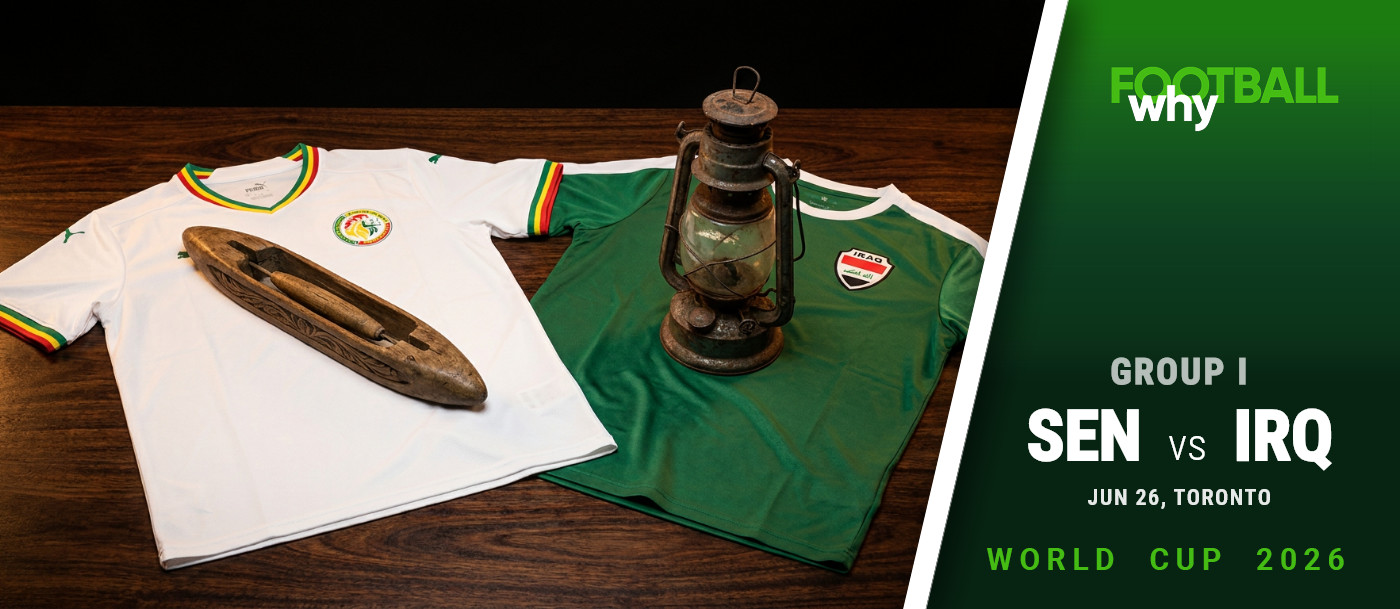
Group I, Matchday 3, Match #62
UTC

BMO Field, Toronto

Prediction by whyFootball readers

SEN
DRAW
IRQ
57%
24%
19%
Not a recommendation for betting
Tap [+] to cast your expert forecast.
SCORE BY AI PREDICTION: 3:1 SEE SIMULATION

Senegal vs Iraq FIFA World Cup 2026 Group Stage Match The patient loom dismantling a rusted border checkpoint Forecast generated:

Stoic communal dignity collides with siege-forged pride. One side weaves a patient, rhythmic net of brotherhood; the other mounts a defiant, honour-bound barricade. It is a crude, compelling theatre of survival, where cool heads must outlast burning lungs.

Senegal: One side's prayer...

Senegal arrive at the precipice knowing a draw means an early flight home; they must gorge on a two-goal victory to salvage their best-third hopes. The dressing room is fiercely defiant, desperate to avoid the emotional meltdowns that marred recent tournament finals. With captain Kalidou Koulibaly nursing a tight adductor, the public demands a performance that functions like a heavy industrial press — relentlessly squeezing the life out of the opposition without a single spark of unnecessary friction.

Iraq: ...head-on with the other.

Iraq are fighting tooth-and-nail for tournament survival, needing a victory to stay in the conversation after suffering two narrow, agonising defeats. Stripped of their European-hardened fulcrum, Zidane Iqbal, due to a severe knee injury, the squad has been plunged into a strict social-media blackout to block the deafening public noise. They approach this final stand like a rusted border checkpoint — battered, thoroughly exhausted, but violently refusing to lift the barrier for anyone expecting an easy passage.
Senegal vs Iraq Structural Collision

Senegal: How we will host...

Dream
A commanding victory by two clear goals is required to secure progression, alongside a vital clean sheet. A draw guarantees elimination. The team must start quickly but keep their collective pulse completely steady.

Strength
Senegal rely on a stoic, physically assertive foundation. They operate like a heavy industrial press, absorbing pressure before punishing teams on the break. The centre-backs hold a high mid-block. The wingers push wide to isolate their markers.

Plans
Thiaw intends to ruthlessly target the space behind advancing full-backs with rapid diagonal passes. To counter the swirling wind, all crosses must be driven low. Attackers will use near-post decoy runs to carve open the penalty area.

Fears
The primary danger remains their own emotional volatility. When subjected to perceived refereeing injustices, their dignified composure often hardens into frantic protest. This stretches their defensive spacing and invites entirely avoidable bookings.

Iraq: With what we arrive...

Dream
Securing a victory to enter the best-third conversation is the absolute baseline. Avoiding a heavy defeat remains equally vital. They want to pinch a result through sheer transitional grit and dead-ball opportunism.

Strength
Iraq draw power from a deep well of siege-forged resilience. They are a stubborn, hard-running unit that thrives in attritional scraps. Their game is built on fierce midfield duels and relentlessly feeding a talismanic central striker.

Plans
Graham Arnold has designed a compact mid-block to frustrate the opposition. When the ball is won, the instruction is to bypass the midfield entirely and hit the target man. They will aggressively double-up on the left flank to smother the creative danger.

Fears
An emotional honour culture can sometimes override tactical discipline. If a narrow lead is threatened, the team tends to bunker down and invite pressure. Frustration often boils over into impulsive fouls and hurried, panicked clearances.

How it will be...

This fixture should resemble a heavy industrial press testing a jagged rockface. Senegal will likely dictate the early rhythm, weaving their communal net through Pape Matar Sarr’s unyielding central presence. He acts as the bouncer, sweeping up loose debris and feeding the flanks. You might expect Ismaïla Sarr to isolate his fullback, dragging the Iraqi defensive seam until it snaps, before slipping low, cruel cut-backs toward Sadio Mané. Mané’s quiet, explosive slaloms offer the genuine celluloid moments here.

Iraq will not simply wither. Forged in siege conditions, their pride demands a visceral response. When pinned back, they will bypass the midfield entirely, slinging flat, hurried trajectories toward Aymen Hussein. Hussein thrives in the sludge, bullying centre-halves to manufacture something from nothing.

Watch for the structural fraying around the seventy-minute mark. If Iraq snatch a chaotic goal, their emotional honour-culture could override their tactical shape. They might throw their full-backs recklessly high. Senegal’s composure could briefly wobble under this desperate barrage, risking a sudden loss of their defensive structure. Yet, that very Iraqi desperation should eventually vacate the right-back channel, allowing Jackson’s decoy darts to unearth the final, fatal gap.

Senegal: How did they clinch it?

They triumphed because their early wide-to-cutback automation bypassed the Iraqi barricade. Jackson’s clever near-post decoy on a corner provided the crucial cushion. Ultimately, their elite physical spine and diaspora-tempered discipline absorbed the late emotional barrage, ruthlessly punishing the resultant gaps on the counter.

Iraq: Why not go for the win?

Putros’s early booking fatally softened their right-sided clamp on the opposition's wingers. When a rehearsed corner routine breached their near-post zone, panic set in. Their subsequent honour-driven chase stretched the midfield spacing, exposing a systemic inability to process elite transition speeds during the chaotic final quarter.

Secret mastermind intent

Pape Thiaw’s Patient Weaving of the Defensive Net

General Strategy
Thiaw wants this match won by at least two clear goals without sacrificing defensive shape. The plan demands a rapid start to dictate the tempo, followed by strict emotional control.

The team will sit in a compact high mid-block, functioning like the heavy weights of a clock-tower escapement. They will not press wildly. The defensive line stays disciplined to protect the penalty area.
Antidote for the Opponent
The primary defensive job is starving Aymen Hussein of aerial service. Full-backs are instructed to block the crossing foot early rather than just showing their man outside.

In attack, Senegal will relentlessly target the space behind Iraq’s left-back. They will use early diagonal passes to isolate the wingers and force defensive errors.
Internal Task Solving
The wind sweeping across the stadium dictates the entire passing protocol. Goalkeeper distribution must be kept flat, and wide deliveries are capped below waist height to avoid the ball hanging in the breeze.

There is also a specific 'jom' protocol for refereeing controversies. If tempers flare, the captain signals a rigid drop into a 4-4-2 shape for ninety seconds to cool heads.
Crisis Response Plans
If Iraq bypass the midfield and start winning consecutive headers, Thiaw has a clear structural failsafe. The holding midfielder will drop between the centre-backs to form a situational back three.

The wingers will then tuck inside to deny the touchline. The coaching staff also have prepared shifts for double-pivots if the midfield gets overrun, acknowledging that football rarely goes to plan.
Specific Match Orders
Ismaïla Sarr: Sprint behind the opposition left-back the second the ball is won. Do not float crosses into the middle; drill the cutbacks low and hard. The first two actions of the match must result in a concrete end-product. Kalidou Koulibaly: Do not step out early to chase decoy drops from the striker. Defend from a side-on stance to protect the adductor and avoid long recovery sprints. Only attempt diagonal switches if the wind allows for a completely flat trajectory. Nicolas Jackson: Live on the near post as a constant decoy to stretch the staggered centre-backs. Constantly reset your feet on the offside line. If an early chance is missed, the immediate next action must be a simple layoff, not a forced shot.
/ What if Iraq flood the penalty area with early crosses?

If the opposition generates too many wide deliveries or wins the first contacts, the shape changes immediately. The single pivot drops into the defensive line to create a back three. Full-backs hold their ground rather than overlapping, focusing entirely on blocking the delivery foot.

/ What if the required two-goal margin is missing in the final minutes?

The structure shifts into an aggressive 3-2-5. A second striker comes off the bench to partner up top, and the wingers lock into the inside lanes. Set-piece routines are accelerated to happen every ninety seconds, aiming exclusively for near-post flick-ons.

Secret mastermind intent

Graham Arnold’s Quarrying of the Central Rockface

General Strategy
Arnold is setting up a rugged, uncompromising barricade. The emphasis is on maintaining a compact shape and surviving the initial onslaught. Possession is viewed merely as a staging tool, not the end goal.

The midfield will operate like a rusted but functional checkpoint. They will engage in a fierce duel-oriented mid-block, looking to funnel play out wide and collapse the edges of the pitch.
Antidote for the Opponent
To neutralise the primary attacking threat, the right-back and defensive midfielder will form a physical double-clamp. They are tasked with showing the winger outside and completely blocking the cut-back lane.

Offensively, the aim is to launch early diagonal balls into the channels. They want to exploit the space left behind advancing full-backs, specifically targeting the left corridor to bypass the press.
Internal Task Solving
The swirling wind dictates a complete ban on floated crosses. All deliveries, especially from wide areas and corners, must be drilled flat and aimed strictly at the near post.

To insulate the squad from mounting external pressure, Arnold has enforced a strict social-media blackout. This enforced silence is designed to keep minds clear and prevent emotional spillovers after contentious refereeing decisions.
Crisis Response Plans
If the main striker finds himself completely isolated for ten minutes, the blueprint shifts. The near-side winger will abandon the flank and invert to operate as a secondary forward.

This adjustment lasts until the next break in play. Arnold also has a pre-planned shift to a back three if the penalty box comes under sustained, heavy bombardment in the final quarter.
Specific Match Orders
Aymen Hussein: Anchor yourself centrally between the two centre-backs. Prioritise darting runs to the near post to meet flat deliveries. Do not drift into the wide channels looking for touches; your presence in the middle is far more valuable. Amir Al-Ammari: Commit a tactical foul the moment the opposition makes their first clean escape from the press. Guard the edge of the penalty area with your life. Only attempt a shot on goal after a set second phase, never during a live, chaotic turnover. Merchas Doski: Whip your crosses in early and keep them flat. When tracking back, make your recovery runs from the inside out. Never allow the opposing winger to pin your inside foot and beat you to the byline.
/ What if the opposition's star winger keeps turning in the half-space?

The right-back drops ten yards deeper, while the holding midfielder screens the inside lane. The number ten then drops to form a rigid 4-1-4-1 shell without the ball. All subsequent counter-attacks are immediately routed down the opposite flank to relieve the pressure.

/ What if a sudden goal or VAR decision rattles the squad?

The team initiates a strict shock-recovery protocol. They play ninety seconds of entirely risk-free, horizontal passes to settle the nerves. Following this, they execute a scripted wide overload to draw a foul, waiting for a clear signal from the bench before resuming the press.

MAIN SIMULATION 0'-25'

Senegal would likely impose their wide-first blueprint early on, letting Pape Matar Sarr act as the bouncer for Zone 14. A quick regain finds Ismaïla Sarr darting behind Doski; he cuts it back low for Mané to finish around the 13th minute. Iraq attempt a shock-recovery by overloading the wide areas. However, Putros picks up a booking trying to halt Mané's inside carry. The Iraqi right-back is forced to sit deeper, which critically weakens their double-team in the left half-space. Senegal then keep their passes flat to manage the wind.

MAIN SIMULATION 25'-45'

Iraq push a midfield pivot higher to contest the second balls, shifting the rockface pressure. Aymen wins a flick, leading to a Jasim shot that Mendy parries. Senegal respond by tightening their restarts. On 33 minutes, they execute a clever near-post corner routine. Jackson acts as a decoy, and Ndiaye ghosts in at the far post to make it 2-0. With the lead secured, Senegal manage the tempo through flat diagonal passes. They selectively overlap while carefully avoiding cheap fouls on Aymen.

MAIN SIMULATION 45'-65'

Iraq stretch the pitch and persist with flat deliveries. Aymen manages a near-post header on 50 minutes, but Mendy produces a sharp foot save. Senegal react by shortening their possessions and hunting in the left half-space. Sarr successfully isolates Doski twice. With Koulibaly having his workload managed, Pape Matar Sarr shoulders the heavy lifting in front of the back line. He halts two dangerous central feeds to Aymen, keeping the defensive structure intact.

MAIN SIMULATION 65'-90'

Chasing the game, Iraq throw their full-backs forward and speed up deliveries. On 72 minutes, Doski’s flat cross finds Aymen’s near-post dart to make it 2-1. The match briefly turns into a tactical washing machine. Senegal's shape frays, but a captain's call triggers a compact 4-4-2 to cool the chaos. Iraq nearly level on 78 minutes, but Mendy parries well. With Iraq badly stretched, Jackson's decoy run frees Mané to slot home the insurance goal on 88 minutes.

And it will come to...

If this forecast holds true, Senegal’s disciplined approach would systematically dismantle Iraq's passionate chase. The African side would rely on direct width, a resolute midfield screen, and precise set-pieces to secure the points. Iraq would undoubtedly fight to the bitter end, pushing their full-backs high and testing the box. However, their late structural gambles would ultimately leave them exposed. Senegal’s ability to preserve their penalty area integrity and ruthlessly punish transitions should carry the day under intense tournament pressure.
end of Game