

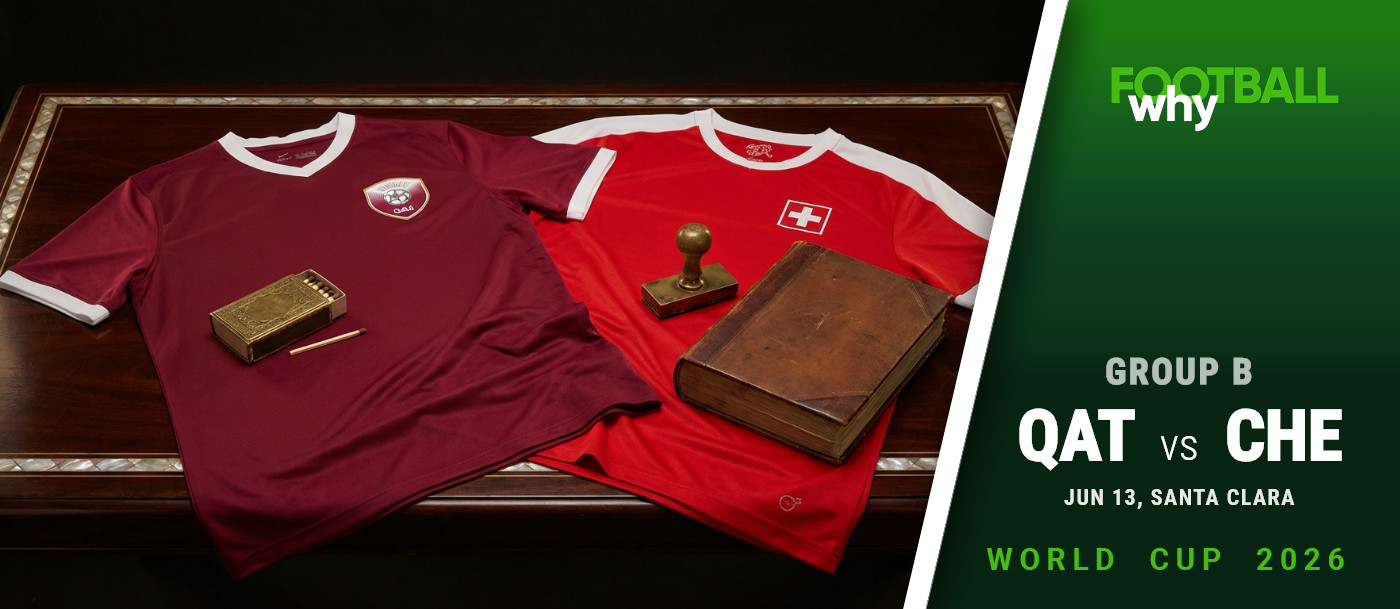
The World Cup Qualification Decider


Levi's Stadium, Santa Clara
SCORE BY AI PREDICTION: 0:2 SEE SIMULATION

Qatar vs Switzerland FIFA World Cup 2026 Group Stage Match Drafting the Diplomatic Protocol for Desert Containment Forecast generated:

The sun-baked patience of the majlis meets the cold, uncompromising precision of an Alpine vault. It is a clash between a host waiting for a singular, mandated spark of magic and a collective militia determined to insure against every conceivable risk.

Qatar: One side's prayer...

Qatar arrive bearing the heavy, uncomfortable weight of their state-funded footballing project. The domestic public demands a performance that validates their soft-power ambitions, terrified of reverting to a shapeless, scrappy identity. The cancellation of their March friendlies stripped them of vital elite-level rehearsal, leaving them stepping into the tournament like actors pushed onto a stage without a dress rehearsal. Fortunately, talismanic striker Almoez Ali has fully recovered from winter leg surgery, and Homam Ahmed is cleared, giving Julen Lopetegui his preferred, heavily drilled cast.

Switzerland: ...head-on with the other.

Switzerland step onto the pitch desperate to scrub away the lingering stench of their recent defensive collapse against Germany. The national expectation is a return to absolute, drama-free reliability. The squad has had to weather unhelpful off-field static, specifically the media circus surrounding Breel Embolo’s summer court ruling for threatening behaviour, which briefly tested their famous dressing-room cohesion. However, with the noise compartmentalised and Ruben Vargas fit after a January hamstring relapse, they are primed to drop the shutters and dictate the game’s temperature.
Qatar vs Switzerland Structural Collision

Qatar: How we will host...

Dream
Avoiding defeat is the absolute basement, but a narrow, controlled victory is the state-mandated ideal. They desperately want to shed the accusation of being a team without an identity, protecting their national image against European opposition.

Strength
They are a product of heavy investment and academy patience. The side operates like a well-rehearsed orchestra, relying on a deeply ingrained, process-first collective structure to feed their talisman, Akram Afif. They trust the script.

Plans
The blueprint is to drag the game into a comfortable, rhythmic tempo. They intend to isolate Afif on the left flank, using him to draw fouls in dangerous areas, while aggressively screening the Swiss midfield orchestrator to force the play wide.

Fears
Chaos is their ultimate enemy. When the match becomes a frantic, athletic sprint, their belief evaporates into sterile, U-shaped passing and a nervous over-reliance on set-pieces. The terror of improvising off-script can paralyse them.

Switzerland: With what we arrive...

Dream
A clinical, drama-free victory that definitively restores their defensive reputation. Following a recent collapse, the Swiss public demands a display of airtight competence, devoid of emotional volatility. They want a performance that feels like a meticulously executed civic audit.

Strength
They are a triumph of diligent engineering and multilingual cohesion. The squad operates like a perfectly calibrated mechanism, relying on seasoned role-fidelity and collective discipline rather than individual ego. They trust the system implicitly to navigate turbulence.

Plans
The strategy is built on diplomatic containment. They intend to shepherd Qatar's talisman down the touchline into a carefully orchestrated trap, before springing rapid, cross-field switches to exploit the vacated spaces on the opposite flank.

Fears
A chronic vulnerability to late-game psychological sinking. When the pressure mounts in the dying minutes, their natural instinct is to retreat into a deep, risk-averse shell, inviting the very chaotic penalty-box scrambles they desperately wish to avoid.
19%
27%
54%
Not a recommendation for betting
Tap [+] to cast your expert forecast. Can you outperform both the AI and the crowd?

How it will be...

This contest will likely resemble a local council meeting repeatedly interrupted by a lone, brilliant busker. Switzerland will impose a suffocating, bureaucratic rhythm, shifting the ball horizontally to drain the game of any volatile emotion. Qatar will sit politely in their shape, waiting for an official mandate to attack.

The entire spectacle hinges on Akram Afif's mood. If the Qatari playmaker can slip the Swiss marking trap, his sudden, slaloming inside cuts might just shatter the meticulous Alpine insurance policy. Yet, Granit Xhaka will be waiting to quietly recalibrate the distances, ensuring the Swiss defensive block absorbs the shock without fracturing. The true psychological test arrives in the final twenty minutes.

Should Qatar find themselves chasing the game, their heavily engineered composure could easily dissolve into a frantic, disjointed scramble. If the Swiss defence gets spooked by the noise and drops too deep, we might witness a desperate barrage of Qatari crosses. Tune in to see if a single flash of romantic improvisation can outwit a team that has meticulously filed away every possible risk.

Secret mastermind intent

Lopetegui’s Majlis Mandate: Patience, Shade, and Sudden Strikes

General Strategy
Lopetegui wants to dictate the match through measured, positional control rather than frantic pressing. The team will sit in a disciplined 4-4-2 mid-block, waiting for the opponent like a cautious host at a formal majlis. They engage only when the ball reaches the middle third.

The primary attacking focus is channelled entirely through the left half-space. The aim is to circulate the ball patiently until a window opens for Akram Afif to exploit, relying heavily on set-pieces to break the deadlock.
Antidote for the Opponent
The major defensive priority is suffocating Granit Xhaka. The forwards are instructed to screen his forward-facing receptions, forcing the Swiss to build heavily down their left touchline where pressing traps can be set.

In possession, the plan is to isolate Afif against the Swiss right wing-back. If Xhaka pinches across to help, Afif will immediately rotate centrally to attack the seam between the two centre-backs.
Internal Task Solving
The manager relies heavily on pre-coded corner routines to bypass open-play struggles. They have a strict two-corner mix, alternating between a near-post flick and a direct outswinger for a delayed far-post run.

They will also exploit hydration breaks as tactical micro-windows. These pauses are used to manufacture deliberate tempo spikes, injecting ten-minute bursts of urgency into an otherwise highly conserved physical output.
Crisis Response Plans
If the Swiss overload the left side and create a numerical advantage, the structure flattens into a rigid 4-2-3-1. The defensive midfielder drops alongside the pivot, and the full-backs freeze their forward runs.

Lopetegui is prepared to sacrifice attacking width to restore central stability. The team is drilled to attack the opposite flank early in these moments, attempting to drag the Swiss wing-backs back into their own half.
Specific Match Orders
Jassem Gaber: Shadow the primary playmaker on his first touch in the middle third. If beaten, commit a tactical foul early and strictly outside the central danger zone. Akram Afif: Start out wide on the left and invert during the second phase of play. If the midfield cover steps across, occupy the central space for ten-minute bursts and actively draw fouls to win dead-ball platforms. Pedro Miguel: Hold an advanced position against the opposition wing-back and time a delayed run to the far post on cross-field switches. Prioritise a defensive body shape over overlapping runs if holding a lead late in the game.
/ What if the opponent scores early or triggers a period of chaos?

The immediate protocol is to drop the defensive line by ten metres and revert to a double pivot. The players must kill any fast transitions with early fouls. The veteran captain will call a huddle to calm the nerves and reset the psychological baseline.

/ What if the primary creator is constantly double-teamed and shut out?

The winger will swap flanks or move into a central playmaking role for a designated ten-minute spell. The left-back then assumes total responsibility for providing width on that side, ensuring the attacking shape is not completely blunted by the double-team.

Secret mastermind intent

Yakin’s Civic Audit: Protocol, Containment, and Redundancy

General Strategy
Murat Yakin will deploy a methodical 5-2-3 mid-block, prioritising structural integrity over frantic pressing. The approach is akin to a meticulous insurance policy, designed to eliminate risk and govern the pitch through central stability.

Possession will be patient and pattern-based. They will happily trade territory for shape, waiting for the precise moment to launch measured vertical passes once control is fully secured.
Antidote for the Opponent
The entire defensive architecture is geared towards neutralising the Qatari playmaker. The right wing-back will aggressively show him down the outside channel, while the central midfielders shade the inside lanes to cut off his preferred passing angles.

Offensively, the Swiss will deliberately overload the left flank to draw the opposition's defensive block. Once the trap is set, a rapid diagonal switch will target the isolated runner on the right.
Internal Task Solving
To combat their historical tendency to collapse deep in the dying moments, the defence employs a strict verbal trigger. The central anchor will bark orders to physically reset the line eight to ten metres higher at every dead ball.

They will also utilise micro-pressing bursts. Following any restart, the team will hunt the ball ferociously for ninety seconds to disrupt the opponent's rhythm before settling back into their disciplined block.
Crisis Response Plans
Should the opposition shrink the pitch and force a sterile horseshoe passing pattern, the backline will bypass the midfield entirely. The centre-backs are instructed to carry the ball forward and launch direct diagonals onto the striker's chest.

Yakin remains deeply averse to sweeping changes. Structural substitutions are strictly capped to designated windows around the hour mark, preserving the core spine of the team to maintain operational continuity.
Specific Match Orders
Silvan Widmer: Force the primary winger down the outside channel constantly. Do not overlap simultaneously with the right-sided forward unless the central midfielder has dropped into a covering position. Manuel Akanji: Resist the urge to chase the inverted winger into the midfield. Protect the central space first and only step forward once the striker's run has been fully tracked by a teammate. Gregor Kobel: Prioritise flat, drilled distributions out to the wing-backs to bypass the central pressing screen. Launch quick, long throws immediately if the opposition's talisman is caught out of position on the far side.
/ What if the opposition's talisman abandons the wing and roams centrally?

The team will instantly drop a wide forward into the midfield, forming a dense 5-4-1 shape. This temporary dam will clog the central zones for a five-to-eight-minute spell until the threat is neutralised and the original shape can be safely restored.

/ What if the team concedes early or suffers a sudden period of turbulent pressure?

The midfield orchestrator will deliberately slow the tempo to a crawl. The team will maintain a strict defensive shell, introduce a combative enforcer to win physical duels, and reassert maximum width before attempting any vertical passes.

MAIN SIMULATION 0'-25'

Both sides will likely open by sizing each other up, like two men refusing to fold a stubborn map in the wind. Switzerland sit in a rigid 5-2-3 shape with Granit Xhaka dictating the tempo. Qatar look to isolate Akram Afif on the left wing. Jassem Gaber acts as a dedicated shadow on Xhaka's first touch.

MAIN SIMULATION 25'-45'

Switzerland tilt the pitch, overloading the left before snapping the ball right like a tightly coiled spring. Embolo secures the ball, feeding Ndoye to cut it back for a probable Swiss opener. Qatar react by dropping deeper and flipping to a 4-2-3-1. Afif drifts inside to find pockets of space, prompting a Swiss midfield reshuffle.

MAIN SIMULATION 45'-65'

Qatar inject a sudden dose of urgency, pushing the tempo in desperate ten-minute bursts. Afif takes a central licence to roam, while Homam provides the width on the left. The hosts manage a dangerous near-post flick. Switzerland are perfectly happy to weather the storm, introducing Denis Zakaria to harden the midfield duels.

MAIN SIMULATION 65'-90'

Qatar throw the kitchen sink at it, expanding into a frantic attacking shape. Switzerland respond by keeping their defensive line bravely high, refusing the instinct to sink into their own box. A sudden Swiss micro-press off a restart catches Qatar out. Embolo rolls his man and squares for Vargas to tuck away the second goal.

And it will come to...

If this forecast holds true, bureaucratic process would inevitably suffocate romantic improvisation. Should Switzerland's consensus-built, redundancy-rich plan function as designed, it would keep the high-value zones entirely clean. Qatar’s engineered control might look tidy, but it would painfully lack a second unpredictable creator once Afif was funnelled wide. Ultimately, the Swiss structure would survive the late chaos, proving that a well-oiled machine usually outlasts a singular, desperate spark.
end of Game