

The World Cup Qualification Decider
Saturday, 4 July

Lincoln Financial Field, Philadelphia

Paraguay vs France FIFA World Cup 2026 Group Stage Match A mugging interrupted by a video monitor Forecast generated:

Forty degrees of sweltering heat, unpunished elbows, and a cynical barricade that only a video monitor could break. Discover how a 70th-minute Mbappé penalty finally dragged this attritional back-alley brawl into the light.
Paraguay vs France Structural Collision

What was it?

Forty degrees of sweltering heat baked the pitch into a sticky, fragmented scrap. Elbows caught ribs, shirts stretched to tearing points, and ankles were routinely clipped as if scythes were being swung at stubborn weeds.

France absorbed this physical attrition with cold, Cartesian patience. They hoarded seventy-six percent of possession and forced twelve corners. The South Americans retreated into a deep, jagged five-man barricade, producing just 0.15 expected goals.

The official on the grass operated with a spectacular, almost willful blindness to the dragging and hacking. It took the introduction of Désiré Doué just past the hour mark to force the issue.

He drove centrally through the tired legs, drawing a blatant trip from Diego Gómez that was initially, predictably, waved away.

Only an intervention from the video booth dragged the referee back to reality. Kylian Mbappé converted the resulting penalty low to the right.

The Europeans simply clocked out and advanced. They survived an incredibly ugly afternoon, leaving their opponents to contemplate the limits of unpunished cynicism.

Why not go for the win?

Paraguay

The South American collapse stemmed directly from the physical toll of executing a purely destructive mandate. Defending in a hyper-compressed shape for extended periods rapidly drains cognitive reserves, inevitably leading to the clumsy, late challenges that gifted France their breakthrough.

Paraguay’s reliance on attritional friction is not a temporary tactical choice, but a desperate cover for an entirely hollow attacking framework. When their primary threat of dead-ball deliveries is neutralised — generating a mere two corners across the contest — the side lacks any alternative method of progression.

This creative void reflects the current generation's severe imbalance. The squad is heavily populated by rugged duel-winners and screening midfielders, yet fundamentally devoid of a central playmaker capable of dictating tempo or retaining possession under duress.

Such structural deficits are the inevitable yield of a domestic development system that prioritises endurance and physical combat over technical fluency. Academies consistently export stoppers and destroyers to neighbouring leagues, starving the national setup of progressive passers.

This reinforces the national myth that suffering and defensive grit are sufficient substitutes for tactical invention. When the romanticised ideal of survival replaces the actual mechanics of chance creation, a squad eventually runs out of luck and oxygen.

Attempting to hold off an elite opponent with only muscle and fouls is akin to patching a crumbling dam with dry dirt.

How did they clinch it?

France

The European victory was secured through a calculated refusal to engage in the chaotic emotional terms dictated by Paraguay. By anchoring the midfield with a disciplined double pivot, France absorbed the physical provocations without losing their structural geometry.

This cold composure allowed them to stretch the pitch methodically. Instead of forcing high-risk vertical passes into congested areas, they utilised wide rotations to slowly exhaust the opposing block, waiting precisely for the moment the defensive joints began to stiffen.

Such extreme patience highlights the luxury of a deeply resourced squad. The management knows they do not need to dominate the chance-creation volume; they simply need to introduce a fresh, elite ball-carrier against fatigued legs in the final third to force a structural error.

This pragmatic approach is deeply embedded in the current squad's identity. They operate with a tournament-hardened cynicism, prioritising efficient game management and transition control over the expansive, high-risk possession that the domestic public often demands.

Ultimately, this reflects a highly centralised, industrialised academy system. Players are forged to possess both elite physical profiles and strict tactical compliance, producing a generation that values systematic problem-solving over individual improvisation.

Victory is achieved not through overwhelming flair, but by methodically isolating the opponent's weakest variable and applying unbearable pressure.

They dismantled the opposition with the cold, inevitable precision of a hydraulic press crushing a hollow tin can.

Match hero...

Orlando Gill
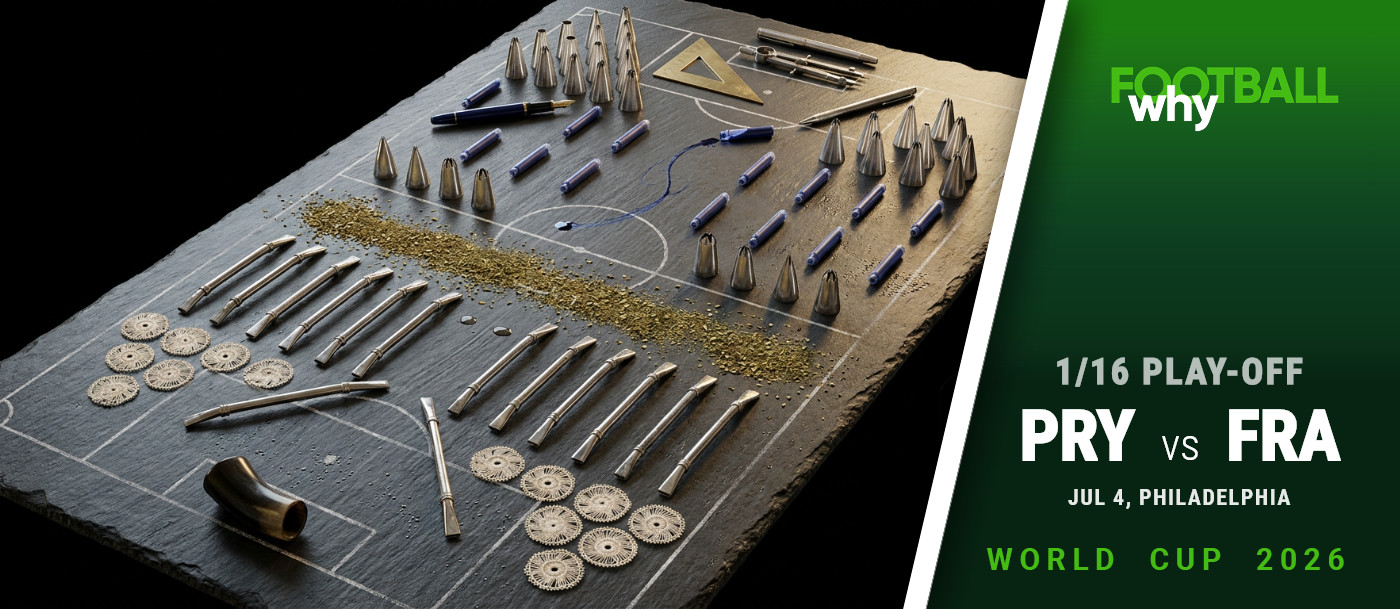
Orlando Gill operated less as a modern goalkeeper and more as the elder cebador of the squad, methodically cooling the mounting panic. While his teammates hacked frantically at European ankles, Gill absorbed the heat, claiming crosses and parrying shots with a heavy, unhurried authority. He exploited his massive frame and spatial awareness to shrink the angles, rationing his energy perfectly in the sweltering forty-degree furnace. He did not just save shots; he temporarily postponed an inevitable collapse.

...and one more

Désiré Doué
Désiré Doué arrived from the bench to act as the ultimate Jacobin override. France’s passing had become a sterile, horizontal debate, so Doué simply bypassed the committee. He used his explosive, low-gravity carry to drive a clean geometric line straight through the chaotic South American thicket. By isolating the tired centre-backs and attacking the exact seam of their exhaustion, he provoked the decisive foul. It was a surgical injection of pace that immediately validated the manager's Cartesian blueprint.