

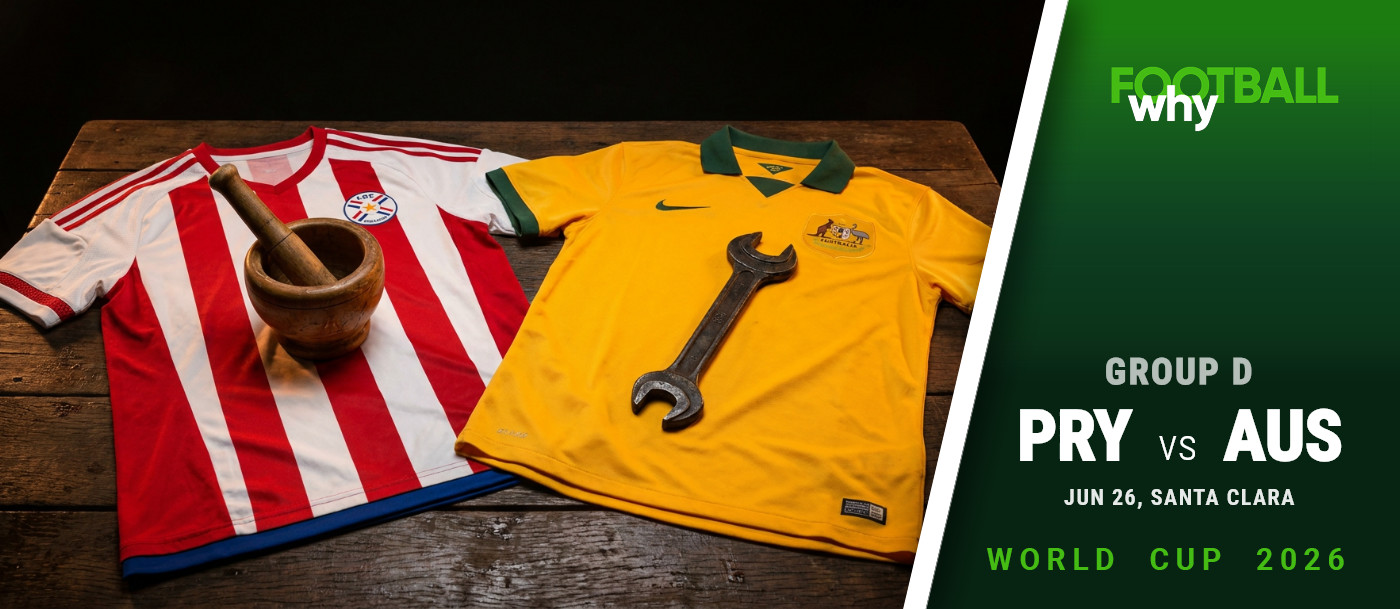
The World Cup Qualification Decider
Friday, 26 June

Levi's Stadium, Santa-clara

Paraguay vs Australia FIFA World Cup 2026 Group Stage Match A mutually beneficial exercise in structural stubbornness Forecast generated:

Ninety minutes of tactical gridlock that felt rather like watching paint dry in a damp room. With a combined expected goals tally of just 0.82, discover how two sides engineered the most cautious stalemate of the tournament.
Paraguay vs Australia Structural Collision

What was it?

The air in Santa Clara hung heavy, functioning rather like a damp provincial council meeting where nobody dared raise the first motion. It operated as an exercise in sheer structural stubbornness. The combined expected goals barely scraped a total of 0.82. Orlando Gill produced five early saves to secure the perimeter.

Anyone skipping the broadcast avoided a masterclass in risk-aversion, yet they missed a fascinating display of defensive joinery. Paraguay clamped together a 5-3-2 shape and refused to step out. They surrendered the midfield entirely. Australia commanded 56 percent possession, driving Jordan Bos down the right flank as though operating a repetitive mechanical piston. But they began without a recognized striker. The deliveries repeatedly drifted into an empty penalty area.

The defining anomaly was the sheer absence of chaos, highlighted by the South Americans earning just a single corner. By the 86th minute, the Australians folded backward into a 5-4-1 shape. They calculated the group mathematics and clamped the fixture shut. The final whistle arrived not as a sporting climax, but as a merciful click of a switched-off monitor.

Why stopped just short of victory?

Paraguay

Paraguay secured a draw because the qualification mathematics actively encouraged their most conservative instincts. They deployed a rigid 5-3-2 block and introduced Mauricio at half-time merely to mirror central numbers, willingly leaving Julio Enciso isolated up front.

This cautious posture highlights a current squad limitation. They consistently struggle to construct intricate open-play sequences against organized opponents, preferring instead to bypass the midfield entirely.

Their usual offensive fallback relies on dead-ball leverage. Yet, generating just a single corner kick across ninety minutes meant that avenue was completely shut down, forcing them to survive purely on defensive discipline.

This creative deficit stems directly from their developmental ecosystem. The domestic schooling system historically exports rugged defensive screeners and center-backs to neighboring leagues, heavily prioritizing physical duels over ball mastery.

Crucially, they possess a deep cultural comfort with enduring pressure. The 'garra guaraní' ethos frames defensive suffering not as a tactical surrender, but as a dignified, collective moral victory against larger opponents.

They feel entirely secure without possession, deferring to a consensus-driven backline to absorb the strain without breaking rank.

Ultimately, Paraguay operated like pragmatic negotiators at a border dam, perfectly content to halt the flow of the river and walk away with a dry, incremental gain.

Why stopped just short of victory?

Australia

Australia dominated the territorial battle but failed to break the deadlock due to a glaring absence in the penalty area. Starting a rotated front three meant their wide deliveries repeatedly drifted into unoccupied space.

The tactical choice to push Jordan Bos down the right flank provided excellent progression. However, the final action was consistently missing until Tete Yengi's late arrival finally offered a tangible physical target.

This attacking bluntness exposes a recurring limitation within the current squad. They rely heavily on wide transitions and second-phase deliveries, struggling significantly to sustain calm, central circulation when the initial rush is halted.

Such patterns stem from their broader developmental ecosystem. Their hybrid academy pathways consistently produce phenomenal athletes capable of executing high-intensity pressing, but they frequently fail to cultivate central creative guile or elite ball mastery.

When faced with a deeply entrenched block, the team lacks the technical nuance to navigate tight spaces. The national sporting ethos prizes relentless exertion and egalitarian work-rate over individual flair.

Consequently, they default to honest, repetitive running rather than subtle positional manipulation. If the opposition refuses to step out, the Australian attack eventually runs out of ideas.

Recognizing the stalemate, they folded backward into a 5-4-1 structure, packing away their tools like exhausted tradesmen accepting that the foundation was simply too hard to drill.

Match hero...

Orlando Gill
Orlando Gill operated as the undisputed guardian of the penalty area. His five saves were crucial, but his true value lay in dictating the emotional temperature. Acting rather like the elder cebador pouring the tereré, he intentionally slowed down restarts and collected crosses to cool Australia's momentum. He exploited his natural authority and the squad's cultural willingness to defer to their goalkeeper during crises, seamlessly organizing the defensive block whenever transitions threatened to become chaotic.

...and one more

Jordan Bos
Jordan Bos provided a relentless outlet down the right channel, shouldering the territorial burden for his side. Shifted to an unfamiliar wing-back role, he attacked the touchline with the uncomplaining stamina of an outback shearer working a double shift. He utilized his sheer aerobic capacity and physical directness to repeatedly bypass Paraguay's congested midfield. In a squad that prizes honest, egalitarian labor over individual indulgence, Bos’s willingness to endlessly shuttle up and down the pitch became their primary tactical weapon.