

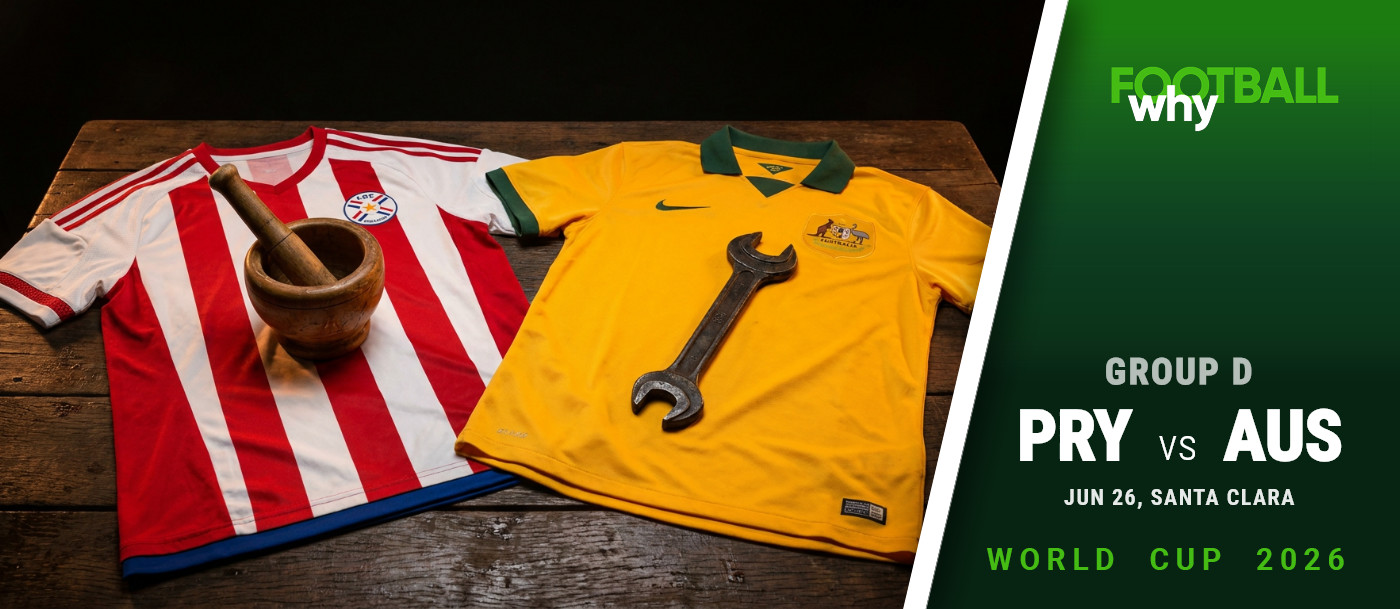
Group D, Matchday 3, Match #60
UTC

Levi's Stadium, Santa Clara

Prediction by whyFootball readers

PRY
DRAW
AUS
31%
30%
39%
Not a recommendation for betting
Tap [+] to cast your expert forecast.
SCORE BY AI PREDICTION: 1:2 SEE SIMULATION

Paraguay vs Australia FIFA World Cup 2026 Group Stage Match Industrial wing mechanics dismantling the stoic Guarani barricade Forecast generated:

The unyielding expanse of outback pragmatism collides with an ancestral memory of survival. It is a sheer industrial workload battering against a deeply ritualised trench; a profound test of whether egalitarian volume can dismantle a solitary, fortified brotherhood.

Paraguay: One side's prayer...

Paraguay arrive at this group-stage precipice facing absolute elimination if they fail to secure three points. The public mood is intensely unforgiving, demanding a restoration of pride after recent missteps and a bizarre distraction regarding their heavily ridiculed kit design — a PR disaster they must block out. Physically, Andrés Cubas is managing a quad strain, and Julio Enciso’s minutes remain strictly capped. They are essentially boarding up the windows for a siege, knowing any lapse in their collective endurance will simply send them packing.

Australia: ...head-on with the other.

Australia step onto the pitch gripping the calculator, needing a victory — and potentially a two-goal margin — to secure second place depending on the USA-Turkey result. The public demands a display of multicultural bravery intertwined with their traditional battler grit. However, Tony Popovic must navigate a patchwork right-back situation and carefully manage Harry Souttar’s return from an Achilles rupture, keeping him as a late tactical lever. They must operate like a relentless industrial piston, hammering the flanks without letting the pressure warp their structural discipline.
Paraguay vs Australia Structural Collision

Paraguay: How we will host...

Dream
Three points or the next flight home. The public mood is entirely unforgiving right now, demanding a restoration of pride after recent missteps. It is not about putting on a sparkling show; it is simply about surviving the night.

Strength
Their truest weapon is a stubborn, collective capacity to suffer. This is a team built on elder leadership and deep-rooted kinship, perfectly content to endure pressure for ninety minutes. They trust the man next to them completely.

Plans
Gustavo Alfaro intends to turn the match into a gritty war of attrition. They will specifically target the Australian right flank to draw cheap fouls, setting the stage for Gustavo Gómez and the big men to dominate dead-ball deliveries.

Fears
The overriding dread is being lured out of their defensive shell. If the game breaks open and forces them to chase possession, their structural discipline evaporates, leaving the forward line completely isolated.

Australia: With what we arrive...

Dream
This is a must-win scenario. The supporters are demanding a display of bravery without abandoning their traditional grit. They need a two-goal victory to truly contest the group standings, meaning the pressure to deliver is immense.

Strength
Their core identity is built upon an egalitarian, industrious work ethic. There are no prima donnas here; it is a squad that embraces travel, adversity, and honest physical labour. They will simply run until the job is done.

Plans
Tony Popovic wants to stretch the pitch entirely, focusing heavily on wide progression and underlapping runs down the left channel. The aim is to drag the opposition out of their shell and punish them with sharp cut-backs to the penalty spot.

Fears
The underlying anxiety is a reversion to aimless long balls when the midfield becomes congested. If they lose their composure in the central areas, they risk gifting cheap fouls and playing directly into the hands of a team that thrives on set-piece chaos.

How it will be...

The fixture should unfold as a territorial siege against a stubborn, low-slung barricade. Australia will likely monopolise the touchlines, feeding a relentless cycle of wide deliveries into the penalty area. Paraguay are perfectly conditioned for this exact hardship, treating defensive endurance not as a chore, but as a national vocation. Their centre-backs will absorb the initial aerial bombardment with stoic indifference.

Yet, the aesthetic monotony might fracture the moment Nestory Irankunda steps off the bench. The teenager’s raw acceleration introduces a volatile element to a previously ordered contest. If he isolates the Paraguayan left-back, his sudden inside cuts could bypass the collective shield entirely. The South Americans would be forced to abandon their rehearsed defensive scripts to contain him.

Late scoreboard pressure will severely test the structural integrity of both sides. Should Australia introduce a towering auxiliary striker, the dual threat of low cut-backs and back-post headers will stretch Paraguay’s defensive assignments. An eventual structural collapse seems probable. The Guarani defenders, usually unflappable, might finally vacate the central zones, leaving the penalty box unguarded for a decisive Australian arrival.

Paraguay: Why not go for the win?

They ultimately succumbed because the late dual-threat of wide cut-backs and a towering aerial target overloaded their defensive algorithms. Forced to chase the game, they abandoned their protective shell and vacated the top of the penalty area. Their chronic reliance on dead-ball scenarios simply left them devoid of open-play solutions.

Australia: How did they clinch it?

Victory arrived because their relentless wide-channel engineering eventually fractured a stubborn defensive block. Introducing a colossal target man late on provided the crucial skeleton key. Furthermore, their goalkeeper’s absolute authority under high balls neutralised the opposition's sole avenue of attack, while their collective discipline prevented any late structural collapse.

Secret mastermind intent

Gustavo Alfaro’s quiet siege and the cooling ritual

General Strategy
The primary directive is to freeze the scoreboard and establish a compact, combative medium block. Alfaro wants to deny central depth entirely, forcing the opposition to cycle the ball harmlessly out wide.

It is a bit like civil service obfuscation: polite, unyielding, and designed to grind you down. Once possession is won, the transition must be immediate and direct, bypassing the midfield entirely to find the wide runners.
Antidote for the Opponent
A major focus is exploiting the patched-up Australian right side. Alfaro wants his wingers driving hard at that specific channel early on, aiming to draw fouls and create dead-ball opportunities around the box.

Defensively, the plan is to jam the greasy gears of Australia's wide overloads. The wingbacks will be forced to receive the ball to feet with their backs to goal, locking them into the touchline.
Internal Task Solving
A brilliant tactical quirk is the use of the indigenous Guaraní language for set-piece triggers. A simple touch of the ear or a two-handed gesture dictates whether the delivery hits the near-post or the back-post screen.

It is an unspoken commuter pact that completely shuts outsiders out of the loop. Additionally, if they take the lead, the goalkeeper has explicit instructions to modulate the tempo, killing the match rhythm at every restart.
Crisis Response Plans
If Australia's left-sided overloads begin producing too many crosses, the structural response is immediate. The right winger will drop back to form a flat five-man midfield, whilst the right-back holds his ground to block underlaps.

This acts as heavy frame sealant against the mounting pressure. Beyond this specific trigger, the bench is prepared to be pragmatic, ready to introduce a second target man late on if the team is forced to chase the game.
Specific Match Orders
Miguel Almirón: Start in the right half-space and feel completely free to invert early. In the final twenty minutes, operate essentially as a second striker to finish off counter-attacks. Avoid getting pinned to the touchline at all costs. Ramón Sosa: Drive directly at the opposition right-back on every single touch for the first fifteen minutes. Hunt for physical contact just outside the penalty area to win direct free-kicks. When defending, drop only to meet the line of the ball and no deeper. Omar Alderete: On corners, make the first run as a near-post screen against their tallest defender. During the second phase of the set-piece, stay high for one extra action if we are trailing.
/ What if they concede the opening goal?

The immediate response is a deliberate shock-cooling protocol. The team will slow all restarts for three or four minutes and compress into a tight 4-5-1 shape. The captain will call a huddle to settle nerves, before relaunching the attack through isolated wide runs and hunting for set-pieces.

/ What if the opposition brings on a pacey winger late in the game?

If an explosive substitute begins winning one-on-one duels, the defence will instantly apply a double-team using the full-back and a central midfielder. The full-back is strictly forbidden from overlapping. Any tactical fouls must be committed out wide, never in the central zones.

Secret mastermind intent

Tony Popovic’s industrial audit and the wide overload

General Strategy
The tactical blueprint demands a mid-high block, designed to squeeze the pitch and establish territorial dominance. The focus is on rapid, vertical transitions out to the flanks, avoiding intricate central build-up unless absolutely necessary.

It is a highly pragmatic, process-driven approach. They will methodically cycle the ball wide, looking to create overloads and hit early, flat crosses or cut-backs into the penalty area.
Antidote for the Opponent
Knowing the opposition relies heavily on deep, floated deliveries, the defence is instructed to aggressively deny those passing lanes. Furthermore, the golden rule for this match is absolute discipline near their own box: zero cheap fouls within thirty metres.

In attack, the strategy involves a deliberate asymmetry. The left wing-back is given a high attacking license to create overloads, while the right wing-back will sit slightly deeper to secure the rest-defence against counter-attacks.
Internal Task Solving
A fascinating, brutalist wildcard is the potential late introduction of their tallest centre-back as an auxiliary striker. If they are chasing a goal in the dying minutes, he will be thrown forward to wreak havoc during set-pieces and final phases.

It is an unashamedly blunt instrument, but highly effective. The entire squad operates under a strict 'mateship' protocol: no public blame, total role clarity, and an expectation that everyone simply gets on with the job.
Crisis Response Plans
If the wide deliveries become sterile — yielding numerous crosses but minimal actual threat — the system will pivot to a 4-2-3-1. A central playmaker will be introduced to operate in the half-spaces, aiming for quick wall passes rather than relying solely on the wings.

Popovic is not one for policy drifting; if the initial plan stalls, he will decisively alter the shape. The bench is primed to inject pace and directness if the game remains deadlocked past the hour mark.
Specific Match Orders
Mathew Ryan: Command the penalty area aggressively and claim all incoming crosses. If leading, deliberately slow down the restarts. Absolutely forbid early long balls unless a clear target lane is visible. Jordan Bos: Constantly alternate between overlapping and underlapping runs. Prioritise cut-backs to the penalty spot rather than floating crosses. If you feel any hamstring tightness, drop your starting position by five metres and recycle possession safely. Jackson Irvine: Time your third-man surges from midfield to arrive late into the penalty box. Be the primary trigger for the counter-press the moment possession is lost.
/ What if the opposition scores first?

The immediate reaction is to pause the high press for ten minutes. The team will slow the tempo down, add an extra connector touch in the central areas to regain control, and strictly avoid spamming long balls before the hour mark.

/ What if the opposition wins early set-pieces near the box?

The engagement line will instantly drop by eight metres. The wide pressing traps will be halted, and the defenders will be instructed to employ a no-contact containment strategy near the penalty area, forcing the opposition to try and play through them instead.

MAIN SIMULATION 0'-25'

Australia will likely build their early attacks down the left, using Jordan Bos's underlaps to bypass Paraguay's medium block. In response, Paraguay are expected to funnel quick diagonals toward Ramón Sosa, deliberately targeting the Australian right-back. This territorial arm-wrestle should see the Aussie defender pick up an early booking around the nine-minute mark. Paraguay will then happily drop into a stubborn 4-5-1, trading possession for foul equity and forcing Australia to cycle the ball wide.

MAIN SIMULATION 25'-45'

Paraguay's patient dead-ball plotting should pay off around the half-hour mark. A rehearsed short corner is expected to drag an Australian centre-back out of position, allowing Omar Alderete to bury a back-post header. Australia will immediately initiate a recovery protocol, slowing the tempo and adding extra passes in midfield to avoid a panicked collapse. Paraguay will comfortably retreat, narrowing their wingers and meticulously managing the clock, perfectly content with a low-event grind.

MAIN SIMULATION 45'-65'

Australia will likely raise their pressing line and finally crack the safe around the 55th minute. A driven cut-back from Bos should force a central parry, allowing McGree to sweep home the rebound. The introduction of Nestory Irankunda shortly after will inject raw chaos, stretching the Paraguayan left-back and drawing a booking. Rattled, Paraguay are expected to call a captain's huddle, attempting to artificially cool the match temperature and revert to hitting long, safe diagonals.

MAIN SIMULATION 65'-90'

Desperation will stretch the tactical fabric in the final twenty minutes. As Australia relentlessly overload the left flank, they will introduce Harry Souttar as an auxiliary target man. This dual-threat of low cut-backs and a towering back-post presence is designed to break Paraguay's defensive algorithms. Around the 84th minute, a floated Bos cross meeting Souttar's head should seal the comeback. Paraguay will likely abandon their shape for a frantic 4-2-4, forcing Australia into a deep 5-4-1 trench to weather the final storm.

And it will come to...

If this forecast holds true, Australia’s relentless wide mechanics and pragmatic teamwork would ultimately outlast Paraguay’s stoic defensive identity. Paraguay might execute their low-block blueprint brilliantly for an hour, but the dual stress of continuous cut-backs combined with a late aerial bombardment would inevitably crack their resolve. Should the South Americans be forced to chase the game late on, their structural discipline would fray, proving that a deep trench is excellent for survival until you actually need to climb out.
end of Game