
Group I, Matchday 3, Match #61
UTC

Gillette Stadium, Foxborough

Prediction by whyFootball readers

NOR
DRAW
FRA
23%
28%
49%
Not a recommendation for betting
Tap [+] to cast your expert forecast.
SCORE BY AI PREDICTION: 1:2 SEE SIMULATION

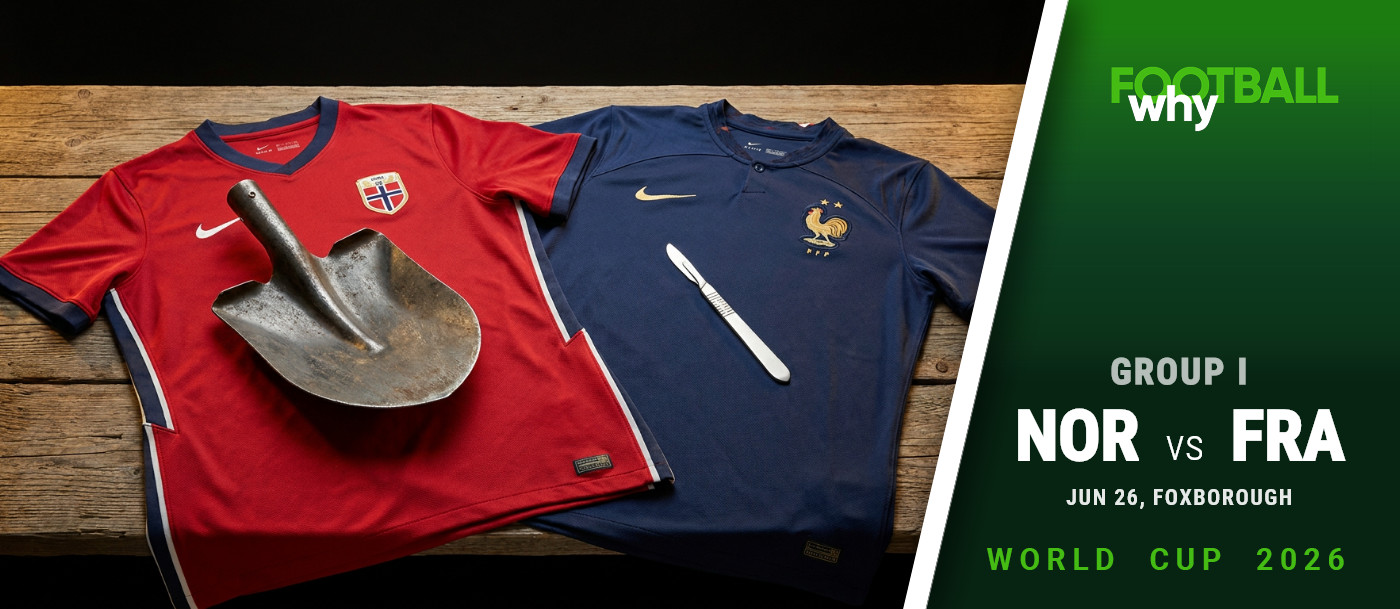
Norway vs France FIFA World Cup 2026 Group Stage Match A silver scalpel slicing through the winter barricade Forecast generated:

The communal instinct of the frost collides with the arrogant refinement of the salon. A fixture where an unshakeable faith in shared toil attempts to blunt the surgical precision of those who consider victory their birthright.

Norway: One side's prayer...

Norway approach this final Group I fixture knowing a draw secures second place, but a victory claims the summit. The mood is pragmatically tense, heavily shadowed by the daily management of Martin Ødegaard’s fragile knee. The domestic public expects nothing less than collective defiance against superior individual talent. They are essentially laying sandbags against a rising tide, preparing to absorb the inevitable French surges through sheer communal discipline and physical grit.

France: ...head-on with the other.

France require merely a point to top the group, yet the Parisian press demands an authoritative victory to validate their elite status. The squad arrives unblemished, having carefully managed the physical loads of Antoine Griezmann and William Saliba during earlier fixtures. There is a cool, hierarchical certainty within the camp, mercifully devoid of domestic soap operas. They intend to systematically dismantle the scaffolding of the Norwegian defence, relying on calculated possession to expose structural flaws.
Norway vs France Structural Collision

Norway: How we will host...

Dream
A draw secures second place, but a win guarantees top spot. Norway approach this with respectful confidence, seeking to prove that their disciplined, collective effort can outsmart bigger reputations without abandoning their core structure.

Strength
Their primary weapon is a stoic, industrious organisation. They are a team built on flat hierarchies and shared labour, defending in a compact shell and dominating the aerial battles. They do not chase spectacle; they wait patiently for controllable moments to strike.

Plans
Ståle Solbakken intends to manage the game’s temperature carefully. He will set a mid-block to deny central access, funneling French attacks out wide. The attacking plan is simple: exploit the space left by Théo Hernandez and deliver early crosses for Erling Haaland to attack.

Fears
The underlying anxiety is over-reliance on their captain's fragile knee. If Martin Ødegaard has to leave the pitch early, their ability to control possession drops sharply. Furthermore, if they are forced to chase the game, their rigid structure can stretch, leaving them vulnerable to rapid counter-attacks.

France: With what we arrive...

Dream
A draw secures the top spot, but the French public demands a victory delivered with Cartesian clarity. They expect their team to project modern excellence, brushing aside the opposition with an effortless, aristocratic grace that justifies their elite status on the world stage.

Strength
Their primary asset is an almost arrogant depth of tournament-hardened talent. They operate with a cool, hierarchical certainty, perfectly content to absorb pressure in a disciplined shape before deploying devastating, vertical surges that simply outclass the opposition through sheer athletic and technical superiority.

Plans
Didier Deschamps will establish a methodical, structured shell. The blueprint relies on drawing the opponent's right side forward, then rapidly switching the play to isolate their star forwards in one-on-one footraces. It is an exercise in calculated opportunism, waiting for a single structural crack.

Fears
The lingering anxiety is a descent into predictable star-reliance. If they repeatedly force the ball down the left flank without proper midfield buildup, their attacks become disjointed. This invites a chaotic, transition-heavy game that entirely disrupts their preferred sense of total control.

How it will be...

The encounter should project an asymmetrical friction. Norway will erect a dense, communal barricade, while France will attempt a clinical dissection of the turf. Do not tune in expecting a sprawling, open exchange; this will be a rigid negotiation of territory. Patience remains the sole currency.

We anticipate witnessing the dugnad ethic fully realised: a synchronised retreat where every Scandinavian shadows his neighbour’s movement. Conversely, Antoine Griezmann will conduct affairs from the interior channels. The French playmaker habitually translates impenetrable defensive knots into elementary theorems with a single, disguised pass.

Yet, the rupture will likely sprout from a singular imperfection. Should Kristoffer Ajer yield to the urge to abandon his quadrant, he will fracture the Norwegian consensus. In that specific void, Kylian Mbappé will detonate his supersonic stride. The Parisian forward invariably punishes positional disobedience with an icy, terminal finish.

Despite the visitors' probable control, the hosts rarely capitulate quietly. In the dying embers, we should expect a rudimentary, yet ferocious, aerial bombardment. Erling Haaland’s sheer physical gravity within the six-yard box will almost certainly force Mike Maignan into an unorthodox, scrambling intervention. It serves as a reminder that even the most enlightened republic can shudder when confronted by a sudden winter squall.

Norway: Why not go for the win?

They succumbed to a solitary positional transgression. Ajer’s slight forward step dismantled the containment on the French winger, yielding the decisive concession. Although Maignan denied their late equalizer, the defeat exposes a chronic limitation: against elite opposition, their creative avenues wither without the blunt instrument of aerial dominance.

France: How did they clinch it?

They triumphed through an exacting administration of the opponent's errors. Griezmann’s vision and Mbappé’s finish exploited the singular fracture in the local barricade. Maignan subsequently sealed the outcome. Ultimately, their Jacobin reflex prevailed: confronted by aerial trauma, they centralized command, suffocated the chaos, and secured the points.

Secret mastermind intent

Ståle Solbakken's winter forethought and collective dugnad

General Strategy
Solbakken is treating this match like preparing a house for a severe winter storm. He wants a compact, methodical 4-5-1 mid-block, sitting roughly halfway up the pitch. The primary focus is to deny France any easy central access through the midfield.

When winning the ball, the instruction is not to rush blindly forward. They will look for structured progression, moving the ball to the half-spaces before delivering early diagonal passes or cut-backs into the penalty area.
Antidote for the Opponent
The defensive trap is specifically designed for Kylian Mbappé. The right-back will start deeper than usual, showing Mbappé the touchline, while a midfielder permanently doubles up on the inside lane to block his route to goal.

In attack, Norway will aggressively target the space behind Théo Hernandez. The plan is to draw the French defence, slip a pass behind the advancing full-back, and hit early, low crosses towards the near post for the striker to attack.
Internal Task Solving
A major internal consideration is managing Martin Ødegaard's workload due to a persistent knee issue. There is a pre-agreed window for his substitution, likely around the hour mark, depending on how heavy the pitch feels.

Fascinatingly, Solbakken has instituted a collective sprint protocol for the first defensive set-piece after scoring a goal. This is designed to immediately reassert their physical dominance and lower the emotional temperature of the match, preventing any post-goal complacency.
Crisis Response Plans
If the initial structure frays and the game becomes too open, Solbakken will enforce a strict tactical timeout. The team will revert to safety-first passing lanes, actively hunt for set-pieces, and cap the tempo of the game until they regain their shape.

Should the French isolate Mbappé successfully early on, the manager is ready to drop the defensive line even deeper. The right-sided midfielder will track all the way back to the full-back line, forming a rigid five-man defence.
Specific Match Orders
Julian Ryerson: Start five yards deeper than the rest of the defensive line. Keep your body shape side-on to show the winger down the touchline. Do not try to win the ball on the front foot inside the penalty area; stay on your feet. Fredrik Aursnes: Form a permanent double-team on the left winger in our half. If the central playmaker drops into your channel, hold your position and let the defensive midfielder engage him first. Erling Haaland: Curve your pressing runs to block the passing lane to their holding midfielder. Inside the box, attack the centre-back's inside shoulder early. Make your first movement towards the near post, then dart across his face for low cut-backs.
/ What if Mbappé breaks the double-team early?

If the French winger successfully isolates the full-back twice within the opening fifteen minutes, Norway will immediately shift to a deeper 4-5-1. The right-back drops further, the winger tracks back to form a back five, and centre-backs are forbidden from stepping out.

/ What if Ødegaard struggles with the tempo?

Should the captain show discomfort or if the pitch conditions hinder his passing, the midfield shape alters. A central midfielder will push higher to link play, a substitute will be introduced for controlled carrying, and the team will switch to earlier, longer diagonal passes.

Secret mastermind intent

Didier Deschamps' Cartesian blueprint for controlled verticality

General Strategy
Deschamps treats the match like a meticulous building inspection. He demands a compact 4-4-2 shape sitting near the halfway line. The aim is to protect the central corridors, win duels without over-committing, and wait for structural cracks to appear in the opposition.

Once the ball is won, the transition must be ruthlessly efficient. The midfield is instructed to play a couple of stabilizing passes before instantly launching the ball into the left channel to exploit the speed of the front line.
Antidote for the Opponent
The tactical snare is set specifically for the opposition's right-sided centre-back. The forwards will use quick wall passes to bait him into stepping out of the defensive line. The moment he bites, a through-ball will be slipped across his inside shoulder.

Defensively, they are acutely aware of the aerial threat in the penalty area. The near-side centre-back is tasked with staying touch-tight on near-post runs, while the holding midfielder drops to explicitly block the cut-back zone.
Internal Task Solving
To prevent the team from lazily relying on their star winger, a strict possession rule is enforced. The ball must be passed at least twice centrally through the midfield before any attempt to isolate the left flank is permitted.

Additionally, the overlapping runs of the left-back are carefully rationed. To preserve energy in humid conditions and protect the defensive transition, these attacking bursts are only allowed upon a specific visual cue from the primary playmaker.
Crisis Response Plans
If the match devolves into chaos or a goal is conceded, a strict 'Jacobin override' is triggered. The manager will issue a single, authoritative sideline call to compress all distances. Full-backs will be frozen in their own half for five minutes to kill the momentum.

During this reset period, the central playmaker is ordered to spike his touch count. The team will lock into a 4-1-4-1 formation, playing short, risk-free passes until total order is restored.
Specific Match Orders
Kylian Mbappé: Start out wide on the left touchline. Wait until the third pass of the possession sequence before darting across the centre-back's inside shoulder. Only track back as far as the forty-metre line; save your sprinting legs for the counter-attacks. Théo Hernandez: Only overlap when the playmaker gives the signal or when the right-back has tucked in to form a back three. If the ball is lost, sprint back towards your own goal immediately. Do not look over your shoulder while recovering. William Saliba: Anticipate the striker making a double-movement towards the near post. Make early physical contact to disrupt his run, but do not follow him all the way to the touchline. Hand him off to the full-back and hold your position near the penalty spot.
/ What if the space behind the left-back is repeatedly exposed?

If the opponent successfully hits diagonal passes into that vacated channel twice, the defensive geometry shifts. The right-back will tuck inside permanently to form a back three, the left-sided midfielder will drop deeper to cover, and overlaps will be restricted to pre-agreed windows.

/ What if the opposition striker dominates the early crosses?

Should the opponent win the first contact on high deliveries, the holding midfielder will drop directly onto the penalty spot. The centre-backs will swap their marking orientation to front-screen the striker, and the full-backs will step up aggressively to block crosses at the source.

MAIN SIMULATION 0'-25'

Both sides will settle into rigid mid-blocks, resembling a tense parish council standoff where nobody wants to speak first. Norway bypass short goal-kicks entirely to keep the French press asleep, aiming early diagonals into the space left by Théo Hernandez. Julian Ryerson drops deep, while Fredrik Aursnes permanently doubles up on Kylian Mbappé. France try to bait Norway forward, but Kristoffer Ajer stubbornly refuses to step into Antoine Griezmann's pocket. The result is a highly disciplined stalemate where structure overrides risk.

MAIN SIMULATION 25'-45'

France accelerate the tempo by resetting the ball centrally to drag Norway out of shape. The turning point arrives with a yellow card for Ryerson at 31 minutes. This booking acts as a leaky washer in Norway's defensive plumbing. Hesitation creeps into their right-sided lock, and France exploit this at 37 minutes: a quick switch isolates Mbappé, who drills a cut-back for Griezmann to finish. Norway then immediately drop deeper and slow the game down to avoid a collapse before half-time.

MAIN SIMULATION 45'-65'

Norway lean heavily on their physical bulk, turning the match into an aerial bombardment. A wave of corners builds immense pressure on the French penalty area. At 58 minutes, a pre-planned routine sees Alexander Sørloth set a screen, allowing Leo Østigård to power home a header. France respond with municipal pedantry: they freeze all full-back advances and lock into a rigid 4-1-4-1 shape. Griezmann takes over to dictate the tempo, while Norway withdraw a tiring Martin Ødegaard to preserve his knee.

MAIN SIMULATION 65'-90'

The game stretches as both managers chase the win. France introduce a natural right winger to pin Norway’s left-back, while Norway switch to a 4-4-2, throwing Sørloth alongside Haaland. At 77 minutes, Ajer finally makes a fatal micro-error, stepping out too early. Griezmann instantly slides Mbappé across the defender's inside shoulder to score. Norway throw everything into late crosses. Haaland connects with a thumping 84th-minute header, but Maignan tips it onto the crossbar. France then shut the door completely.

And it will come to...

If this forecast holds, France’s surgical central control would ultimately outlast Norway’s collective grit. Should Ajer break the defensive line just once, Mbappé would undoubtedly extract the maximum penalty. Norway would validate their identity through immense set-piece power and structural discipline, but they would struggle to generate open-play chances without their captain. Ultimately, if France maintained their composure under aerial duress, their individual brilliance and late-game governance would secure the points, leaving Norway to rue fine margins.
end of Game