

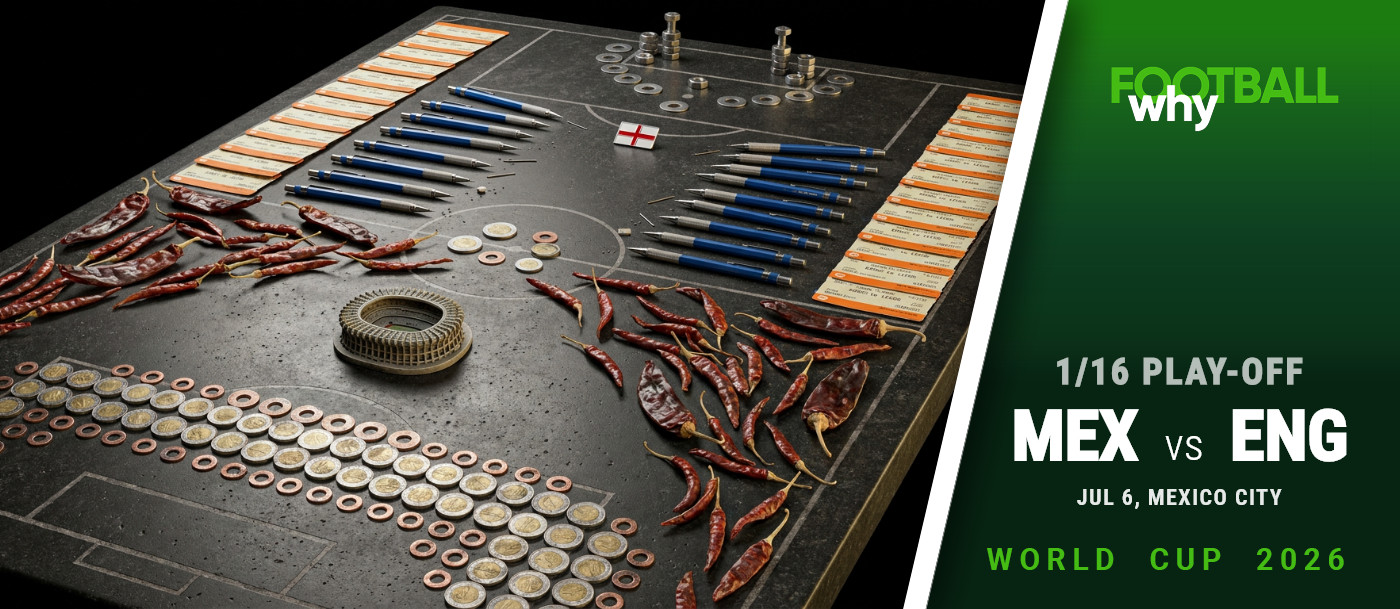
The World Cup Qualification Decider
Monday, 6 July

Estadio Azteca, Mexico-city

Mexico vs England FIFA World Cup 2026 Group Stage Match Drowning the noise: survival at altitude Forecast generated:

A breathless, rain-soaked siege at the Azteca. England survived thirty minutes with ten men, hacking away 48 clearances to protect a fragile 3-2 lead. Discover how a mechanical rearguard silenced eighty thousand voices.
Mexico vs England Structural Collision

What was it?

The thinning oxygen at the Azteca burned the lungs. Heavy rain slicked the grass, and eighty thousand voices drove the local side forward like a physical headwind. Jude Bellingham simply silenced the noise. He struck twice in 120 seconds, finishing quick transitions with the cold precision of a ledger clerk balancing the books.

Julián Quiñones volleyed a lifeline from a set-piece rebound shortly before the break. Then Jarell Quansah saw red on 54 minutes, and Thomas Tuchel immediately ordered a structural retreat. He introduced John Stones and Dan Burn to form a back five. Harry Kane and Raúl Jiménez traded penalties in a chaotic nine-minute spell, leaving the score at 3-2.

Down to ten men, the visitors abandoned possession entirely. Mexico flooded the penalty area with three strikers and swung in twelve corners. The English defence responded by heading and hacking 48 clearances into the night sky, their highest tournament tally since 1990. Jordan Pickford scrambled across his line to punch away danger. They absorbed the fury, clamped the gears shut, and survived.

Why not go for the win?

Mexico

Mexico’s emotional surge ultimately battered itself into exhaustion against an immovable shape. Javier Aguirre’s response to falling behind was to flood the penalty area, introducing three centre-forwards and sacrificing wide defenders for creative midfielders.

This created a frantic pursuit of volume. Instead of unpicking England’s low block through the centre, the side defaulted to swinging early, hopeful crosses from the flanks.

The half-time injury to César Montes had already forced structural patches in the backline, but the attacking haste proved more fatal. When the scoreboard pressure mounted, patient combinations vanished entirely.

The legendary aura of the Azteca pushed them forward, demanding a spectacle. However, that same crowd energy shortened their patience, demanding immediate strikes rather than methodical breakdowns.

This tendency to rush under stress exposes a deeper generational anxiety. The overwhelming desire to deliver on home soil, shadowed by the perennial 'quinto partido' complex, turns tactical discipline into impulsive hero-ball.

The domestic system consistently produces players with immense technical grit and combative spirit, perfectly suited for regional dominance. Yet, against elite European defensive automation, that raw passion frequently lacks the cold, calculated final pass required to break the lines.

They threw the entire weight of their history against a locked door, only to find that pure physical effort cannot forge a missing key.

How did they clinch it?

England

England secured their progression by entirely abandoning their possession ideals the moment adversity struck. The early red card could have triggered a structural collapse, but instead, it activated a deeply ingrained survival protocol.

Thomas Tuchel immediately withdrew attacking assets to construct a rigid five-man defensive line. The remaining forward players, usually the central figures of the narrative, accepted this shift without complaint, dropping deep to absorb pressure.

This capacity to suffer without fracturing highlights the tactical maturity of the current squad. They did not attempt to force progressive play while numerically disadvantaged; they simply cleared the danger and methodically reset their shape.

Such pragmatism is forged in the relentless churn of their domestic league. The players are accustomed to grinding out results in hostile winter fixtures, where securing the points often outranks aesthetic appeal.

Historically, the national team has buckled under tournament pressure, caught in a tug-of-war between tabloid demands for entertaining football and the inherent anxiety of knockout football.

Here, they completely ignored the spectacle. They embraced the sheer ugliness of the task, knowing that style points offer no protection against elimination.

They operated like a heavy, weather-beaten breakwater, perfectly content to let the storm crash over them without yielding a single inch.

Match hero...

Julián Quiñones
Julián Quiñones operated like a street vendor setting up shop on a blind corner. When England’s central structure blocked the main thoroughfares, he found his trade in the left channel. His goal wasn’t a product of grand design, but a scavenged second phase from a free-kick. He exploited the physical friction, turning broken plays into viable currency, and kept his side breathing when the tactical oxygen ran thin.

...and one more

Jude Bellingham
Jude Bellingham simply bypassed the usual queue for possession. Rather than waiting for patient, committee-led build-up, he seized on early transitions with brutal efficiency. His first-half brace established an immediate precedent, exploiting the spaces left by the hosts' emotional surge. Yet, when the red card forced a retreat, he quietly filed back into the ranks, clearing lines and respecting the defensive boundary like a dutiful citizen.