

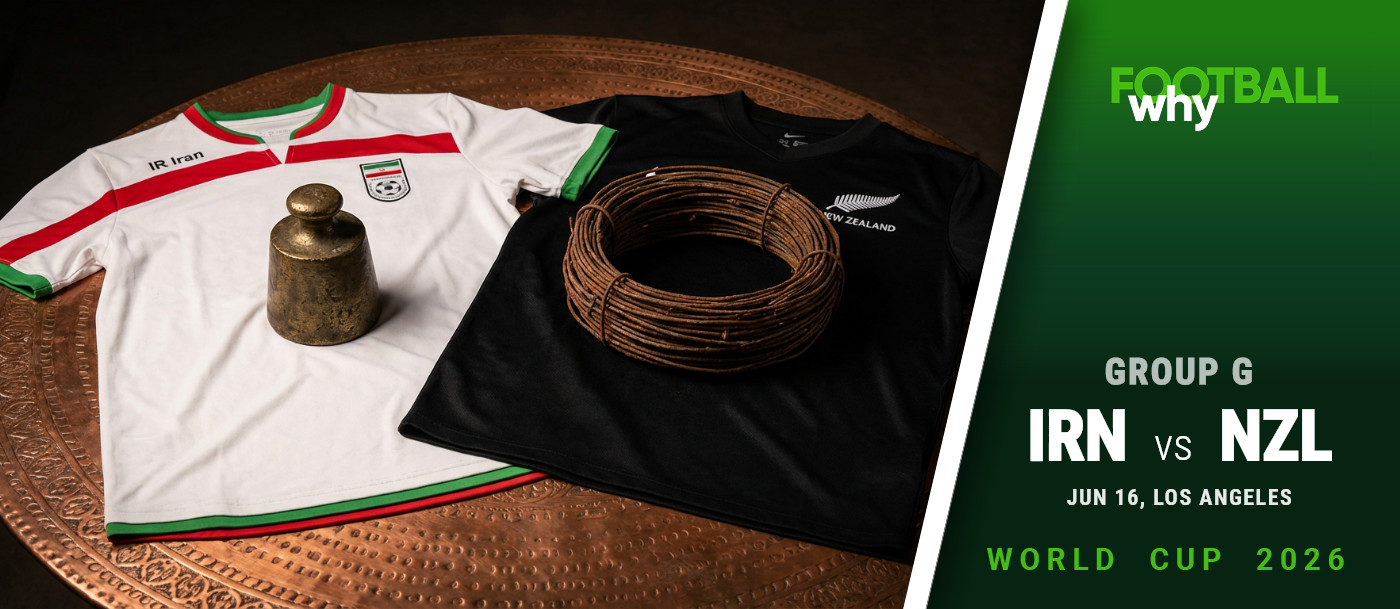
The World Cup Qualification Decider
Tuesday, 16 June

SoFi Stadium, Los-angeles

IR Iran vs New Zealand FIFA World Cup 2026 Group Stage Match Blown Fuses and Bypassed Midfields in Los Angeles Forecast generated:

Expected to be a cautious slog, this clash blew its fuses early, turning into a breathless 31-shot sprint. Discover how bypassed midfields and relentless right-wing overlapping tore the tactical scripts entirely to shreds.
Iran vs New Zealand Structural Collision

What was it?

The tactical circuit boards overloaded almost immediately. Seventy thousand spectators turned up expecting a cautious, attritional slog. They witnessed an open sprint that stretched lungs and ruined defensive shapes.

New Zealand attacked as if hoisting heavy scaffolding, bypassing the middle completely to drop long deliveries onto Chris Wood. He absorbed the physical contact and laid off two precise assists for Elijah Just. Those direct entries yielded a 2-1 lead by the hour mark.

The opposition responded by relentlessly drilling down the right-hand touchline. Ramin Rezaeian pushed incredibly high up the pitch to operate as a primary creator. He finished the evening with a goal and an assist.

Pre-tournament logistical chaos forced early substitutions, temporarily leaving the central midfield looking like a dismantled engine block. Space opened up wildly in transition. The eventual introduction of Ehsan Hajsafi tightened the left flank and allowed them to execute the cross-field switch for the final equaliser.

Anyone who skipped the broadcast missed a genuinely thrilling spectacle. It proved that rigid setups can still produce a breathless display of honest sweat, leaving a quiet admiration for the sheer physical effort on show.

Why stopped just short of victory?

Iran

IR Iran secured a point because they managed to recalibrate their structure mid-flight, even as physical exhaustion threatened to tear their defensive shape apart.

The early second-half introductions of Mehdi Ghayedi and Ali Alipour added necessary attacking runners but instantly hollowed out the central rest-defense.

Without a solid midfield anchor, New Zealand easily bypassed the pressing lines, forcing the Iranian backline into desperate, retreating sprints.

Stability only returned when Ehsan Hajsafi entered to lock down the left side, providing the structural baseline needed to launch accurate cross-field switches toward the right corridor.

This reliance on mid-game scrambling points to a squad running on fumes. Pre-tournament visa delays and disrupted travel itineraries clearly drained the players' physical reserves.

The manager was forced into reactive, cramp-driven substitutions rather than making proactive tactical upgrades.

Furthermore, the team leans heavily on an aging veteran core to navigate these chaotic spells. While this seniority guarantees emotional resilience under pressure, it severely limits the squad's ability to dictate the tempo.

The national football infrastructure consistently produces teams that thrive on defiance and a siege mentality, yet it struggles to develop modern, proactive midfield controllers.

They survive by absorbing the pressure, trusting their hardened veterans to mend the leaks just before the hull gives way.

Why stopped just short of victory?

New Zealand

New Zealand dropped a hard-earned lead because their defensive width fractured under sustained repetition.

The initial game plan functioned perfectly: bypass the congested midfield and use direct, vertical entries to exploit the spaces behind the high Iranian line.

However, after taking the lead, the team naturally sank deeper to protect the penalty area, inviting continuous pressure onto their fullbacks.

The late substitutions, particularly removing Liberato Cacace, completely disrupted the continuity on the left flank.

Fresh legs failed to translate into tactical awareness, leaving the back post repeatedly exposed to deep, weak-side crosses.

This inability to manage a lead highlights a broader tension within the squad.

There is a clear desire to implement a modern, pressing style, but under stress, the players instinctively revert to a deep, survivalist block.

They rely entirely on a single focal striker to relieve pressure, lacking the secondary ball-carriers needed to retain possession and kill the clock.

This tactical anxiety stems directly from their geographic isolation and regional dominance.

Cruising through the Oceania qualifiers rarely exposes the defensive unit to the relentless, high-speed problem-solving required against elite international wingers. When the intensity spikes, the muscle memory for controlled possession simply does not exist.

They construct a sturdy shelter from salvaged parts, only to watch it collapse under the weight of an unfamiliar storm.

Match hero...

Ramin Rezaeian
Ramin Rezaeian operated the right flank by rationing his bursts like a desert merchant calculating his remaining water. He did not sprint blindly; he bargained for space, waiting for the New Zealand shape to shift left before arriving unmarked on the blind side. His timing exploited the opposition's heavy focus on central aerial battles. By arriving late into the penalty area, he bypassed the physical confrontations entirely, quietly collecting the profit while the defenders watched the ball.

...and one more

Chris Wood
Chris Wood anchored the forward line like a deep-water mooring holding fast in a rising tide. He absorbed the blunt-force trauma of two centre-backs, refusing to be bullied off his spot. This allowed him to cushion dropping balls into the path of oncoming runners. He stripped the game down to its raw, industrial mechanics: draw the physical contact, protect the space, and lay the ball off simply. He survived the defensive battering to ensure others could run free.