

The World Cup Qualification Decider
Tuesday, 30 June

MetLife Stadium, East-rutherford

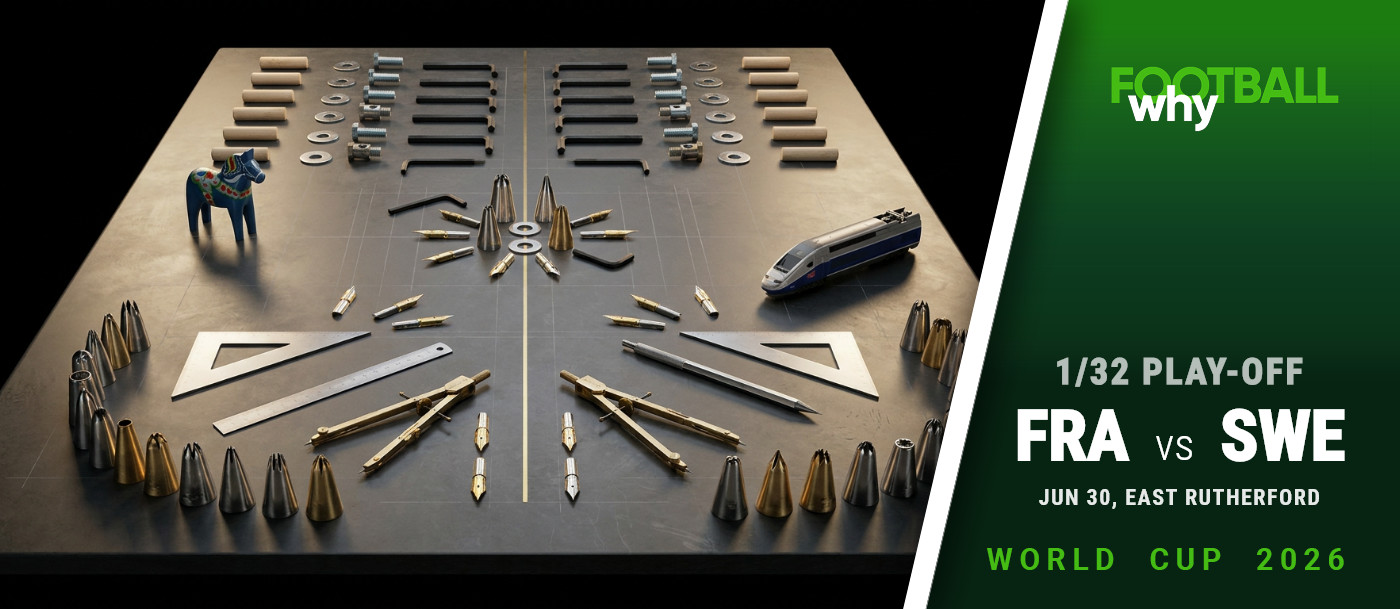
France vs Sweden FIFA World Cup 2026 Group Stage Match An administrative dismantling of yellow scaffolding Forecast generated:

France processed Sweden with the cold, administrative efficiency of a tax audit, racking up 25 shots in a chilling 3-0 victory. Discover how an unfeeling tactical blueprint systematically unbolted the Scandinavian scaffolding.
France vs Sweden Structural Collision

What was it?

The air inside MetLife Stadium felt heavy with inevitable bureaucratic processing. A yellow-shirted 4-4-2 block sweated and strained to maintain its shape, chasing blue shadows that unbolted their defensive pipework joint by joint.

Didier Deschamps’s men registered 25 shots and an expected goals tally north of three. Michael Olise operated with absolute freedom in the central corridors. He repeatedly threaded vertical passes through the exact gap between the Swedish left-back and centre-half.

Jacob Widell Zetterström offered a magnificent, solitary act of defiance. He produced nine saves to keep the scoreline faintly respectable. The woodwork also intervened twice early on to delay the inevitable.

But static resistance always expires. A short-corner routine bypassed the Swedish blueprint entirely on the stroke of half-time, allowing Kylian Mbappé to finish.

The second half was a mere filing exercise. Sweden pushed their lines higher without the tools to inflict damage, leaving vast tracts of space that Bradley Barcola and Mbappé gleefully exploited. You watch them jog off, barely sweating, and a cold realization hits: the trophy might already be theirs.

How did they clinch it?

France

France did not overwhelm Sweden with passion; they processed them through a highly regulated system. The foundation of this victory lay in a sterile, suffocating midfield pivot. By deploying Aurélien Tchouaméni and Adrien Rabiot, Didier Deschamps ensured that any Swedish transition was smothered before it crossed the halfway line.

Once a set-piece variation unlocked the scoring, the French tactical posture instantly cooled. They narrowed their risk appetite, tightening the rest-defence and allowing the opponent to overextend. The wide isolations were not about flair, but stretching the defensive fabric to its tearing point.

It is a calculated pragmatism that defines this current squad. They possess an embarrassment of attacking riches, yet strictly adhere to a hierarchical, risk-averse blueprint. Individual brilliance is permitted, but only as a finishing touch to a methodically engineered sequence.

This chilling efficiency is the direct yield of a national academy system that industrializes talent. The domestic pipelines mass-produce athletes who combine supreme physical conditioning with a strict respect for tactical discipline, integrating diverse backgrounds into one coherent, undeniable force.

They win because they have engineered the unpredictable chaos out of the sport, leaving only the cold, load-bearing mechanics of victory.

Why not go for the win?

Sweden

Sweden collapsed because their entire tactical framework was designed for survival, leaving no contingency for falling behind. They arrived with a strictly regimented 4-4-2, maintaining a compact two-line block that successfully denied central progress for nearly an entire half.

But a system built purely on resistance is inherently fragile. Conceding right on the interval forced an immediate, uncomfortable change in game state. When they pushed their wide players higher to chase an equalizer, the distances between their fullbacks and centre-halves fatally expanded.

This created the exact corridors the opponent was waiting to exploit. The inability to shift gears gracefully exposes a deeper flaw in the current squad. When forced to dictate play or chase a deficit, their attacking patterns skew toward low-percentage crosses and isolated forward runs.

Ultimately, this is the byproduct of a national footballing culture that strictly prioritizes collective order over individual audacity. The developmental pipeline champions reliability, positional discipline, and consensus, systematically weeding out the erratic, high-variance mavericks who might single-handedly salvage a broken game.

They built a magnificent, heavily reinforced shelter to survive the winter, but simply forgot to install a door to step outside when the storm finally broke inside.

Match hero...

Michael Olise
Michael Olise did not sprint; he audited the pitch. Operating as the central ten, his posture remained distinctly upright, head swivelling like a surveyor measuring property lines. He exploited Sweden's mid-block by simply waiting for the geometry to align, slipping passes into the fullback-centre-half channels. This wasn't frantic improvisation; it was the cool application of a Cartesian formula. He found the structural flaw in the yellow wall and politely handed his forwards the tools to dismantle it.

...and one more

Jacob Widell Zetterström
Jacob Widell Zetterström approached nine saves not as moments of glory, but as necessary winter maintenance. After parrying blistering shots, there was no chest-thumping — just a heavy resetting of his feet, sweeping snow from the porch while the blizzard raged. He survived the onslaught because his positioning was relentlessly orthodox, minimizing wasted movement. He became the ultimate ombudsman of the penalty area, dutifully logging complaints and denying entry to a French side that had already breached the outer perimeter.