

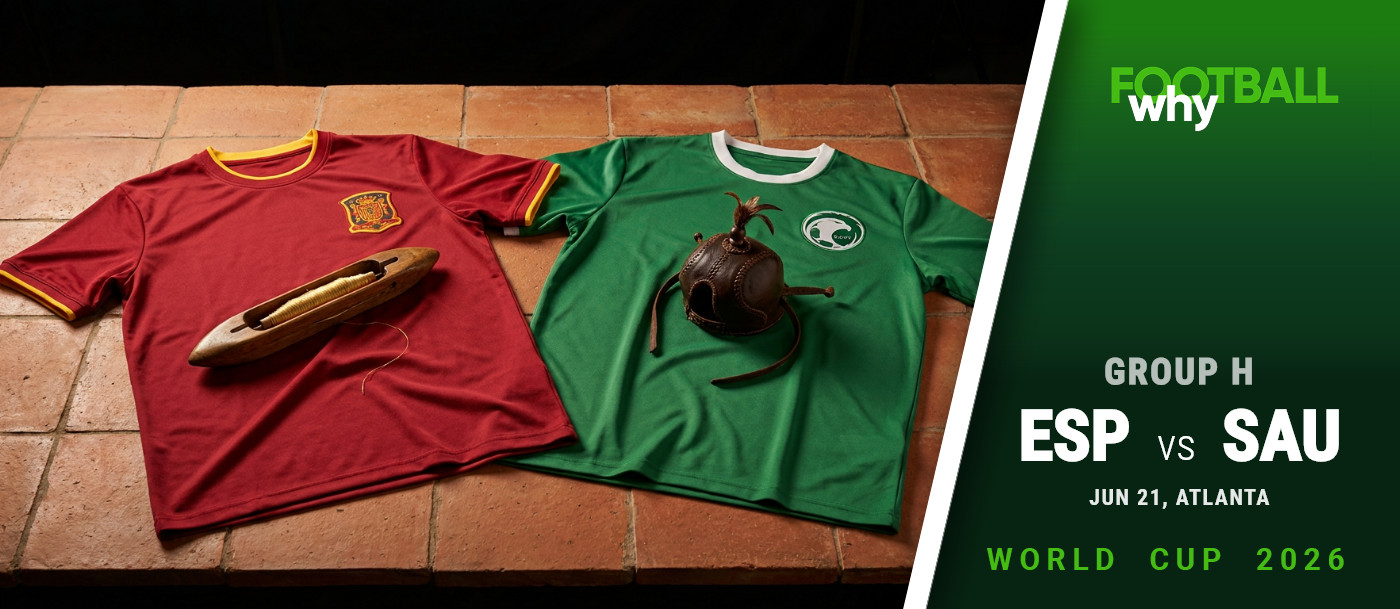
Group H, Matchday 2, Match #38
UTC

Mercedes-Benz Stadium, Atlanta

Prediction by whyFootball readers

ESP
DRAW
SAU
54%
0%
46%
Not a recommendation for betting
Tap [+] to cast your expert forecast.
SCORE BY AI PREDICTION: 3:0 SEE SIMULATION

Spain vs Saudi Arabia FIFA World Cup 2026 Group Stage Match Weaving the rope to pull the barricade down Forecast generated:

The consensus of the plaza against the stoic endurance of the desert. A choreography of woven passes meets an unwavering faith waiting for the right moment to unleash the storm. It is a clash between collective reason and the pride seeking redemption.

Spain: One side's prayer...

Spain enter the match carrying the heavy mandate of tournament favourites, expected not just to qualify, but to do so with the serene authority of their recent Euro 2024 triumph. The dressing room is deliberately insulated and calm, focused purely on resetting their rhythmic control after the chatter surrounding a recent 0-0 draw. The coaching staff are meticulously managing the physical loads of key midfielders like Pedri. There is also a heightened focus on behavioural discipline, following a recent FIFA spotlight on the team's conduct.

Saudi Arabia: ...head-on with the other.

Saudi Arabia arrive in a state of contrite, barricade-building survival. Following severe public backlash and media demands for the manager's sacking after their previous outing, the squad is desperate to display visible fight and limit the damage against elite opposition. The internal mood is tense but rallied around a leadership group demanding emotional control. They are carefully managing background noise regarding a dispute over the starting goalkeeper hierarchy, while also monitoring the match-fitness of their talisman, Salem Al-Dawsari, hoping he can tolerate sharp sprints.
Spain vs Saudi Arabia Structural Collision

Spain: How we will host...

Dream
The absolute minimum requirement here is to secure qualification early and shut down any lingering noise about their recent goalless draw. The expectation is to project authority, ensuring there are no cheap gifts handed over during defensive transitions.

Strength
This team’s core identity is built on rhythmic, collective control. They possess an elite midfield capable of acting as a human metronome, dictating the pace and ensuring safety before attempting anything risky. It is a deeply ingrained cultural habit: horizontal consensus must be established before making a vertical incision.

Plans
The manager intends to deliberately unbalance the pitch. By heavily overloading the left side, he hopes to force the opponent's defence into a corner, eventually creating a sudden, isolated one-on-one for Lamine Yamal on the far right. It is about stretching the fabric until a seam tears.

Fears
The recurring nightmare for this side is sterile possession. When faced with a deep, stubborn defence, their methodical passing can become a blunt instrument, leading to public impatience. If the game descends into a chaotic, end-to-end brawl, they risk losing both their structural integrity and their psychological comfort zone.

Saudi Arabia: With what we arrive...

Dream
The absolute baseline ambition is to scrape points to survive the group stage and dodge an early, humiliating exit. Following a fierce public backlash back home, the squad is under immense pressure to show some genuine grit. They must avoid a structural cave-in at all costs.

Strength
Their fundamental asset is a deeply ingrained collective resilience. They naturally default to a tight, industrious mid-block that chokes the central spaces. Once the ball is won, they rely on rapid, wing-led transitions to bypass the midfield entirely and hurt teams on the break.

Plans
The manager has drawn up a bespoke containment strategy to starve the opposition's star winger. He is ordering his own full-back to stay bolted to the defensive line, refusing the bait to attack. Furthermore, the goalkeeper is instructed to artificially slow the game down at every restart.

Fears
Their ultimate vulnerability is an emotional unravelling if they concede early. When the original plan suffers a dent, the team often abandons its shape in a desperate bid to save face. This frantic urge to restore honour usually results in chaotic, disconnected pressing.

How it will be...

The match will likely unfold as a methodical, asymmetrical siege. Spain will dictate the rhythm, heavily loading their left flank to erode the opposition's containment lines. We should expect to see the European side threading short, repetitive circuits to locate a structural flaw, whilst Saudi Arabia wait in a state of reverential, disciplined obedience.

Beneath this apparent monotony, a quiet duel of intentions will simmer. Lamine Yamal will act as a decoy on the far touchline; his feints to cut inside will command double vigilance. On the Saudi side, the instinct for self-preservation will entirely bury their right-back’s attacking urges.

The breaking point will probably materialise in the gloves of goalkeeper Nawaf Al-Aqidi. Should the stopper succumb to the sheer volume of efforts and spill a short rebound, the Asian block will shed its lethargy. Driven by the urgent need to salvage honour, they will push their defensive lines up in a disjointed scramble.

In that fractured environment, winger Salem Al-Dawsari might attempt to rebel against the European snare with sudden, angled darts. However, that very surge of pride will dismantle the Saudi compactness, gifting the Spanish midfield the exact acreage they require to finalise the contest.

Spain: How did they clinch it?

Spain constructed their victory by capitalising on a short goalkeeper rebound, the inevitable result of sustained pressure. This advantage forced the opposition to abandon their trenches. Structurally, the discipline to keep their right-back withdrawn completely neutralised the counter-attack, validating their historical matrix of territorial control.

Saudi Arabia: Why not go for the win?

Saudi Arabia fell victim to an unforced error between the posts that detonated their defensive script. Following the goal, the desperation to equalise dissolved their midfield compactness. Systemically, they paid a heavy price for their reliance on a single winger for relief and a lack of exposure to relentless elite circulation.

Secret mastermind intent

De la Fuente's municipal blueprint: left-lane scaffolding

General Strategy
The central strategy revolves around deliberately tilting the pitch to the left to pin the opposition back. Luis de la Fuente wants to build structural superiority down one flank, essentially laying all the scaffolding on one side of the building. The team will maintain a high-mid defensive line to smother backwards passes.

Simultaneously, the right-back will operate from a much deeper starting position than his counterpart. This asymmetrical shape is designed to provide immediate cover against counter-attacks, prioritising structural safety over reckless forward runs.
Antidote for the Opponent
A primary focus is exploiting the space behind the Saudi right-back. The plan involves alternating underlapping and overlapping runs to confuse the defensive markers. It is about applying constant pressure to a corroded pipe until it bursts.

Defensively, the midfield pivot is instructed to shift leftwards to cast a shadow over the opponent’s most dangerous creative player. The aim is to deny him the ball in central areas and force him to receive it facing his own goal or out wide.
Internal Task Solving
There is a strict mandate to restart play from dead balls in under six seconds. This 'time-wasting immunity' is designed to prevent the game from stagnating and to stop the opposition from resetting their defensive block. You cannot let the planning committee take a tea break.

Furthermore, following recent disciplinary scrutiny, the manager has reiterated a zero-tolerance policy towards dissent. The players are expected to maintain absolute behavioural discipline, avoiding unnecessary bookings that could compromise the team's tactical plan.
Crisis Response Plans
If the match settles into a pattern of harmless, U-shaped passing without creating clear chances, a central midfielder will be pushed higher to operate as a temporary number ten. In this scenario, the focus shifts to delivering low, driven crosses across the near post rather than floating the ball aimlessly into the box.

Should the opponent successfully break through the initial press multiple times, the manager is prepared to abandon the single pivot. The team will immediately form a double midfield screen to plug the leaks and restore order before resuming the attack.
Specific Match Orders
Dani Carvajal: Start your runs five to seven yards deeper than the left-back. Do not bomb forward early if the winger is isolated. If we lose the ball, your absolute first job is to drop back and shut down the inside lane. Only overlap when you get a direct shout from the bench. Rodri: Shift your weight to the left to screen their main playmaker. If their number 10 blocks you out, drop in between the centre-backs to form a temporary back three so we can get the ball out cleanly. If they break on us, take the tactical foul around the halfway line. Do not let them get near our box. Lamine Yamal: For the first twenty minutes, just ask for the ball to your feet. Draw two men towards you, then slip the pass inside. If their full-back starts flying out at you, drift into the middle for a few minutes to link up. Keep the ball on the floor; no early, hopeful crosses.
/ What if... the opponent repeatedly counters down our right channel?

If the opposition manages two or more dangerous breaks down the right side within the opening twenty minutes, the team will immediately switch to a double pivot. The right winger will be instructed to delay his pressing and drop back to help form a solid defensive block, sacrificing some attacking width for structural security.

/ What if... the possession becomes sterile against a deep block?

If the team fails to create meaningful chances by the half-hour mark, the manager will instruct an interior midfielder to push up as a 'false 10'. The team will abandon floated crosses in favour of early, low cutbacks, trying to force the issue through sheer penalty-box occupation.

Secret mastermind intent

Renard's municipal barricade: tight borders and delayed fuses

General Strategy
The tactical blueprint demands a highly disciplined, compressed mid-block designed to suffocate the centre. Hervé Renard wants his men to sit behind the ball and refuse to engage until a backwards pass acts as a trigger. It is a stubborn refusal to grant planning permission in their own half. The defensive line will remain strictly conservative. Any temptation to break shape must be entirely suppressed.
Antidote for the Opponent
To neutralise the opposition's primary right-sided threat, the left-back and a central midfielder will form a persistent double-team. The objective is to construct a physical wall that forces the winger to turn back.

Meanwhile, the attacking outlet relies entirely on the left winger exploiting the space behind the advancing Spanish right-back. The counter-attack must be launched the moment possession changes hands.
Internal Task Solving
A highly specific instruction has been handed to the goalkeeper regarding the tempo of the match. He must hold onto the ball for an extra two seconds after every claim or catch. This deliberate delay acts as a blown fuse in the opposition's pressing circuit. It breaks the relentless rhythm and gives the defending players crucial time to breathe.
Crisis Response Plans
Should the defence be breached in the opening fifteen minutes, the squad will immediately drop into an even flatter 4-5-1 formation. The left winger will retreat to the midfield line to absorb the pressure. It is about sealing the bulkhead doors before the lower decks flood. Survival takes absolute precedence over chasing an immediate equaliser. The players must absorb pressure without taking risks.
Specific Match Orders
Saud Abdulhamid: Keep forward runs completely shelved for the first twenty-five minutes. Tuck inside a couple of metres closer to the centre-back and keep the body open to the touchline. Only think about pushing up when the central midfielder has fully secured the ball. Mohamed Kanno: Keep the temper strictly in check and avoid getting dragged into arguments with the referee. The only trigger to jump and press is when the opposition plays a negative pass backwards. Absolutely no lazy, reaching fouls on the edge of the penalty area. Nawaf Al-Aqidi: Hold the ball for a mandatory two-second pause after every single catch. Do not rush long kicks straight down the middle into their centre-backs. If the left winger is marked out of the game, aim the diagonal distribution towards the right-back's channel.
/ What if... the team concedes a goal inside the first fifteen minutes?

If the worst happens early on, the entire unit will instantly morph into a rigid 4-1-4-1 setup. The attacking playmaker will drop deep to man-mark the opposition's pivot, while the striker falls back to clear any loose balls. The sole objective is to freeze the match for ten minutes.

/ What if... the left-back picks up an early yellow card under heavy pressure?

Should the left flank become critically compromised, the nearest central midfielder will drop in to act as an auxiliary full-back. The team will happily concede the cross-field switch to the far side. Protecting the cutback zone inside the penalty area becomes the sole priority.

MAIN SIMULATION 0'-25'

Spain tilt the pitch heavily to the left. Rodri shifts over, dragging the play, while Marc Cucurella and Nico Williams run a two-man operation behind Saudi Arabia's right-back. The Saudi midfield try to double up on Lamine Yamal on the opposite flank, but this simply accelerates Spain's left-sided switch. After an early Spanish goal from a cutback, Saudi Arabia immediately drop the shutters. They pull into a tight 4-5-1 shape to stop a complete municipal collapse and limit further damage.

MAIN SIMULATION 25'-45'

Saudi Arabia find stability in their 4-5-1 shape. Spain respond by slowing the tempo, widening their passing circuits, and baiting pressure to the left before switching to Yamal. The Saudi midfield strictly blocks central bounce passes, forcing Spain into a sterile horseshoe shape. It becomes a slow, probing exercise. Spain lean on corners and cutback feints rather than committing extra bodies forward, while Saudi Arabia contest the first contact on every set-piece.

MAIN SIMULATION 45'-65'

Spain adjust into a steadier 4-2-3-1 without the ball, sliding Fabián Ruiz alongside Rodri to lock the back door. Around the 55-minute mark, Saudi Arabia push their right-back higher to chase the game. Spain instantly exploit this. A quick switch to Yamal isolates the defence, and the resulting shot volume overwhelms the Saudi goalkeeper. A spilled save allows Álvaro Morata to tap in, turning Saudi's chase into a ragged, disjointed scramble.

MAIN SIMULATION 65'-90'

Trailing by two, Saudi Arabia abandon the blueprints and tilt into a frantic 4-2-4. They throw full-backs forward and launch diagonal crosses. Spain remain completely unbothered. They sit in their 4-2-3-1 shell, deny the cutbacks, and keep the pitch compact. Once Saudi Arabia lose their defensive structure entirely, Spain transition cleanly down the left. Fabián Ruiz arrives late to pass the ball into the net, comfortably killing the game.

And it will come to...

If this scenario were to unfold, Spain's core identity — methodical control followed by vertical incision — would cleanly dismantle the opposition. Saudi Arabia would likely show immense organisation and grit in their low block. However, the structural necessity to chase the game would shatter the very compactness keeping them alive. Ultimately, Spain’s rigid rest-defence and superior capacity to punish transition errors would ensure a comfortable, multi-goal victory.
end of Game