

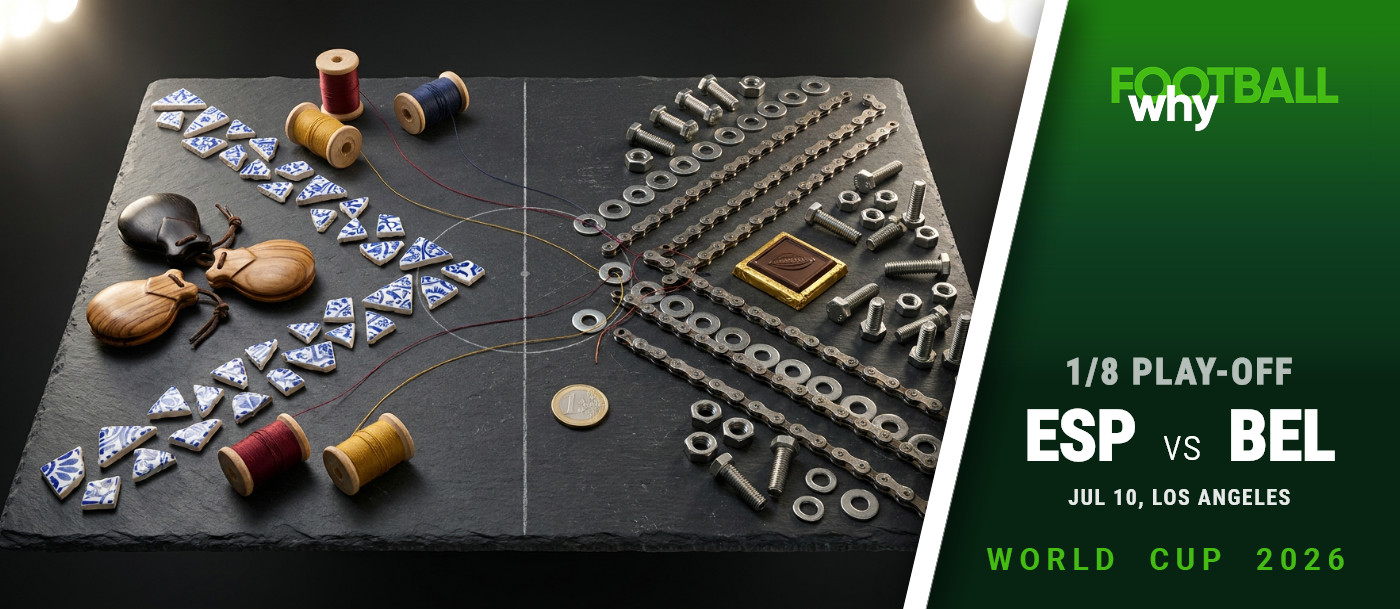
round_1_8, Match #98
UTC

SoFi Stadium, Los Angeles

Prediction by whyFootball readers

ESP
DRAW
BEL
58%
0%
42%
Not a recommendation for betting
Tap [+] to cast your expert forecast.
MATCH IS FINISHED. SEE REVIEW

Spain vs Belgium FIFA World Cup 2026 Group Stage Match Weaving a Trap for the Technocratic Breakaway Forecast generated:

The sunlit plaza’s communal rhythm clashes with the quiet, functional efficiency of the northern crossroads. It is a contest between those who seek safety in collective, overlapping discourse and those who wait patiently in the slipstream, ready to launch a sudden, irreversible breakaway.

Spain: One side's prayer...

Spain enter this Round of 16 tie under intense domestic scrutiny, burdened by a public mandate that demands absolute possession without the curse of sterile dominance. The squad remains insulated from the ongoing media storm surrounding Unai Simón’s selection. Manager Luis de la Fuente has a fully fit core, though winger load management remains a strict physical parameter. They approach the fixture like a master weaver tightening a loom, methodically suffocating the opposition’s space while actively hunting a decisive, regulation-time victory.

Belgium: ...head-on with the other.

Belgium arrive at the knockout stage carrying the heavy psychological baggage of past tournament failures and lingering debates over their star-centric hierarchy. Domenico Tedesco’s squad is functionally healthy, but Jérémy Doku’s minutes require strict management following minor muscular caution. The dressing room relies heavily on Thibaut Courtois and Kevin De Bruyne to project a process-driven calm amidst relentless national media pressure. They will operate like a coiled spring in the half-spaces, willing to absorb prolonged Spanish possession before snapping forward into sudden, isolating transition footraces.
Spain vs Belgium Structural Collision

Spain: How we will host...

Dream
Spain’s minimum requirement is to advance securely in ninety minutes without letting the occasion dissolve into a chaotic shootout. The domestic public demands total control, viewing any loss of midfield grip as a betrayal of their footballing heritage.

Strength
Their core advantage lies in the structural anxiety management of the rondo. Spain’s elite club core uses the ball as a shield, weaving intricate left-sided progressions to suffocate the opposition's transition hopes before they can even begin.

Plans
Luis de la Fuente intends to drag the Belgian centre-halves into uncomfortable channels using Mikel Oyarzabal's blind-side darts. From there, the plan relies on slipping low cut-backs into the penalty spot channel for late-arriving midfielders.

Fears
The grand fear is sterile possession ending in counter-attacking ruin. If their wing isolations fail to produce an end-product, the team risks falling into a sterile, U-shaped passing loop that invites late Belgian crosses.

Belgium: With what we arrive...

Dream
Belgium’s ambition is to survive the Spanish possession centrifuge and land the first clinical blow. The ultimate goal is to finally shatter that stubborn quarter-final ceiling, doing so without sacrificing their structural dignity or descending into panic.

Strength
Their true power resides in a technocratic, star-studded spine that thrives in the half-spaces. When the passing lanes momentarily open, these elite creators can instantly tilt the pitch, feeding isolated wingers with brutal, surgical efficiency.

Plans
The blueprint hinges on exploiting the turf left vacant by overlapping full-backs. Rather than getting bogged down in the midfield gridlock, they aim to bypass the centre entirely, using early, raking diagonals to isolate their wide men against retreating defenders.

Fears
The creeping dread of past tournament failures always lingers. If the opposition dictates the tempo for too long, the team's shape tends to fray, leaving yawning gaps between the midfield and defence as frustration inevitably takes hold.

How it will be...

Expect an initial phase of hypnotic territorial sequestration. Spain should monopolise the turf, treating possession not as a weapon, but as a soothing ritual to sedate the occasion. Their left-sided circuitry — with Marc Cucurella overlapping outside Dani Olmo’s disguised drifts — will likely test the Belgian defensive lattice early on.

However, observers should await the inevitable Belgian recalibration around the hour mark. When Domenico Tedesco introduces Jérémy Doku, the fixture’s temperature will spike. Doku’s kinetic, low-gravity slalom runs against a fatiguing Spanish flank offer the most potent disruption to the Iberian consensus. If he bypasses the initial tackle, the match could fracture into thrilling, end-to-end geometry.

Spain’s structural arrogance usually absorbs such volatility. Their immediate counter-pressing reflex acts as a tourniquet against transition bleeds. Yet, should Belgium pivot to a blunt, late-stage aerial bombardment via Thomas Meunier, the refined Spanish centre-backs might find themselves engaged in crude penalty-box wrestling. It is this precarious friction — balletic control besieged by late-surging, technocratic desperation — that makes this knockout tie so compelling.

Spain: How did they clinch it?

Spain triumphed because their left-sided combinations successfully dismantled the opposition's mid-block for the opener, while a ruthlessly executed quick-restart punished a disorganised defensive line late on. Ultimately, their ingrained positional schooling and unshakeable rest-defence simply starved their opponents of any chaotic transition oxygen.

Belgium: Why not go for the win?

Belgium faltered because they failed to capitalise on a brief window of transition dominance, squandering crucial half-chances. Conceding a second goal from a rapidly taken set-piece exposed their lingering transitional lethargy. Fundamentally, their reliance on late aerial bombardments left structural voids that elite possession teams effortlessly exploit.

Secret mastermind intent

De la Fuente’s Blueprint for a Quiet Plaza

General Strategy
Spain will seek to dictate the tempo and deny any descent into end-to-end chaos. The primary objective is to secure the match in regulation time through methodical, positional control.

The midfield will operate as a slow-burn consensus engine. Rodri and Pedri are tasked with circulating the ball until the opposition block shifts, at which point the left flank will aggressively accelerate the play.
Antidote for the Opponent
The primary defensive task is extinguishing Kevin De Bruyne's right half-space threat. Rodri will shade across early to screen the passing lanes, acting as a firewall against the Belgian playmaker.

Nearest midfielders will step up to block diagonal deliveries at the source. At the back, Marc Cucurella is instructed to delay Jérémy Doku rather than diving in, waiting for inside support to arrive before engaging.
Internal Task Solving
De la Fuente has prepared a highly specific quick-restart routine for the final twenty minutes. If the match is deadlocked, Spain will abandon their usual patient build-up for sudden, pre-scripted throws and free-kicks near the Belgian box.

Ferran Torres is designated as the trigger for these routines. Mikel Merino will be deployed as a late, high runner to break the last line before the defence can reset.
Crisis Response Plans
If the team concedes a dangerous high-transition chance, the manager has installed a deliberate calming sequence. The players will immediately form a tight huddle to reassign marking duties and drop the defensive line by one band.

The ball will then be recycled through the centre-backs for two minutes to kill the game's temperature. Other contingencies include rapid winger rotations if attacking isolations stall for more than ten minutes.
Specific Match Orders
Unai Simón (Goalkeeper): He is instructed to immediately abort any short build-up if the Belgian front three lock down the central pivot. Instead of forcing flat passes through the middle, he must hit crisp diagonals out to the full-backs. Marc Cucurella (Left-Back): His primary job is to make first contact with Doku on the outside shoulder and simply delay the winger. He is explicitly told not to bite into the tackle, but rather to stall the play and call his left-sided midfielder over to form a double-team. Mikel Oyarzabal (Centre-Forward): He must prioritise near-post darts and drift onto the blind shoulder of the young Belgian centre-backs. He is strictly warned to minimise back-to-goal wrestling matches, focusing instead on creating space for late midfield arrivals.
/ What if Belgium's high press suffocates the goalkeeper early on?

If Simón is forced into multiple risky passing sequences in the opening ten minutes, the short build-up is binned entirely. He will bypass the press by clipping diagonals directly to the full-backs. Up front, Oyarzabal will adjust his positioning to flick on these longer clearances.

/ What if Doku starts winning his one-on-one duels down the flank?

Should the Belgian winger bypass Cucurella repeatedly before the half-hour mark, the left-sided central midfielder will be ordered to double up much earlier. Pedro Porro will tuck in on the opposite side to form a makeshift back three, heavily restricting Spain's counter-attacking windows.

Secret mastermind intent

Tedesco’s Timetable for the Peloton

General Strategy
The strategy is rooted in calculated patience, operating like a disciplined peloton waiting for the perfect moment to break away. They will sit in a compact mid-block, absorbing the sterile circulation of the ball without breaking their defensive ranks.

Once possession is won, the immediate focus shifts to rapid vertical transitions. The midfield will look to spring the wingers into one-on-one footraces before the opposition can set their defensive perimeter.
Antidote for the Opponent
Defensively, the mandate is to suffocate the opposition's deep-lying playmaker using relentless cover shadows. By removing the engine of the passing game, they hope to force the play into less dangerous, wider areas.

Whenever the teenage Spanish winger receives the ball, he will face an immediate, aggressive double-team. The objective is to smother the threat on his first touch, preventing him from cutting inside onto his stronger foot.
Internal Task Solving
A highly coordinated pressing trap has been set specifically for the opposition's goalkeeper. On the trigger of a backward pass, the entire forward line will suddenly hunt the ball, aiming to force a catastrophic error on the edge of the box.

Later in the match, there is a pre-planned option to fundamentally alter the attacking shape. By substituting a defensive full-back for an attacking one, they will transition into a relentless crossing machine aimed squarely at the penalty spot.
Crisis Response Plans
Should the match descend into refereeing controversy or emotional chaos, the captain is instructed to pull the squad into a tight huddle. This deliberate pause serves as a technocratic override, stripping away the noise and resetting the collective pulse.

During this stoppage, communication will shift entirely to conservative, pre-agreed code words. If the team finds themselves starved of the ball for extended periods, the wingers are ordered to adopt much wider starting positions to stretch the play.
Specific Match Orders
Thibaut Courtois (Goalkeeper): He is directed to take a half-step forward on all out-swinging corners. His absolute priority is to dominate the far-post airspace and physically bully the opposition's centre-backs. Amadou Onana (Defensive Midfielder): For the first hour, his sole existence is to shadow the opposition's pivot. He is strictly warned against lunging at clever feints, maintaining his position as the structural anchor at all times. Kevin De Bruyne (Attacking Midfielder): His task is to launch early diagonal passes into the space behind the advancing left-back. If those passing lanes are blocked, he must drop just a few yards to find a new angle, resisting the urge to retreat entirely into his own half.
/ What if the focal striker is booked early on?

The target man will immediately abandon back-to-goal wrestling to avoid a second yellow card. Instead, he will be instructed to make runs into the wider channels, while the supporting forward shifts centrally to link the play and maintain the attacking focal point.

/ What if the defence starts leaking high-quality chances before the half-hour?

The full-backs will be ordered to abandon their attacking overlaps and bolt themselves to the defensive line. The holding midfielder will drop deeper to form a rigid screen in front of the centre-backs, effectively killing the game's momentum until the storm passes.

MAIN SIMULATION 0'-25'

Spain is expected to dictate the early tempo, turning the midfield into a slow-burn passing carousel. They will likely command roughly 60% of possession, using Marc Cucurella and Dani Olmo on the left to methodically unpick the Belgian mid-block. Belgium will sit in a compact defensive shape, relying on Kevin De Bruyne to thread early diagonal passes. The friction will be high in the central zones, but Spain's positional discipline should keep the match tightly contained.

MAIN SIMULATION 25'-45'

The tactical deadlock should break as Spain aggressively overloads the left flank following a scheduled hydration pause. We anticipate a disguised switch from Fabián Ruiz to unlock the penalty area, allowing Mikel Oyarzabal to finish a cut-back around the 37th minute. Once ahead, Spain will likely drop Pedro Porro slightly deeper to conserve energy and reduce risk. Belgium will continue to probe with De Bruyne's passes, but will struggle to overcommit before the half-time whistle.

MAIN SIMULATION 45'-65'

The match is expected to stretch as Belgium injects pure pace into the fray, turning a tactical chess match into a chaotic footrace. Jérémy Doku and Romelu Lukaku are slated to enter around the 62nd minute to tilt the field. Spain will counter this by withdrawing Lamine Yamal to protect their defensive structure. Friction will spike on Belgium's right wing, but Spain's conservative rest-defence, anchored by Rodri, is projected to absorb the erratic surges without breaking.

MAIN SIMULATION 65'-90'

Belgium will likely abandon their intricate passing for a blunt-force aerial bombardment. Thomas Meunier should arrive to spam crosses into the box, testing the Spanish centre-halves. However, Spain is predicted to survive this siege and launch a devastating, pre-scripted quick-restart around the 84th minute. Fresh legs from Ferran Torres and a late midfield run from Mikel Merino should secure a second goal. Spain will then shut the game down with a rigid 4-1-4-1 formation.

And it will come to...

This forecast suggests that Spain’s meticulous preparation would ultimately suffocate Belgium’s late volatility. It would be a victory of the architect over the opportunist. While the Belgians might threaten through chaotic wing surges and a desperate late aerial siege, Spain’s rigid positional play and perfectly timed bench interventions are expected to hold firm. A methodical cut-back and a ruthlessly executed quick-restart would likely prove the difference, proving that structured anxiety management can outlast raw, uncoordinated desperation.
end of Game