

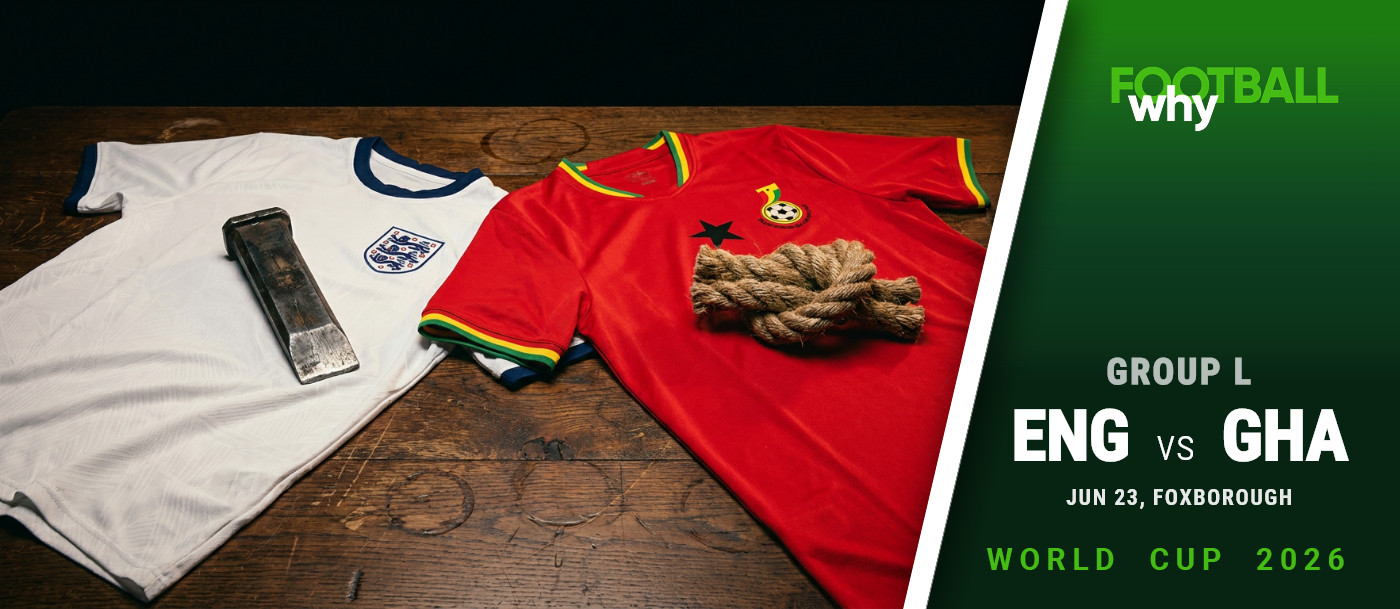
Group L, Matchday 2, Match #45
UTC

Gillette Stadium, Foxborough

Prediction by whyFootball readers

ENG
DRAW
GHA
62%
22%
16%
Not a recommendation for betting
Tap [+] to cast your expert forecast.
SCORE BY AI PREDICTION: 3:1 SEE SIMULATION

England vs Ghana FIFA World Cup 2026 Group Stage Match Extracting the final seam from a stubborn rockface Forecast generated:

The bureaucratic phlegm of the old continent collides head-on with communal pulse and unyielding faith. It is the empire of orderly procedure attempting to domesticate a brotherhood that thrives in the margins. A clash of worldviews where patience audits pride.

England: One side's prayer...

England arrive at their second group fixture carrying the usual suffocating baggage. The public mood is simmering, demanding blood and thunder rather than sterile, sideways passing. Behind the scenes, the manager is frantically tightening loose pipes: Kane, Saka, and Stones are all managing lingering muscle strains, while the toxic tabloid circus surrounding the right-back selection continues to cast a long shadow. They must squeeze a decisive result out of this fixture before the domestic anxiety boils over into open revolt.

Ghana: ...head-on with the other.

Ghana step onto the pitch seeking to wash away the bitter residue of recent tournament failures. Under a new managerial regime, there is a renewed emphasis on collective suffering, though the squad is heavily compromised. Their brightest spark, Mohammed Kudus, is sidelined with a torn quad, forcing them to rely on sheer graft rather than individual magic. With the relentless off-pitch noise of Thomas Partey’s legal proceedings still humming in the background, the team is manning the picket line, determined to survive through sheer communal defiance.
England vs Ghana Structural Collision

England: How we will host...

Dream
The minimum requirement is securing an early lead and quietly suffocating the contest before half-time. A draw is entirely unacceptable for a public desperate to see domestic dominance translated onto the international stage without any nervous late-game drama.

Strength
Their core advantage lies in a deeply ingrained, almost bureaucratic discipline. Much like a nation that prides itself on orderly queuing, this squad relies on methodical, precedent-driven possession, using elite club experience to slowly squeeze the opposition rather than relying on chaotic brilliance.

Plans
The blueprint involves a relentless overloading of the left flank. By dragging defenders out of position with intricate movements, they intend to create space for low cut-backs, while relying on immediate, cynical fouls in midfield to prevent sudden counter-attacks.

Fears
The lingering anxiety is that this structured approach devolves into sterile possession. If the tempo drops, the team risks falling back into cautious sideways passing, inviting public frustration and leaving themselves vulnerable to a single, explosive break against the run of play.

Ghana: With what we arrive...

Dream
A stubborn, bruising draw would be celebrated as a triumph. The mandate is to absorb the pressure, keep the European side at arm's length, and snatch a gritty goal on the break to banish the lingering ghosts of recent tournament misfires.

Strength
Their foundation is built on an intense, communal work ethic and explosive athleticism. Drawing on a deep-seated cultural reliance on collective responsibility, they excel at suffering together without the ball before unleashing fearless, direct runners the moment possession turns over.

Plans
The strategy relies on a disciplined mid-low block, essentially daring the opposition to break them down through the middle. Upon winning the ball, the immediate trigger is a vertical thrust into the right channel, bypassing the midfield entirely to isolate their quickest forwards against retreating defenders.

Fears
The primary concern is structural collapse brought on by raw emotion. If a refereeing decision goes against them or frustration mounts, their shape tends to elongate, leaving the full-backs stranded and exposing a chronic vulnerability when defending set-pieces under heavy stress.

How it will be...

The contest should unfold as a bureaucratic audit of communal effervescence. England will likely monopolise possession with a wearying cadence, aiming to peacefully erode the African side's right flank. Foden will prowl the interior crevices, allowing his full-back to underlap without fanfare. It is, essentially, a white-collar siege.

Ghana’s riposte should germinate within their unionised resistance. Clustered in a solidaristic retreat, the Africans will bide their time. If the British lethargy prompts a miscalculation in rest-defence, Iñaki Williams will carve an undetectable diagonal behind the centre-backs. A sudden spasm of pure verticality could easily shatter the positional monopoly.

Yet, fatigue inevitably frays good intentions. If a transient equaliser inflames Ghanaian pride, the team may elongate their shape, chasing an ill-advised epic. In that terminal phase, goalkeeper Ati-Zigi might capitulate under the barrage of perimeter shots. A short spill into the six-yard box would be the final ruling. Saka, alert in the dying embers, would capitalise on the clerical error to close the ledger. The rigidity of the method ultimately prevails over neighbourhood fervour.

England: How did they clinch it?

England picked the lock because their crisis protocol operated flawlessly. Upon conceding the equaliser, the team did not flinch: they reassembled their defensive shell and reinstated the left-sided overload. That capacity to anaesthetise panic ultimately allowed them to harvest the late rebounds.

Ghana: Why not go for the win?

Ghana capitulated due to a surplus of enthusiasm in the closing stages. The urge to hunt down a victory fractured their solidaristic shape, leaving the right-back channel completely marooned. That tactical disobedience exposed a chronic vulnerability that proved fatal.

Secret mastermind intent

Thomas Tuchel's strict queuing system for pitch control

General Strategy
Tuchel is demanding absolute territorial dominance from the first whistle, aiming to establish a solid lead by half-time. The tactical foundation rests on a structured defensive shell during build-up, ensuring the centre-backs and holding midfielders dictate the tempo without unnecessary risks.

The primary objective is to suffocate the game state entirely. It is a bit like a parish council strictly enforcing the local hedge-height bylaws: methodical, unyielding, and designed to kill any chaotic joy the opposition might hope to find.
Antidote for the Opponent
The main attacking blueprint targets the right side of the African team's defence. The left-winger and the attacking midfielder will constantly rotate in the inside-left channel, dragging defenders out of position to open up space for low cut-backs.

Defensively, the focus is entirely on shutting down their transition threat on the opposite flank. The holding midfielder is tasked with shading the right half-space, ready to deploy immediate tactical fouls to stop quick runners before they can accelerate.
Internal Task Solving
The intense media scrutiny surrounding the right-back position has heavily influenced the defensive setup. To avoid feeding the tabloid circus, the chosen defender on that flank is instructed to play a highly conservative, risk-averse game.

Furthermore, lingering fitness concerns for key players dictate how the ball is moved. The goalkeeper is explicitly told to avoid booming central clearances, ensuring the team does not have to engage in taxing, chaotic sprints to win back loose second balls.
Crisis Response Plans
If the opposition repeatedly breaks through the initial counter-press, the manager is prepared to shut up shop. The right-winger will be ordered to drop into central midfield to act as an extra defensive shield.

Simultaneously, the full-backs will take up much deeper starting positions. This overarching readiness to sacrifice attacking width for central density highlights a pragmatic willingness to grind out a result if the original blueprint begins to leak.
Specific Match Orders
Harry Kane: Stay pinned against the last line of defence for the opening twenty-five minutes. Do not drop deep to collect the ball alongside the attacking midfielder. Attack the blindside of the centre-back whenever a cut-back is prepared. Declan Rice: Hold the central defensive lane within fifteen metres of the centre-backs during transitions. Shade towards the right half-space to block the opposition winger's first forward carry. Commit a tactical foul early if beaten off the dribble. Jordan Pickford: Avoid launching the ball directly down the middle. Use flat, diagonal passes out to the right flank only when the team has established a solid structure to win the second ball. Delay all restarts after opposition surges to kill their momentum.
/ What if the left-back picks up an early yellow card?

The manager will immediately invert the booked defender, pulling him into the central midfield base to keep him out of isolated sprints. The left-winger will shift inside to act as a playmaker, while the original number ten moves out to the right flank to attack from a fresh angle.

/ What if the opposition repeatedly breaks the first line of pressing?

The right-winger will be pulled narrower to operate as an auxiliary central midfielder when possession is lost. The right-back will adopt a deeper starting position, and the left-back will be told to underlap rather than overlap, artificially clogging the middle of the pitch.

Secret mastermind intent

Otto Addo's picket line and the vertical thrust

General Strategy
Addo is demanding a dogged, pragmatic shift from his squad, setting up a compact defensive wall that refuses to budge. The primary directive is to deny any central penetration, forcing the opposition to shuffle the ball harmlessly out wide.

It is a classic picket-line mentality: link arms, hold the ground, and do not let management dictate the terms of the working day. The team will only aggressively press when the opponent is pinned against the touchline.
Antidote for the Opponent
To counter the anticipated wide overloads, the defensive anchor is instructed to sit rigidly in front of the centre-backs. He must refuse the bait to chase dropping playmakers, keeping the core of the penalty area completely sealed.

Meanwhile, the wide midfielders will double up defensively, aiming to trap the opposing wingers. The goal is to concede the deepest parts of the flank while fiercely protecting the cut-back zones.
Internal Task Solving
Missing their primary creative talisman due to injury, the squad must manufacture threat through rehearsed dead-ball routines. Decoy runs to the near post will be used extensively to free up shooters on the edge of the box.

The goalkeeper is specifically tasked with manipulating the match cadence. He has orders to deliberately slow down his distribution and compress the tempo whenever the stadium volume rises.
Crisis Response Plans
Should the pressure become unbearable, the manager has drilled a specific trauma response. The captain will call a brief on-pitch huddle to reset the emotional temperature, and the shape will instantly morph into a five-man defence.

Clearances will then be hooked long into the channels, buying the team vital seconds to breathe. The players are instructed to win cheap fouls and slow the game down to a crawl until the storm passes.
Specific Match Orders
Thomas Partey: Anchor yourself dead centre just ahead of the defensive line. Ignore the urge to track their playmaker if he wanders away from the penalty arc. Once the ball is won, immediately look for a one-touch pass into the right channel. Antoine Semenyo: Ensure your very first touch always takes you forward. If trapped against the touchline by two men, bounce the ball inside instantly rather than trying to force a dribble. Sprint hard into the inside-right lane the second we regain possession. Iñaki Williams: Hover right on the shoulder of the last defender to stretch their shape. Time your runs to cut diagonally behind the left-sided centre-back. Resist the temptation to drop into midfield for touches; stay high to maintain our attacking depth.
/ What if the right-back loses early duels or picks up a swift booking?

The formation immediately shifts to a 5-4-1. The right-midfielder drops in as an auxiliary wing-back, while the defensive midfielder shuffles across to plug the gap. The team will concede the touchline entirely to protect the cut-back lane.

/ What if the opposition starts winning every second ball off long diagonal passes?

The midfield four must flatten out and drop five yards deeper. The lone striker will retreat to shadow the opposition's holding midfielder, while the goalkeeper alters his distribution, aiming exclusively for the touchline to disrupt their pressing traps.

MAIN SIMULATION 0'-25'

England will likely hammer the left flank like clockwork. Foden operates in the inside-left channel, dragging Ghana’s right-back out of shape to allow the left-back to underlap. This specific friction point — England's left-sided overload against Ghana's narrowing right flank — is the primary battleground. Once Stones hits a prepared diagonal, Foden’s cut-back should find Kane for an early lead. Ghana will respond to this early dent by temporarily dropping into a rigid 5-4-1 to weather the storm, while England sensibly throttle back into a patient 2-3-5 circulation.

MAIN SIMULATION 25'-45'

The game settles into a mild holding pattern. Thomas Partey anchors the central screen, strictly refusing to be drawn out, which forces England into a patient tilt-and-recycle routine. England will keep their crosses low and avoid central punts to deny Ghana transition fuel. The friction here shifts to Ghana's wide double-teams blunting England's one-on-ones. We should see brief counter-punches from Ghana — relying on Semenyo feeding Iñaki Williams in the right channel — but mostly, it is a period of methodical, low-risk territorial control.

MAIN SIMULATION 45'-65'

The second half sparks to life with a sudden Ghanaian surge. The introduction of Fatawu stretches England's rest-defence horizontally. A quick right-wing transition — exploiting the space behind England's left-back — likely sees Iñaki Williams score. This equaliser forces England to activate their trauma protocols: a quick huddle, a reset to a 3-2 defensive shell, and a renewed focus on the left-sided overload. As Ghana's midfield screen loses its compactness in the post-goal euphoria, Foden will find the underlap again, setting up Bellingham for a late-arriving finish.

MAIN SIMULATION 65'-90'

The final quarter becomes a chaotic footrace. Trailing Ghana will abandon their rigid structure, toggling frantically between a 5-4-1 and a 4-2-4 to chase the game. England shifts to a 4-3-3 out of possession, relying on a conservative right-back to absorb Fatawu's threat. The key tactical friction emerges from late-phase instability. Ghana's rest-defence on the edge of the box degrades as fatigue sets in. After a flurry of saves, goalkeeper Ati-Zigi is highly likely to parry a shot centrally, allowing Saka to sweep home the rebound.

And it will come to...

If this forecast unfolds, we would see England's control-first philosophy survive the very volatility it occasionally invites. England’s elite-club spine should enable rapid trauma recovery, allowing them to methodically exploit the pre-flagged seam on Ghana's right flank. Ghana would likely demonstrate immense dignity through discipline, but their late-phase instability and reliance on emotionally driven surges would eventually stretch their shape. Ultimately, the systemic gap in full-back depth and rest-defence focus would see the European side's tactical blueprint overcome the African side's spirited defiance.
end of Game