

, Match #102
UTC

Mercedes-Benz Stadium, Atlanta

Prediction by whyFootball readers

ENG
DRAW
ARG
49%
0%
51%
Not a recommendation for betting
Tap [+] to cast your expert forecast.
SCORE BY AI PREDICTION: 1:1 SEE SIMULATION

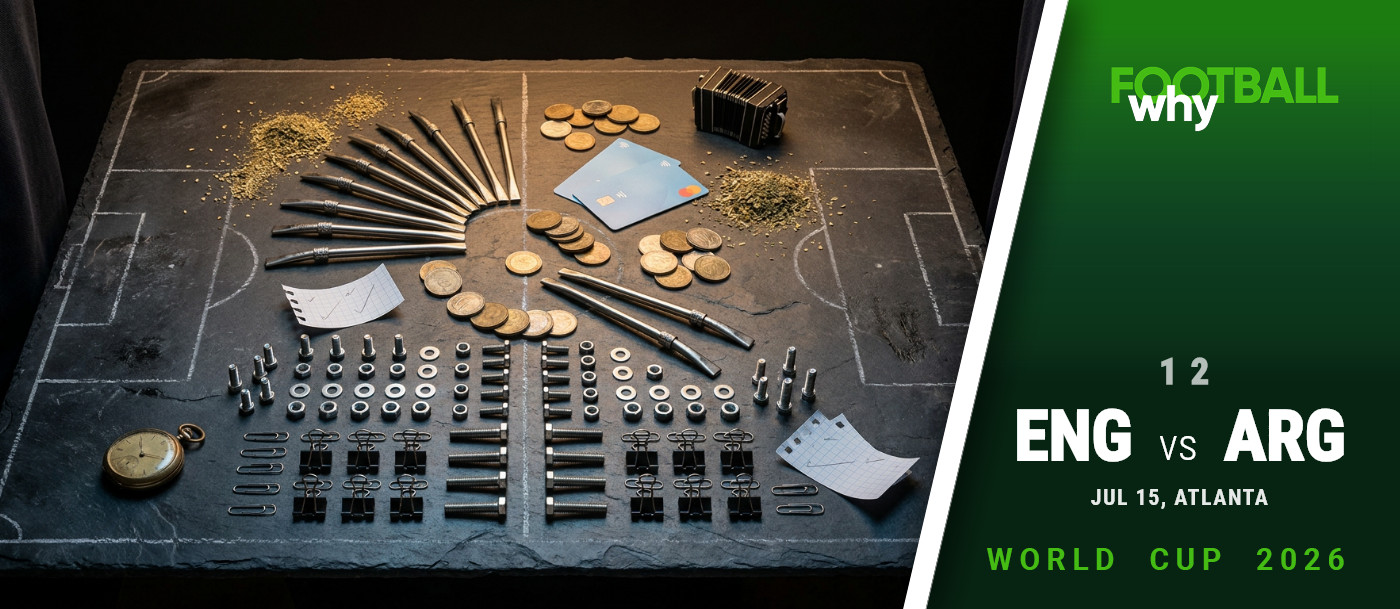
England vs Argentina FIFA World Cup 2026 Group Stage Match A quiet auction room waiting for a frantic bluff Forecast generated:

The stoic queue of committee-led pragmatism collides with the chaotic, relational hustle of the barrio. It is a fundamental clash of philosophies: the safety of established precedent versus the cunning improvisation of survival. A fixture where dignity meets sheer, unapologetic malice.

England: One side's prayer...

England arrive at this semi-final under a suffocating tabloid glare. The public has exhausted its patience for romantic near-misses; they simply demand a route to the final. With Reece James nursing a hamstring issue, the squad has adopted a strictly businesslike tone. They are pulling the heavy iron shutters down on external noise. The dressing room is leaning heavily into precedent and order, fully prepared to sacrifice possession if it guarantees their survival.

Argentina: ...head-on with the other.

Argentina step onto the pitch carrying the momentum of their gruelling extra-time victory over Switzerland. The squad radiates a veteran, almost tribal calm. Despite minor physical concerns — Cristian Romero’s managed knee and Emiliano Martínez’s taped finger — their champion entitlement remains entirely intact. They are looking to slowly tighten a vice grip on the midfield rhythm. The domestic public expects them to outfox the English, demanding victory that validates their street-smart cunning and collective brotherhood.
England vs Argentina Structural Collision

England: How we will host...

Dream
The ultimate aim is to reach the final by executing a thoroughly professional, unflustered progression. Amid a relentless tabloid gaze, the public tolerance for romantic failure has vanished. They demand a steady course, seeking validation of their domestic dominance through a cold, calculated victory rather than a chaotic spectacle.

Strength
This is a squad forged in the wealthiest, most physically demanding league in the world. Their baseline character is disciplined and deeply status-aware, thriving when operating within a structured defensive block. They possess the athletic stamina to absorb immense pressure and the elite technical quality to execute highly repeatable set-piece routines when the margins are tight.

Plans
The manager intends to bypass the congested midfield battle by launching early, direct passes towards the left flank, aggressively isolating their rapid wingers against the South American full-backs. The captain is tasked with dropping deep to act as a decoy, pulling defenders out of shape before feeding the advancing midfield runners who will crash the penalty area.

Fears
Their historical baggage in knockout tournaments creates a lingering, suffocating expectation. If the game becomes chaotic and spaces compress, they risk reverting to overly safe, sterile possession. This cautious retreat could allow the opposition to dictate the tempo, reigniting old stigmas of freezing under the brightest lights.

Argentina: With what we arrive...

Dream
The objective is to project unity and prestige by imposing their rhythm on a grand stage. They aim to outfox their structured opponents, proving that their collective intelligence and shared suffering can dismantle mechanical systems. Success here validates their barrio cunning and secures their status as undisputed protagonists.

Strength
This squad is a brotherhood hardened by relentless continental and global triumphs. Their core strength lies in patient, positional control punctuated by sudden, vicious vertical surges. They blend elite technical craft with a competitive malice, happily breaking up play with tactical fouls to protect their shape when possession is lost.

Plans
The strategy revolves around manipulating the half-spaces and feeding their gravitational creator. They plan to target the blind spots of the English centre-backs with curved runs from their forwards. Additionally, they have preloaded specific near-post set-piece routines designed to catch the opposition cold in the opening fifteen minutes.

Fears
The primary concern is becoming overly reliant on their talisman. If the opponent successfully crowds the centre, their possession can shrink into sterile, predictable patterns. Furthermore, the physical toll of managing rapid English wingers could force them into cheap fouls, risking card accumulation and exposing their defensive flanks.

How it will be...

The match will likely resemble a prolonged municipal audit: periods of heavy, bureaucratic silence punctuated by sudden, frantic disputes over the ledger. England are expected to erect a perimeter fence around their penalty area, trusting their industrial stamina to absorb pressure. Argentina, meanwhile, will circulate the ball with a slow, almost hypnotic cadence, probing for rusted hinges in the English structure.

Observers should watch Jude Bellingham’s attempts to bypass the midfield congestion. His ability to suddenly accelerate past Leandro Paredes offers the clearest route through the South American lattice. Conversely, Argentina’s threat relies on the subtle, delayed underlaps of Rodrigo De Paul, attempting to unpick the English right-back channel — a known structural vulnerability.

The simulation points toward a rigid, unyielding psychological landscape. Neither side is prone to a total systemic collapse. However, if an early Argentine set-piece routine bypasses the English sentries, the resulting panic could force the home side to abandon their cautious precedent.

Should the scoreline level late on, expect a mutual, unspoken pact of non-aggression. The fear of a fatal transition error will see both managers retreat to their allotments, preferring the structured lottery of extra-time over the raw exposure of a ninetieth-minute shootout. For the neutral, it promises a fascinating, slow-burn psychological thriller.

England: Why stopped just short of victory?

England failed to secure victory because their ingrained caution overrode their attacking momentum. Following their second-half breakthrough, they instinctively compressed their defensive lines, inviting sustained pressure rather than hunting a decisive second. Systemically, their reliance on risk-averse, precedent-led game management leaves them vulnerable to late equalisers.

Argentina: Why stopped just short of victory?

Argentina fell short of an outright win due to a stubborn insistence on central combinations. Until the final quarter, their attacks funnelled predictably towards their heavily marked talisman, ignoring the flanks. On a broader level, their romantic attachment to star-centric build-up play often delays necessary, wider pragmatic adjustments.

Secret mastermind intent

Tuchel’s Bureaucratic Clamp on the Argentine Escapement

General Strategy
The blueprint prioritises territory and structural control over pure possession. England will settle into a measured mid-block, content to circulate the ball patiently and wait for transitional triggers rather than forcing the issue.

They are fully prepared to abandon the ball if they secure an early lead. The focus then shifts to a robust defensive shape, clearing their lines and ensuring the match ticks down like a heavily weighted grandfather clock.
Antidote for the Opponent
The primary defensive mandate is to build a cage around the edge of the penalty area. The defensive pivot will anchor this zone exclusively, ensuring the opposition's talisman is never allowed to turn and face the goal.

In attack, the strategy targets the space behind the South American right-back. By releasing early diagonal passes to a designated wide outlet, they aim to expose the spaces left by overlapping runs, treating the flank like an overgrown allotment patch that needs aggressive clearing.
Internal Task Solving
A highly unusual pre-authorised protocol exists for closing out the match. If holding a narrow lead, the team has explicit permission to retreat into a deep shell and rely purely on the goalkeeper's long distribution, completely bypassing central build-up.

There is also a strict containment policy regarding late-game risk. The squad will not overexert themselves chasing a winner in normal time; they are instructed to protect their legs and trust their rehearsed routines from the spot, treating the shootout like a predictable local parking tribunal.
Crisis Response Plans
Flexibility is built into the defensive line if the right channel starts leaking chances. The manager is ready to immediately introduce a substitute and shift to an asymmetrical back five, shutting down the corridor before the damage becomes fatal.

Other contingencies include dropping an attacking midfielder deeper to form a double-screen if the central zones become overwhelmed. The overarching philosophy is to apply manual overrides and buy time with structural shifts rather than chasing the game recklessly.
Specific Match Orders
Declan Rice (Midfielder): Anchor the central zone just outside the penalty area. Never push ahead of the ball when their primary playmaker is lurking centrally; if the press is bypassed, commit the tactical foul before he can turn. Anthony Gordon (Winger): Sprint onto the first touch directly into the right-back's channel. Serve as the designated wide outlet for all long clearances once the defensive block is set. Harry Kane (Striker): Drop deep into the midfield to pull their aggressive centre-back out of the defensive line. Play a quick third-man wall pass to the advancing midfielders, then arrive late into the penalty box.
/ What if the right-back corridor is repeatedly breached?

If the opposition overloads the flank and penetrates the depth multiple times within a short window, the left-back will tuck in deeper. At the next stoppage, a substitute will be introduced to form a rigid five-man backline, permanently sealing the leak.

/ What if the opposition playmaker dominates the central arc?

Should the central creator draw consecutive fouls or repeatedly enter the crucial zone, an advanced midfielder will immediately drop alongside the pivot. This temporary double-screen will choke the central space, forcing all attacks out to the less dangerous wide areas.

Secret mastermind intent

Scaloni’s Street-Smart Hustle to Dismantle the System

General Strategy
The intention is to dominate the rhythm of the game through deliberate pauses and sharp, sudden accelerations. They will employ a compact mid-block, prioritising the ball to dictate the tempo and drain the opposition’s enthusiasm.

Defensively, they will maintain a staggered full-back system to ensure their rest-defence is never fully exposed. It is a calculated hustle, keeping the back door locked while probing the front for weaknesses.
Antidote for the Opponent
A targeted pressing trap will be set for the English right flank. The midfield will initially screen the central passing options, inviting the pass down the line before snapping shut aggressively from the outside in.

Offensively, they are looking to exploit the moments when the English left-back tucks inside. The playmaker will drift to the right half-space, aiming to slide diagonal passes across the blindside of the retreating centre-backs.
Internal Task Solving
There is a deeply ingrained protocol for managing moments of chaos or after conceding a goal. The team will literally huddle around their captain, slowing the restart to a crawl, and execute a prolonged sequence of safe passes to drain the emotion from the stadium.

They are also bringing heavily rehearsed set-piece routines specifically for the first quarter of the match. The aim is to snatch an early lead from a dead ball, forcing the structured English side to abandon their cautious blueprint prematurely.
Crisis Response Plans
If the team finds themselves chasing the game late on, the manager is prepared to throw caution to the wind. A second striker will be introduced, and both full-backs will be pushed high to saturate the penalty box and hunt for second balls.

Conversely, if the right defensive channel begins to leak under transition pressure, the shape will conservatively morph. The right-sided midfielder will drop alongside the lone pivot to form a temporary double-screen, patching the rusted pipework before it bursts.
Specific Match Orders
Nahuel Molina (Defender): Overlap only when the midfield cover is securely in place. The absolute priority is to avoid leaving the right channel exposed to the pace of the opposition's left winger. Rodrigo De Paul (Midfielder): Act as the immediate bodyguard for the primary playmaker. If the lone defensive midfielder is trapped, drop back immediately to form a double pivot and recycle the ball to the weak side. Emiliano Martínez (Goalkeeper): Do not hold the ball to bait the high press for longer than a single pause. Once the opposition's line is set, use clipped diagonal passes to the full-backs or go direct to the striker on the right side.
/ What if the creative focal point is entirely man-marked?

If the primary playmaker is starved of the ball facing the goal by the 25th minute, he will abandon the right half-space and move fully central as a traditional number 10. The pressing intensity will drop, allowing the team to recycle possession safely through the deeper midfielders.

/ What if the opposition generates transition shots from the wide areas?

Should the flanks yield multiple transition opportunities for the opponent within a short spell, the full-backs will be ordered to hold a lower starting position. The midfield will shift into a 4-2-3-1 structure, and attacks will rely on delayed underlaps rather than early, risky crosses.

MAIN SIMULATION 0'-25'

England are expected to set up in a compact mid-block, looking to bypass the midfield scrap with long diagonal passes to Anthony Gordon. Argentina will likely dominate early possession, holding around 56% of the ball, and tilt the pitch slightly while prodding for a rehearsed set-piece opening. The friction here is a slow-burn standoff. England's midfield trap will try to smother Leandro Paredes, while Argentina will carefully cap their full-back runs to avoid leaving a gaping hole for Gordon to exploit.

MAIN SIMULATION 25'-45'

Following a brief hydration pause, England inject a sudden dose of adrenaline into the game. Between the 25th and 35th minute, they launch a sanctioned wave of high pressure. Harry Kane jumps on loose touches, forcing Argentina to adapt. Rodrigo De Paul drops deeper to form a double-pivot alongside Paredes, absorbing the sting of the press. The tactical friction spikes significantly during this spell, but the half ultimately fizzles out into late-half caution. Neither side wants to concede the dressing-room advantage.

MAIN SIMULATION 45'-65'

The tactical deadlock is expected to break around the hour mark. Jude Bellingham slips a pass behind the Argentine left-back, allowing Saka to cut the ball back for a composed Kane finish. Immediately after, England pull the shutters down. They compress the space and drop the tempo, content to manage the game from a deeper stance. Argentina respond without panic, initiating a slow passing cycle to clear their heads and re-establish Paredes as the primary outlet, though they struggle to find clean central access.

MAIN SIMULATION 65'-90'

Entering the final stretch, Argentina finally throw the kitchen sink at the problem. From the 75th minute, they shift to a wider, higher-pressing shape and introduce an extra striker. The tactical friction hits its absolute peak as England try to weather the storm. The pressure eventually tells when a blocked shot falls kindly for Lautaro Martínez to finish. With the score level, both managers suddenly hit the brakes. The fear of a late transition goal overrides the desire to win in normal time.

And it will come to...

If this forecast holds true, the match would unfold as a clash of marginal edges. England would look to impose their control-first identity, striking through a scripted right-flank combination. However, Argentina’s ingrained late-phase resilience would eventually stretch the pitch and force a second-phase equaliser. Ultimately, the fear of a fatal mistake would paralyse both sides in the closing moments. Rather than risking a chaotic finale, these two high-class systems would pragmatically accept a draw, trusting their fate to extra time.
end of Game