

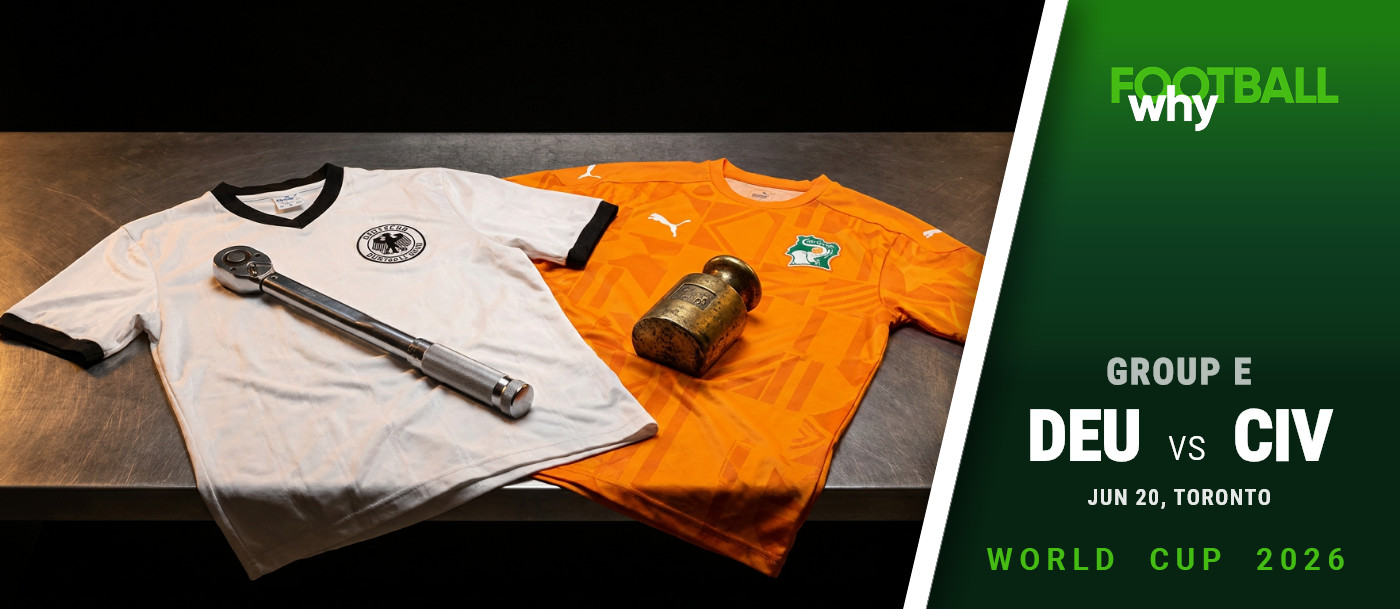
Group E, Matchday 2, Match #33
UTC

BMO Field, Toronto

Prediction by whyFootball readers

DEU
DRAW
CIV
47%
27%
26%
Not a recommendation for betting
Tap [+] to cast your expert forecast.
SCORE BY AI PREDICTION: 2:1 SEE SIMULATION

Germany vs Côte d'Ivoire FIFA World Cup 2026 Group Stage Match Filing precise paperwork during a frantic street auction Forecast generated:

The certified procedure collides with the charismatic wave. One side demands a fail-safe audit of the pitch; the other relies on a communal surge of momentum to shatter the blueprints. It is the classic tension between the architect's ruler and the street's raw energy.

Germany: One side's prayer...

Germany enter this second group fixture carrying the heavy, familiar burden of their tournament-team mythology. The public mandate is clear: secure top spot and avoid any messy transitional leaks. Internally, the mood is focused but vigilant, treating this tie as a rigorous load-test for a squad missing Marc-André ter Stegen to injury, while Jamal Musiala’s fragile ankle requires careful management. A win here effectively seals qualification, allowing the manager to rotate and rest weary legs before the knockout furnace truly ignites.

Côte d'Ivoire: ...head-on with the other.

Côte d’Ivoire arrive seeking at least a point to keep their progression hopes firmly alive, though the public yearns for a scalp. The mood is assertive but shadowed by the usual intense scrutiny; Emerse Faé’s strict meritocracy — highlighted by the controversial omission of established names like Nicolas Pépé — means the squad must vindicate his choices on the pitch. They are operating like a frantic trading floor, eager to prove their worth. Sébastien Haller’s managed minutes following a hamstring issue adds a layer of physical jeopardy, but their underlying belief remains unshaken.
Germany vs Côte d'Ivoire Structural Collision

Germany: How we will host...

Dream

The primary objective is to secure a victory that seals top-spot leverage, avoiding the messy mathematics of group qualification. A draw is an acceptable consolation prize, provided the team maintains absolute control and avoids the chaotic transitions that fray public nerves.

Strength

This squad operates like a well-catalogued library archive, where every player knows exactly where they belong. Their greatest asset is a deeply ingrained tactical literacy, combining a suffocating counter-press with a disciplined midfield platform that calmly dictates the overall rhythm of the match.

Plans

The manager intends to systematically dismantle the opposition's left defensive seam. By instructing the central striker to make curving decoy runs, they hope to isolate their primary playmaker in dangerous pockets of space. Defensively, the strategy is to ruthlessly smother the opposition's target man on the very first contact.

Fears

The underlying anxiety is that their efficiency-first structure might suffocate their own improvisational talent. When put under severe stress, this preference for order can harden into a rigid, nervous caution, leaving them vulnerable to fast, unpredictable surges down the flanks.

Côte d'Ivoire: With what we arrive...

Dream

Securing a point is the baseline requirement to keep the group stage mathematics friendly, but a victory acts as a fast-track to the top. The public mandate demands a display of bravery and flair, yet the squad knows they must avoid cheap bookings and maintain absolute composure against a suffocating European press.

Strength

This side operates with the undeniable physical presence of a bustling auction room, where every challenge is a frantic bid for momentum. Their core strength lies in a muscular midfield platform combined with an explosive, wing-driven directness. They excel when breaking lines rapidly, relying on seasoned European academy habits laced with an improvisational, street-football edge.

Plans

The tactical blueprint involves setting an aggressive mid-block trap. The aim is to ambush the opposition's inverted full-back, instantly springing their own wide attackers into the vacated space behind. Offensively, they will look to target the seam between the opposition's left-back and centre-back with early, sweeping crosses aimed at their powerful target man.

Fears

The nagging worry is that their collective discipline might fray under intense emotional pressure. When chasing the game, distances between players tend to stretch, and full-backs can overcommit forward. This pride-led urge to force the issue often leaves gaping transitional holes for a calculating opponent to exploit.

How it will be...

The contest should unfold as a fascinating friction between institutional protocol and raw, improvisational nerve. Tuning in, one would likely witness Germany attempting to smother the pitch with their suffocating counter-press, treating possession as a regulatory requirement. Côte d’Ivoire, conversely, will lurk on the periphery, waiting to exploit any transitional slack with sudden, muscular surges.

The real intrigue lies in the margins of these systems. Florian Wirtz, hovering in the left channel, is expected to thread reverse passes with the quiet precision of an archivist locating a misfiled folio. Against this, Simon Adingra offers a completely different texture; his elastic, stop-start dribbling down the right flank threatens to fray the edges of the German defensive blueprint. He might just force a structural collapse if he isolates the full-back.

Yet, the vulnerability cuts both ways. Should the Ivorian midfielders push too eagerly in search of an equaliser, they risk vacating the central zones entirely. If Franck Kessié’s late penalty-box arrivals are tracked effectively, the resulting counter-attacks could prove fatal. The visitors will undoubtedly push until the final whistle, driven by their 'peace mandate' pride, but the hosts' capacity to instantly recalibrate their formation — shifting to a pragmatic two-striker system when troubled — should ultimately secure the points.

Germany: How did they clinch it?

The hosts triumphed through their rapid, procedural crisis management. When the visitors' wide overloads threatened to derail the game, the immediate introduction of a second striker altered the structural arithmetic. This capacity to casually switch from patient build-up to a pragmatic, two-man battering ram allowed them to monopolise the second balls and secure the result.

Côte d'Ivoire: Why not go for the win?

The visitors fell short due to a breakdown in transitional spacing during the final quarter. Their emotional urge to force an equaliser led to over-committed full-backs, which exposed the central defenders to rapid counter-attacks. Ultimately, their reliance on wide volume over premium central chances failed to breach a disciplined, five-man defensive shell.

Secret mastermind intent

Julian Nagelsmann's strict structural audit of the midfield

General Strategy
The manager views the midfield as a grand but draughty corridor that needs meticulous weatherproofing. The primary tactical focus is establishing absolute territorial control through a highly disciplined central platform.

They will build a flexible shape in possession, heavily relying on the right-back stepping inside to dictate the tempo. Once the ball is lost, an immediate, aggressive counter-press is mandated to smother any transitional sparks before they catch fire.
Antidote for the Opponent
Defensively, the plan treats the opposition's target man as a structural hazard requiring immediate intervention. The lead centre-back is instructed to dominate the first aerial contact, preventing any easy lay-offs to trailing runners.

In attack, the focus shifts to the opposition's left-sided defensive seam. The false nine will make curving runs into this specific channel to drag markers away. This deliberate movement is designed to create isolated pockets of space for the central attacking midfielders to exploit.
Internal Task Solving
A rather unusual environmental wildcard dictates the set-piece strategy for the evening. The coaching staff will actively monitor the stadium's wind conditions during the opening exchanges to calibrate their corner-kick deliveries.

If the breeze is too strong, floated crosses to the back post are strictly prohibited. Instead, the team will switch to low, driven balls aimed squarely at the near post. This precautionary measure perfectly reflects the national preference for certified, fail-safe procedures over hopeful improvisation.
Crisis Response Plans
If the structural integrity fails and a goal is conceded, the team executes a pre-planned emergency lockdown. The full-backs are ordered to freeze their advanced runs and sit deeper, instantly reinforcing the defensive base.

Passing routines are temporarily simplified to direct balls into the channels, removing unnecessary risk from the middle third. Beyond this immediate shock protocol, the manager is prepared to introduce a second striker around the hour mark if the game remains stubbornly tied.
Specific Match Orders
Joshua Kimmich: Delay stepping into the central midfield role until the opposition's left winger is securely pinned to the touchline. Keep your body shape angled to block his route inside. If the wind picks up, cut out the long diagonal passes and rely on short, sharp bounces through the holding midfielder. Antonio Rüdiger: Command the first physical contact against their central striker on every long ball. Only step forward to challenge if the defensive midfielder is covering the space behind. Do not leap recklessly through his back to win the header; secure your body position first, then dominate the aerial duel. Florian Wirtz: Anchor yourself in the left half-space pocket to draw out their right-sided centre-back. Once he bites, slip a reverse pass behind him for the striker's diagonal run. If the central midfield becomes too congested, rotate swiftly to the right flank to attack the full-back's blindside.
/ What if Adingra dominates the inside channels?

If the opposition winger consistently beats the press and drives inside, the defensive structure undergoes a swift renovation. The right-back's license to invert is immediately revoked. The right winger will drop back to create a permanent double-team, and the defensive midfielder will shade heavily to that side to choke the space.

/ What if Haller dictates the aerial knock-downs?

Should the opposition striker start winning the crucial first contacts on early crosses, the defensive assignment shifts. The lead centre-back will be ordered to take a permanent front-side body position. The full-backs will be forbidden from overlapping on that flank until central control is comprehensively restored.

Secret mastermind intent

Emerse Faé's frantic bidding war in the central zones

General Strategy
The manager sees the midfield battle as a high-stakes auction, where aggressive early bids are required to unsettle the established order. The primary strategy revolves around a robust mid-high defensive line, setting deliberate pressing traps to force turnovers.

Once possession is secured, the transition must be violently fast. The midfield engine room is tasked with carrying the ball vertically through the centre, looking to rapidly isolate the wingers in one-on-one duels against retreating defenders.
Antidote for the Opponent
To blunt the opposition's primary playmaker, the defensive pivot and the nearest central midfielder are ordered to form a double-screen in zone 14. Their job is to constantly shadow his movements, forcing him wide and denying him any central reception pockets.

In attack, the focus is drawn to the opposition's left flank. The strategy relies on overloading the right side to pull the defensive shape out of alignment, before delivering a flat, weak-side cross to the winger arriving blind on the back post.
Internal Task Solving
A pre-authorized tactical wildcard involves a sudden, orchestrated swap of the wide attackers. If the right flank becomes bogged down, the wingers are instructed to switch sides to alter the angle of attack.

This move is designed to force the opposition's left-back into uncomfortable one-on-one defending against a completely different athletic profile. It is a calculated gamble, relying heavily on the players' improvisational instincts to suddenly change the lock when the initial key fails to turn.
Crisis Response Plans
Should the defensive dam burst early, the squad is instructed to avoid any frantic, pride-led surges. The immediate response is to hold the ball for two slow, risk-free circulation cycles to bleed the emotion from the stadium.

Following this brief cooling period, the passing lines will become highly direct. The team will bypass the midfield entirely, launching long balls toward the central striker to draw fouls, climb the pitch, and allow the captain to lead an on-field huddle to reset the shape.
Specific Match Orders
Simon Adingra: Always initiate your movement with a sharp check inside, then explode towards the touchline to bypass the opponent's defensive curl trap. Your primary target is the space left vacant behind their right-back the moment he tucks into the midfield. Franck Kessié: Time your runs into the penalty area late; do not get bogged down in early wrestling matches near the box. If you pick up an early yellow card, drop anchor in front of the centre-backs and let the other midfielders carry the attacking burden. Sébastien Haller: Pin their lead centre-back immediately. Demand the ball to your feet to drag their holding midfielder out of position, then spin sharply to attack the near post on any wide deliveries. Use your body to draw contact and win cheap set-pieces if the wind makes crossing difficult.
/ What if the opposition playmaker finds space between the lines?

If the opposition's primary creator receives the ball cleanly three times in the opening fifteen minutes, the pressing triggers are immediately abandoned. The team will drop into a rigid 4-2-3-1 shape out of possession. A second holding midfielder will sit deep, and the attacking midfielder will drop to block the diagonal supply lanes.

/ What if the primary winger is completely bottled up?

If the left winger is entirely neutralised by double-teams, the flanks are swapped for a ten-minute spell. The team will bypass the wide build-up entirely, opting instead for early, direct deliveries into the penalty area to force set-pieces and draw defensive bookings.

MAIN SIMULATION 0'-25'

The opening exchanges will likely resemble a tense property auction, with both sides testing the reserve price. Germany will set up a high press, looking to dominate the left half-space through Florian Wirtz. To guard against sudden counter-attacks, Joshua Kimmich will tuck inside, anchoring a cautious defensive base. Côte d’Ivoire will sit slightly deeper, waiting to spring Simon Adingra down the right channel. However, Antonio Rüdiger’s physical dominance over Sébastien Haller should smother the visitors' direct escape routes.

MAIN SIMULATION 25'-45'

Germany’s systemic grinding eventually finds a crack in the masonry. Wirtz will likely drag defenders out of position before slipping a pass for Kai Havertz to curve behind the centre-backs. The hosts' possession acts as a launchpad for these vertical surges. Côte d’Ivoire will respond by crowding the central zones and hunting for cheap fouls to disrupt the rhythm. Yet, the German defence should remain robust in the air, confidently heading away the resulting set-pieces.

MAIN SIMULATION 45'-65'

The visitors will dial up the emotional heat, swapping their wingers to expose tired legs. This surge often forces an equaliser, with Haller turning in a cross at the near post. Germany will immediately reach for the emergency brake. They will freeze their full-backs, simplify their passing, and introduce Deniz Undav to create a front two. This pragmatic shift turns a chaotic brawl back into a structured contest, stabilising the ship before the hour mark.

MAIN SIMULATION 65'-90'

The heavy industry of Germany's two-striker system eventually pays dividends. They will hoover up second balls on the edge of the box, allowing Wirtz to thread a pass for Undav to finish. Once ahead, the hosts will ruthlessly shut the doors, dropping into a back five to suffocate the space. Côte d’Ivoire will throw bodies forward in a desperate final assault. Despite a barrage of late crosses, Germany's disciplined penalty-box defending should see them safely through the storm.

And it will come to...

If this scenario unfolds, systemic midfield control will ultimately outlast raw, emotional surges. Germany would dictate the tempo, surviving the inevitable physical onslaught by relying on their robust counter-press and rapid tactical resets. Côte d’Ivoire would likely threaten heavily down the flanks, punishing any momentary lapses in concentration. However, the hosts' ability to casually switch into a pragmatic, two-striker battering ram should provide the crucial final blow. In the end, calculated structure trumps brilliant chaos.
end of Game