

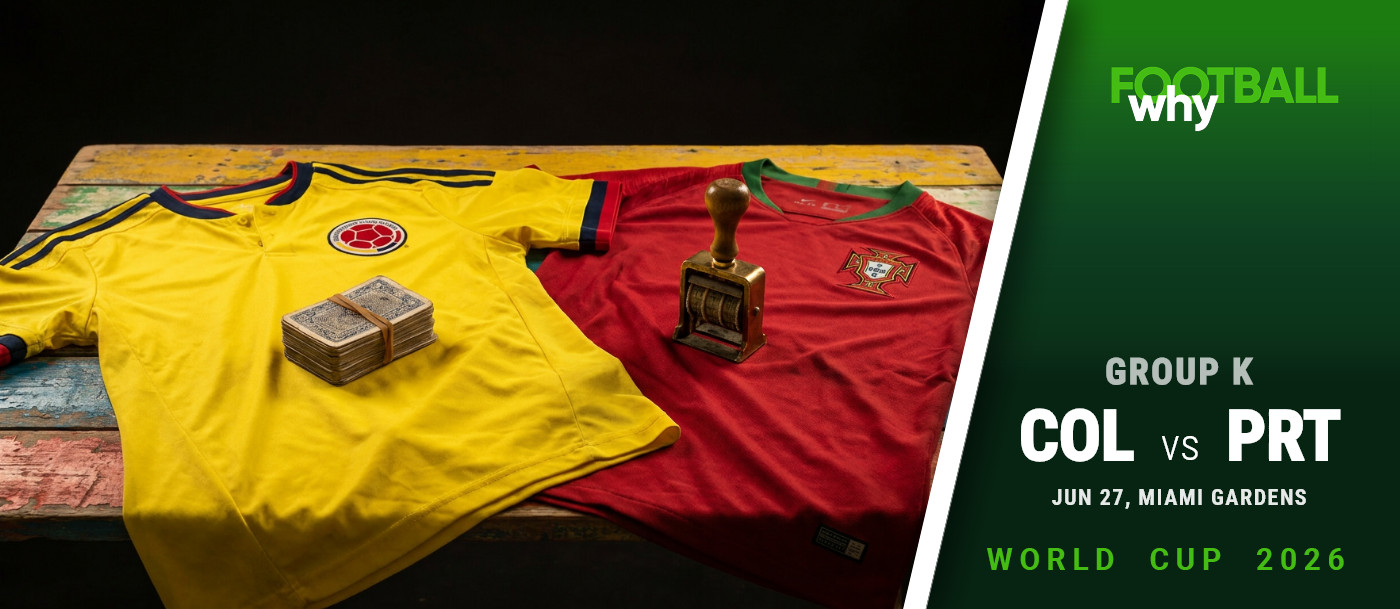
Group K, Matchday 3, Match #71
UTC

Hard Rock Stadium, Miami Gardens

Prediction by whyFootball readers

COL
DRAW
PRT
31%
31%
38%
Not a recommendation for betting
Tap [+] to cast your expert forecast.
SCORE BY AI PREDICTION: 2:2 SEE SIMULATION

Colombia vs Portugal FIFA World Cup 2026 Group Stage Match Filing the Paperwork for a Street Corner Hustle Forecast generated:

The improvisational hustle of the South American barrio clashes with the maritime cartography of the old navigators. It is a contest of contrasting dignities: the visceral, rhythmic insurgency attempting to bypass the cold aristocracy of calculation.

Colombia: One side's prayer...

Heading into this final Group K fixture, Colombia know a draw secures qualification, but the vocal Miami diaspora demands they snatch top spot. The squad is nursing its heavy hitters through the tournament grind. James Rodríguez is on a strict sixty-minute physical curfew, while Daniel Muñoz is managing a fragile shoulder. The pressure to deliver a statement victory is immense, forcing them to balance their natural, freewheeling rhythm with the pragmatic need to survive the group stages intact.

Portugal: ...head-on with the other.

Portugal approach this group decider with the calm detachment of a team whose paperwork is already filed. A draw guarantees progression, but public expectation back home demands a clean, authoritative win to secure pole position. The medical staff are carefully managing the workloads of their ageing royalty, meaning Cristiano Ronaldo and Rúben Dias will have their sprint exposures strictly monitored. They will aim to quietly suffocate the match, preserving vital energy reserves for the gruelling knockout rounds ahead.
Colombia vs Portugal Structural Collision

Colombia: How we will host...

The Dream
Securing top spot is the absolute minimum required to satisfy the vocal diaspora packing out Miami. A draw mathematically works, but the crowd demands a genuine statement against European royalty.

The Strength
Their football is built on streetwise cunning and pure, unadulterated flair. Luis Díaz provides the electric, touchline-hugging isolation, while James Rodríguez acts as the central hub, turning chaotic sprints into coordinated strikes.

The Plans
The manager intends to bypass the clogged midfield entirely. They will bait Portugal's full-backs high up the pitch, then ruthlessly expose the empty tarmac left behind with early, flat diagonals and low cut-backs.

The Fears
Emotional turbulence remains their Achilles heel. When the refereeing feels harsh or the game state turns against them, the team's festive bravado often collapses into rushed long shots, cheap fouls, and a dangerously stretched defensive line.

Portugal: With what we arrive...

The Dream
Securing the summit of the group without breaking a sweat is the ultimate objective. A draw serves the administrative purpose perfectly. However, a clean victory allows the medical staff to manage the fragile hamstrings of their ageing royalty ahead of the knockout stages.

The Strength
They operate with the quiet, devastating efficiency of seasoned municipal planners. The squad is packed with elite technicians who treat possession as a sacred duty. They dictate the tempo through intelligent, slow-burn circulation before suddenly accelerating into the final third to finish the job.

The Plans
The strategy involves a deliberate, hypnotic passing rhythm designed to lull the opposition to sleep. Once the defensive shape shifts, they will launch sudden diagonal switches to isolate their wingers. Late, untracked runs into the penalty area will provide the finishing touches from the midfield.

The Fears
A descent into aimless, predictable crossing remains their chronic flaw. When the opposition parks a deep block, the midfield can become overly reliant on a central talisman. This frustration stretches their shape and invites exactly the sort of chaotic transitions they despise.

How it will be...

This fixture should project a stark collision of temperaments. Portugal will likely attempt to smother the occasion, stringing together short, hypnotic passes to drain the ambient tension. Colombia, conversely, will sit coiled, trusting their fate to the sheer kinetic violence of their transitions. This friction between cadences will define the afternoon. The archivist’s patience against the hustler’s sudden pivot.

Keep a close eye on the touchlines. Luis Díaz could dismantle any defensive structure with his stuttering acceleration and that elastic hip-shift which routinely unbalances full-backs. Yet, if the visiting defenders synchronise their retreats, the winger might find himself relegated to peripheral skirmishes. On the opposite flank, Rafael Leão’s loping strides behind the right-back will force the interior midfielders into exhausting, lung-bursting recovery sprints.

Eventually, metabolic drag will dissolve the tactical scaffolding. The local defence, historically brittle under sustained interrogation, could fracture against a barrage of flat deliveries. That is the exact environment where Cristiano Ronaldo’s predatory, blind-side intuition thrives. A concluding act where European proceduralism squeezes the last drops of resistance from a remarkably permeable emotional shell.

Colombia: Just short of victory

Victory slipped away due to an erosion of concentration. The relentless volume of low Portuguese crosses eventually wore down the zonal markers, gifting the late equaliser. Denied their primary playmaker's calming influence in the final quarter, the team reverted to an overly frantic tempo, exposing their historic inability to comfortably manage a lead.

Portugal: Just short of victory

They were denied a win by their own initial caution and a singular defensive lapse. A rehearsed set-piece routine neutralised their premier aerial defender, costing them a crucial goal. Furthermore, their rigid adherence to positional symmetry occasionally starved the attack of raw numbers, confirming their tendency to lapse into sterile possession against compact blocks.

Secret mastermind intent

Néstor Lorenzo’s Streetwise Hustle and Sideline Bartering

General Strategy
Néstor Lorenzo is setting up a pragmatic stall, balancing the urge to attack with the need to protect the till. The primary focus is managing risk against elite opposition.

He will deploy a compact mid-block, aiming to absorb pressure without retreating too deeply. The defensive line will sit near the halfway mark, prioritising stability.

From there, the transition strategy relies on isolating their left winger as quickly as possible.
Antidote for the Opponent
The defensive blueprint revolves around suffocating Bruno Fernandes. A holding midfielder will shadow his every move in the central zones, stepping hard on his back-to-goal touches.

Out wide, the plan is to double up on Rafael Leão. The right-back and nearest midfielder will force him towards the touchline to deny the inside cut.

In attack, they will target the space left by João Cancelo. When the Portuguese full-back drifts inside, early low crosses will punish the gap.
Internal Task Solving
There is a strict, pre-planned cap on James Rodríguez’s physical output. He is mandated to play no more than 65 minutes, preserving his legs strictly for final-third creation rather than pressing.

The medical staff are also managing Daniel Muñoz’s shoulder load. He will avoid unnecessary aerial duels and physical landings.

Finally, the goalkeeper has a clear directive to slow the game down. If they take the lead, he will delay restarts to let the defensive block breathe.
Crisis Response Plans
Lorenzo is prepared to rip up the floorboards if Portugal’s right-sided overloads start breaking through. Should the opposition breach the defensive line repeatedly, Colombia will immediately narrow into a flat 4-4-2.

The right winger will drop deep to form a double pivot, sacrificing attacking width to plug the gaps.

Beyond this specific trigger, the manager remains entirely flexible. He is ready to throw on a physical striker and switch to a chaotic 4-2-4 if chasing a late goal.
Specific Match Orders
Luis Díaz: Hug the touchline and stay completely wide. Sprint into the space behind the right-back the moment he commits forward. Never drop deep into the central zones; keep at least five yards of vertical distance from the playmaker at all times. Jefferson Lerma: Shadow their main playmaker zonally. Step right onto his back the second he tries to receive the ball facing his own goal. You have an allowance of exactly one tactical foul per half, so use it wisely. Daniel Muñoz: Hold your defensive position as the default setting. Do not overlap unless the opposite winger is comfortably pinned back. Avoid forcing first-time crosses into a crowded box; simply recycle the ball back to the central midfielders.
/ What if Portugal tear through the right flank?

If their wide combinations break the defensive line three times in ten minutes, the shape immediately collapses into a narrow 4-4-2. The right winger drops alongside the holding midfielder to build a secondary wall. The right-back holds his position, and all clearances are hooked into the channel behind their advancing left-back.

/ What if the central playmaker fades or gets marked out?

If the number ten is physically exhausted or starved of the ball for fifteen minutes, the bench will intervene. A fresh, high-tempo runner will take over the central hub to increase the passing speed. If the team is pinned back, a physical striker will be introduced early to stretch the pitch.

Secret mastermind intent

Roberto Martínez’s Municipal Planning and Archival Patience

General Strategy
Roberto Martínez is drafting a meticulous council proposal, determined to lay the tarmac at his own methodical pace. The primary objective is absolute territorial control.

He wants to dictate the game through a structured possession phase, starving the opposition of the ball. The defensive line will push up to a medium-high height of 55 metres.

This ensures the midfield remains compact and ready to suffocate any counter-attacks at the source.
Antidote for the Opponent
The defensive blueprint features a bespoke shadow operation for the opposition's playmaker. A designated pivot will track him relentlessly to block his favoured left-footed slip passes.

On the flank, the instruction is to immediately double-team their explosive winger upon his first touch. They will forcefully usher him towards the touchline to neutralise his threat.

Offensively, Portugal will exploit the vacuum left behind the advancing left-back with rapid winger rotations.
Internal Task Solving
The medical department’s traffic-light system heavily dictates the starting shape. The veteran striker is under strict orders to conserve his energy entirely for penalty-box poaching.

Similarly, the lead centre-back must manage his sprint loads, angling his body to delay attackers rather than diving into footraces.

Intriguingly, the goalkeeper has been told to avoid lofted central clearances. He will exclusively target the far full-back with diagonal chips to bypass the press.
Crisis Response Plans
Martínez is perfectly willing to tear up the planning permission if the central playmaker is isolated. Should the primary creator be boxed out for ten minutes, the full-back will invert much earlier.

This instantly engineers a three-versus-two numerical superiority in the middle of the park.

Otherwise, the manager retains a pragmatic flexibility. If chasing the game late on, he will unceremoniously dump the patient build-up for a flat, aggressive front four.
Specific Match Orders
João Cancelo: Step into the midfield only when the opposite full-back remains securely behind the ball. If he pushes high, lock down the outside lane entirely. Delay any inside carries to maintain structural balance. Bruno Fernandes: Act as the absolute governor of the match's tempo. Take quick restarts whenever the opposition's holding midfielder is grounded. Avoid ambitious, low-percentage passes if the defensive block is set; use a third-man combination instead. Rúben Dias: Never chase the opposing winger into the wide channels. Protect the seam between the centre and the right-back as an absolute priority. Manage your sprint loads by angling your body to show the attacker outside.
/ What if the opposition exploit the space behind the full-backs?

If repeated diagonal balls pin the defence back, the asymmetrical shape is immediately binned. The right-back locks into a fixed double-pivot role, severely restricting his forward runs. The right-winger then drops deeper to restore stability to the rest-defence.

/ What if the trailing team adopts a direct, physical approach?

Should the opposition introduce a target man and bypass the midfield entirely, Portugal will anchor the backline. A dominant aerial centre-back will be introduced, and the full-backs will retreat five yards. The central midfielders are then strictly tasked with sweeping up the second balls.

MAIN SIMULATION 0'-25'

Portugal will likely operate a classic bait-and-switch. They overload the right side to drag Colombia's midfield, then suddenly pivot to Rafael Leão on the isolated left. Colombia's right-back holds his ground, but the central midfielder is a fraction late to cover. Leão hits the byline and cuts back for Bruno Fernandes, who ghosts onto the penalty spot to score around 14 minutes. Colombia respond by bypassing the midfield altogether, launching flat diagonals towards Luis Díaz.

MAIN SIMULATION 25'-45'

Colombia throw cold water on the tempo. They stitch together a few safe passing sequences to regain their footing, then deploy a municipal-grade set-piece routine. A short-corner chain drags Portugal's zonal markers out of position, screening Rúben Dias out of the play. Jefferson Lerma arrives late to finish through the traffic around 33 minutes. Portugal immediately lock down their full-backs to absorb the shock and prevent further bleeding.

MAIN SIMULATION 45'-65'

The match settles into an industrial grind. Portugal tweak their shape, bringing João Cancelo inside earlier to create a central overload and speed up their passing. Colombia counter this by tightening the right channel and leaving Díaz high as a pure outlet. Around 63 minutes, James Rodríguez hits his physical limit and is substituted. Colombia lose his creative pause but inject more vertical running, while both defensive structures begin to feel the metabolic drag.

MAIN SIMULATION 65'-90'

Tactics give way to heavy legs. Portugal introduce Cristiano Ronaldo and stretch the pitch, while Colombia throw on Durán to batter the defensive line. On 78 minutes, Díaz isolates Dias, hits the byline, and crosses for Durán to smash home. Yet, Colombia's defensive discipline decays. Battered by relentless Portuguese cut-backs, the penalty-spot screen finally collapses. At 86 minutes, Nuno Mendes overlaps, and Ronaldo ghosts off a tired centre-back's blind shoulder to tap in the equaliser.

And it will come to...

If this scenario were to unfold, the match would be a fascinating audit of two contrasting philosophies. Colombia would likely lean on their streetwise wing isolations and rehearsed set-pieces to bypass the midfield entirely. Portugal, conversely, would dictate the tempo through methodical, positional control, probing for structural weaknesses. Ultimately, both systems would fracture under fatigue. Colombia's defensive screen would decay against relentless wide pressure, while Portugal's reliance on late box arrivals would barely salvage a draw from the chaos.
end of Game