

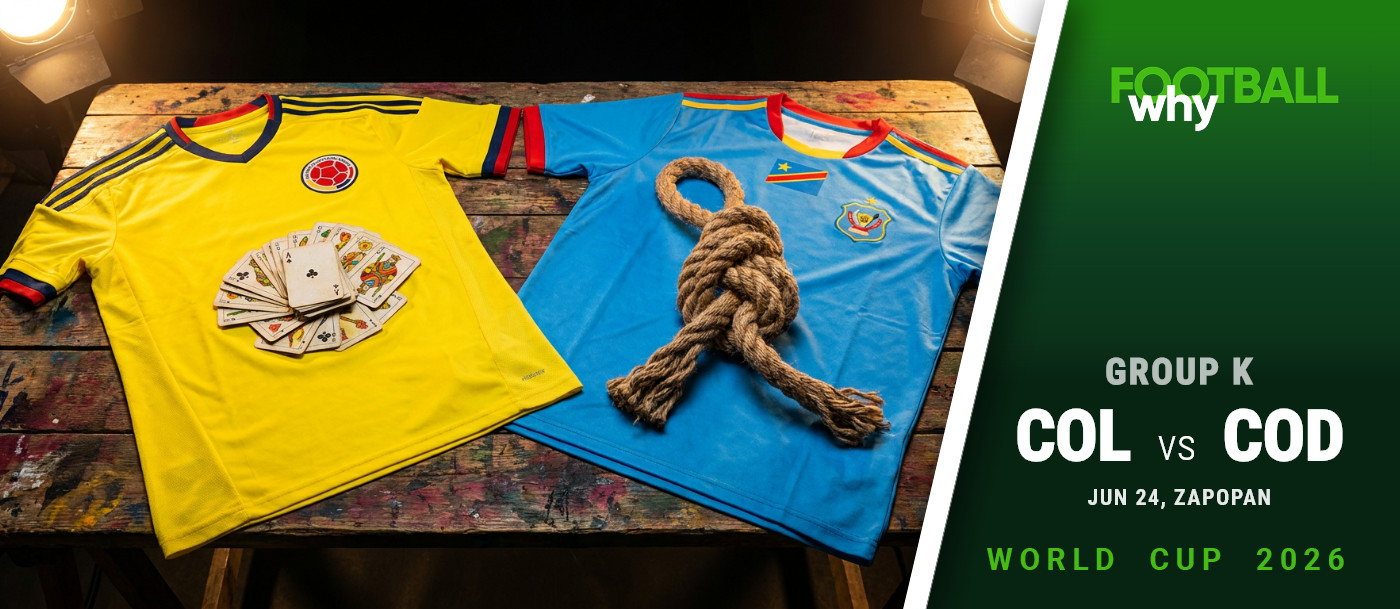
Group K, Matchday 2, Match #48
UTC

Estadio Akron, Zapopan

Prediction by whyFootball readers

COL
DRAW
COD
52%
28%
20%
Not a recommendation for betting
Tap [+] to cast your expert forecast.
SCORE BY AI PREDICTION: 2:1 SEE SIMULATION

Colombia vs DR Congo FIFA World Cup 2026 Group Stage Match A Street-Corner Hustle at the Concrete Checkpoint Forecast generated:

The ingenuity of the informal market collides with the resilience of the tribe. It is barrio cunning attempting to outwit a brotherhood forged in adversity. A contest where rhythmic flair challenges a wall of pure, communal pride.

Colombia: One side's prayer...

Colombia arrive burdened by severe public expectation; the galleries demand not just their customary rhythmic flair, but a ruthless, clean-sheet efficiency to secure six points from their opening fixtures. The dressing room is fiercely focused, though a lingering anxiety hums around James Rodríguez’s strictly capped minutes and Daniel Muñoz’s fragile shoulder. The manager must carefully spool out their creative lifeline, ensuring the match is effectively killed off before their talisman is forced to retreat to the bench.

DR Congo: ...head-on with the other.

DR Congo ride into this fixture on a wave of euphoric national pride following their qualification, yet the mandate remains brutally pragmatic. Securing a point is vital to avoid a suffocating final-day scenario. The squad is tightly bonded, having successfully parked the minor administrative noise surrounding players delaying their return to European clubs for victory parades. They are primed to absorb the pressure, treating the defensive third like a reinforced barricade that they will fiercely hold until the final whistle.
Colombia vs DR Congo Structural Collision

Colombia: How we will host...

Dream
The bare minimum is securing three points without the usual cardiovascular strain. The public demands a clean sheet and absolute control, politely requesting that the traditional flair is backed by cold, municipal efficiency rather than emotional chaos.

Strength
They possess a brilliant, street-smart cunning. It is a squad built on technical mastery and fearless wide play, always finding a clever workaround when the front door is bolted. This hustle is woven deeply into their collective fabric.

Plans
Lorenzo intends to exploit the space left by the opposition's attacking left flank. The idea is to slip flat, early crosses into the box, completely bypassing the imposing central defenders who dominate the aerial battles.

Fears
The creeping anxiety of sudden disorganisation. When the initial approach stalls, frustration historically boils over into unnecessary fouls, while the creative hub drops far too deep to influence the final third.

DR Congo: With what we arrive...

Dream
The ultimate objective is to extract points and secure a clean sheet. Despite the euphoric hangover from qualification, the mandate is brutally pragmatic. Securing a draw here is perfectly acceptable; losing merely tightens the noose for the final group match.

Strength
This squad is defined by a defiant, communal resilience. They possess an impressive capacity to absorb pressure, relying on athletic duellists and a formidable set-piece threat. It is a collective spine that thrives on shared defensive labour.

Plans
The strategy hinges on denying the opposition's left flank. They aim to double-team the primary dribbler, forcing the play wide, and then ruthlessly exploit the space left behind by the advancing full-back with rapid, left-channel counter-attacks.

Fears
The recurring nightmare is a lapse in emotional control. When frustration mounts, the defensive shape frays. Players are prone to chasing isolated duels and conceding cheap free-kicks, transforming a solid block into a chaotic scramble.

How it will be...

The fixture should unfold like a tense, low-stakes poker game played in the stifling mid-afternoon heat. Colombia will seek to sedate the rhythm with lateral circulation, weaving their snare before snapping the trap shut, whilst Congo erect a stubborn, communal barricade, committing to uncompromising physical attrition. Patience remains the only viable currency. The South Americans will prioritise territorial governance, refusing to gamble their capital prematurely.

The vault’s combination likely rests on streetwise opportunism. Should Mpasi spill a low drive into the six-yard box, Luis Díaz’s predatory instincts could capitalise on the orphaned ball. That singular miscue from the soloist would unpick the entire score. The winger will act as a decoy until he scents vulnerability. The Africans, in turn, will channel their rebellion down the left flank, attempting to inflict damage via stealthy, wide incursions.

The script threatens to unravel if the Congolese physical imposition crosses the referee's threshold, or if Vargas falters beneath a barrage of diagonal deliveries. A single misjudged flap from the goalkeeper would rewrite the verdict. Congo will never hoist the white flag. Their collective resilience will compel them to bombard the penalty area until the final whistle, guaranteeing a frayed, nervous epilogue.

Colombia: How did they clinch it?

Colombia likely prevailed because they translated territorial governance into precise incisions. Capitalising on a goalkeeper's rebound and executing a surgical cutback unlocked the African barricade. Individual quality from the bench compensated for premature fatigue, underpinning a victory built on municipal patience and streetwise opportunism.

DR Congo: Why not go for the win?

Congo probably succumbed due to a creative vacuum in the final third. The inability to convert an early, glaring opportunity buried their ambitions when the match state demanded ruthlessness. Their physical ferocity and a late consolation goal revealed an indomitable pride, yet a lack of positional variety condemned them to chase shadows.

Secret mastermind intent

Néstor Lorenzo’s Streetwise Hustle Meets Municipal Pragmatism

General Strategy
Lorenzo wants to govern the match state with cold authority. The primary directive is to secure the points while fiercely protecting the goal difference, avoiding any chaotic, end-to-end exchanges.

The team will deploy a stable mid-block, enforcing a strict two-pass cooling sequence before attempting vertical thrusts. It is essentially an exercise in municipal planning. They will secure the borders first, then build the attacks.
Antidote for the Opponent
The tactical crosshairs are firmly fixed on the space behind Arthur Masuaku. Colombia intends to hit early, flat deliveries across the six-yard box, specifically targeting the channel outside the right-sided centre-back.

They are explicitly avoiding floated crosses. Testing Chancel Mbemba in the air is a fool's errand. The focus shifts entirely to sharp cutbacks and rehearsed set-piece routines.
Internal Task Solving
The medical staff are effectively dictating the tempo. James Rodríguez is operating under a strict 60-to-70-minute ceiling. Colombia must establish their dominance before their creative fulcrum is withdrawn.

Daniel Muñoz is nursing a shoulder issue. He is instructed to avoid risky aerial duels, a restriction that demands alternative solutions when clearing the back post.
Crisis Response Plans
If the opposition wingers start isolating the full-backs and winning the initial contact, the structure immediately shifts. The right winger will drop to form a rigid bank of four, completely sacrificing the overlap to restore order.

Should the central playmaker fade physically, the blueprint changes again. An orthodox striker will be introduced to stretch the defensive line, turning patient circulation into direct, vertical pressure.
Specific Match Orders
Luis Díaz (Left Winger): Act as a decoy for the opening twenty minutes. Receive the ball wide, draw the markers, and recycle possession to trigger a switch of play. Defer the heroic, solo dribbles until the team has established a clear numerical advantage in the final third. Jefferson Lerma (Defensive Midfielder): Commit absolutely zero fouls in the central channel within thirty yards of goal. Shade towards the right half-space to screen against overlapping runs. Trigger vertical passes only after the team has completed a two-pass stabilising sequence. Davinson Sánchez (Centre-Back): Avoid stepping out for front-foot duels thirty-five yards from goal. Hold the defensive line and force the opposition to cross under heavy pressure. On defensive set-pieces, dominating the near post is the absolute priority.
/ What if an early goal is conceded or the team suffers multiple rapid counter-attacks?

The shock-recovery protocol is immediately activated. The players are to huddle, deliberately slow the restart, and execute a patient, two-possession sequence through the midfield to reset their spatial distances. The right-back remains firmly tucked inside until the panic subsides.

/ What if the creative hub loses physical duels and the team cannot access the edge of the penalty area?

The system becomes decidedly more blunt. Arias slides centrally to operate as the playmaker, a traditional physical striker is introduced to run off the defender's outside shoulder, and the wingers are instructed to attack the far post for early, low crosses.

Secret mastermind intent

Sébastien Desabre’s Defiant Wall and the Counter-Punch

General Strategy
Sébastien Desabre is advocating a policy of disciplined attrition. The focus is on denying central territory, maintaining a compact mid-block, and ruthlessly managing the foul count.

They will gladly concede harmless width. The objective is to delay the opposition, spring sideline traps, and then launch direct transitions via the flanks. It is a system built on robust rest-defence rather than possession purity.
Antidote for the Opponent
The defensive blueprint is heavily tailored to neutralise the opposing left winger. The instruction is to aggressively double-team him upon reception, absolutely forbidding any inside cuts towards the penalty arc.

Offensively, the plan is to target the space outside the opposition's right-sided centre-back. They intend to use early, flat deliveries across the six-yard box, specifically seeking out late runners arriving from deep.
Internal Task Solving
There is a minor, lingering noise regarding post-qualification ceremonies and club releases. Consequently, the coaching staff are doubling down on punctuality and focus within the camp, treating discipline as a non-negotiable metric.

The goalkeeper is under strict orders to slow down the restarts. This is a deliberate tactic designed to neutralise any sudden surges in the opponent's rhythm, effectively pouring cold water on the match tempo.
Crisis Response Plans
If the opposition playmaker continuously finds pockets of space to turn and face the goal, the defensive geometry alters. A holding midfielder will step up earlier to apply pressure, covered closely by a centre-back.

Should the opponent overload the penalty area with an extra striker, the response is purely numerical. The formation shifts to a 5-3-2, dropping an auxiliary defender into the backline to ensure dominance over the first contact.
Specific Match Orders
Chancel Mbemba (Centre-Back): You have explicit permission to step across and double-team the left winger when he cuts inside, but you must reset the defensive line immediately afterwards. On attacking corners, attack the delayed back-post lanes; arrive at pace, do not stand static. Arthur Masuaku (Left-Back): Maintain a conservative starting position. Only overlap when given the explicit green light — specifically when the opposing right-back is tucked inside. If caught high up the pitch, turning early and tracking the far runner is the absolute priority. Samuel Moutoussamy (Defensive Midfielder): Commit absolutely no central fouls within thirty yards of our goal. If the opposition winger receives the ball with his back to goal, arrive on his blindside to nick possession; under no circumstances should you wrap your arms around him.
/ What if the opposition consistently breaks the defensive line down our left flank?

The left-back is immediately pinned to a defensive role. The right-back remains conservative, and a holding midfielder rotates across to act as an auxiliary full-back, effectively shutting down the exposed channel.

/ What if a goal is conceded early in the match?

The captain will instantly convene a huddle. The team will execute a ninety-second calming phase, focusing entirely on field-position play by driving long balls into the corners, ensuring the defensive distances are fully re-established before attempting to press again.

MAIN SIMULATION 0'-25'

Both sides would likely settle into cautious mid-blocks, treating the opening exchanges like a municipal planning dispute. Colombia probes down the right, trying to slip Arias and Muñoz behind Masuaku, while Díaz plays the decoy on the opposite flank. Congo responds by compressing the centre and sending Mbemba to shadow Díaz. An early booking for Congo’s right-back on 11 minutes acts as a tactical sedative. Mpasi slows the tempo with deliberate restarts, and Colombia insists on a strict two-pass sequence before attempting any vertical balls.

MAIN SIMULATION 25'-45'

The deadlock would break on 33 minutes through a rehearsed set-piece routine. James plays short to Arias, who slips Ríos in at the edge of the box; his low drive forces a central parry from Mpasi, allowing Díaz to sweep home the rebound. Congo immediately activates a shock-recovery protocol. They launch long balls to the corners to re-establish field position. They manage a late set-piece flurry around 41 minutes, but Colombia successfully navigates the aerial bombardment by keeping their shape and avoiding cheap fouls.

MAIN SIMULATION 45'-65'

Congo tilts the pitch, directing their first passes out to Wissa on the left. On 55 minutes, he slips outside Sánchez and delivers a cross for Bakambu, forcing Vargas into a sharp save. Sensing momentum, Desabre introduces Banza on the hour mark. Colombia counters this by retreating into a tighter defensive shell. They enforce their two-pass cooling mechanism to drain the sting from the game. James's stamina wanes noticeably, restricting Colombia to conservative, risk-averse circulation rather than high-octane overlaps.

MAIN SIMULATION 65'-90'

The match devolves into a desperate scrap. Colombia swaps James for Durán on 69 minutes, dropping their right winger to form a temporary five-man backline. On 77 minutes, Arias plays a wall pass to release Muñoz, whose cutback is hammered in by Durán. Trailing by two, Congo throws the kitchen sink at the box. Their persistence pays off on 86 minutes when Mbemba flicks a corner to the back post for Banza to convert. Colombia then shuts up shop, funnelling play to the touchlines.

And it will come to...

If this forecast holds, Colombia would validate their philosophy of 'joy with control'. Their expressive wide play would be effectively harnessed by clever set-piece design and pragmatic late-phase management. Conversely, DR Congo would embody a disciplined, defiant resilience, showcasing genuine bite from dead-ball situations. However, the African side would likely struggle to find a stable creative solution through the centre once forced to chase the game. Ultimately, clinical bench interventions and structural discipline would separate the two sides.
end of Game