

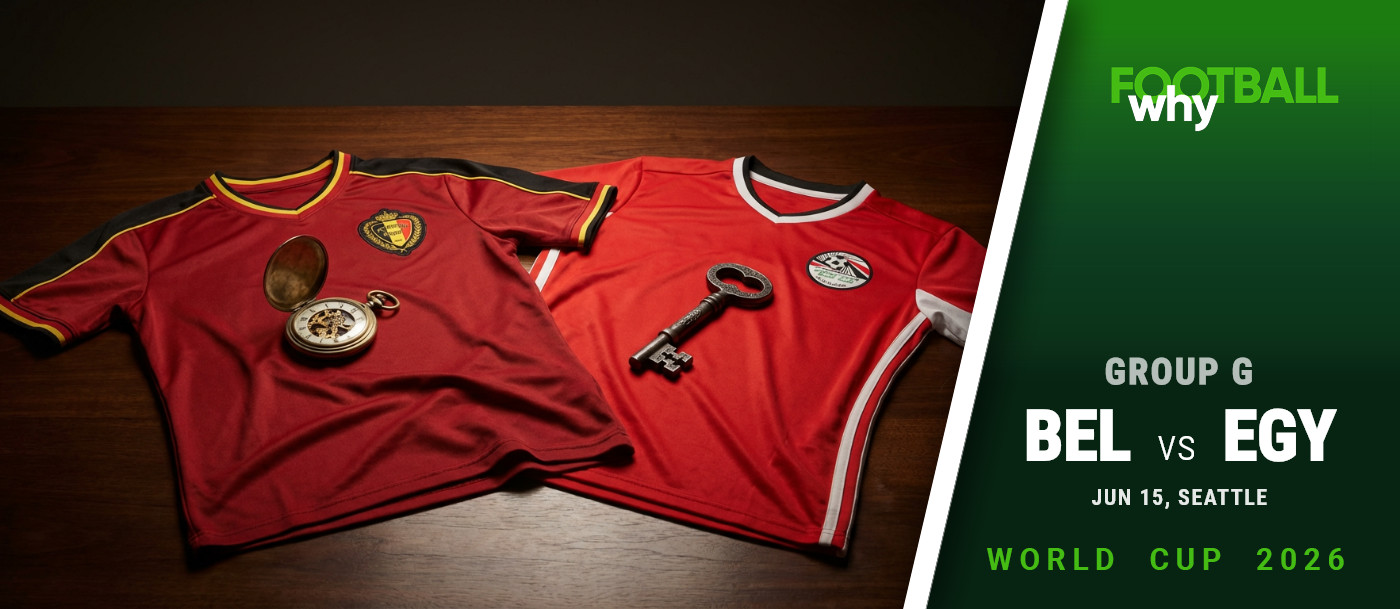
The World Cup Qualification Decider
Monday, 15 June

Lumen Field, Seattle

Belgium vs Egypt FIFA World Cup 2026 Group Stage Match Seattle heat, tactical pedantry, and Lukaku’s blunt intervention Forecast generated:

Twenty-two men dragged their legs through the suffocating Seattle heat, producing an hour of endless lateral passing. Then Romelu Lukaku stepped off the bench and dismantled the tactical pedantry in twenty-two seconds. Unpack the grinding stalemate.
Belgium vs Egypt Structural Collision

What was it?

The Seattle heat pressed down on Lumen Field like a wet towel. Twenty-two men dragged their legs through the humidity, producing a spectacle so thoroughly average it bordered on municipal pedantry. The statistics recorded twenty-eight total shots and a couple of mandated hydration breaks. Everything felt grey and suffocatingly routine.

Egypt struck early and immediately shuttered the windows. Emam Ashour finished from the edge of the area on 19 minutes, assisted by Mohamed Salah. From that moment, they anchored themselves into a deep shape. They survived by winning midfield duels and slowing the tempo to a crawl.

The Europeans responded by filing endless lateral passes. Kevin De Bruyne hit the post from a 52nd-minute free-kick, but they otherwise refused to commit bodies forward. Anyone tuning in late missed an hour of cautious, risk-averse circulation. They opted to wait for an opening rather than force one.

Then Romelu Lukaku stepped onto the grass. He abandoned the procedural caution, sprinting straight at the near post to attack a Thomas Meunier cross. His sheer physical bluntness panicked Mohamed Hany into conceding an own goal just twenty-two seconds after the substitution.

That singular, violent disruption justified the afternoon. Lukaku is a man you suffer alongside, someone whose raw dignity cuts through the tactical noise.

Mostafa Shobeir made a late save to preserve the 1-1 scoreline, confirming a draw that accurately reflected the stubborn grind.

Why stopped just short of victory?

Belgium

Belgium drew because their initial setup prioritised cautious circulation over penalty-area occupation. Starting without a traditional striker meant the midfield double pivot lacked an aggressive target. This reduced their early attacks to repetitive, lateral passing sequences.

They managed the game state by funnelling possession wide, yet consistently refused to commit a third-man runner into the box. The structure seemed designed exclusively to limit transition turnovers rather than force the issue against a deep block.

This hesitation stems from a transitional squad heavily dependent on a single central creator. When Kevin De Bruyne finds his passing lanes squeezed, the collective instinct is to slow the tempo and wait for a perfect opening that rarely materialises.

It reflects a deeper structural neurosis within the national footballing identity. The system relies on club-led academies that consistently produce technically flawless, but inherently risk-averse, system players. They are educated to maintain positional play at all costs.

Under the weight of tournament expectations, the historical trauma of repeated quarter-final exits surfaces. The team subconsciously defers to hierarchy and procedural control, terrified that individual risk-taking will lead to an unmanageable structural collapse.

The resulting football is polite, highly educated, and entirely devoid of friction.

They spent an hour filing meticulous tactical paperwork before finally remembering to swing the heavy hammer.

Why stopped just short of victory?

Egypt

Egypt failed to hold their lead because their instinct for self-preservation entirely consumed their attacking intent. After securing an early advantage, they immediately collapsed into a rigid mid-block, inviting relentless territorial pressure.

Their transition threat evaporated once they began funnelling every counter-attack down the right flank. By withdrawing their primary creator late in the game, they surrendered any remaining capacity to relieve pressure or hold the ball up the pitch.

This reactive posture exposes a severe creative deficit in their midfield. The squad is built to suffer compactly and rely on a single, talismanic figure to manufacture moments of brilliance from isolated, low-probability situations.

When that star gravity is removed, the team defaults to a safety-first survival mode. They prioritise drawing fouls, slowing the cadence, and managing the clock over establishing any sustained possession.

Such conservatism is baked into a domestic-first ecosystem that values defensive honour over expansive risk. Accustomed to dominating the African continent through sheer resilience, they approach the global stage with an ingrained siege mentality.

The public demands dignified suffering and clean sheets. Consequently, the players treat a narrow lead not as a platform to build upon, but as a fragile heirloom to be desperately guarded.

They locked the door from the inside, only to realise they had trapped themselves in the room with the fire.

Match hero...

Romelu Lukaku
Romelu Lukaku bypassed the committee. While his teammates circulated the ball like a draft proposal waiting for regional signatures, he applied a brutal manual override. He simply stepped onto the pitch and drove his bulk straight at the near post. He exploited the sudden contrast between polite, educated possession and raw physical intent. In a system obsessed with procedural control, his willingness to embrace chaotic friction was the only thing capable of forcing a genuine outcome.

...and one more

Emam Ashour
Emam Ashour haggled for every inch of the midfield. He understood the afternoon not as a tactical exercise, but as a test of endurance under the Seattle sun. After securing the advantage, he aggressively bartered away the remaining minutes. Winning the vast majority of his physical duels, he used a low centre of gravity and sheer stubbornness to drag the European tempo down into a suffocating, grinding rhythm that suited his side perfectly.