

The World Cup Qualification Decider


Levi's Stadium, Santa Clara
SCORE BY AI PREDICTION: 2:1 SEE SIMULATION

Austria vs Jordan FIFA World Cup 2026 Group Stage Match Driving a Steel Wedge Through the Desert Barricades Forecast generated:

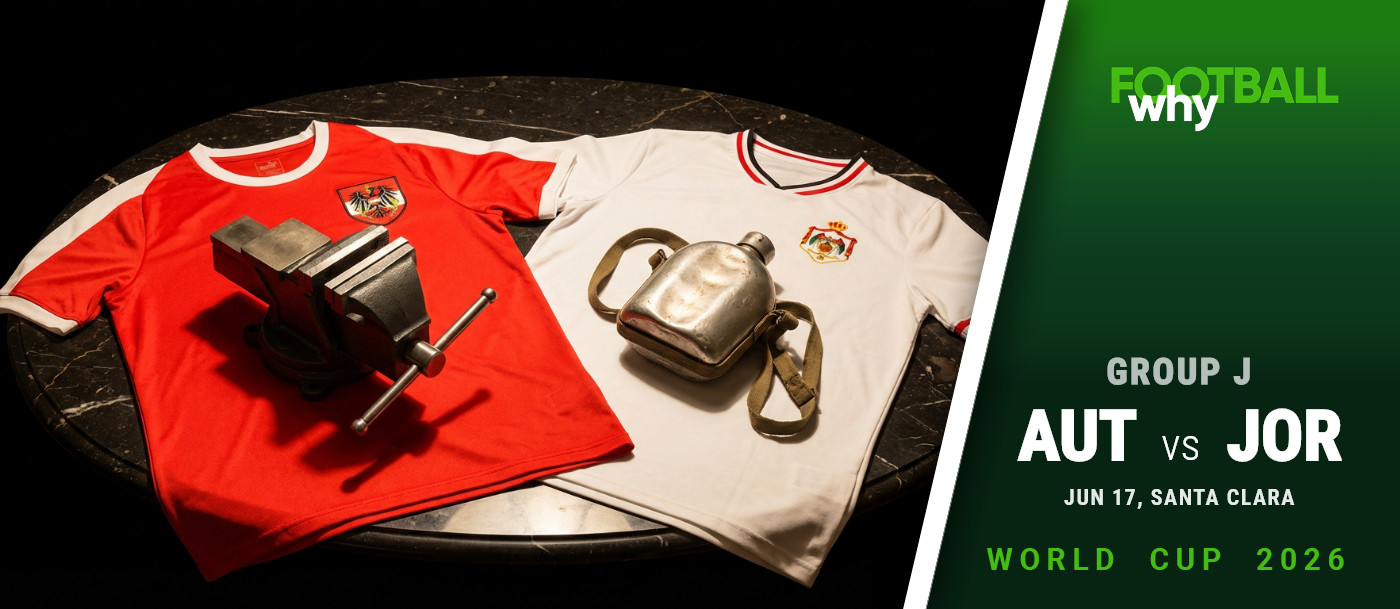
The clinical certainty of Alpine engineering collides with the fierce, protective pride of the desert. It is a battle of relentless, scheduled efficiency against a brotherhood willing to suffer together. Only one survival logic can prevail when the whistle blows.

Austria: One side's prayer...

Austria enter this Group J opener under the heavy burden of domestic expectation, where anything less than a convincing win will spark a neurotic national autopsy. The squad is focused and businesslike, successfully compartmentalising the background noise surrounding Ralf Rangnick’s uncertain contract renewal — a boardroom standoff over federation structures that hasn't fractured dressing-room discipline. With key veteran David Alaba having his minutes managed and Konrad Laimer nursing a slight knee irritation, the starting XI must balance their high-octane pressing engine without blowing a gasket before the knockout rounds.

Jordan: ...head-on with the other.

Jordan arrive at their World Cup debut shielded from immediate pressure but carrying the immense weight of national pride. The squad is tightly bonded but severely bruised, having lost their talismanic striker Yazan Al-Naimat to a ruptured ACL, while Ali Olwan faces a race against time with ankle damage. Forced to navigate a brutal group, they are treating possession like a rationed canteen in a drought. The public expects them to suffer with dignity, demanding only that they do not unravel embarrassingly in the dying minutes.
Austria vs Jordan Structural Collision

Austria: How we will host...

Dream
Bank the three points with total intensity control. The domestic media demand a win and a healthy goal difference, treating this group stage opener almost like an administrative formality. Any slip-up against the debutants will instantly trigger a neurotic national autopsy.

Strength
A highly disciplined, industrious collective built on Bundesliga-schooled pressing. They are a team of qualified craftsmen who value work-rate and quiet swagger, led by the relentless engine of Konrad Laimer and the tactical intelligence of Marcel Sabitzer.

Plans
Isolate the space behind Jordan's advancing left-back. The manager wants early diagonal balls into that channel, immediately followed by cutbacks to the penalty spot rather than hopeful, looping crosses. Defensively, the entire structure is geared towards doubling up on Jordan's star winger, forcing him onto his weaker foot.

Fears
Late-game naivety and emotional unraveling. When fatigue sets in or decisions go against them, the team has a habit of rushing vertical passes, stretching their compact shape, and engaging in pointless arguments with the referee. This temporary loss of procedural discipline is their biggest vulnerability.

Jordan: With what we arrive...

Dream
Secure a respectable point and reach the interval unscathed. The national mood is fiercely proud but guarded, viewing this formidable opener as a stern test of dignity. Avoiding a late collapse is absolutely paramount for preserving collective face on the global stage.

Strength
A stoic, community-first resilience forged through rigorous defensive schooling. They operate with the grim, unyielding solidarity of small-town traffic wardens facing a bank holiday crowd. This is a side that suffers together, grafting technical upgrades onto a deeply resilient counter-punching backbone.

Plans
Surrender possession entirely to meticulously control the remaining space. The blueprint relies on a compact mid-block, denying the central avenues before releasing the ball in two swift touches toward the right flank. Set-pieces will be treated as precious equalisers, deliberately congesting the goalkeeper's runway to hunt for second balls.

Fears
The dreaded closing stages when physical decay invites structural chaos. Under severe tension, they tend to retreat excessively deep, force hopeless passes toward their solitary star, and engage in futile disputes with officials. This concentration deficit frequently turns manageable control into panicked, reactive defending.
54%
0%
46%
Not a recommendation for betting
Tap [+] to cast your expert forecast. Can you outperform both the AI and the crowd?

How it will be...

This clash shapes up as a fascinating structural audit, testing whether Austrian industrial pressing can dismantle Jordan’s fiercely communal low block. From the outside, it will likely resemble a relentless building inspection, with Austria tapping every joint of the Asian defence until a floorboard creaks. Ralf Rangnick’s side will dictate the tempo through high-intensity vertical access. Their Bundesliga-schooled engine room, driven by Marcel Sabitzer, will repeatedly probe the half-spaces.

However, the genuine intrigue lies in the margins of error. If Austria's left flank pushes too high, they risk exposing the blind-side. This is the exact territory where Mousa Al-Tamari operates. The Jordanian winger possesses the explosive first step to turn a minor Austrian positional lapse into sudden, chaotic peril.

As the clock ticks down, expect the mental attrition to become the defining narrative. Jordan's stoic patience may eventually fray into desperate, heroic defending, resembling a town hall barricading its doors. Austria, conversely, might shed their procedural calm and rush their final passes if frustrated. The late stages promise raw, unvarnished human effort, making it a compelling watch for those who appreciate tactical grit over pristine aesthetics.

Secret mastermind intent

Ralf Rangnick’s structural audit and vertical efficiency

General Strategy
The core objective is to blitz the opening twenty minutes with high recoveries, setting the defensive line almost fifty yards from their own goal. It’s an aggressive, front-foot strategy designed to keep the ball firmly in the red zone.

Once possession is secured, the focus shifts to fast vertical access via the interior lanes. The double-pivot is instructed to look for third-man combinations rather than sterile horizontal recycling. The team operates like a finely tuned escapement mechanism, valuing forward momentum over possession for its own sake.
Antidote for the Opponent
The defensive preparation is almost entirely focused on containing Mousa Al-Tamari. The instruction is to establish a two-versus-one coverage trap whenever he receives the ball to his feet. The left-back will hold his position squarely, while the near-side defensive midfielder doubles up from the inside, forcing the winger outward toward his weaker finishing angles.

In attack, Austria will target the channel behind Jordan's advanced left-back. The plan relies heavily on early diagonal balls into this space, specifically aiming for cutbacks to the penalty spot, exploiting Jordan's tendency to collapse deeply into their six-yard box under pressure.
Internal Task Solving
There is a fascinating micro-management tool built into the team's stress response. If they suffer a period of heavy counter-attacks, the nearest senior player — likely Sabitzer — is empowered to call a brief, ten-second shape check before the next restart.

Furthermore, there is a pre-planned double substitution scheduled for the hour mark. This is designed to inject fresh pace between the lines exactly when Jordan's 'killer minutes' usually begin, ensuring Austria's pressing engine doesn't rust late in the game.
Crisis Response Plans
If the initial high press fails and Al-Tamari repeatedly breaks the double-team, the manager has a pragmatic fallback. The team will immediately flatten into a compact 4-4-2 out of possession for a ten-minute spell.

During this period, the left-back's depth is strictly preserved, and the right-back is ordered to stop making overlapping runs unless the ball is completely static. It’s a temporary retreat to basic procedural solidity, ensuring the structural alignment isn't permanently fractured by early chaos.
Specific Match Orders
David Alaba: Hold the left centre-back line and minimise any forward stepping during open play. Do not drift into midfield until at least the seventieth minute. If Al-Tamari squares you up, show him towards the touchline and delay the action until the defensive midfielder arrives. Konrad Laimer: You are the first responder on the right-sided double-teams. Only make underlapping runs if the right-back is holding his position. Following any soft turnover, your immediate next action must be a tactical foul or forcing the play wide; do not attempt square recovery passes. Christoph Baumgartner: Attack the penalty spot on every single cutback from the right side. Under no circumstances should you contest the front-post area with the centre-forward. Arrive late and wait for the pull-back.
/ What if they concede an early goal?

The team will immediately drop into a compact 4-4-2 shape for five minutes. The rhythm will be deliberately slowed, utilising two longer switches of play per sequence. The pressing triggers will only be re-primed on the opponent's next goal kick or back-pass. The coaching staff will use the next stoppage to recalibrate distances.

/ What if the defensive block stretches and player protests rise?

The captain will mandate a strict three-pass settling period before any further vertical balls are launched. Blind, early crosses are completely forbidden. The bench will vocally reaffirm the priority of using the inside lanes to restore order and calm the structural panic.

Secret mastermind intent

Jamal Sellami’s unyielding clockwork and defensive rationing

General Strategy
The primary directive is to hold a disciplined mid-block roughly forty metres from their own goal. Selective pressing triggers will only be activated by square passes across the opposition's backline. Prolonged high pressing is strictly prohibited to conserve energy.

They will absorb pressure with the bureaucratic caution of a planning committee denying a conservatory extension. The midfield will employ a strict early-release rule, shifting the defensive shape with a single pass. A vertical ball will then be punched into the half-spaces to ignite the counter-attack.
Antidote for the Opponent
Defensive preparations are heavily skewed toward protecting the penalty spot from cutbacks. An extra midfielder will be permanently stationed at the edge of the area to track late arrivals. The near-side central midfielder is tasked with remaining touch-tight to the opposition's primary right-sided creator.

Offensively, the strategy hinges on testing the channel behind the advancing Austrian left-back. Early diagonal balls will be launched from the centre of the park to the weak-side winger. If the opposition full-back tucks inside, the wide men are instructed to exploit the resulting isolation.
Internal Task Solving
A unique tempo-control mechanism is entirely entrusted to the goalkeeper. If the defensive block becomes pinned and exhausted, he is mandated to hold the ball for a full ten seconds during restarts, allowing the lines to breathe and reset.

There is also a designated aggression window planned between the 55th and 75th minutes. A fresh ball-winner will be introduced to disrupt the opposition's rhythm. The team is explicitly permitted to accept early yellow cards to halt dangerous counter-attacks during this critical phase.
Crisis Response Plans
Should the opposition's counter-pressing pin the midfield and monopolise the loose balls, the manager will flatten the shape into a rigid 4-1-4-1. The goalkeeper will then bypass the press entirely by distributing long towards the left flank for a designated ten-minute window.

This temporary adjustment allows the team to play away from the heaviest pressure. It serves as a necessary release valve when central passing lanes evaporate. The wider midfielders will drop slightly deeper to secure the defensive perimeter until the storm passes.
Specific Match Orders
Mousa Al-Tamari: Remain predominantly in the inside-right channel until the hour mark. Ensure your first touch faces inside only if the defensive double-team is not yet set. Otherwise, drive down the outside to win territory and draw fouls. Noor Al-Rawabdeh: Adhere strictly to a two-touch limit when operating under pressure. If the opposition denies you the opportunity to turn, bounce the ball immediately to the nearest full-back. Do not attempt a third touch or carry the ball through central attacking zones. Yazan Al-Arab: Do not step aggressively onto the back of the opposing striker without prior warning. If you commit to stepping out, you must communicate loudly so the defensive midfielder can plug the vacated gap. Prioritise protecting the goalkeeper's flight path during all defensive set-pieces.
/ What if they concede an early goal?

Retreat immediately into a 5-4-1 shell for eight to ten minutes. Restarts must be taken slowly, and the mid-block will only be re-established when defensive distances are perfectly clean. The bench will simplify passing cues to target the right winger immediately before switching play.

/ What if they are trailing with twelve minutes remaining?

Shift aggressively to a 4-2-4 formation by adding a second striker. The right-back will be released to overlap, while the left winger underlaps into the penalty area. One centre-back will be permanently committed forward for late set-pieces to hunt second balls.

MAIN SIMULATION 0'-25'

Austria attempt to tilt the pitch through wide overloads and third-man runs in the half-spaces, treating Jordan’s defensive block like a stubborn tenon joint needing a hammer. Jordan sit in a narrow formation, diligently shielding the penalty spot from central cutbacks. Austria are forced down the touchlines, resulting in crosses from awkward, low-percentage angles. Jordan’s best outlet involves spinning Al-Tamari into the channel, but Austria's conservative rest-defence closes the initial switch.

MAIN SIMULATION 25'-45'

Jordan begin to calibrate their pressing triggers, occasionally jumping on backwards passes like overzealous traffic wardens spotting an expired parking ticket. This briefly disrupts Austria’s rhythm, forcing a spell of deeper possession. Austria cool the temperature by circulating the ball horizontally across the midfield pivot. They then attempt to bypass the block with early diagonal balls over the top, while Jordan defend corners with a heavy double-screen.

MAIN SIMULATION 45'-65'

Jordan attempt a more assertive phase after the break, pushing their fullbacks higher to compress the touchlines. Austria counter this by accelerating their passing combinations, slipping into the vacated spaces like water through creaky school floorboards. On 57 minutes, Austria finally bypass the penalty-spot shield. A reverse pass to the byline is cut back for Baumgartner, who arrives unmarked to guide a finish home.

MAIN SIMULATION 65'-90'

Jordan’s resolve hardens as they chase the game, throwing bodies forward with the desperate energy of a parish council meeting running past midnight. Austria become disciplined and slightly ascetic, prioritising shape over spectacle. The game stretches, and Austria punish the risk on 82 minutes with a swift transition finish from Sabitzer. Jordan manage a stoppage-time consolation from a set-piece, but Austria kill the remaining seconds.

And it will come to...

If this scenario were to unfold, high-output industrial pressing would ultimately outlast resource-hoarding patience. Austria would likely impose their identity of width-fed incision, while Jordan’s compact, low-variance approach would require a set-piece equaliser that simply might not arrive in time. The hinge would be Austria solving the central access problem without feeding Jordan's inside traps. Once ahead, the Europeans' structured rest-defence would create repeatable transition exits that the tiring underdogs could not fully contain.
end of Game