

The World Cup Qualification Decider
Friday, 3 July

AT&T Stadium, Arlington

Australia vs Egypt FIFA World Cup 2026 Group Stage Match Heavy Legs, Blocked Shots, and a Cruel Penalty Forecast generated:

Two hours of heavy-legged, bruising attrition yielded 16 Australian shots but only a single effort on target. Discover how Egypt absorbed the physical bombardment and calmly stole the shootout in our full match breakdown.
Australia vs Egypt Structural Collision

What was it?

The Texas heat baked the stadium into a stifling, breathless vacuum. Twenty-two men battered against each other for two hours, treating the pitch like a scrapyard of aerial duels and heavy collisions.

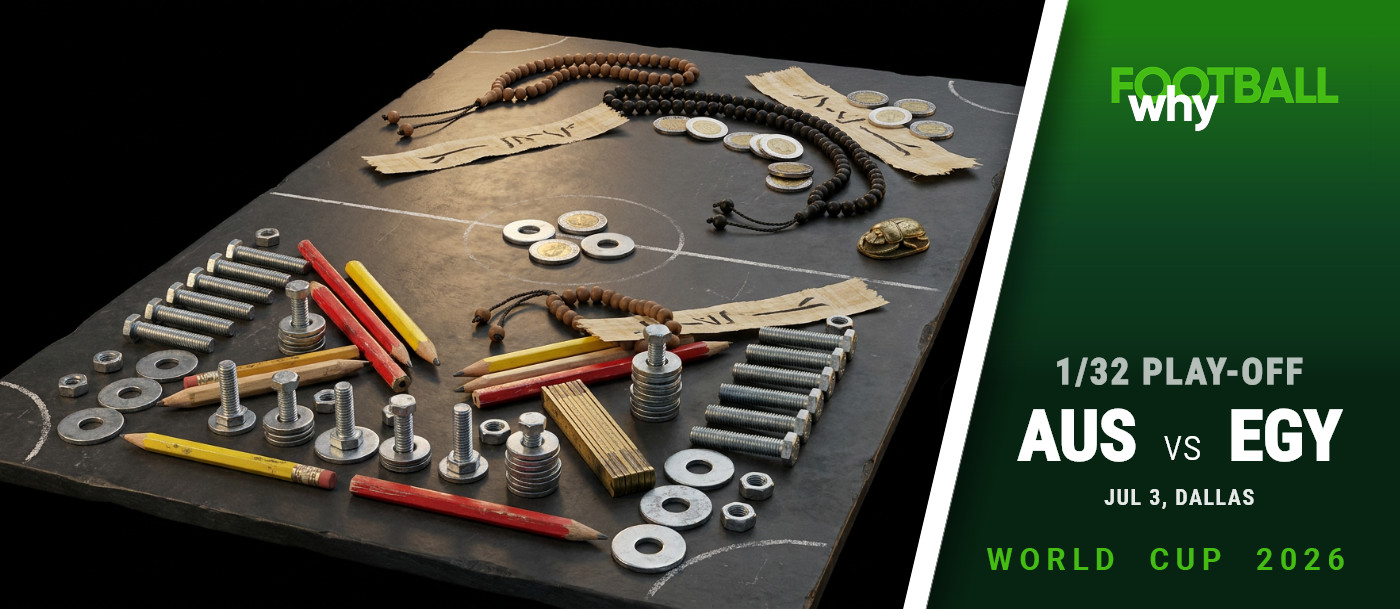
Australia hammered away like a frantic plumber wrenching at a rusted pipe, generating 16 shots. Yet only one actually tested the goalkeeper, with nine efforts thudding directly into Egyptian shins. Both goals mirrored this scrappy reality. Emam Ashour nodded in following a recycled dead-ball delivery on 13 minutes, before an outswinging free-kick glanced off Mohamed Hany’s head for an equaliser just after the break.

Open-play creativity completely evaporated. Egypt retreated, bringing on an extra centre-half to barricade the penalty area. The Australians, devoid of a central playmaker, just kept looping crosses into the mixer.

Then came the shootout tinkering. Tony Popovic dragged on Mat Ryan at 119 minutes specifically for the penalties. Ryan saved nothing. Instead, the crushing weight of the evening fell onto Lucas Herrington. The 18-year-old missed the decisive spot-kick, a quietly devastating end for a kid asked to carry the burden of an entire nation.

Why stopped just short of victory?

Australia

Australia's inability to break the deadlock stemmed directly from the absence of a stable, back-to-goal centre-forward. Using Nestory Irankunda as a vertical outlet stretched the pitch initially, but it left the penalty area entirely unoccupied during periods of sustained possession.

When Jordan Bos departed at half-time with a knee injury, the left-sided structural balance collapsed. The attack subsequently tilted into predictable, hurried deliveries from wide areas, entirely bypassing the central midfield.

This bluntness forced the team to rely exclusively on set-pieces and second-ball scrambles. When technical solutions vanish, the default response is simply to run harder and cross earlier.

Tony Popovic’s decision to swap goalkeepers at 119 minutes highlighted a desperate reliance on pre-planned scripts over reading the room. It placed immense, cold pressure on a substitute and an eighteen-year-old in the shootout.

These match-day limitations are rooted deep in the domestic development pipeline. Competing against rival football codes in a vast sporting landscape, the system consistently produces magnificent athletes capable of pressing relentlessly.

However, it struggles to forge creators comfortable with pausing on the ball. Whenever the game state demands intricate, slow-tempo problem-solving, the collective instinct is to revert to sheer physical attrition.

They operate like a demolition crew trying to pick a delicate lock with a sledgehammer, working honestly but entirely without the right tools.

Why stopped just short of victory?

Egypt

Egypt secured their passage through a masterclass in risk minimisation. Marwan Attia anchored the midfield with a staggering 96 percent passing accuracy, effectively acting as a pressure valve whenever the game threatened to become chaotic.

Sensing the increasing volume of aerial deliveries, the bench introduced an extra centre-back midway through the second half. This tactical morphing into a back five deliberately conceded the flanks to pack the penalty area.

Such defensive shifts are not signs of panic; they are calculated retreats. By absorbing the physical pressure deep in their own half, the team eliminated the space behind them and neutralised the opponent's transition speed.

The hyper-specific introduction of Mahmoud Saber at the 120th minute solely to take a penalty demonstrated absolute faith in hierarchical, top-down instruction.

This extreme pragmatism reflects a deeply ingrained footballing culture anchored by dominant domestic clubs. In a high-pressure environment where public scrutiny is fierce, there is an overarching existential fear of expansive, open play.

Success is traditionally built on suffering with dignity, keeping the structural integrity intact, and waiting for a moment of talismanic intervention or a dead-ball opportunity to settle the score.

They survived the evening like a heavy stone breakwater, perfectly content to let the waves crash against them until the tide finally receded.

Match hero...

Harry Souttar
Harry Souttar patrolled the penalty box with the heavy-shouldered diligence of a boundary rider mending fences before a storm. He contested first balls relentlessly, winning ten of his fifteen aerial duels to keep the defensive line intact. His sheer physical acreage allowed him to smother central threats when the midfield coordination frayed. Missing the opening penalty felt particularly cruel. The man who hauls the heaviest timber all afternoon rarely has the delicate touch left when the final bell rings.

...and one more

Mohamed Salah
Mohamed Salah navigated the right flank with the unhurried patience of a veteran merchant in the Khan el-Khalili bazaar. He never sprinted when he could simply dictate the space, surviving the full 120 minutes by drawing fouls and slowing the tempo to a manageable murmur. He leveraged the sheer terror his reputation induces, forcing defenders to back off and grant him breathing room. Capping it off with a Panenka in the shootout was pure Cairo theatre: projecting absolute authority to mask the underlying exhaustion.