Where it hurts?
Uruguay: current status and team news
Patching The Seams
Without A Spark
Uruguay approach their group fixtures trying to reignite a damp campfire after a miserable four-game winless drift. Marcelo Bielsa has placed a strict expiry date on his own tenure. The squad must now survive the group stage while hastily patching a severely torn right flank.
The shock exclusion of Nahitan Nández has completely unpicked the seams of their defensive structure. Facundo Pellistri is now tasked with providing pure width down that corridor. Meanwhile, Giorgian De Arrascaeta remains isolated in a separate rehabilitation block, desperately racing to regain fitness.
Without their primary creator, the recent goalless draw against Algeria felt like staring at flickering monitors broadcasting absolute dead air. The attack repeatedly stalled into harmless vertical surges. Supporters are increasingly agitated by the lack of final-third precision against deeply entrenched defensive lines.
Rivals will aggressively press that rebuilt right side to choke off the supply lines to Darwin Núñez. The side will consequently rely on heavy set-piece investment and sudden, jarring transitions. Manuel Ugarte must shuttle tirelessly to seal the exposed channels and protect the centre.
When they cross the white line, expect a fiercely pragmatic unit perfectly willing to suffer through long periods without the ball. They will commit cynical fouls to shatter the opposition's rhythm. It is an abrasive, unglamorous survival mission waiting for their creative spark to return.
The Proposition?
Uruguay : Tactical guide - how to identify their movements and game variations on the pitch
The Brutal Dance Of
Vertical Ferocity
Marcelo Bielsa’s tenure with Uruguay demands a relentless physical toll and precise tactical recalibration. The mission heading into the World Cup window focuses strictly on restoring their trademark vertical ferocity while stabilizing a shaky defensive structure following a turbulent 2025.
The core tension lies in balancing Bielsa’s maximalist, man-oriented pressing against the harsh realities of game-state management, alongside a heavy reliance on Federico Valverde to hold the midfield together.
Uruguay operates with an aggressively high defensive line and a pressing scheme built on zonal-man references. In possession, they rapidly accelerate into a 3-3-1-3 formation, with the wingers pinning the opponent's defensive line deep into their own penalty area.
What to look at: In the opening 15 minutes, if the back line pushes near the halfway mark, with Manuel Ugarte screening the passing lanes and the distances between players tightly compressed, they are executing a flank lock. They aim to force rushed clearances directly into the right half-space, instantly launching a vertical attack toward Darwin Núñez.
The progression mechanism heavily favours the right side. It relies on the immense physical engine of Valverde paired with the technical craft of Nicolás de la Cruz.
What to look at: As the team crosses the halfway line, watch de la Cruz receive the ball on the half-turn while Valverde surges aggressively through the inside-right channel. The right-back will overlap to stretch the defending full-back, setting up a near-post dart from Núñez or a low cutback to the penalty spot.
The tactical framework bends specifically to maximise Valverde’s two-way capacity. He acts as the primary trigger for both the counter-press and the vertical carries.
What to look at: When Valverde receives the ball facing forward, notice how Núñez darts across the right centre-back and de la Cruz drags the defensive midfielder laterally. This orchestrated movement clears an inner lane for a direct slip pass straight to the striker.
However, this aggressive, man-oriented squeeze exposes massive vulnerabilities, particularly on the weak side of the pitch.
What to look at: If an opponent manages to beat the flank trap with a quick one-two pass around Ugarte and switches the play diagonally behind the advancing right-back, the Uruguayan backline splinters. Ronald Araújo is forced to drag across the pitch, leaving the far-post runner completely unmarked and opening a clear cutback lane for the attackers.
Despite the inherent fragility of this maximalist pressing approach, Uruguay remains a breathtaking spectacle. The sheer, combative intensity of their tackling and the relentless power of their midfield transitions guarantee a bruising, electrifying energy in every single match.
The DNA
Uruguay: football's importance and what we will see in their game at the 2026 World Cup
The Concrete Bowl
And The Shared Mate
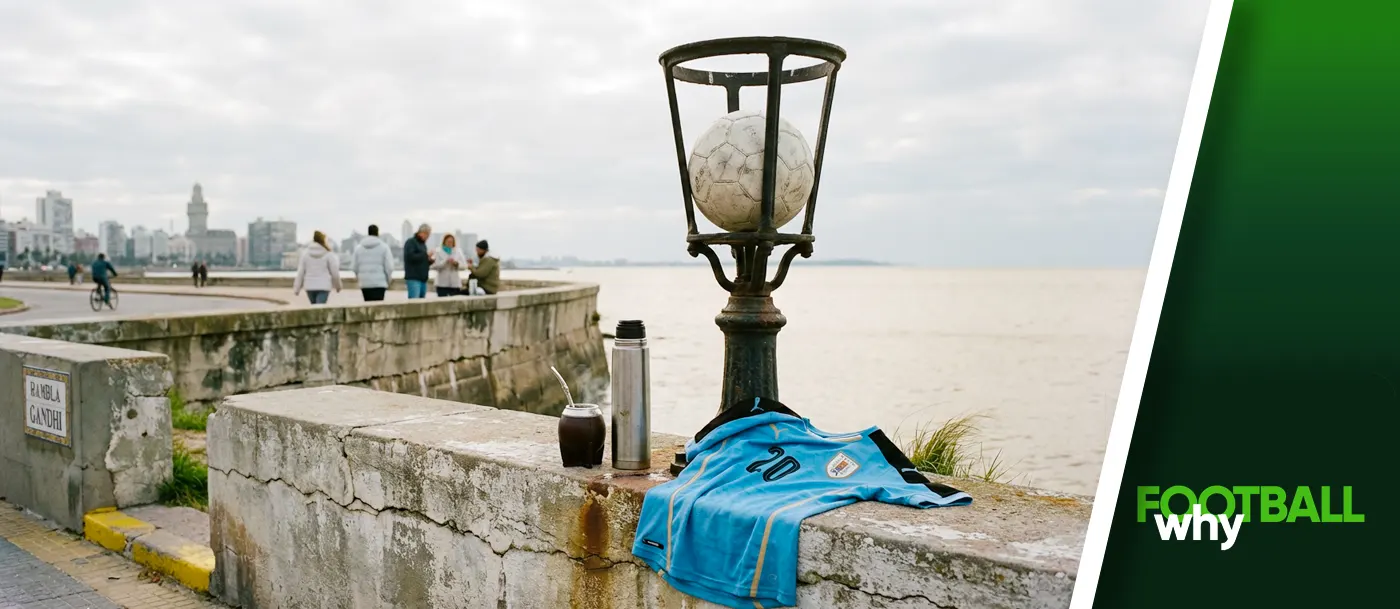
Before the whistle blows at the Estadio Centenario — a massive, brutalist concrete bowl in Montevideo — a specific ritual unfolds on the bench. The coaching staff and substitutes pass around a single hollowed gourd, sipping hot mate through a metal straw.
It is a quiet, intimate act of communal sharing.
If someone is invited to drink, they do not take two sips and keep the gourd. They drink, pass it back, and wait their turn. This is the unwritten law of the Pampas. In a small, resource-scarce community, mutual aid and strict adherence to shared codes are absolutely non-negotiable.
This egalitarian, cooperative ethos forms the marrow of Uruguayan football. On the pitch, it manifests as a ferocious, suffocating compactness. The team operates with incredibly short distances between players, physically funnelling the opposition into bruising central duels.
They do not rely on flamboyant soloists; they rely on a collective willingness to suffer.
This is the essence of Garra Charrúa — a tenacious, stoic resilience. It views a tactical foul not as a failure of skill, but as a necessary, calculated sacrifice for the group's survival.
Global audiences often view this through a lens of disdain, labelling the team as cynical spoilers or purveyors of dark arts. This critique peaks when matches devolve into physical confrontations or mass meltdowns, much like the ugly scenes following their 2024 Copa América exit.
What outsiders completely miss is the intricate moral thermostat governing this aggression. This thermostat is strictly controlled by the captain.
In a culture where authority must be earned through steady, reliable service, the captain is not merely a tactician; he is the moral arbiter. When a young player loses his temper and risks a red card, the captain steps in immediately, physically pulling him away by the shirt to re-establish the emotional baseline. The aggression is meant to be fiercely protective against the opponent's superiority, never a selfish loss of control.
Currently, this delicate system operates under immense strain. Marcelo Bielsa, a foreign ideologue known for his relentless, high-octane pressing, is attempting to graft a front-foot identity onto a squad historically wired for deep counter-attacks.
When the system works, it is breathtaking.
When the pressing triggers fail, as they did spectacularly in a humiliating 1-5 defeat to the United States in late 2025, the defensive cover collapses entirely. The subsequent emotional unravelling on the pitch is swift and brutal.
Compounding this tactical friction is a severe creative drought and a sudden void at left-back due to injury. The team’s historical reliance on gritty resilience is being severely tested by modern elite opponents who simply refuse to be bullied.
To compensate, the players are reverting to their deepest instincts.
They escalate physical duels, lean heavily on dead-ball situations, and drag matches down into the mud to disrupt the opponent's rhythm.
To watch this team is to witness a profound sociological experiment. They are a squad attempting to modernise their pressing structures and clean up their disciplinary optics, all without losing the combative soul that allows a nation of three million people to routinely conquer giants. It is a beautiful, brutal struggle, fuelled by hot water, bitter herbs, and an absolute refusal to yield.
Character