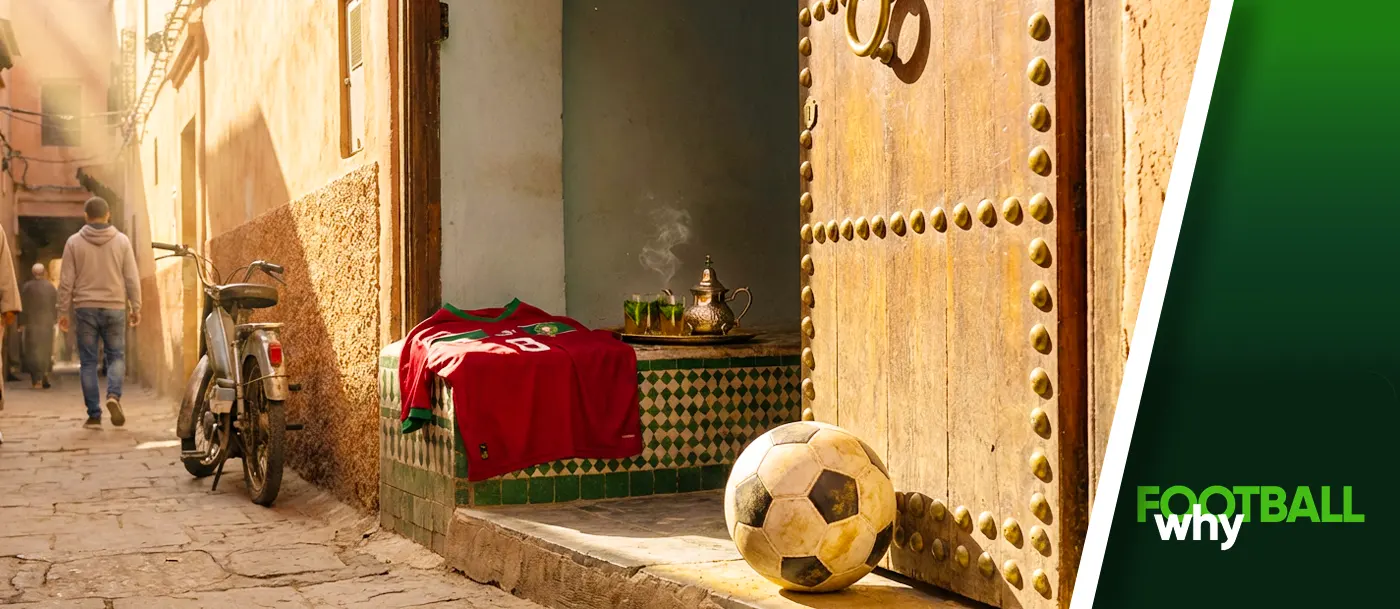
Forged in the searing heat of the desert caravan, they carry the immense weight of a continent's shattered ceilings. Yet, the cafes of Casablanca demand more than mere endurance; they crave the bravery to step out of the fortified walls and dictate the storm. Watch them absorb relentless pressure before unleashing blistering, diagonal lightning down the flanks. The negotiation is over; the expedition begins.
Team at a Glance
What do they want?
To prove they aren't just romantic giant-killers, but a ruthless African-Arab powerhouse expecting the semi-finals.
What are they strong at?
Suffocating patience. They will politely sip mint tea while draining your attacking will, then sprint away.
What will they show?
A meticulously fortified fortress that suddenly erupts into terrifying, lung-busting sprints down the right corridor.
Why are they as they are?
When you survive centuries of harsh desert trading, you never gamble your resources on reckless attacks.
What is the chance of winning the title?
12%. Entirely possible if they can legally negotiate the match duration down to a single counter-attack.
Where it hurts?
Morocco: current status and team news
Weaving Central Ambition
From Flank Reliance
Achraf Hakimi’s carefully managed return from an ankle sprain for the AFCON home final ended in a gruelling 1-0 extra-time defeat, laying bare the physical limits of a national icon. Morocco enters the 2026 cycle carrying the immense weight of a global reputation. The ambition is to punch back into the World Cup semi-finals, demonstrating that their trademark disciplined suffering can evolve into reliable, multi-dimensional chance creation.
Walid Regragui’s tactical system remains heavily anchored to the right corridor. The build-up, rest-defence, and rapid transitions all route directly through the boots of their talismanic captain. This structural reliance triggers visible impatience in the packed cafes of Casablanca and across the diaspora. Supporters sipping mint tea in front of flickering screens remain fiercely proud of the team's defensive steel, yet they grow increasingly frustrated by conservative, flank-heavy passing patterns when chasing a late goal.
To diversify the attack without dismantling their famed compact block, Regragui is integrating European-schooled interiors to actively carve open the half-spaces. Brahim Díaz provides the crucial carrying spark, dropping a shoulder to unglue deep defensive lines, while Abde Ezzalzouli attacks the blindside to inject sudden transitional chaos. The coaching staff deliberately scripts these runner pairings to de-risk the inevitable periods when Hakimi must lower his physical output.
Anticipate a Moroccan side maintaining its ruthless defensive geometry while attempting braver, faster central progression. The squad is carefully recalibrating its setup, determined to show the world an African-Arab powerhouse fully capable of out-thinking the elite.
The Headliner
Morocco: key player and his impact on the tactical system
The Inexorable Right-
Sided Engine
Achraf Hakimi steps onto the pitch as an austere, inexorable force, immediately anchoring the national resting heart rate across the bustling cafes of Casablanca. He operates as the ultimate modern high-and-wide full-back, yet his impact feels deeply personal to the supporters watching his every stride.
He launches into space with a distinct chest-out sprint, boots tearing up the turf as he instantly converts deep defensive recoveries into final-third incursions. Morocco’s entire right-sided architecture is meticulously calibrated to his lung capacity. He supplies the crucial attacking width, initiates the aggressive counter-press, and expertly manages the far-side rest-defence when the play shifts away.
When heavy legs force him to pause, the squad's transitional threat noticeably flattens. Without his relentless overlapping runs, their attacking width collapses into predictable central congestion.
Under the immense pressure of his soft-power status, his focus narrows rather than fractures. He has refined his cut-back radar and underlap timing, stripping away excess flair in favour of ruthless, repeatable efficiency. He carries the immense weight of a nation’s defensive discipline and attacking ambition, moving with a stoic, locomotive grace that demands absolute reverence from both teammates and rivals alike.
The Wild Card
Morocco: dark horse and player to watch
The Press-
Resistant Central Spark
Morocco’s defensive structure historically suffers from a severe central creativity leak. This void demands a player capable of receiving the ball cleanly while surrounded by three opponents in the tightest areas of the pitch.
Bilal El Khannouss steps directly into this high-pressure role. He glides through heavy midfield traffic with his hips open and his head constantly scanning the turf ahead. Operating as both a press-resistant connector and a sudden accelerator, he receives the ball on the half-turn under intense physical duress. He disguises his through-balls with subtle eye movements and punches into the half-spaces, effectively preventing attacks from stalling into predictable, easily defended wide patterns.
Extreme crowd heat and the frantic pace of tournament football test his decision-making speed. Heavy physical duels can occasionally goad the young midfielder into forcing a killer pass when a simple retention ball is required. Savvy opponents will deliberately try to body him before his first touch and violently swarm his wall-pass returns.
Yet, when he keeps his touches simple and trusts his instincts, his endless stamina stabilises the entire possession phase. He arrives at the tournament carrying the nation's hope of orchestrating direct, match-turning sequences right from the eye of the storm.
The Proposition?
Morocco : Tactical guide - how to identify their movements and game variations on the pitch
Asymmetrical Control And The Right-
Corridor Overload
Morocco enters the tournament on a ruthless efficiency drive, aiming to fuse compact control with rapid corridor accelerations. The coaching staff faces a constant battle to balance their heavy right-lane dependence against the urgent need for a multi-lane threat, all while navigating the immense pressure of an expectant home crowd chanting Dima Maghrib.
Walid Regragui deploys a 4-3-3 that seamlessly morphs into a 4-1-4-1 out of possession. Sofyan Amrabat acts as the single pivot, anchoring the mid-block, while the tempo is entirely dictated by the right-sided asymmetry.
What to look at: If within the first ten minutes the wingers tuck tightly inside and the back four holds a line 35–45 metres from goal with Amrabat screening the passing lanes, expect a funnel-wide strategy. They will deliberately steer circulation to the flanks and prepare for a sudden right-corridor launch upon regaining the ball.
In the build-up phase, the shape metamorphoses to ensure clean progression.
What to look at: If Amrabat drops between the centre-backs during a goalkeeper restart, while Achraf Hakimi pushes to winger height and the right central midfielder occupies the half-space pocket, they are actively bypassing the first press. This creates a 3+2 structure to safely access the right half-space.
The primary attacking vector is a relentless right-sided overload. The team utilizes third-man patterns involving Hakimi, Brahim Díaz or Ismael Saibari, and Ayoub El Kaabi. On the opposite flank, Abde Ezzalzouli isolates his marker to pin the defence on the touchline.
What to look at: If Díaz or Saibari receives the ball in the right half-space as Hakimi accelerates past him and the striker darts to the blind side, anticipate a low cutback. The evening dew on the pitch quickens these skidding passes toward the penalty spot for a late-arriving interior.
The entire system warps to maximize Hakimi, their Al-Mulhim. The right central midfielder vacates the touchline, the striker pins the near post, and Amrabat biases his defensive cover to the right to allow repeated thrusts.
What to look at: If Hakimi controls the ball out wide, the interior steps onto the last defensive line, and the far winger ghosts to the back post, their hidden objective is underway. They are actively compressing the opponent’s back four to open a seam for an underlap or a sudden switch to a 1v1 on the weak side.
Heavy reliance on this specific corridor stretches the team's defensive shape. The rest-defence on the right regularly thins out, leaving the grass ahead of the centre-backs highly attackable during transitions.
What to look at: If an opponent baits the press on Hakimi’s side and then hits a fast diagonal pass to Morocco’s left, watch the collapse mechanics. Amrabat will be dragged laterally, opening a central void, and an untracked back-post runner will likely receive a high-quality crossing opportunity.
When the crowd noise peaks and the pressure spikes, Regragui signals a retreat into a narrow 4-1-4-1 survival mode.
What to look at: If taking the lead prompts the defensive block to sink 10–15 metres and only press on poor touches out wide, Morocco is consciously conceding territory. They prioritize box density and game management, looking to release a fresh runner like Duracell (El Khannouss) only when the passing lanes are completely safe.
The Atlas Lions remain a formidable tournament force. Their unyielding defensive resilience, paired with lightning-fast corridor accelerations, ensures they stand as one of the most intelligently organized and thrilling teams to watch.
The DNA
Morocco: football's importance and what we will see in their game at the 2026 World Cup
Negotiating Margins
Within The Desert Caravan
A stadium holds its collective breath in the Qatari night. After 120 minutes of gruelling, suffocating geometry against a European heavyweight, a chipped penalty floats down the middle of the goal. Complete stillness is followed by a roaring eruption that literally shakes the concrete stands.
If a visitor wants to buy a hand-woven rug in the labyrinthine alleys of the medina, accepting the first price is unthinkable, just as storming out in anger is considered deeply disrespectful. Instead, the buyer sits on a low cushion, sips scalding sweet mint tea, discusses the afternoon heat, and slowly, incrementally stretches the seller’s patience until the margin finally tilts in their favour.
This exact rhythm of high-context bargaining dictates the national team's mastery of game management. The players rarely chase the ball with reckless aggression. They drop into a meticulously calculated shape, commit tactical fouls in utterly safe zones near the touchline, and deliberately slow down every throw-in and goal kick. They negotiate the tempo of the match, draining the opponent’s urgency drop by drop.
Picture a merchant caravan crossing the harsh, sun-cracked desert centuries ago. A wise leader does not spread resources wide across the dunes to invite raiders. The caravan clusters tightly together, protecting the vital centre at all costs, and only sends out a swift, targeted rider when the path ahead is absolutely clear.
This ancestral blueprint shapes their modern defensive architecture. A ruthlessly compact core denies any central passes. Yet, when the precise moment arrives, the team unleashes explosive, vertical expeditions down the right lane. They seamlessly convert deep, patient suffering into sudden, diagonal strikes.
What happens, however, when the negotiation abruptly stalls? If a sudden, unexpected dispute breaks out in the market, the medina often falls quiet. Nobody acts rashly without first consulting the elders, waiting for a trusted broker to give a clear signal.
When the team falls behind and the rehearsed tactical script breaks, a remarkably similar procedural paralysis sets in on the pitch. Chasing a game requires embracing chaotic risk, an act that deeply violates their cultural aversion to losing face in public. Attackers struggle to unlock entrenched defences, passing sideways along the perimeter, waiting for a cue that never comes. This hesitation exposes a glaring fragility in central chance creation.
To counter this paralysis, a steady influx of European-schooled creators from across the diaspora is now injecting brave, central playmaking, actively attempting to pick the locks when the wide lanes are firmly closed.
Observe the intricate geometric zellij mosaics, the deafening stadium drumlines, the agonising missed chances, and the stoic, unblinking faces of the players under fire. Life is viewed as a long, arduous journey across unforgiving sands. True honour lies not in a reckless rush forward, but in enduring the searing heat until fate finally opens the door.