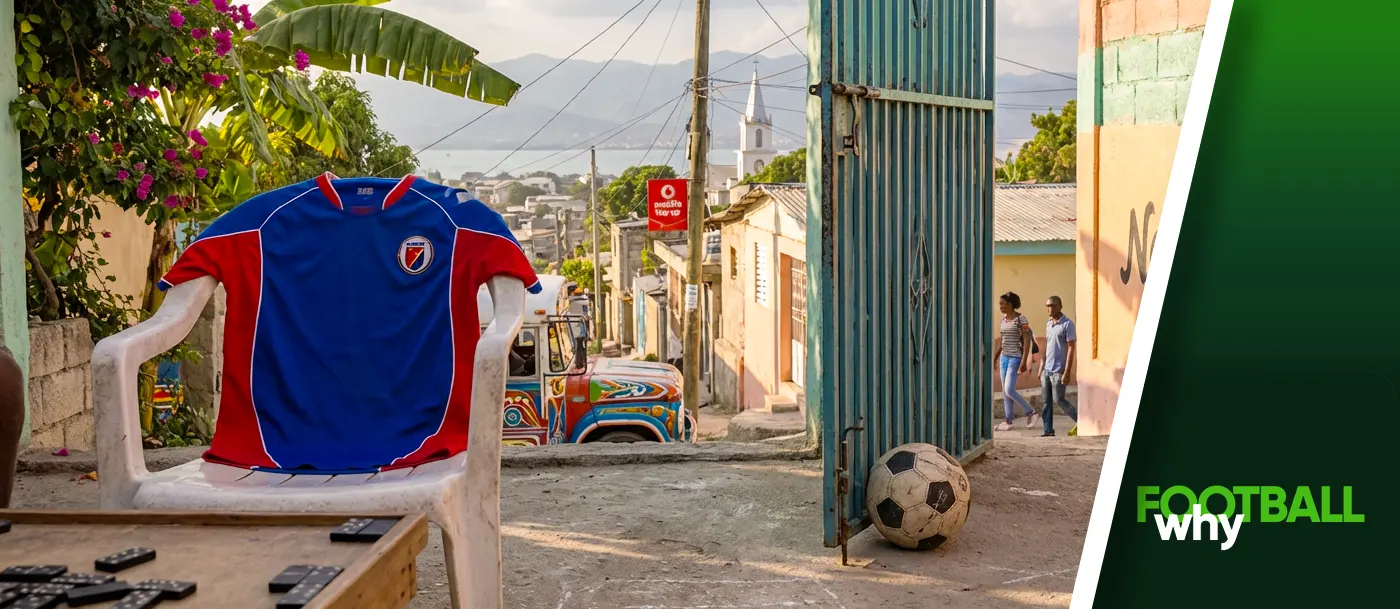
Born from revolution, they carry the heavy, glorious ghost of historical defiance across oceans of exile. Stripped of their home stadiums and battling the constant undertow of administrative chaos, they refuse to quietly fade. Watch them absorb suffocating pressure before violently detonating into rapid, breathless sprints down the flanks. Survival here is not a defensive act; it is an explosive rebellion.
Team at a Glance
What do they want?
To prove their diaspora-fueled defiance belongs in the knockouts, silencing the pitying whispers of administrative collapse.
What are they strong at?
Uncontainable emotional surges, paired with a dual-striker battering ram that thrives on absolute, beautiful chaos.
What will they show?
Relentless 1v1 dribbling and frantic, vertical counter-attacks. They hit the manual override when the tactical script burns.
Why are they as they are?
When you navigate a fractured, bustling street market every day, you learn to sprint through the cracks.
What is a chance of getting a title?
4%. Entirely possible if sheer communal willpower suddenly becomes a legally recognised method of scoring goals.
Where it hurts?
Haiti: current status and team news
The Offshore Shadow
And Vertical Releases
Operating entirely in exile requires a massive, invisible shadow operation. Haiti’s diaspora switchboard — a network of agents and families smoothing travel documents and routing talent — keeps the national team breathing through volatile preparation windows. The squad approaches 2026 desperate to advance past the group stage, aiming to prove they are more than just opportunistic survivors of administrative chaos.
Domestically, the joy of qualification is heavily tempered by a lingering anxiety. The recent Gold Cup loss to Saudi Arabia exposed the physical toll on an aging core, amplifying fears that chance creation remains dangerously concentrated on the twin focal points of Duckens Nazon and Frantzdy Pierrot. Fans are fiercely proud but increasingly vocal about the need for a deeper, less predictable rotation.
Sébastien Migné is aggressively codifying their transition lanes, aiming to decouple their attacking output from this talismanic reliance. He is capping the minutes of his senior forwards while elevating younger, wider outlets like Ruben Providence to stretch compact defences. The coaching staff is drilling formal pressing triggers and set-piece routines to ensure the squad can withstand elite pacing without resorting to panicked, card-prone tackles.
Expect a tightly disciplined Haitian side that absorbs pressure before unleashing fast, vertical releases. They are actively constructing a resilient framework to ensure their undeniable diaspora spirit translates into sustainable tournament danger.
The Headliner
Haiti: key player and his impact on the tactical system
The Clairvoyant
Burden Of Deliverance
Chasing the ghost of a national legend requires more than just accumulating goals; it demands a sly, theatrical sense of timing. Duckens Nazon provides exactly this imperious deliverance. When the match devolves into a chaotic scramble, he enters a state of clairvoyant stillness inside the penalty area. As a pure direct-counter finisher, his game relies entirely on disguised, snap shots and an uncanny anticipation of second balls.
Haiti’s attacking ecosystem funnels toward his instincts. If his radar is off, the pressing cues lose their bite and the collective belief loop noticeably frays. Fans fret over the physical toll on his aging legs, fearing a drop in sprint volume when the margins are razor-thin. Still, he thrives on this communal burden. A slow prowl to the spot, a calm penalty, and an arms-wide celebration instantly re-energise the lakou. He is the ultimate opportunist, transforming fragmented transitions into enduring national folklore.
The Wild Card
Haiti: dark horse and player to watch
The Elastic Spark Of Width
A sudden hush falls over the stands when the ball shifts to the right touchline, anticipating the elastic, skip-step detonation that follows. Don Deedson Louicius injects a joyful defiance into the flanks, offering a true 1v1 separator who requires absolutely no overlapping support.
Operating as a left-footed inverted winger, he finds separation in his first three steps, cutting inside to unleash early strikes or raid the half-space. This self-propelled lane stretches compact blocks and supplies crucial entry points for veteran strikers, preventing the attack from collapsing into predictable long balls.
His rhythm can be disrupted by contact-heavy defenders who violently dislodge his timing, and early failed dribbles sometimes push him into rushing the final pass. Defences will inevitably set two-man traps to steer him onto his weaker foot. Still, one successful take-on resets his internal tempo. Fans are eager to witness his daring accelerations unbalance elite full-backs on the global stage.
The Proposition?
Haiti : Tactical guide - how to identify their movements and game variations on the pitch
Pragmatic Return And
The Vertical Strike
Haiti's mission for 2026 is a rugged return to the World Cup, powered by a compact defensive block, lightning-fast vertical releases, and a senior spine carrying the hopes of a diaspora-fueled collective. The central conflict lies in their ambition to punch above their weight against elite opposition, battling a midfield creativity deficit, severe travel strain, and the defensive exposure of fielding two out-and-out strikers.
The foundation is a narrow 4-4-2 mid-block designed to protect central lanes. Leverton Pierre and Danley Jean-Jacques act as the double-pivot screen, prioritising rapid progression over slow circulation.
What to look at: If the back four holds a line just 5–10 metres above their own penalty box, and the wingers narrow sharply within the first 15 minutes, the trap is set. They are imposing a funnel-to-flank strategy to win second balls and spring direct counters into the channels for their strikers.
When transitioning to attack, the shape morphs to bypass midfield congestion.
What to look at: If Jean-Ricner Bellegarde drops to receive the ball upon regaining possession, then accelerates into the central pocket while Danley holds his position, Haiti is actively bypassing the first press. This creates a 3v2 advantage in the half-spaces, enabling cleaner central entries.
The primary method of progression relies on early diagonals from the goalkeeper or centre-backs to the wingers, followed by early crosses to Frantzdy Pierrot or Duckens Nazon.
What to look at: If right-back Carlens Arcus receives the ball in the half-space after crossing the halfway line, or a winger isolates his marker 1v1, watch the penalty area. They will target a near-post whipped cross to Pierrot or a cutback for Nazon or a late-arriving Bellegarde.
The entire attacking structure orbits around the talismanic presence of Le Duc, Duckens Nazon.
What to look at: If Nazon receives the ball between the lines or pins the last defender, watch how his teammates react. They will immediately clear his lane and sprint beyond him, exploiting the blindside with a far-side winger and an overlapping Arcus to isolate the opposition full-back.
This aggressive two-striker system carries a heavy defensive price. It thins central cover and leaves the rest-defence stretched when both full-backs advance.
What to look at: If the opponent circulates the ball away from Arcus after luring him high up the pitch, or wins a steal centrally under Haiti’s double-pivot, danger is imminent. The channel behind the full-back opens, pulling the centre-back wide and creating a high-quality cutback lane to the penalty spot.
When control erodes in the Caribbean humidity, manager Sébastien Migné frantically signals for survival mode.
What to look at: If Haiti is protecting a lead after the 60th minute and the block drops deep, forming a narrow, layered 4-5-1, they are deliberately trading territorial control for box density. Goalkeeper Johny Placide will dramatically lengthen restarts, and clearances will be prioritized over retention.
Despite the structural risks of their vertical approach, Les Grenadiers are a thrilling spectacle. Their fearless transitions and the sheer emotional momentum they generate make them a wildly entertaining, unpredictable force.
The DNA
Haiti: football's importance and what we will see in their game at the 2026 World Cup
The Upheaval And The
Vertical Override
Picture carrying a heavy sack of rice down the steep, fractured pavement of the Iron Market in Port-au-Prince. You cannot walk in a straight line. You must take rapid, stuttering steps, dropping your hips to maintain balance as crowds surge past, instantly rerouting your path when a vendor’s cart suddenly blocks the alleyway.
This environment shapes the exact biomechanical and mental foundation of the national team’s attack. They do not rely on patient, sweeping passing networks. Instead, attackers receive the ball in a compact mid-block and instantly launch vertical counter-attacks. They utilize a low centre of gravity and street-honed agility to execute explosive 1v1 dribbles, completely bypassing defensive structures. This was glaringly evident during their legendary 2019 Gold Cup quarterfinal against Canada, where relentless, isolated winger surges overturned a 0-2 deficit through sheer, uncontainable momentum.
Consider a neighbourhood the morning after a severe tropical storm. There is no central emergency truck coming to the rescue. Instead, the lakou — the extended communal courtyard — springs into immediate action. Neighbours rotate leadership on the spot to clear debris, and anyone caught hoarding fresh water is swiftly shunned by the community. You survive through fierce, spontaneous mutual aid.
On the pitch, this crisis-normalized activation translates into momentum-driven, emotional surges. When a rehearsed tactical plan fails, players instinctively hit a manual override. They abandon rigid formations for heroic individual actions, fearing the social shame of passivity far more than a tactical error. This explains the frequent sight of extra forwards sprinting forward and frantic long diagonals launched late in games, creating thrilling chaos but also exposing them to defensive lapses and set-piece concessions.
Currently, the team faces the immense hurdle of playing 'home' matches in empty stadiums across the Dominican Republic or Florida due to severe domestic administrative and security vacuums. Yet, this exile has activated a powerful parallel welfare state: the diaspora. WhatsApp networks and foreign-based scouting have fused a polyglot squad, bringing much-needed European and North American defensive compactness to balance their innate Kreyòl-forward audacity.
Observers often see a chaotic, raw underdog, missing the profound communal resilience binding the squad together. When the ground beneath your feet constantly shifts, survival is never about following a perfect map; it is about trusting the person next to you to catch you when you stumble.