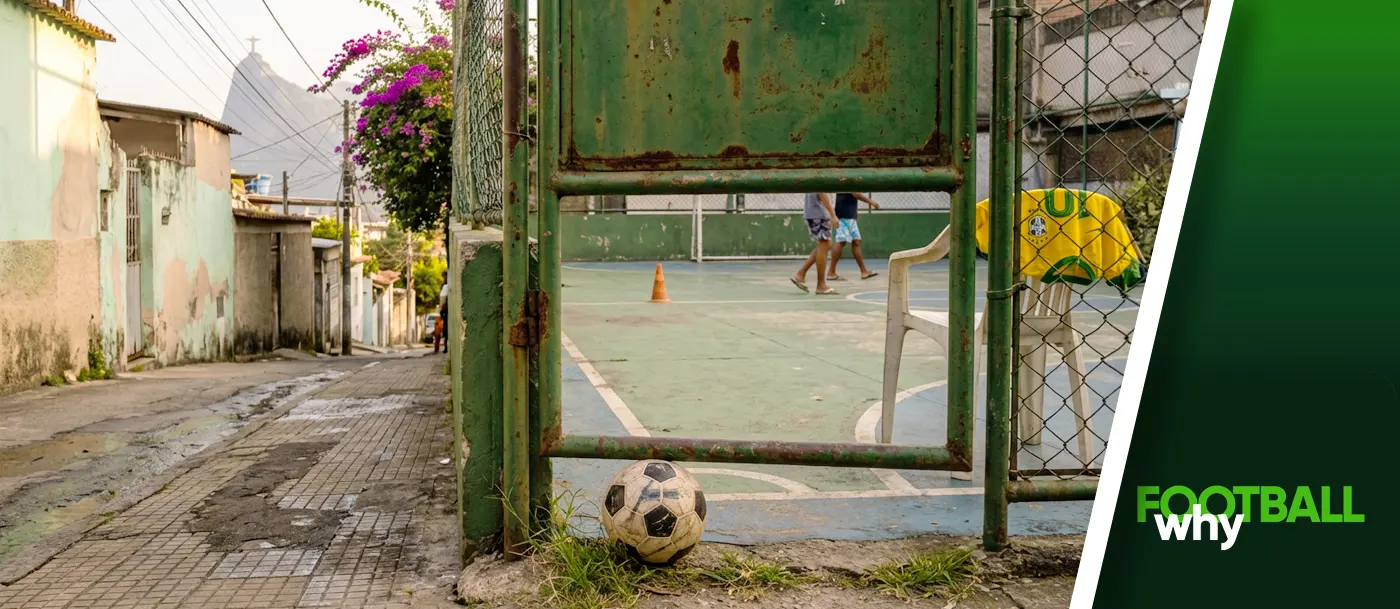
Bearing the ghosts of past artistry and the crushing weight of a five-star crown, they battle an endless storm of boardroom chaos. Driven by a desperate hunger to survive ruthless European pragmatism, watch for the sudden, breathless manual override. It is a blinding flash of street-taught agility tearing straight through rigid concrete walls. Joy is no longer just a dance; it is an act of survival.
Team at a Glance
What do they want?
To finally end a two-decade European knockout curse without sacrificing their sacred obligation to entertain the globe.
What are they strong at?
Lethal, lightning-fast transitions down the wings, fueled by an absolute, petulant refusal to lose a one-on-one duel.
What will they show?
Breathtaking step-overs and sudden diagonal sprints, proving that a rigid defensive shell can still house a carnival.
Why are they as they are?
When the municipal authorities fail and the street floods, you learn to patch things up with a smile.
What is a chance of getting a title?
18%. Assuming the federation doesn't sack the manager mid-tournament and the left wing doesn't spontaneously combust from overwork.
Where it hurts?
Brazil: current status and team news
Vertical Pragmatism And The Left-
Wing Orbit
Hours after his squad omission, Neymar took a penalty in the Kings League — a viral spectacle perfectly capturing the tug-of-war between celebrity status and a new era of ruthless meritocracy. Brazil approaches 2026 desperate to end their European knockout trauma. The squad targets a semi-final minimum, aiming to beat a heavyweight while preserving their rhythmic, improvisational flair.
This structural shift faces immediate turbulence from above. Judicial interventions at the CBF recently created an executive vacuum, feeding domestic anxiety that the promised stability is merely a fragile patch over institutional chaos. In Rio's cafes, supporters scroll through despairing memes one minute and share optimistic predictions the next, heavily scrutinising the federation's every move.
On the pitch, the tactical blueprint relies on rapid vertical releases to Vinícius Júnior. This creates a severe attacking tilt toward the left flank. To balance this heavy orbit, the coaching staff is hardening the right-side architecture, though persistent injury chatter around Raphinha keeps the depth chart volatile. Meanwhile, the goalkeeper debate — Alisson’s shot-stopping versus Ederson’s distribution — remains a fierce proxy war for how the team should initiate play.
Brazil now abandons sprawling, slow build-ups in favour of sharp, wing-led transitions. They are constructing a resilient, pragmatic foundation to secure their attacking essence, earnestly fighting to prove that tactical discipline and innate joy can finally coexist.
Brazil: key player and his impact on the tactical system
The Kinetic Geometry
Of Audacity
The head-bob feint and the pre-touch shimmy act as a kinetic trigger before the ball even arrives at his feet. Vinícius Júnior operates less as a traditional winger and more as an inverted, isolationist vanguard. Opposing full-backs face a mercurial puzzle: he purposely draws them high to fracture their defensive shape, then ruthlessly exploits the resulting diagonal channels. It is a petulant, brilliant geometry.
Brazil’s build-up heavily leans on his ability to cleanly separate from markers in 1v1 situations. Without this initial spark, their progression often stagnates into predictable sideways passing. He absorbs hostile atmospheres — shrugging off targeted fouls and jeers from the stands — doubling down on duels when provoked. This emotional taxation occasionally clouds his shot selection against entrenched low blocks, but his recent evolution into a sharper finisher from the inside-left lane solidifies his status as a clinical match-winner. He translates the street-taught audacity of malandragem into a highly functional tactical weapon, standing as a defining, relentless creator of the modern era.
The Wild Card
Brazil: dark horse and player to watch
The Spring-Loaded Penalty-
Box Predator
He bypasses muscular wrestling matches with towering centre-backs entirely, anticipating the play to win the footrace to a vacant patch of grass. Endrick operates as a compact, explosive focal point inside the penalty area. His kinetic profile relies on sudden power surges and a low centre of gravity, allowing him to execute two-footed snap finishes before defenders can even plant their feet.
Brazil desperately needs this central reference point to convert their high-volume wing isolations into tangible second-ball conversions. Without his blindside near-post darts, their box presence noticeably thins. The primary risk lies in his limited senior volume and the emotional weight of his domestic aura. Opponents will try to neutralise him by crowding the near-post channel and rotating a physical destroyer onto his turn.
Yet, if an early pass finds his feet cleanly, his confidence spikes, often resulting in an immediate, driving run at the heart of the defence. The world awaits a teenager capable of delivering a ruthless knockout blow on the grandest stage.
The Proposition?
Brazil : Tactical guide - how to identify their movements and game variations on the pitch
Weaponising The Left Flank
Under Pragmatic Control
Brazil approaches the tournament seeking a pragmatic reboot under Carlo Ancelotti. Haunted by the scars of a 4-1 midfield collapse against Argentina, the mission is to establish a 4-4-2 control that weaponises Vinícius Júnior while restoring knockout efficiency. A central tension remains: the ambition for sharp incision heavily biases their attack to the left, clashing with the need for structural prudence against central overloads.
The baseline is a medium-tempo 4-4-2 mid-block. The right-back anchors the defence to create a back three in possession, while the double-pivot of Casemiro and Bruno Guimarães dictates the rhythm.
What to look at: If the back four holds their line just past midfield and the wide men flatten out alongside them, expect Brazil to impose a compact trap. They will funnel play to the flanks to patiently set up left-side isolations.
When they win the ball, the shape morphs to bypass pressure.
What to look at: If the right-back tucks inside during a goalkeeper restart and Casemiro locks down the central pocket, Brazil is bypassing a high press. This creates a stable 3v2 at the base, opening a clear passing lane for Bruno Guimarães.
The primary attacking route is a fast weak-side switch to Vinícius. Bruno acts as the half-space connector, while the left-back overlaps to create a 2v1 advantage.
What to look at: If Bruno executes a quick half-turn past the halfway line and punches a diagonal pass straight to Vinícius’s boots on the touchline, watch the penalty area. They will immediately target low cutbacks, with the striker attacking the near post.
The entire system warps to amplify the player they call Malvadeza.
What to look at: If Vinícius receives the ball wide-to-feet with his body open, ready for a live 1v1 duel, watch for Bruno's underlap. This run drags the defensive cover away, suddenly opening a back-post seam for a weak-side runner like Rodrygo or Raphinha.
This severe left-sided bias carries a heavy price. Building with a front two often leaves their midfield outnumbered, and the aggressive left-back leaves space behind.
What to look at: If the opponent builds with a 3-2 base, bounces the press via a third man, and switches the ball rapidly to Brazil’s left flank, danger is imminent. Casemiro gets stretched laterally, and a diagonal pass into the exposed left half-space will yield a high-quality transition chance.
When under pressure, Ancelotti — the calm paizão on the touchline offering brief pointers rather than shouting — signals a retreat into survival mode.
What to look at: If Brazil holds a lead after the 60th minute and the front line stops aggressively chasing the centre-backs, they are trading territory for box density. They will burn the clock and only counter through Vinícius or Endrick (Predestinado) on clean triggers.
Despite the structural risks of a lopsided attack, this iteration of Brazil is an enthralling watch. Their ability to fuse Italian-style defensive pacing with sudden, lethal bursts of individual genius guarantees an electric tournament presence.
The DNA
Brazil: football's importance and what we will see in their game at the 2026 World Cup
The Joyful Patchwork Over
Institutional Storms
Step into a sweltering street market in Rio, the air thick with the scent of fried pastries and the thrum of a distant samba bateria. Suddenly, the main pathway is entirely blocked by a collapsed fruit cart. Nobody waits for the municipal authorities to clear it. A vendor tosses a rope, someone wedges a wooden crate under the broken wheel, and within seconds, a new, jagged path is negotiated through the chaos with a wink and a joke.
This is the culture of remendar — the improvised patch over a rigid, failing plan. On the pitch, when a meticulously crafted European defensive block suffocates the game, panic does not set in. Instead, the attackers execute a manual override. They abandon the lateral passing matrix, isolate a defender on the wing, and force a sudden, breathless 1v1 duel to tear a path straight through the lines.
Now, watch the children playing on a concrete court wedged between towering city buildings. Space is a luxury they simply do not possess. To survive this claustrophobic box, a player must constantly shift sideways, rolling the sole of the foot over the ball to open a new angle before the concrete scrapes their knees.
This horizontal survival instinct births the nation's historic obsession with attacking full-backs. The width is never static. It is a constant, rhythmic overlapping and underlapping, turning wide defenders into primary playmakers who bend the pitch to their will, creating chances out of sheer lateral agility.
Yet, a sudden tropical downpour floods the avenue. The traffic lights short-circuit, and the official wardens are nowhere to be found because the municipal office is locked in an endless legal dispute.
This institutional volatility perfectly mirrors the federation's endless boardroom chaos. Coaches rotate, philosophies whiplash, and when the team faces elite, machine-like transitions, the lack of deeply ingrained automatisms shows. The midfield disconnects, the old ghosts of past tournament humiliations whisper loudly, and the collective heartbeat spikes into anxiety.
There is, however, a quiet infiltration of foreign pragmatism settling over the squad, attempting to marry this innate rhythm with a sturdy midfield anchor.
Look at the canary-yellow fabric heavy with sweat, the endless court disputes, the tears of elimination, and the sudden, dazzling step-overs. It is a beautiful, exhausting mess, but ultimately, joy must always find a way through the concrete, even if it requires a little cunning to survive the storm.