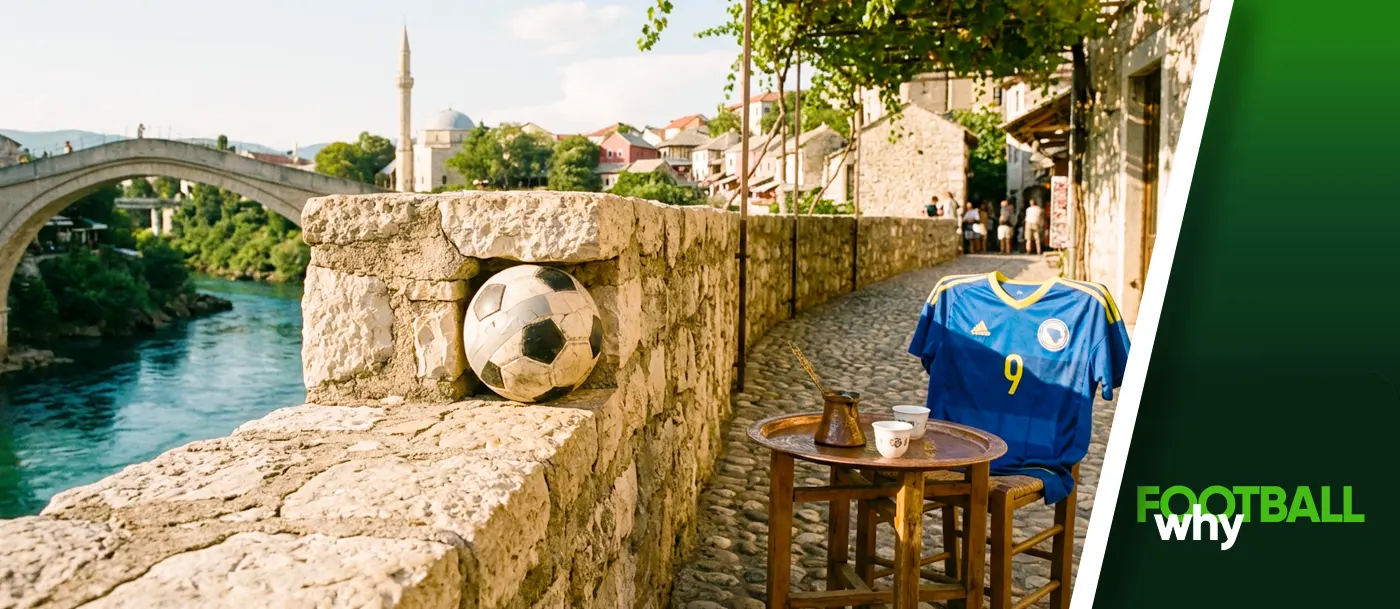
Smoke from illicit flares still clings to their shirts, a heavy inheritance from a decade in the international wilderness. They fight a perpetual internal war against bureaucratic mazes and their own aging legs. Yet, a fierce, stubborn roar fuels them. Watch them absorb endless punishment, only to launch one sudden, lethal strike toward a towering focal point. Defiance is their only tactic.
Team at a Glance
What do they want?
To disrupt the knockout stages and prove that pure stubbornness can overcome a completely dysfunctional federation.
What are they strong at?
Absolute, unyielding defiance. Plus an uncanny ability to funnel every single attack toward one aging giant.
What will they show?
Relentless right-wing surges and majestic headers, proving that sometimes, blind faith in your elders actually works.
Why are they as they are?
Try navigating a country run by three different committees. You quickly learn to rely entirely on yourself.
What is a chance of getting the title?
6%. Entirely possible if their veteran striker discovers the fountain of youth and the federation behaves.
Where it hurts?
Bosnia and Herzegovina: current status and team news
Brewing Bitter Coffee
Over Leaking Pipes
Sergej Barbarez is attempting to serve a calm, hospitable round of coffee while the kitchen sink aggressively backs up. Qualifying for the tournament required immense stubbornness, banishing ghosts of past failures. Now, they must piece together a functional eleven from a tightly locked squad.
The central pipes are rattling ominously just as the pressure spikes. A day-to-day midfield muscle issue for Ivan Šunjić forces emergency patch jobs in the holding role. Meanwhile, the federation bickers over kit designs, adding unnecessary noise while staff desperately plug glaring depth gaps.
Starting Edin Džeko on the bench in Sarajevo ignited an immediate neighbourhood panic. The #NSBiHOut hashtag resurfaces whenever creation labours, exposing deep mistrust between terraces and boardroom. Locals watch the new shape trial with crossed arms, convinced the entire structure hinges on one aging striker.
The immediate fix relies on shifting chance creation to the right lane and managing veteran minutes carefully. Contingency set-piece routines now lean heavily on others when the talisman rests. The squad uses this brief experimentation window to stress-test their defensive spacing.
The group stage will reveal a proud, vertical-minded side perfectly comfortable with suffering without the ball. Viewers will see a compact block prioritizing rugged duels and aerial first contacts. It is a deeply human refusal to fold, relying on sheer communal defiance against polished opponents.
Bosnia and Herzegovina: key player and his impact on the tactical system
A Statuesque Anchor
In The Storm
The moniker 'Dijamant' was forged on a European night over a decade ago. Edin Džeko still carries its weight with a statuesque, imperious grace. Operating as the primary penalty-box reference point, he thrives in the modern cross-and-cut-back environment. He utilizes double-movement separation and elite aerial timing to carve shooting angles out of heavily congested areas.
When the supply line dries up, his reaction remains glacial and calculated. He drops deeper into midfield to connect play, issuing quiet, palms-down gestures to settle his teammates' nerves. The entire Bosnian attacking structure leans heavily on this presence. Without him on the pitch, the team’s second-ball structure and penalty-area threat noticeably shrink.
Despite the undeniable toll of an aging body, Džeko continually refines his front-post angles and back-to-goal link play. He stands as a stoic, timeless finisher, transforming chaotic, hopeful crosses into moments of clinical deliverance.
The Wild Card
Bosnia and Herzegovina: dark horse and player to watch
The Relentless
Pulse On The Flank
Amar Dedić attacks the right flank with a chest-forward urgency, blending aggressive ball-winning with immediate, high-volume progressive carries. Functioning as a wide playmaker from a defensive starting position, he executes rapid overlap and underlap sequencing to deliver low, whipped cut-backs into the penalty area.
Creating striker-quality chances directly from the backline provides a repeatable entry mechanism that the Bosnian system desperately requires to feed near-post runs. This relentless engine carries a structural cost. An impulse to over-commit after duels occasionally leaves vast tracts of space behind him. Smart opponents actively bait his step with decoy midfielders, firing early diagonals into that vacated territory and forcing him into lofted, lower-percentage recovery crosses.
Yet, Dedić's instinct for rapid recovery runs and sharp changes of direction usually compensates for these gambles. He operates as a tireless machine, fully capable of delivering a momentum-swinging surge and multiple open-play assists on the global stage.
The Proposition?
Bosnia and Herzegovina : Tactical guide - how to identify their movements and game variations on the pitch
The Asymmetric Engine
Behind The Balkan Block
Sergej Barbarez brings his squad to the World Cup chasing redemption through a disciplined 4-4-2 reset. The tactical blueprint relies heavily on two contrasting forces: the veteran presence of Edin Džeko and the relentless right-sided engine of Amar Dedić. The squad must maintain structural control while masking the vast space left behind their advanced right-back, all while coping with a reduced first-line press.
The core identity rests on a default 4-4-2 mid-block. In possession, the shape becomes highly asymmetric. Dedić pushes extremely high on the right flank, while the left-back tucks inside. The double-pivot of Benjamin Tahirović and Ivan Šunjić provides stability, allowing for a medium-direct tempo that heavily favours right-lane progression and rapid penalty-box occupation.
What to look at: If, during the opening 15 minutes, the back four positions themselves 8-12 metres above the deepest opponent, keeping horizontally tight, and Dedić repeatedly starts his runs ahead of the ball. Then, the team is attempting to impose mid-block control. They want to force play to the flanks, win territory on the right, and create early crossing access for Džeko and Ermedin Demirović.
During the build-up phase, the structure morphs into a 2-4-4 or 3-2-5. The left-back tucks in, and Šunjić situationally drops to stabilize the rest-defense.
What to look at: If Šunjić drops to split the centre-backs or the left-back steps inside on the very first pass from goalkeeper Nikola Vasilj. Then, they are creating a 3v2 advantage against the first press, freeing up the right half-space to bypass man-oriented pressure before the opponent's block can reset.
The entire system warps to maximize Dedić's influence, tilting the team to the right while the striker pair staggers to occupy both centre-backs.
What to look at: If Dedić receives the ball on the run, the winger immediately vacates the touchline, an attacking midfielder runs beyond to pin the defense, and Demirović curves outward. Then, the hidden aim is to draw the opponent’s defensive midfielder wide, opening a central wall-pass lane into Tahirović for a quick switch or a free cut-back zone.
The primary progression vector relies on these right-channel chains, culminating in early driven crosses or cut-backs to Džeko.
What to look at: If the ball-carrier crosses the halfway line and pauses to fix the opposing full-back, allowing Dedić to sprint beyond while Džeko holds the centre-backs. Then, expect a low cut-back to the penalty spot or a delivery to the front post, creating a second-ball shooting window for the weak-side midfielder.
This extreme asymmetry carries a heavy structural cost. The space behind Dedić is vast, and handover gaps frequently appear between the pivot and the centre-backs during fast transitions.
What to look at: If an opponent hits an early diagonal switch into the space behind Dedić immediately following a turnover in the right lane. Then, a centre-back is dragged wide, Tahirović arrives from the wrong side, and the central lane opens for a late runner, creating a highly dangerous scoring opportunity.
When under severe stress or protecting a lead, Barbarez will order the team into survival mode, sinking into an extremely compact, low 4-4-2.
What to look at: If the engagement line retreats 10-15 metres and the striker pair stops initiating pressure on the opposing goalkeeper. Then, they are trading possession for box density, accepting a high volume of crosses while prioritizing first-contact clearances and long outlets directly to Džeko's chest.
While their transition defense can look agonizingly fragile against elite speed, their tactical commitment is unwavering. The sheer willpower of their right-sided overloads and the clinical, timeless presence of Džeko in the penalty area ensure they remain a deeply dangerous, methodical threat capable of unpicking stubborn defenses.
The DNA
Bosnia and Herzegovina: football's importance and what we will see in their game at the 2026 World Cup
A Stubborn Roar In A
Fractured Cauldron
Securing a World Cup spot by eliminating Italy via a penalty shootout in April 2026 required a masterpiece of stoic, elder-sanctioned discipline. That single night shattered the lazy assumption of Balkan emotional fragility. Still, the environment surrounding the national team operates as a constant labyrinth of friction. Navigating the tripartite governance of this nation resembles buying a cross-country bus ticket where three different cantonal companies claim the route, and the final schedule exists only in the driver’s head.
This bureaucratic maze directly mirrors the federation’s opaque ticketing procedures. When hardcore supporters felt marginalized before the Romania clash in late 2025, they skipped writing polite letters of complaint. They self-organized, mobilized online under the #NSBiHOut banner, and filled the concrete bowl of Bilino Polje with the crack-pop of flares and a suffocating blue-yellow glare.
A deep-seated siege mentality forms the absolute core of their home momentum. The players feed on this defiant persistence — a cultural reflex locally known as inat. Out on the pitch, however, this raw emotion gets funneled into a strictly hierarchical system. Attend a large Sunday family lunch in a mountain town: the roasted meat is hot, the voices are loud, but absolutely nobody touches a fork until the grandfather breaks the bread. The footballing equivalent is their absolute devotion to the veteran target man.
Every attacking sequence flows toward Edin Džeko. The squad absorbs pressure in a deep, resource-conserving block, moving in tight, multilingual huddles, before launching a sudden vertical release to their undisputed focal point.
Relying so heavily on a single, aging icon secures late goals but strictly limits their tactical flexibility. It dictates a highly conservative game management style that occasionally proves fatal. In Vienna in late 2025, leading the match until the 77th minute, the defensive line dropped fifteen meters too deep. Terrified of making a catastrophic error under the intense communal gaze, the players stopped circulating the ball and merely tried to survive the clock. Their clearances grew frantic and long, the set-piece defending faltered, and the inevitable equalizer arrived.
The squad possesses an ex-Yugoslav technical base, fully capable of beautiful, low-risk circulation. This technical grace constantly battles the thin elite depth caused by fragmented domestic pathways. Integrating a younger, diaspora-trained cohort slowly raises the pressing baseline, attempting to modernize the midfield engine room. Yet, the shadow of the elders remains heavy across the pitch.
The national team operates in a perpetual state of contradiction, balancing impending UEFA sanctions with the desperate public need for a unifying civic ritual. It is a loud, complicated, and deeply stubborn existence. The whole structure holds together by the wry, everyday understanding that while the roof might be leaking and the local committees are arguing, the coffee is still warm and the fight is far from over.