

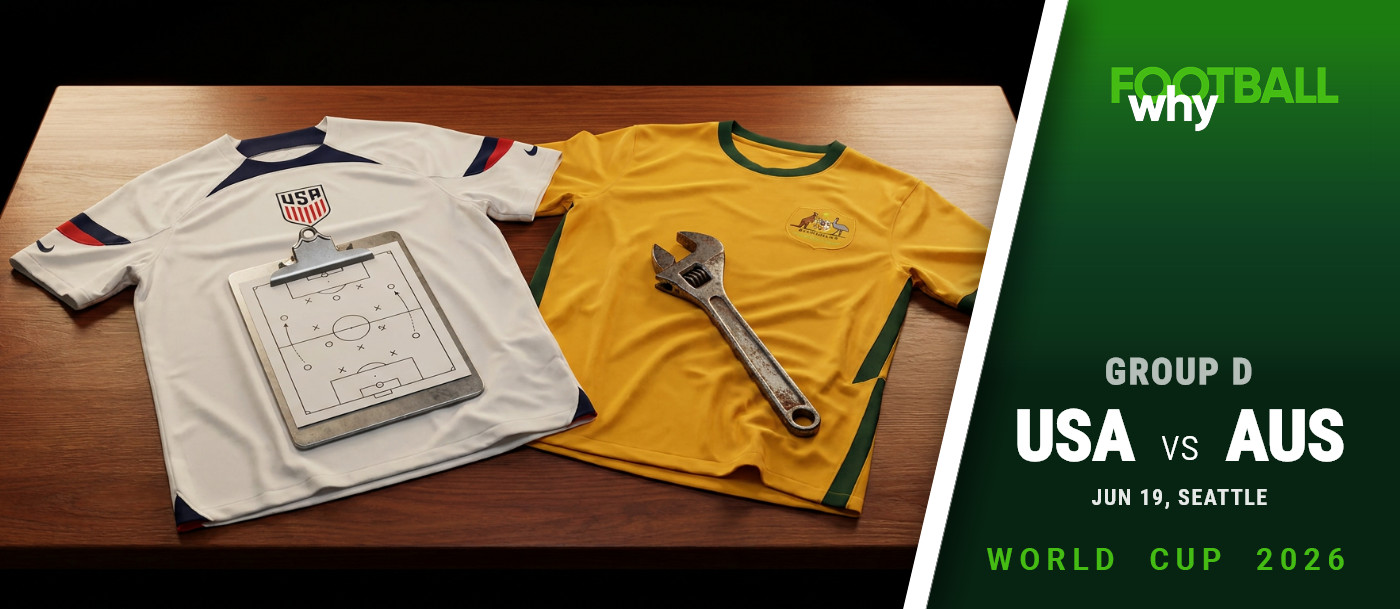
Group D, Matchday 2, Match #32
UTC

Lumen Field, Seattle

Prediction by whyFootball readers

USA
DRAW
AUS
46%
28%
26%
Not a recommendation for betting
Tap [+] to cast your expert forecast.
SCORE BY AI PREDICTION: 2:0 SEE SIMULATION

USA vs Australia FIFA World Cup 2026 Group Stage Match A pristine production line jamming on rusted gears Forecast generated:

The restless entrepreneur faces the resilient islander. It is a collision between an optimism that demands immediate returns and a brotherhood forged in isolation, ready to endure any discomfort. The urgency of the spectacle versus the quiet pride of survival.

United States: One side's prayer...

The United States step onto the pitch carrying the suffocating weight of host-nation expectations. Public patience has worn remarkably thin following recent stumbles, demanding an immediate, front-foot authority. Mauricio Pochettino must navigate this cauldron with a compromised squad; Sergiño Dest is sidelined with a hamstring tear, whilst Tyler Adams’ fragile knees require meticulous minute-management. With goalkeeper Matt Turner’s confidence under intense public scrutiny, the hosts must tighten their structural joinery early to prevent stadium anxiety from bleeding onto the grass.

Australia: ...head-on with the other.

Australia arrive with the quiet, unbothered resolve of a side perfectly comfortable in the trenches. Tony Popovic’s squad embraces the underdog narrative, seeking to scrape a pragmatic point to keep their progression hopes alive. They face their own physical hurdles, with creative talisman Craig Goodwin ruled out via a groin strain and towering centre-half Harry Souttar on a strict minutes limit following Achilles surgery. Stripped of aesthetic pretension, the visitors will rely on egalitarian industry to drag the hosts into a bruising, attritional scrap.
United States vs Australia Structural Collision

United States: How we will host...

Dream
Securing three points to calm an increasingly restless home crowd is the bare minimum. Mauricio Pochettino knows the public demands a front-foot response, expecting the team to shoulder the weight of hosting rather than buckling under it.

Strength
Their engine is built on relentless, athletic transitions and an almost Puritan work ethic. This is a squad that thrives on vertical surges and collective pressing, leaning heavily on a European-tested core that runs until the final whistle.

Plans
The blueprint is to hammer the left flank relentlessly. They intend to overload Australia's right-sided defenders, bypassing the aerial route entirely to drill low cutbacks into the box for their central runners.

Fears
Early anxiety remains their Achilles heel. If the goalkeeper wobbles or the crowd groans after a misplaced pass, their tactical discipline often frays, leading to rushed clearances and dangerously isolated full-backs.

Australia: With what we arrive...

Dream
Leaving the stadium with a point to keep their qualification hopes alive is the pragmatic target. Tony Popovic understands the hostile environment and wants his side to embrace their underdog status, proving their resilience without needing the ball to validate their worth.

Strength
Their core asset is an egalitarian, sleeves-rolled-up industry. There are no primadonnas here; this is a team built on collective sweat, defensive honesty, and a profound physical endurance that often frustrates technically superior opponents.

Plans
The strategy relies on clogging the central areas to stifle the opposition's talisman, then launching rapid, straight-line counters down the flanks. They will deliberately target the penalty area with an aggressive, highly orchestrated set-piece routine.

Fears
When the midfield pressure becomes overwhelming, they have a habit of abandoning any passing structure entirely. A reliance on aimless long balls and hurried clearances can quickly leave them camped in their own penalty box, completely isolated from their forwards.

How it will be...

If the simulation holds true, we are in for a clash of entirely opposing textures. The hosts will likely dictate a frantic monologue, funnelling their entire offensive apparatus down the left channel to dismantle the visitors' right flank. The Australians, conversely, will offer a stoic, deep-seated resistance, waiting for the inevitable moment the Americans over-commit before launching bruising, vertical counters.

The American pragmatism should manifest in the relentless overlapping of their left-back, a player functioning less like a defender and more like a piston, delivering low, squared passes into the box. Against this, the Australian rearguard will rely on a deeply ingrained mateship, throwing bodies into the trajectory of the ball and treating every defensive header as a point of national pride.

Yet, the script could tear if early anxiety grips the American goalkeeper under a barrage of long throws. Should he falter, the introduction of Australia's unpredictable teenage winger — a player whose chaotic sprints defy structural logic — might suddenly unravel the hosts' defensive screen.

Rather than folding, the visitors are projected to escalate their physicality in the final quarter. It will not be a quiet surrender, but a blind, cross-heavy siege that, ironically, leaves vast tracts of grass entirely unguarded for the Americans to exploit on the break.

USA: How did they clinch it?

Victory stemmed from their clinical exploitation of the left channel, capitalising on a delayed defensive shift to open the scoring. Beyond that, their structure absorbed the late aerial siege without fracturing. Ultimately, their European-honed pressing matrix proved too sophisticated for a side reliant on raw physicality.

Australia: Why not go for the win?

Defeat was rooted in their structural vulnerability down the right flank, which was irreparably breached for the opening goal. Their reliance on physical endeavour and set-piece deliveries could not mask a severe lack of central creativity. The dependence on dead balls finally collapsed against an opponent structurally prepared to sweep them away.

Secret mastermind intent

Pochettino's structural joinery along the left-hand touchline.

General Strategy
Mauricio Pochettino intends to control territory by driving the game heavily down the left channel. The primary objective is to starve the opposition of counter-attacking opportunities by pinning them back and forcing defensive clearances.

Out of possession, the hosts will employ a disciplined mid-to-high pressing trap. They plan to engage primarily when the ball is played backwards, using their central midfielders as a brake to stop quick breaks at the source.
Antidote for the Opponent
The hosts have identified the Australian right-back corridor as the primary structural weakness. They will overload this zone with three players, specifically avoiding floated crosses to deny the visiting centre-halves any easy aerial clearances.

Defensively, the focus shifts entirely to surviving dead-ball situations. The most dominant American centre-back has been assigned to track the opposition's primary target, while the rest of the defensive unit will maintain a strict zonal stack at the near post.
Internal Task Solving
To mitigate early nerves, the goalkeeper will be placed under a strict distribution cap for the first twenty minutes. He is ordered to avoid central passes entirely, instead clipping angled balls towards the left touchline to turn the opposition around.

There is also a fascinating contingency for rising stadium anxiety. If the crowd grows restless following a mistake, the team will immediately compress their spacing and route all exits through their deepest midfielder to restore calm.
Crisis Response Plans
If the primary playmaker struggles to find space centrally in the opening stages, he will be instructed to drift wide to the left touchline. This structural shift is designed to improve ball retention and force the opposition's defensive seams to stretch.

The managerial staff also have contingencies ready for a barrage of set-pieces. Should they face early pressure, the full-backs will be ordered to stay deep, and the goalkeeper will bypass the press entirely.
Specific Match Orders
Christian Pulisic (Attacking Midfielder): If you find yourself starved of touches in the first ten minutes, initiate a swap to the left flank yourself. Do not take direct free-kicks from deep areas; play them short and quick to keep the tempo high. Antonee Robinson (Left-Back): Your first option is always an early, low cutback rather than a floated cross. When recovering, run diagonally towards the near-post channel rather than straight back to the goal line, and ensure you communicate clearly before overlapping. Matt Turner (Goalkeeper): For the first twenty minutes, completely avoid building out through the centre if they press high. Clip your exits towards the left touchline to turn them around, and deliberately slow the tempo down after waves of pressure to let the block reset.
/ What if Australia create a barrage of dangerous restarts early on?

If the visitors force multiple corners or long throws in the opening twenty-five minutes, the right-back will permanently invert to form a solid back three. Both full-backs will be forbidden from attacking simultaneously, and the goalkeeper will be instructed to send the vast majority of his distribution long to bypass the midfield scrap.

/ What if the team falls behind and faces a deep defensive block?

Should they trail late in the game, the shape will escalate into an aggressive front five. A second striker will be introduced to crash the penalty area, the crossing volume from the left will dramatically increase, and the deepest midfielder will be parked on the halfway line to sweep up any loose clearances.

Secret mastermind intent

Tony Popovic's stubborn scaffolding and set-piece architecture.

General Strategy
Tony Popovic is preparing a deeply pragmatic, safety-first structure designed to weather the storm. The foundation is a highly disciplined mid-block that prioritises defensive shape over possession, aiming to frustrate the hosts and force them into wide areas.

Once the ball is won, the transition will be ruthlessly vertical. The plan is to bypass the midfield entirely, using early diagonals to hit their target man and subsequently fight for the second balls.
Antidote for the Opponent
To neutralise the American attacking threat, the visitors will deploy a two-man bracket to crowd the inside channels. They are entirely willing to concede sterile, cross-field passes as long as the cutback zones remain heavily guarded.

Offensively, the focus shifts to testing the hosts' penalty-box organisation. They will utilise flat, long throw-ins aimed directly at the near post, looking to create chaos and capitalise on any resulting loose balls.
Internal Task Solving
There is a highly specific, pre-planned substitution window for their towering centre-half. Managing his return from a long-term injury, he will be introduced around the hour mark to either bolster the defence under an aerial siege or to exploit late set-piece opportunities.

The team also has a fascinating reset protocol for moments of sustained pressure. Following two consecutive defensive corners, the captain will call a quick huddle to reassign marking duties and add a zonal guard to the back post.
Crisis Response Plans
If the hosts successfully overload the left flank and break through the lines, the defensive shape will flatten out considerably. The right-sided midfielder will tuck in permanently to form a rigid back five, effectively shutting down the width of the pitch.

The coaching staff are fully prepared to bypass the central third if the early pressing proves too intense. The goalkeeper will be instructed to launch long distribution towards the channels, delaying any attempts at short build-up play until the game settles.
Specific Match Orders
Nestory Irankunda (Winger): You have the green light to isolate your fullback and shoot early from distance. Your defensive tracking responsibility ends at the halfway line; after that, hand your man over and conserve your energy for repeat sprints. Mathew Ryan (Goalkeeper): For your first-phase distribution, default to long balls aimed at the striker's outside shoulder. Only trigger quick throws if you see our right winger completely isolated against his fullback with green grass ahead. Harry Souttar (Centre-Back): On our first two attacking corners, act entirely as a decoy to drag their heavy markers away. On the third corner, delay your run and attack the far post. In open play, under no circumstances should you step out beyond thirty-five yards.
/ What if the hosts score early via a left-channel cutback?

The immediate response will be to drop the right wing-back five yards deeper and pin the wide midfielder further back to seal the breach. The goalkeeper will dramatically slow down all restarts to compress the game's tempo, and all exits will be routed directly to the centre-forward to avoid dangerous turnovers.

/ What if the goalkeeper starts parrying shots into dangerous traffic?

Should the goalkeeper show signs of handling jitters, the team will immediately increase their volume of flat crosses and shots from distance. Two players will be assigned to crash the box specifically for rebounds, aiming to force corners and leverage their set-piece superiority.

MAIN SIMULATION 0'-25'

The United States will immediately lean on their left flank, pushing Antonee Robinson high while skipping risky central build-up. Australia will counter this by dropping their right wing-back and bracketing Christian Pulisic to force sterile crosses. The main tactical friction lies between the hosts' defensive screen and Martin Boyle's sprint threat. If the American right-back tucks in late, Australia will find joy on the break. Otherwise, it is a disciplined, territorial arm-wrestle.

MAIN SIMULATION 25'-45'

Frustrated by the central traffic, Pulisic will briefly drift out to the left touchline, creating a potent overload. This slight tweak is expected to unlock the Australian defence around the 34th minute, with a low Robinson cutback finding Folarin Balogun. Falling behind forces Australia into a survival protocol, dropping deeper and relying on direct balls to Mitchell Duke. The half will end with the visitors ramping up their set-piece pressure to force an equaliser.

MAIN SIMULATION 45'-65'

The match becomes a scrappy, attritional contest. Australia will push Jordan Bos higher on the left and significantly increase their crossing volume, looking for Jackson Irvine's late runs. The United States will manage this metabolic shift by refusing to let their centre-backs step out simultaneously, maintaining their safety net. The visitors might carve out their best open-play chance near the hour mark, but the hosts will quickly answer with rapid counter-attacks to keep them honest.

MAIN SIMULATION 65'-90'

Australia will roll the dice, shifting to an aggressive 4-2-4 shape and throwing Nestory Irankunda into the fray to chase the game. The United States will sensibly drop into a 4-4-2, tucking their right-back inside to form a defensive wall against the barrage of crosses. This desperate Australian push will inevitably leave massive gaps at the back. Around the 74th minute, the hosts are expected to exploit an isolated defender, slipping substitute Ricardo Pepi through for a clinical, match-killing finish.

And it will come to...

Should this scenario unfold, the United States would secure victory through their meticulous left-lane engine and disciplined defensive screen. Australia's reliance on grit and set-piece deliveries would create moments of genuine tension, but they would ultimately struggle to breach a well-prepared, higher-executing opponent. If the American full-backs were to maintain their structural discipline, the hosts would successfully absorb the late aerial bombardment and exploit the resulting gaps, proving that coordinated transitions can dismantle raw, attritional pressure.
end of Game