

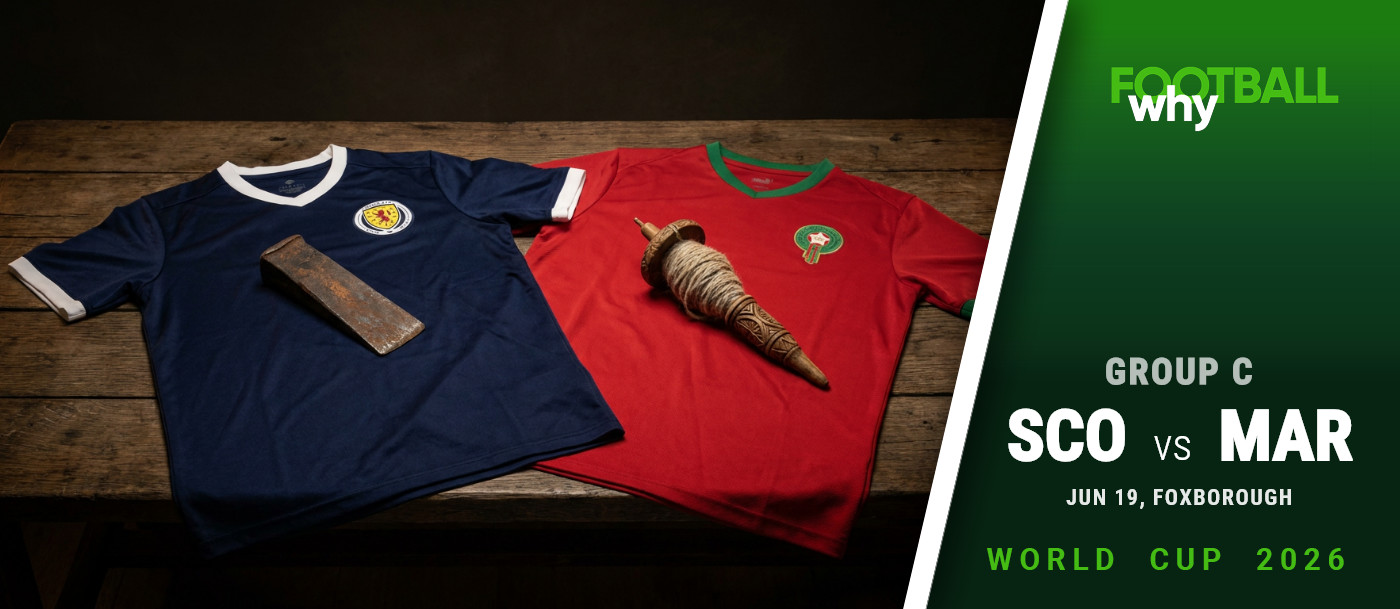
Group C, Matchday 2, Match #30
UTC

Gillette Stadium, Foxborough

Prediction by whyFootball readers

SCO
DRAW
MAR
26%
30%
44%
Not a recommendation for betting
Tap [+] to cast your expert forecast.
SCORE BY AI PREDICTION: 0:1 SEE SIMULATION

Scotland vs Morocco FIFA World Cup 2026 Group Stage Match Waiting for the damp timber to finally crack Forecast generated:

Maritime grit confronts desert patience. On one side, the stubborn pride of industrial scarcity; on the other, the quiet, woven certainty of those who wait for the perfect thread to snap. A clash where sweat challenges geometry.

Scotland: One side's prayer...

Scotland enter this second Group C fixture fully aware that their tournament survival is hanging by a thread. The Tartan Army are not demanding champagne football; they simply expect honest, unrelenting graft to keep the campaign alive. Steve Clarke must carefully manage Kieran Tierney’s fragile hamstrings on the artificial surface, treating the defender's sprint load like a rationing book in wartime. Bolstered by John McGinn’s return to the midfield engine room, the mood is stubbornly defiant. They are ready to dig in and fight for every inch.

Morocco: ...head-on with the other.

Morocco arrive carrying the heavy weight of national expectation, needing a sharp response after their projected opening defeat to Brazil. Despite the intense public pressure, the squad remains anchored in a ritualised patience, refusing to let panic dictate their rhythm. Walid Regragui faces a delicate balancing act with Achraf Hakimi, whose recovering ankle requires careful minutes management on the unforgiving synthetic pitch. The mood is one of quiet, steely resolve. They are prepared to absorb the physical storm and wait for the precise moment to pick the Scottish lock.
Scotland vs Morocco Structural Collision

Scotland: How we will host...

Dream
The baseline ambition is survival, but the quiet hope is a gritty victory snatched from a set-piece. The Tartan Army do not demand glamorous football; they want honest graft and a team that refuses to yield. A draw keeps the campaign alive, but a narrow win is the ultimate prize.

Strength
This squad’s power lies in its weather-proof resilience. Built around a tough, experienced core, they possess a stubborn, collective defiance that thrives under pressure. Their dead-ball routines are carefully rehearsed, providing a constant, looming threat when open play breaks down.

Plans
The strategy is to absorb pressure and deliberately overload the left channel. They will use overlapping runs to drag the Moroccan midfield out of position before delivering precise cut-backs. Defensively, a dense wall will be erected to force Morocco's dangerous right flank into sterile, wide areas.

Fears
The underlying anxiety is what happens if the midfield gets suffocated. Under severe stress, this side tends to bypass their playmakers entirely, launching hopeful clearances that merely invite relentless waves of attacks. If nervous energy takes over, their patient structure could easily collapse into chaotic defending.

Morocco: With what we arrive...

Dream
The absolute minimum is avoiding defeat, but the true mandate is securing all three points. Expectation weighs heavily, yet the squad shoulders it with a ritualised patience, trusting that their moment will inevitably arrive. They want a clean, professional kill.

Strength
Their bedrock is a highly disciplined, European-honed spine that refuses to panic. They combine a compact defensive structure with a lethal, calculated thrust down the right flank, valuing absolute efficiency over needless possession. They suffer without the ball, but they do so together.

Plans
The blueprint revolves around suffocating the opposition’s left wing and launching surgical strikes through the right channel. They intend to use decoy short corners to pull defenders out of position before delivering precise cut-backs from the byline.

Fears
The primary concern is being physically bullied in their own penalty area by an aerial bombardment. If they drop too deep to weather the crosses, their natural attacking rhythm could stall, trapping them in a desperate, reactive cycle.

How it will be...

The match projects as a suffocating war of attrition, likely decided by a single, momentary lapse in concentration. For the first hour, expect a deeply entrenched stalemate where Scotland’s industrial, weather-proof graft collides with Morocco’s patient, ritualised sabr. The visitors will absorb the physical pressure, trusting Hakimi to operate like a silent piston down the right flank, waiting for the precise millisecond to deliver a fatal cut-back.

Scotland, true to their maritime heritage, will refuse to yield. Their strategy relies on the Robertson-Tierney axis forcing dead-ball situations near the penalty area. Yet, the emotional tipping point hinges on Bounou’s handling; if the Moroccan goalkeeper cleanly plucks crosses from the damp artificial turf without spilling rebounds, Scottish belief may slowly evaporate.

Should the tactical script tear, look for McTominay to override the system. His ghosting runs into the six-yard box possess the raw, unvarnished power to shatter Morocco’s geometric defensive shape. In the dying embers, if Scotland trail, the stadium will demand a frantic aerial bombardment. Morocco will have to maintain their granite hull integrity against a side throwing the kitchen sink with the desperation of men who have run out of options.

Scotland: Why not go for the win?

Why did Scotland fall short? The fatal blow stemmed from a momentary lapse in tracking Hakimi's delayed run. Tactically, their lack of central guile meant they relied entirely on predictable wide deliveries. Once Morocco compressed the penalty box and Bounou refused to spill crosses, Scottish endeavour simply could not overcome their creative scarcity.

Morocco: How did they clinch it?

Why did Morocco triumph? Because they managed the tension flawlessly. Hakimi's cut-back capitalised on the exact moment of Scottish structural fatigue. The victory was anchored in Amrabat’s cynical but necessary tactical foul and the goalkeeper's flawless handling. It was a masterclass in securing a lead and then quietly swallowing the key.

Secret mastermind intent

Steve Clarke’s weather-proof blueprint for the storm

General Strategy
Steve Clarke’s primary directive is rooted in absolute thrift. The aim is to avoid defeat, give nothing away cheaply, and hunt a narrow win through set-pieces and sharp left-channel transitions. The Scottish shape will sit in a disciplined mid-to-low block, inviting pressure but denying space.

It is an exercise in battening down the hatches. Possession will be sacrificed for territorial solidity, with the team instructed to throttle the game’s rhythm and wait for their specific moments to strike.
Antidote for the Opponent
The tactical architecture is heavily tilted to neutralise Morocco’s devastating right-hand side. The plan is to starve Achraf Hakimi of space by forming a defensive bottleneck. The left wing-back has been told to engage only if the Moroccan takes a heavy touch or passes backwards.

Meanwhile, the left-sided centre-back will step out to seal the inside passing lanes. Offensively, Scotland intend to pin Sofyan Amrabat by positioning an attacking midfielder directly on his inside shoulder, forcing the pivot to face his own goal.
Internal Task Solving
There is a meticulous, almost clinical focus on load management, particularly regarding fragile hamstrings in the defensive line. High-intensity sprints are to be strictly rationed in the opening exchanges to prevent a catastrophic early breakdown on the artificial surface.

Set-pieces have also been specially tailored. The delivery routines are designed to disrupt the opposition goalkeeper's starting position, using decoy runs across his eyeline to create chaos and second-ball opportunities at the near post.
Crisis Response Plans
Clarke is prepared to rip up the initial shape if Morocco sustain early penetration down the right flank. The immediate emergency response is to drop into a rigid 5-3-2, dragging an attacking midfielder back to crowd the inside-right channel.

If the midfield is completely overrun, the manager has secondary triggers ready. The team will shift dynamically to a 4-2-3-1, pushing a natural winger high up the pitch to bypass the central congestion entirely and stretch the play.
Specific Match Orders
Andrew Robertson: Do not whip the ball in first-time unless there are at least two shirts attacking the six-yard box. Hold the width, wait for the underlapping run to drag the screening midfielder away, and look for the low cut-back. Kieran Tierney: Step out to press the right-back only when the midfield pivot is covering the space behind. Force him down the outside channel and completely block the inside slip pass. Cap the high-intensity sprints early on to protect the hamstring. Billy Gilmour: If the forward passing lane is screened, bounce the ball out to the left-back triangle and immediately switch the play. Keep it to one touch when the press arrives, and do not force blind diagonal balls into traffic.
/ What if Hakimi constantly breaches the left channel?

If the Moroccan right-back sustains byline access in the opening twenty minutes, Scotland will abandon their initial shape and drop into a 5-3-2. An attacking midfielder will be sacrificed to crowd the inside-right space, while the striker sits squarely in the defensive midfielder's lane to block any central release valves.

/ What if the midfield cannot escape the press?

If the central playmakers are pinned and passing exits vanish, the system will flip to a 4-2-3-1 on the fly. The wing-back will drop to a conventional full-back role, allowing a true winger to push aggressively high. Build-up play will instantly bypass the middle, relying on quick diagonals.

Secret mastermind intent

Regragui’s structural rivet-work for the Moroccan hull

General Strategy
The overarching strategy relies on a meticulously constructed 4-1-4-1 mid-block, designed to channel the opposition into harmless wide areas. Morocco will exercise extreme patience, absorbing pressure like dry soil taking in a long drizzle. The defensive lines will remain incredibly tight, refusing to be drawn out of position.

Once the ball is won, the transition must be razor-sharp. The focus shifts entirely to the right flank, where the intention is to manufacture clean cut-back opportunities rather than lofting hopeful crosses into a crowded penalty area.
Antidote for the Opponent
The defensive machinery is specifically calibrated to clamp down on the Scottish left flank. The ball-near winger has strict orders to track his opposing full-back all the way to the halfway line, ensuring no numerical advantage is conceded.

In possession, the attacking patterns are designed to exploit the blind side of the Scottish right-sided centre-back. Early, low deliveries are preferred, targeting sharp near-post runs to bypass the physical congestion in the middle of the box.
Internal Task Solving
The artificial turf demands significant adjustments to their standard operating procedures. Players have been explicitly instructed to stay on their feet and avoid slide tackles, minimising the risk of conceding cheap fouls on the edge of the box.

The goalkeeper's instructions are equally tailored to the surface. He must command his area through proactive movement and catch the ball whenever possible, as punching a wet, unpredictable ball on artificial grass invites catastrophic secondary phases.
Crisis Response Plans
Should the opposition successfully pin the right-back deep in his own half, a contingency protocol is instantly activated. The left winger will shift across to bolster the defensive line, while the holding midfielder drops deeper to plug the gaps.

If the penalty area descends into chaos during set-pieces, the manager will not hesitate to abandon zonal marking. A dedicated man-marker will be deployed against the primary aerial threat, and a forward will be left high to deter opposing centre-backs from joining the attack.
Specific Match Orders
Achraf Hakimi: Only break the defensive line when the interior midfielder has successfully pinned the outer centre-back. If pushed deep, switch the play early and arrive late at the far post for the second phase. Sofyan Amrabat: Sit firmly in the passing lane on the edge of the penalty area and track any late midfield runners. Accept a tactical yellow card if an opponent breaks the line in the final twenty minutes, but not before. Yassine Bounou: Command the penalty area with proactive movement before the set-piece is taken. Catch the ball whenever possible to avoid unpredictable bounces on the artificial turf, and slow down the restarts unless the opposition wing-back is caught upfield.
/ What if the right flank is overrun?

If the opposition's overlapping runs consistently pin the right-back deep inside the first twenty minutes, the left winger will immediately swap flanks to provide double-coverage. The holding midfielder will drop closer to the defence, and recoveries will be instantly switched to the isolated left winger.

/ What if defensive set-pieces become unmanageable?

Should the penalty box turn into a chaotic scramble, the marking system will instantly adapt. A dedicated blocker will be assigned to the most dangerous late runner, and a forward will push up to the halfway line to force the opposition centre-backs to retreat rather than flood the box.

MAIN SIMULATION 0'-25'

The opening exchanges are an exercise in mutual restraint. Scotland attempt to build pressure down the left through Robertson and Tierney, but they stick strictly to the plan of avoiding hopeful crosses unless the box is packed. Morocco respond by dropping their winger to track the run, while Hakimi holds his ground and Amrabat screens the edge of the area. It is a tactical stalemate. Scotland hold the ball out wide but cannot reach the byline, and Morocco accept the wide pressure without breaking their shape.

MAIN SIMULATION 25'-45'

Morocco slowly start to dictate the rhythm of the game. Hakimi manages to find a window to the byline, but Tierney forces him out wide, resulting in a cut-back from a poor angle that the goalkeeper easily claims. Scotland respond by earning a couple of set-pieces through Robertson's driving runs, but they refuse to panic, opting for low, calculated deliveries rather than throwing the ball into the mixer. Morocco try a clever short-corner routine to drag Scotland's defence out, but the resulting shot is blocked.

MAIN SIMULATION 45'-65'

The tactical deadlock is broken with surgical precision. Around the 57th minute, El Khannouss pins the Scottish defender, allowing Hakimi to burst past Robertson. Tierney tries to cover the inside, but the delayed cut-back finds El Kaabi, who finishes smartly at the near post. Scotland immediately shift into survival mode. They drop into a flat back five, lower the height of their wing-backs, and simplify their passing to try and weather the storm. It takes them about ten minutes to shake off the shock and regain any sort of control.

MAIN SIMULATION 65'-90'

Scotland throw caution to the wind. They switch to an aggressive 4-2-4 formation, loading the penalty area and relying heavily on aerial bombardments. Morocco counter this by retreating into a rigid 4-5-1 shape. Amrabat takes a calculated yellow card to halt a dangerous Scottish break. The final minutes are a siege, with Scotland generating a flurry of corners. However, Morocco compress the space inside their own six-yard box, and goalkeeper Bounou decisively catches the crosses, refusing to punch the ball and risk a chaotic scramble on the artificial turf.

And it will come to...

If the match followed this trajectory, Morocco's calculated, scheme-led efficiency would ultimately outlast Scotland's pragmatic graft. The visitors' structured approach to exploiting the right channel and managing the game state would prove too resilient for a Scottish side heavily dependent on set-pieces and left-wing crosses. Scotland would need either a moment of set-piece perfection or an unexpected spark of central creativity to alter the outcome. In the end, the disciplined artisans would likely edge out the hard-working underdogs.
end of Game