

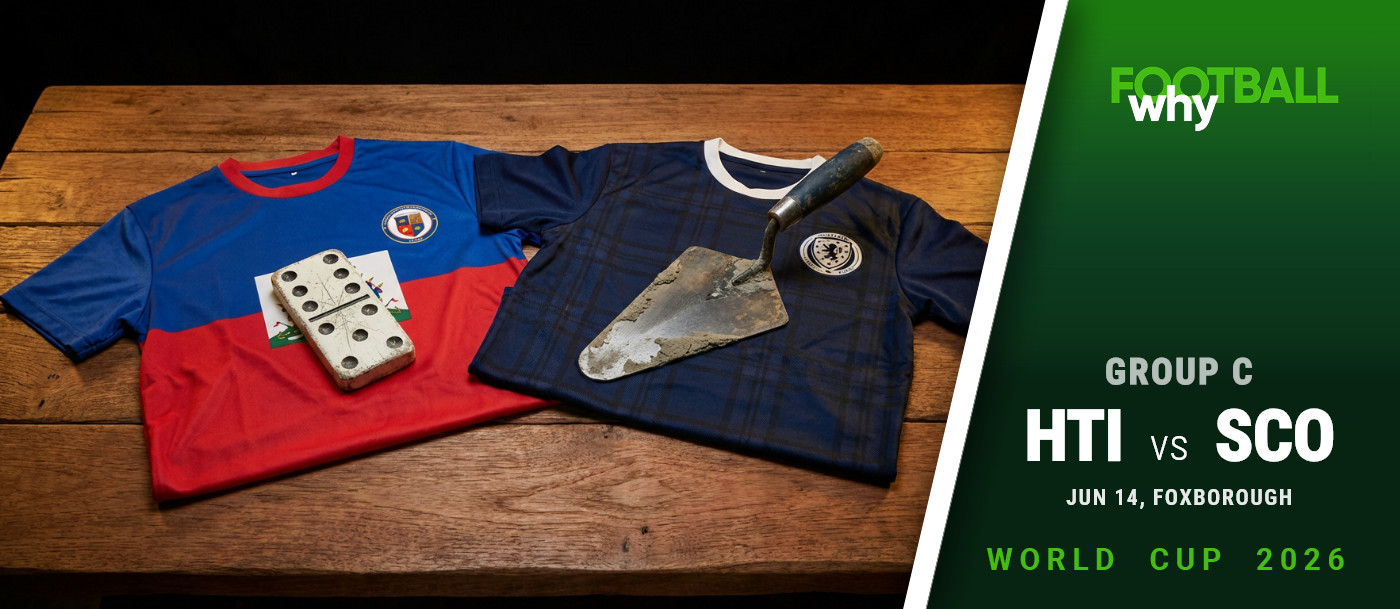
Group C, Matchday 1, Match #5
UTC

Gillette Stadium, Foxborough

Prediction by whyFootball readers

HTI
DRAW
SCO
22%
27%
51%
Not a recommendation for betting
Tap [+] to cast your expert forecast.
SCORE BY AI PREDICTION: 1:2 SEE SIMULATION

Haiti vs Scotland FIFA World Cup 2026 Group Stage Match Fastening the courtyard shutters against the northern squall Forecast generated:

The Northern squall meets the resilience of the port. A clash between methodical thrift and survival forged in the courtyard. The quiet faith of anticipating an error against the sheer weight of accumulated graft. A fixture where dignity allows no discounts.

Haiti: One side's prayer...

Haiti enter this opening Group C fixture carrying the heavy expectations of a diaspora desperate for an upset. Preparation has been slightly fractured; a late visa hold for Woodensky disrupted their Florida training camp, forcing the coaching staff to splice together a cohesive unit on the fly. Furthermore, veteran goalkeeper Johny Placide is managing a knee complaint, meaning his workload is being carefully monitored. Despite these logistical hurdles, the squad’s underdog defiance remains fully intact as they prepare to dig in against European opposition.

Scotland: ...head-on with the other.

Scotland arrive at this tournament opener burdened by a public desperate for professional, drama-free progression. Steve Clarke has a largely fit squad, though the right-back position requires careful management; both Aaron Hickey and Nathan Patterson are nursing recent soft-tissue concerns, meaning their minutes must be strictly rationed. With Ben Conway dropped from the final list, the forward line will rely heavily on aerial dominance and set-piece routines. The mandate is clear: batten down the hatches early and secure three points without unnecessary exertion.
Haiti vs Scotland Structural Collision

Haiti: How we will host...

Dream
Take points off the board. In a group where every goal matters, a draw is a valuable lifeline; a narrow victory completely rewrites the mathematical landscape. The public expects underdog defiance, but the reality demands a pragmatic, unglamorous shift.

Strength
A raw, streetwise resilience forged in adversity. This is a hard-running group that thrives on collective sacrifice and explosive transitions. Their power stems from an elastic emotional core and a devastating set-piece punch, making them incredibly dangerous when their backs are against the wall.

Plans
The manager intends to construct a compact, rugged low block. The focus is on denying space in the central lanes and tracking runners diligently. When possession turns over, the objective is to spring vertical counters instantly, bypassing the midfield to feed their powerful forwards.

Fears
The erosion of tactical patience under pressure. When chasing a game, the team has a habit of abandoning the game plan in favour of rushed, desperate long balls. The real danger is a breakdown in spacing and an escalation of rash tackles when the emotional temperature rises.

Scotland: With what we arrive...

Dream
Secure the victory efficiently and conserve vital energy for the challenges ahead. The objective is a professional, controlled performance without unnecessary gambles, perhaps boosting the goal difference through rehearsed dead-ball situations if the opportunity arises.

Strength
An industrious, collective unity built on tactical conservatism and physical graft. This is a squad that measures bravery in tackles won and distances covered, leaning heavily on well-drilled flank routines and a profound, weather-hardened resilience.

Plans
The blueprint revolves around dominating the wide areas. The strategy involves overloading the left channel to manufacture high-quality deliveries, while simultaneously deploying targeted pressing on the opposition’s holding midfielder to disrupt their rhythm straight from the turnover.

Fears
A historical tendency to bypass the midfield when anxiety creeps in. The underlying worry is that frustration in the final third might provoke rushed, direct long balls, eroding their measured composure and inviting chaotic, end-to-end transitions.

How it will be...

The fixture looms as a collision of densities. Scotland are projected to establish a perimeter fence, hammering the flanks with the cadence of a freight train that ignores the timetable. Haiti, conversely, will likely crouch in the undergrowth. Their design relies on the sudden, coiled reply. They will absorb the British downpour, waiting for the precise millisecond to release Isidor and Nazon into the vacant tracts of grass behind the full-backs.

Yet, the Caribbean barricade harbours microscopic fractures. Arcus’s radar at the back post might fray under the sheer repetition of Robertson’s left-footed deliveries. In that blind spot lurks McTominay, a specialist in arriving unnoticed. A fraction of a miscalculation. A momentary lapse in the tracking index.

Should Haiti navigate that initial siege, the complexion of the afternoon alters. A contested corner, a rugged near-post flick from Pierrot, and the underlying defiance ignites. The underdog collective would suddenly find its voice.

However, Scottish professionalism rarely buckles under emotional spikes. Their Presbyterian modesty acts as a sealant against panic. If the contest stalls on the precipice of a draw, Clarke’s contingent will rotate their wing-backs, congest the edge of the penalty area, and seek to exploit the opposition's mental fatigue. It is the patience of the parish archivist.

Haiti: Just short of victory

Haiti succumbed to microscopic lapses that exacted a disproportionate toll. A brief failure in Arcus's back-post radar and porous coverage at the edge of the penalty area proved fatal. Enduring ceaseless peripheral pressure eventually compromises any structure. Relying entirely on individual inspiration leaves the collective exposed when fatigue sets in.

Scotland: Just short of victory

Scotland prevailed through unyielding orthodoxy. McTominay’s stealthy arrival and McGinn’s deflected strike capitalised on the asphyxiation manufactured out wide. The precise rotation of their wing-backs replenished the siege engine. It was a triumph of a system rehearsed to the point of tedium, perfectly suited to dissolving hermetic blocks.

Secret mastermind intent

Migné’s storm-proofing for the Scottish left flank

General Strategy
The fundamental directive is to secure points without chasing sterile possession. The team will set up in a pragmatic mid-to-low block, prioritising defensive shape over territorial control.

The dressing room message is clear: maintain structural discipline first, and only punch back on turnovers. Emotional energy must be channelled carefully, ensuring nobody attempts to win the game single-handedly until the defensive foundation is secure.
Antidote for the Opponent
The primary defensive focus is suffocating Scotland’s potent left-sided partnership. The winger will double up with the full-back, staying narrow to force the play outside and kill the supply of crosses at the source.

Offensively, the plan targets the spaces on Scotland’s right flank. The attacking midfielder will drift into the inside-left channel to exploit the seam between the wing-back and the central defender, aiming to deliver early diagonal balls to the target man.
Internal Task Solving
Logistical hurdles have necessitated some specific adaptations. A visa issue delayed one player, and the goalkeeper’s workload is being carefully managed following a knee complaint.

Tactically, there is a strict rule against 'hero-ball'. If the main striker is double-marked, the attacking sequence must be routed through the central attacking midfielder. It is a necessary safeguard to prevent the team’s attacking structure from degenerating into predictable, isolated individualism.
Crisis Response Plans
If the team becomes pinned back by repeated crosses from the left, or if they concede an early goal, a specific contingency plan is triggered. The shape will immediately drop into a back five to crowd the penalty area.

The right-back will tuck inside to act as a third central defender, while the winger drops to cover the flank. The tempo will be deliberately slowed down to weather the storm before resetting the attacking outlet.
Specific Match Orders
Carlens Arcus: Keep the handbrake on for the first twenty minutes. Your primary job is tracking the late runner at the back post when crosses come in from the opposite side. Only push forward when you hear the specific call that your cover is set. Duckens Nazon: Stay connected to the blindside of their centre-backs. Only drop deep to link the play if you hear the trigger word. Do not waste possession on low-percentage shots from distance before the hour mark. Jean-Ricner Bellegarde: Drift into that pocket on the left to target the gap between their wing-back and right-sided centre-half. Look to play early, diagonal balls into the main striker. Make sure to accelerate the tempo on quick free-kicks.
/ What if the opposition goalkeeper bypasses the press with long balls?

If the Scottish keeper starts clipping passes over the first line of pressure, the defensive line must step up immediately. They will contest the second balls higher up the pitch for a brief, five-minute spell to disrupt the rhythm before dropping back into the standard shape.

/ What if the team is overwhelmed by repeated crosses from the left?

If the opposition generates a high volume of crosses early on, the team will shift into a 5-3-2 formation off the ball. The right-back tucks in as an extra centre-half, the winger drops to cover the flank, and the game is funnelled towards the touchlines to kill the supply.

Secret mastermind intent

Clarke’s weather-proofed navigation of the flanks

General Strategy
The overarching aim is to dictate the tempo and secure three points without exhausting the squad. The side will operate from a stable mid-block, refusing to be drawn into an expansive, end-to-end shootout.

Possession will be functional rather than decorative. The intention is to manage the game state intelligently, waiting for the right moments to strike rather than forcing the issue.
Antidote for the Opponent
There is a clear mandate to exploit lapses at the opposition's back post. Deliveries from the left will be calibrated to find late midfield runners arriving blindside of the opposing full-back.

Defensively, the focus is on nullifying the Caribbean side’s main attacking threat. The centre-backs and midfield pivot will compress the central zones, starving their talisman of space and ensuring he cannot turn and run at the defensive line.
Internal Task Solving
Workload management dictates the selection on the right side of the defence, with minutes carefully pre-allocated to protect vulnerable hamstrings. It is a calculated measure for a gruelling tournament schedule.

Furthermore, there is a strict prohibition on speculative long-range efforts if frustration builds. The attacking unit is instructed to recycle the ball and hunt for second phases rather than squandering possession on low-probability strikes.
Crisis Response Plans
Should the opposition successfully launch quick counter-attacks down the right side, the tactical failsafe is immediately activated. The wing-back on that side will be instructed to hold his position, while the midfield shifts across to close the gaps.

It is a swift, pragmatic adjustment to plug the leak. The team is fully prepared to sacrifice a degree of attacking width temporarily to restore defensive solidity.
Specific Match Orders
Scott McTominay: Time those late runs to arrive at the far post just behind their right-back when the crosses come in from the left. When they are building from the back, make sure to screen their main striker if he drops deep to receive. Ryan Christie: Position yourself right on their holding midfielder whenever we lose the ball. Trigger the press the moment he takes his first touch. Drive directly at their left-back in one-on-one situations to win corners. Che Adams: Pin yourself against the inside shoulder of their central defender. Make sharp diagonal runs across him when the through-balls are played. Stay central between the width of the goalposts; do not drift out to the touchlines.
/ What if the goalkeeper is pressured heavily during the build-up?

If the opposition commits two strikers to press high and the short passing options evaporate, the instruction is to bypass the midfield entirely. The goalkeeper will clip the ball directly towards the forwards, allowing the midfield to push up and fight for the second balls.

/ What if the opposition full-back starts delivering unopposed crosses?

Should their right-back manage several clean deliveries early on, the left-sided midfielder will drop deeper to track him. The defensive line will shift to show him inside towards the traffic, effectively suffocating the space required for an early whip.

MAIN SIMULATION 0'-25'

Scotland will likely set up shop on their left flank, using the Andrew Robertson and Kieran Tierney partnership to test Haiti’s discipline. Haiti’s response is a stubborn 4-4-2, deliberately freezing Carlens Arcus on the right to deny central gaps and force crosses. It is a tactical waiting game. Scotland might try an early barrage of long throws and corners to rattle the goalkeeper. However, Johny Placide is expected to command his box effectively, punching clear through the traffic to keep the scoreline blank.

MAIN SIMULATION 25'-45'

The relentless Scottish hammering down the left usually yields a breakthrough. As the half wears on, Robertson and Tierney will mix underlaps with deep crosses, slowly eroding Haiti’s defensive communication. It is a classic case of structural fatigue. Eventually, the repetition drags Haiti’s right-back out of position. A deep delivery is likely to find McTominay arriving on the blindside to slot home. Following the setback, Haiti will briefly retreat into a back five to survive until the interval.

MAIN SIMULATION 45'-65'

Chasing the game, Haiti will throw off the handbrake. Arcus gets the green light to overlap, injecting sudden vertical pace into the match. This emotional surge unsettles a Scottish side trying to manage player fitness with full-back rotations. A tactical substitution on Scotland's right flank creates a momentary disjoint. Haiti are primed to exploit this with a rehearsed near-post corner routine. A flick-on across the six-yard box should allow Nazon to stab home an equaliser, sending the crowd into raptures.

MAIN SIMULATION 65'-90'

The equaliser forces Scotland to abandon their conservative pacing. Bringing on a traditional striker, they will flood the box and hunt for second balls. Haiti's shape stretches as fatigue sets in, pulling their central midfielders uncomfortably wide. This creates a gaping hole at the edge of the penalty area. A recycled cross will likely be headed out only as far as the 'D', where John McGinn is waiting. A driven shot through a thicket of legs, aided by a cruel deflection, should seal a late Scottish victory.

And it will come to...

If this scenario were to unfold, Scotland’s risk-averse pragmatism and relentless flank-based delivery would eventually outlast Haiti’s spirited, vertical bursts. Haiti would likely put up a fierce resistance, leaning heavily on their talismanic forwards and quick transitions. However, demanding flawless back-post tracking for ninety minutes is a tall order. The sheer volume of Scottish crosses, combined with their ability to exploit the edge of the box when the Caribbean side tires, would ultimately tip the scales in the Europeans' favour.
end of Game