

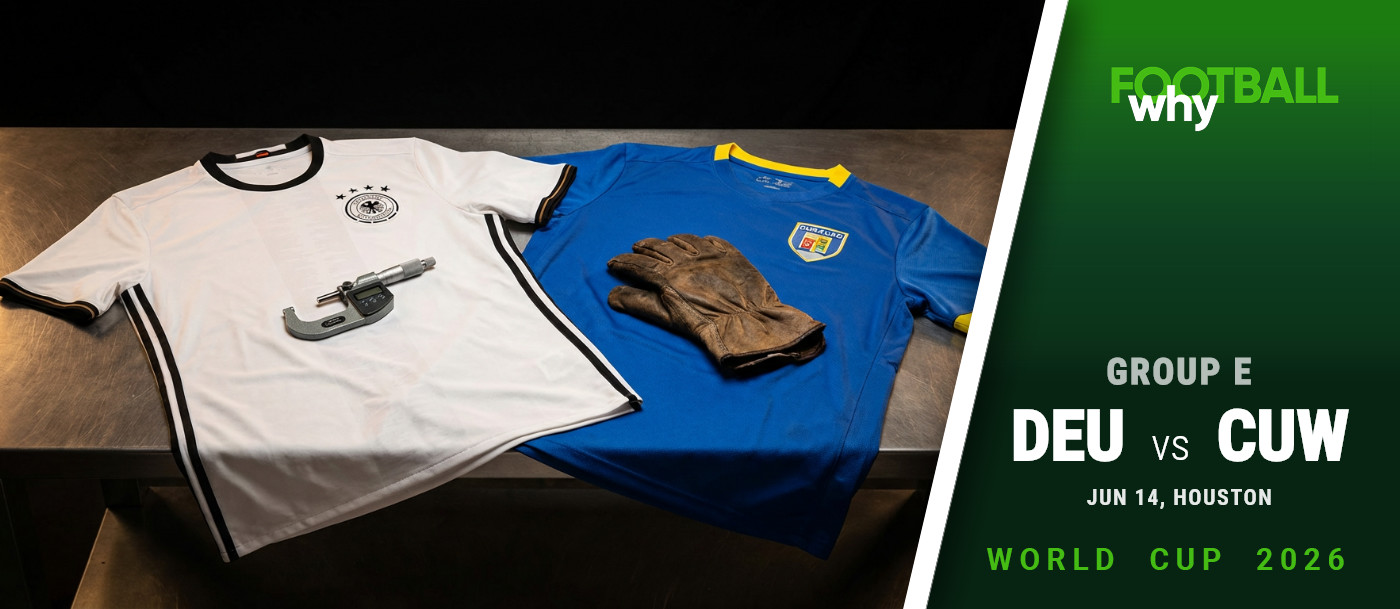
Group E, Matchday 1, Match #10
UTC

NRG Stadium, Houston

Prediction by whyFootball readers

DEU
DRAW
CUW
86%
10%
4%
Not a recommendation for betting
Tap [+] to cast your expert forecast.
SCORE BY AI PREDICTION: 3:0 SEE SIMULATION

Germany vs Curaçao FIFA World Cup 2026 Group Stage Match A certified mechanical dismantling of maritime island resistance Forecast generated:

The strict ordinance of continental industrialism clashes with the proud resilience of island mariners. It features certified, rule-bound authority attempting to domesticate a blue wave that, despite lacking resources, vows to bail water until the vessel shatters.

Germany: One side's prayer...

Germany arrive at this Group E opener carrying the heavy, unyielding expectation of their public: a deep tournament run is not a hope, but a mandate. The media chatter has largely orbited around Manuel Neuer’s managed calf issue, which marginally alters their defensive distribution. The national mood demands a clinical, risk-managed victory. There is no tolerance for chaotic, end-to-end spectacles; the host nation expects to see the valves tightened early, suffocating any underdog rebellion before it can even draw breath.

Curaçao: ...head-on with the other.

Curaçao step onto the pitch fuelled by the intoxicating pride of a historic World Cup debut. The islanders are acutely aware of their underdog status but remain deeply anchored by their Dutch-schooled defensive discipline. A pre-tournament scare regarding Jürgen Locadia’s friendly red card has evaporated, leaving their primary attacking focal point cleared to play. The public expects nothing less than total, collective sacrifice. They are prepared to batten down the hatches, absorb the inevitable pressure, and wait patiently for a singular, fleeting counter-attack.
Germany vs Curaçao Structural Collision

Germany: How we will host...

The Dream
Bank the three points early and quietly file the paperwork. The national expectation demands a ruthless, composed opener without any chaotic transitions. There is absolutely zero tolerance for a messy, end-to-end shootout. The public wants to see a certified, risk-managed dominance that respects their tournament pedigree.

The Strength
Control flows from a deeply educated, top-tier midfield spine. They rely on an apprenticeship of shared tactical grammar, where collective duty always trumps individual flair. It is a system built on robust engineering, combining an immediate counter-press with patient, probing possession to suffocate opponents.

The Plans
The design features heavily asymmetric full-backs and a deliberate left-sided overload. By dragging the opposition out of shape, they intend to isolate defenders and exploit the far-post seams. A bespoke pressing trap is also prepared to snap shut on the opposition's primary ball-playing centre-back.

The Fears
The rigid preference for order can sometimes stiffen into over-caution. If the attacking structure becomes too heavily systematised, it risks suffocating the creative sparks needed to break down a stubborn low block. There is also a lingering anxiety about defending vast spaces if the initial pressing structure fails.

Curaçao: With what we arrive...

The Dream
Survive the opening squall and keep the ship afloat. The islanders carry a strictly pragmatic mandate to frustrate the heavy favourites. They aim to protect the scoreline at all costs and snatch a historic result via a ruthlessly timed counter-attack.

The Strength
Their foundation is built on Dutch-schooled positional discipline imported by the diaspora. It is a blue-collar, shift-work mentality where collective cohesion overrides individual ego. They suffer together, maintaining a compact shape and conserving energy like a precious resource.

The Plans
The defensive blueprint floods the central zones to deny the hosts any creative breathing room. Upon regaining possession, the immediate trigger is to launch swift, direct diagonals into the channel vacated by the opposition's advancing left-back.

The Fears
A glaring lack of aerial dominance haunts the backline. If the hosts bypass the congested midfield and resort to a relentless bombardment of crosses, the defensive structure might simply buckle under the physical weight of repeated penalty-box duels.

How it will be...

The fixture should resemble a protracted civil service inquiry into a structurally sound but outgunned island port. Germany would circulate possession with bureaucratic patience, probing for compliance failures. Stiller will likely sift through the midfield, seeking permissible passing corridors. They rely on established procedures rather than spontaneous invention.

The rigid paperwork might tear if Musiala decides to bypass the committee entirely. His slalom carries could splinter Curaçao’s defensive tenon joints, offering moments of authentic individual brilliance. Conversely, if Bazoer misreads a pressing trigger, the Caribbean side’s entire containment policy collapses under the subsequent counter-press. Yet, should Locadia manage to anchor himself against the centre-halves and win cheap fouls, observers might witness a genuinely touching display of island defiance.

Curaçao’s squad will not simply disintegrate. Their shared diaspora blueprint prevents total capitulation; they will bail water until the final whistle blows. Tune in to discover whether cold, structural alignment inevitably crushes a brave, undersized experiment, or if a single rogue wave can unseat the administrators.

Germany: How did they clinch it?

They triumphed because the pressing trap snapped shut on Bazoer, yielding the crucial second goal. Earlier, a rehearsed near-post corner routine breached the islanders' perimeter. Beyond these isolated sequences, their robust rest-defence structure smothered transitions, reflecting an academy-forged spine that prioritises systemic stability.

Curaçao: Why not go for the win?

They succumbed due to minor procedural lapses that elite opposition ruthlessly penalise. A missed near-post marking assignment and a forced turnover in possession sealed their fate. Fundamentally, their pronounced aerial deficit and a lack of sustained, high-intensity repetitions caused their defensive timber to warp under continuous pressure.

Secret mastermind intent

Nagelsmann’s protocol for tightening the structural joints

General Strategy
The primary objective is to secure the points early while managing risk with cold, procedural efficiency. This is about establishing a dominant rhythm from the first whistle. The team will operate with a high block, squeezing the pitch to suffocate the islanders' buildup.

Once the opening goal is secured, the tempo will be deliberately throttled down. Possession becomes a defensive tool. The players are instructed to maintain a stable central platform, ensuring the game does not devolve into an open-court transition shootout.
Antidote for the Opponent
The tactical design heavily overloads the left flank. Raum, Wirtz, and Havertz will combine to isolate the opposition's right side, dragging their defensive block out of alignment. This creates a jagged splice in their backline. The far post is then exposed for late runners arriving on the blind side.

Without the ball, the focus shifts to neutralising the Bacuna brothers. The midfield pivot is tasked with screening the initial vertical passes. By cutting off these central arteries, the opposition is forced into harmless, predictable wide distribution.
Internal Task Solving
The goalkeeper's distribution is carefully managed due to a lingering calf issue. Long, sweeping kicks are entirely off the table during the opening exchanges. Play must be restarted quickly and shortly to the centre-backs before the opposition press can set.

The full-backs will operate with a strict asymmetry. The left side is given a license to push high and wide to stretch the play. The right side is tethered to the midfield, tucking inside only when the opposing winger is pinned deep into his own half.
Crisis Response Plans
If the opposition successfully flattens into a low block and clogs the half-spaces, the width of the pitch will be maximised. Wingers will hug the touchlines to stretch the defensive shape. Early, whipped crosses will replace intricate central combinations.

Should the initial buildup rhythm falter against a high press, the structure will safely default to a back three. A midfielder will drop between the centre-halves to steady the ship. The team will compress distances to win second balls rather than playing out under severe duress.
Specific Match Orders
Manuel Neuer: Keep distribution conservative for the first twenty minutes. Do not force long kicks if the calf feels tight. If the press arrives, play the ball early to the centre-halves rather than resetting under pressure. Joshua Kimmich: Tuck into the midfield only when the opposition winger is pinned back. If he holds a high starting position, stay wide and block his running lane. Never overlap at the same time as the right winger. Pascal Groß: Orient your body to block the straight vertical passing lanes through the centre. Assume control of all primary set-piece deliveries until the hour mark. Drop deep to form a back three if the buildup stalls.
/ What if the first-phase buildup is heavily disrupted?

If the opposition initiates high waves of pressure and the goalkeeper signals discomfort, the fallback sequence is triggered immediately. The midfield pivot drops between the central defenders to create a numerical advantage. The right-back stays wide, and the team utilises diagonal launches toward the left channel, compressing the pitch to secure second balls.

/ What if the match descends into an open-court transition shootout?

Open exchanges erode the structural control that the team relies upon. If the game becomes chaotic, the tempo must be killed for ninety seconds. The shape resets to a rigid defensive block, and a tactical foul is used to secure a dead-ball situation, allowing everyone to breathe and recalibrate.

Secret mastermind intent

Advocaat’s maritime blueprint for weathering the storm

General Strategy
The default stance is a compact, line-protecting block set deep in their own half. They will concede the flanks entirely, prioritising central denial and body-on-the-line defending.

Patience is the primary currency. They will not chase shadows or press high unless specific triggers are met, choosing instead to trim the sails and absorb pressure until the game state demands a riskier escalation.
Antidote for the Opponent
To counter the hosts' creative playmakers, the wingers will narrow significantly, creating a dense thicket in the half-spaces. The objective is to force all distribution into wide, harmless areas.

In transition, the right winger is tasked with exploiting the gap left by the advancing opposing left-back. Early deliveries and cutbacks are favoured over elaborate central patterns, targeting the weak-side seams before the defensive recovery arrives.
Internal Task Solving
A pre-agreed cooling protocol is implemented for moments of severe stress. Following a dangerous turnover or a near-miss, the team is instructed to drain the tempo for ninety seconds, stringing together safe passes to reset their heart rates.

Goal kicks are heavily managed. Short build-ups are banned for the opening twenty minutes. The goalkeeper will stagger the target man and the weak-side winger to create a trap for second balls.
Crisis Response Plans
If the opposition’s left-back repeatedly delivers unopposed crosses, the entire defensive line will drop three to five metres deeper. The near-side winger will collapse into the defensive chain to kill cut-backs.

Should they fall behind with ten minutes remaining, the shape wildly pivots to a desperate 4-2-4. A central defender steps into midfield, throw-ins become set-pieces, and the team resorts to shooting on sight from any available angle.
Specific Match Orders
Eloy Room: Refuse any short restarts while the opposing press is set. Maintain a deliberate twelve to fifteen-second cadence on goal-kicks to drain the game's tempo. Drive the ball long toward the striker's left shoulder to contest the second ball. Tahith Chong: Track the opposing left-back diligently until the defensive third, then hold a high position to threaten the counter. Ensure the first touch upon receiving the ball is always directed forward into the right-back corridor. Riechedly Bazoer: Step out of the defensive line only up to the penalty stripe. Pass on any drifting playmakers to the midfield rather than following them into no-man's land. Distribute firmly and flatly; square risks are strictly prohibited.
/ What if the playmakers begin receiving freely between the lines?

The formation immediately flattens into a rigid 4-5-1. The central midfielder drops deeper alongside the defensive screen, while the wingers tuck inside to crowd the central zones. The lone striker is left isolated against the centre-backs, tasked solely with holding the ball up to win fouls and relieve the mounting pressure.

/ What if the team suffers sustained aerial bombardment while protecting a draw?

The tactical shape shifts to a 5-4-1 with an extra, aerially dominant centre-back introduced from the bench. Full-back overlaps are completely banned. The sole instruction becomes clearing the ball wide into the channels, with no attempts made to exit through the centre of the pitch.

MAIN SIMULATION 0'-25'

Germany immediately squeeze the pitch. They overload the left flank with Raum, Wirtz, and Havertz, accepting Curaçao’s invitation to play wide as the islanders choke the central zones. This is a classic siege setup. Germany protect themselves with a disciplined backline and pepper the box with crosses. The pressure eventually breaks Curaçao’s aerial resistance, culminating in a rehearsed near-post corner routine finished by Tah at 21 minutes.

MAIN SIMULATION 25'-45'

Curaçao retreat into a rigid 4-5-1, thickening the defensive mud in the half-spaces. Germany respond by stretching the pitch and shifting play through Groß. The pivotal moment arrives on 33 minutes via a pre-planned pressing trap. Germany’s forwards collapse on Bazoer's first touch, forcing a turnover that leads to Wirtz hammering home a rebound. Curaçao subsequently initiate a survival protocol, slowing the game down to reach the interval.

MAIN SIMULATION 45'-65'

The tempo flattens out. Germany shift into a precautionary gear, trimming their attacking risks to protect the two-goal cushion. Curaçao push their defensive line slightly higher, hunting for quicker diagonal passes. Locadia begins to make the ball stick up front, drawing fouls to win territory. To counter this physical shift, Germany introduce Goretzka at 61 minutes. This adds crucial midfield muscle, dampening Curaçao’s momentum and killing open-court transitions.

MAIN SIMULATION 65'-90'

Advocaat throws caution to the wind, morphing Curaçao into an aggressive 4-2-4. Germany adapt seamlessly, dropping Kimmich to form a temporary back three out of possession. This structural pivot absorbs the islanders' surges. The space left behind is eventually exploited on 74 minutes. A cleared cross turns into a rapid German transition, and Havertz times a blind-side run perfectly to finish across the goalkeeper. The match ends with Germany cleanly managing possession.

And it will come to...

If this forecast holds, the match would showcase a triumph of certified mastercraft over spirited pragmatism. Germany would likely balance their structural rigidity with moments of creative incision, suffocating transitions at the source. Curaçao would display commendable Dutch-schooled discipline, but ultimately succumb to systemic aerial deficits and a beautifully sprung pressing trap. It highlights the brutal reality of tournament football. The meticulously audited machine simply outlasts the brave island experiment.
end of Game